Boundary

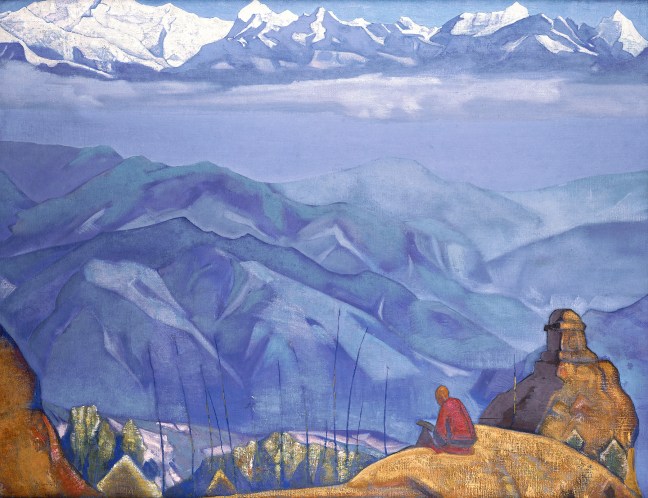
‘Book of Wisdom’ – Nicholas Roerich, 1924 – WikiArt

It is naive to imagine that there is a boundary or separation between consciousness and the world we are conscious of. It would be extraordinary to find that boundary, where our consciousness ends and where the outside world begins. We have an apparent and necessary boundary between body-mind and world, for our convenience, for practical purposes, and have left it there as an unquestionable fact. And everybody has complied, including scientists, that this separation must exist, that consciousness is a competence of the body, that it cannot be challenged, that it would be madness, beyond reason to do so. But there is an impossibility here. For this boundary can never be found at the deepest level, or even conceptualised. It is inexistant. Something like a pure invention. But this illusion of a separation was broken, seen through long ago, in the world of mind, of which our spiritual traditions are experts. Sages have seen long ago that there was here, between consciousness and the objective world, a seamless relationship, an undoubted oneness, no boundary, no separation, not even an unlikeness. It was all one with nothing besides it. The world is wholly contained in Mind, as Mind, and Mind or consciousness is all we are, all there is — our fundament.

So we have invented the reality of a world out of the reality of consciousness. After all, it is a beautiful find, a gorgeous dream, that we have a world, and that this world was shaped, sculpted by our five senses for as long as our senses have existed, and for as long as our bodies have been made the inevitable side effects of the appearance of a world. Everything — world, body, mind, senses — is an appearance in a more fundamental, non-objective reality. So nothing new, or other, or different was ever introduced in our reality. Reality is all there is. Consciousness is our playground, our only field or ground, and it is hosting everything in and as itself, including our apparent self. This is how we have a father and a son. A reality, and a temporary, individual, apparently located point of view on that reality. But between father and son, between reality and ourself, there is only one seamless consciousness. God has made sure that all things and beings find a habitation within him — or her. And then, ‘within’ was too taken away, for how would you have a within and a without when there is only the One?

So we have to meditate on the appearance of this world. On what is hiding behind it. On what it teaches us on our nature, on our reality, on our humanness. By the way, being human is by no means derogatory. In its most ancient Sanskrit root, the word for ‘human’ means: “The being whose essence is the capacity for self-remembrance of its divine nature.” So this knowledge of the reality of the world is a sacred knowledge. For with that knowledge firmly held, you can now enjoy personhood without the burden of separation, without the suffering that is its natural outcome. So we don’t have to be spiritual anymore. We have acquired our personhood, our humanness. Our nature has been realised, uncovered, in its primal, intended truth, and it is once and for all. Now we can enjoy a world for the first time. Now we can be lovers. Watchers. Listeners. Devoid of the superfluous. Free of our cumbersome, limiting beliefs. Recognising and accepting God’s will as our own. 

.

~~~

Text by Alain Joly

Painting by Nicholas Roerich (1874-1947)

~~~

.

Website:
Nicholas Roerich (Wikipedia)

Suggestion:
– Other ‘Reveries’ from the blog…

.
Remembrance

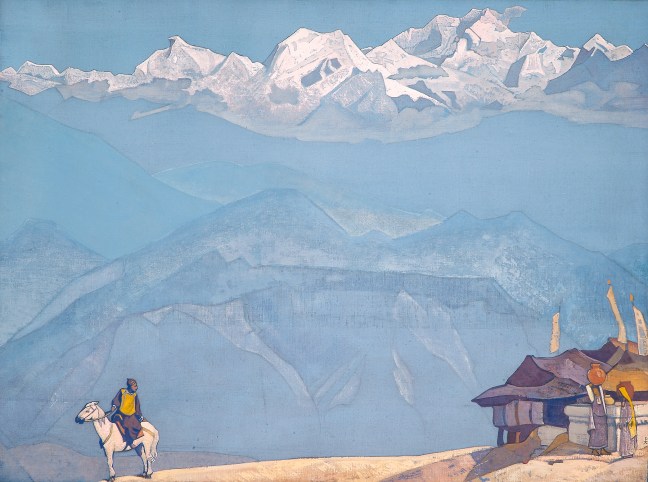
‘Remember’ – Nicholas Roerich, 1924 – WikiArt

All the things that stand out in us, and that we finally believe to be us — our story — are the rugged parts of our existence. They are what we fear or project. What we separate from and refuse to embrace. What we identify with and refuse to let go. What we have used for our identity, to shape our person, and draw some pride and contentment, or some shame and resentment. All the same. We are the children of circumstances and failures, of successes and apparent choices. Of sufferings. So we have shaped ourself with and from what we are not — from what we can remember and hook on. From events and ideas. From what can give us a form and a semblance of reality. But with all these, we are left only with what doesn’t truly satisfy us, doesn’t quench our thirst, doesn’t make us a rock but only a fragile, elusive entity. There is more to us than story and existence. There is what we cannot remember and make a story of. What we cannot fit into the shape of a person. What we have left unnoticed in the interstices of our life.

Why is it, do you think, that we often have difficulty remembering the happiest parts of our lives, which tend to disappear into thin air? Why cannot we seize happiness? Why is it that we seem to disappear in it and with it? That the best part of what we are, is the part less remembered and graspable? We tend to emphasise the foreground, the highlights, what exists, appears, and disappears. We have little consideration for what stands behind, unnoticed — the still, silent, benevolent matrix of it all. The unfathomable that we are, with its indomitable nature. That which lends a ground to all forms and appearances, including time and space. That which is not an object in our experience. Which is not an idea or a representation. Which is alive and can only be felt in and as the depth of our being. Which has the solidity of a rock that can never be moved. Which will never be a person, never have accidents, never be shamed or shaped by circumstances or events. This most profound nature of our being holds for us the peace and happiness which we are seeking in the foreground. We borrow the happiest parts of our existence to our own nature, while thinking it lies in chances and accidents.

If this nature of ourself is not felt, we will live with fear and lack. So this is our worthiest remembrance. This is where we have to be. To live as that field of being is to remember our nature as the rock-like essence of all beings, things and events. Then, this sublime identity that we have found ourself to be will matter more than any life achievement or result. It will be like the air we breathe. It is ourself seen in the conscious light of our being. In this, happiness is prevailing because it is the very colour of being. In fact, happiness is devouring our old self, which is why and how we as a separate entity disappear every time we feel at peace and content. Peace becomes our very identity — the eternal, ever-present nature of our being. Life then puts on the clothes of clarity and well-being, and our self deserts the ruggedness of the eventful life of time and place. What we ‘remember’, according to the etymology, is what we ‘call to mind’. So we ought to be cautious of what we remember or forget. That will condition our being happy or miserable.

.

~~~

Text by Alain Joly

Painting by Nicholas Roerich (1874-1947)

~~~

.

Website:
Nicholas Roerich (Wikipedia)

Suggestion:
Other ‘Ways of Being’ from the blog…

.

The Names of God

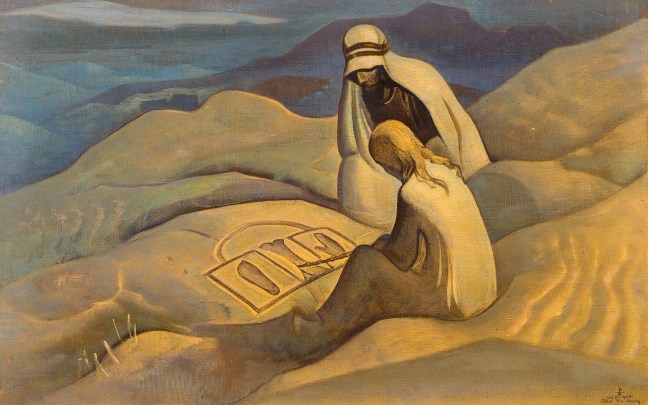
‘Signs of Christ’ – Nicholas Roerich, 1924 – WikiArt

.

The knowing of ‘I am’
is the apparition of God’s being
in our human experience.
It is the being of all beings,
the self of all selves
.”
~ Rupert Spira

.

יהוה               الله               ईश्वर

ब्रह्म               رحمن

אֱלֹהִים

.

There is something that is very hard to understand about God. A survey of the names that have been given to god makes it unequivocally clear, but we keep missing the target: ‘Being’, ‘Mighty Being’, ‘I Am’, and so many others, refer to the fundamental equation of god with ‘being’, with our very everyday experience of plain, simple, pure being. And yet, we keep projecting the presence of god in an hypothetical outside, another ‘being’ that our very ‘being’. So it seems that a study of the different names of god will help focusing on the fundamental nature of god’s being, this mighty Being whose being rests unseen, unnoticed in our own being.

Etymologically, the word ‘god’ (Proto-Germanic ‘gudan’) finds its root meaning in the ancient ritual of sacrifice, as in ‘libation’, or ‘to pour’, or in the Sanskrit ‘hutá’, meaning ‘having been sacrificed’. So god is ‘the one to whom sacrifices are made’, which extends to the sense of calling, invoking. To whom or what do I give the primary attention in myself? Do I indulge in, or fall to any objective appearance as thoughts, sensations, perceptions? Or do I sacrifice these appearances and find rest in the stillness of the one that is aware of these, which is pure being? To whom does my pouring, my libation go?

[…]

See how the many names of god relate to the sense of ‘being’… (READ MORE…)

.