Four Variations on Love

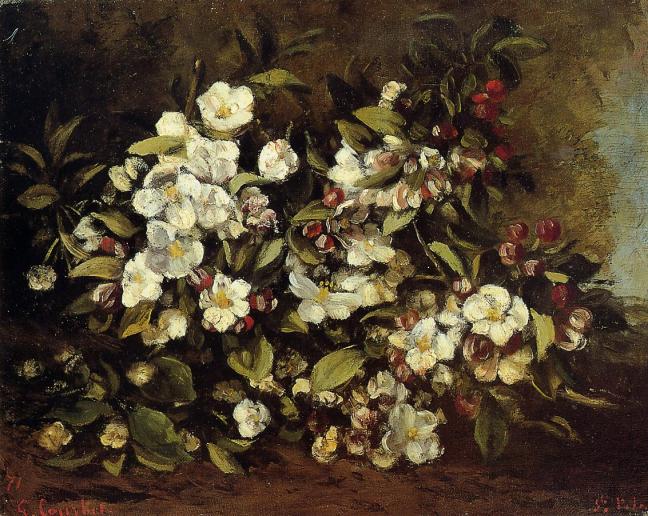
‘Branch of apple blossoms’ – Gustave Courbet, 1871 – WikiArt

.

God is love, and he who dwells in love
dwells in God and God in him.”
~ The Bible (1 John, 4:16)

.

I have been reading Meister Eckhart’s sermon n°5 lately, in the translation by Clare de B. Evans, from an old publication named simply ‘Meister Eckhart’. It’s a sermon dedicated to love and its many aspects. At the very beginning, Meister Eckhart sums up the nature of love in four magistral sentences that had a deep effect on me. So I decided to write down some of my take and understanding on each of these quotes by the Meister and present them to you. I hope they will be of interest…

.

‘God is love’. That is so, inasmuch as all that can love,
all that does love, he compels by his love to love him.”
~ Meister Eckhart

It is greatly convincing to think that we can love someone or something. That there is something inside us, a quality or emotion, that can spring out of our mind and body and direct itself towards an object, a someone loved, a something loved, and that this love is a personal affair. Well now the question arises: What is it in us that can love, and what is this other that is loved? Notice first that there is nothing in you that can love but love itself. Our mind is in no capacity to love. Rather love happens, shows up naturally, when our mind is set aside for a while — for our thoughts, most of our thoughts, have the power to defeat love, to render it unfelt, dormant, as if inexistent. So if you love anything, anyone, it is not because of him, or her, or it. It is because you have been freed from yourself as a private, separate self or mind, and that in this freedom, love can arise, unfettered, can stretch its dormant limbs, and shine in all directions. After all, have you ever been in love with someone without at the same time loving everyone, everything, around that one? Love is an awakening, an opening. And in that opening, in that crack, reality shows its profound nature. Love is the profound, intimate nature of everything. So when you love someone, there is nothing there, and nobody, no other, that can be loved, except the essence that this one is. Therefore you can only ever love the essence. And you could not love the essence of anything if you were not yourself the essence of everything. That’s how you are compelled, when you love anything, to love god first, which is the essence of both the lover and the loved.

[…]

More reflections on some Meister Eckhart’s statements about love… (READ MORE…)

.
The Nature of Everything

We don’t apprehend reality, or ‘what is’, directly, fully. Thought is in the way. There is a thin screen — in fact not so thin — that prevents us from seeing reality. This layer between ourself and our true being has the consistency of an old, worn out thinking habit. We have projected a pseudo reality of ourself as an entity, before we have even comprehended the reality of everything. So we have made a mash up of it all. We have made thought into a confused and a confusing device, entangled as it is with feelings and perceptions. So thought is slowing us down. And the result is that we as thought have created this world such as it is: divided, broken up, split apart, and therefore confused, angry, in capacity to hate another. Then, thought has set itself up as the one that can solve it all. Don’t get me wrong here, thought can help solving many intricate problems, and can create the most wonderful things. But it can never be the saviour of our world, or of ourself. It has first to go down its pedestal and take a step aside.

For thought is not just thought. It is much more than that and this is where the problem lies. Thought, strengthened by feelings and experience, has developed to the point of being us. We are a thought that has grown two legs. This is how we imagine ourself to be separate: by thinking ourself to be a body and mind; and by thinking the world to be out there. But thought has here produced an illusion. In trusting thought, we have failed to see that we are not on an equal footing with the world. We are not an existing thing along with ten thousand other existing things. We are the presence that is hosting every single existing thing including our body-mind, in its one infinite, all-pervading embrace. So we never have the right focus. We are always wrongly favouring the dictates of thought, which is the most conditioned instrument there is. So thought has become that bit of haziness in front of our vision. It is that made up confusion in front of our inborn clarity. It is an illusion made entity. But a well-conducted thought can be of help to see itself as being the problem. It can be the thorn that helps removing the thorn, and then is discarded. When the thought of ourself gets out of the way, our being is then seen to have espoused reality. The distance between ourself and ‘what is’ is seen to be non existent. And we will then have vision and clarity, for our self as a being separate from reality is nowhere to be found.

Without a self, whose structure is nothing but a thought swollen by its many identifications with feelings and experiences, the nature of reality is seen in a new light. Without a self to break it up, the structure of reality appears undivided. Because it is undivided, it is one. Because it is one, nothing in it can appear that is other than itself. Not a person. Not a thought. Not a world. Nothing. The world, the person, the thought, everything, has been revealed as being the One — a reality so infinite that nothing can be by its side, with its own separate existence. Therefore this reality can only be who we are, since it is the only one thing that is in capacity to be. So we are that. Or rather ‘that only is’, since there cannot even be a ‘we’ to be it, let alone to become it. So we don’t need a thought to exist, or to represent us. We don’t need an idea of ourself. And our identity is not dependent on objects of any kind. We are ourself by ourself. And this recognition can never be made by thought. It is alive. A living truth whose reality can only be seen, like something that suddenly comes into focus. Then our self, the world, everything, is that living truth — what we all participate in. This shared being is sometimes called love. Unless you prefer to call it happiness. Or God.

.

~~~

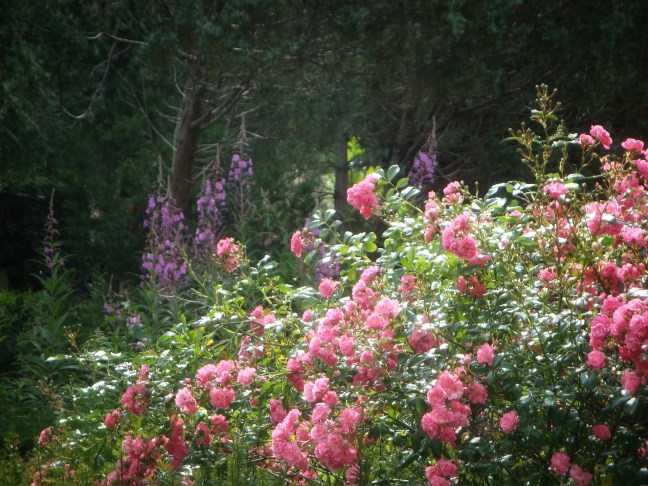
Text and photo by Alain Joly

~~~

.

Suggestion:
– Other ‘Reveries’ from the blog…

.

Of Dimitry’s Prayer

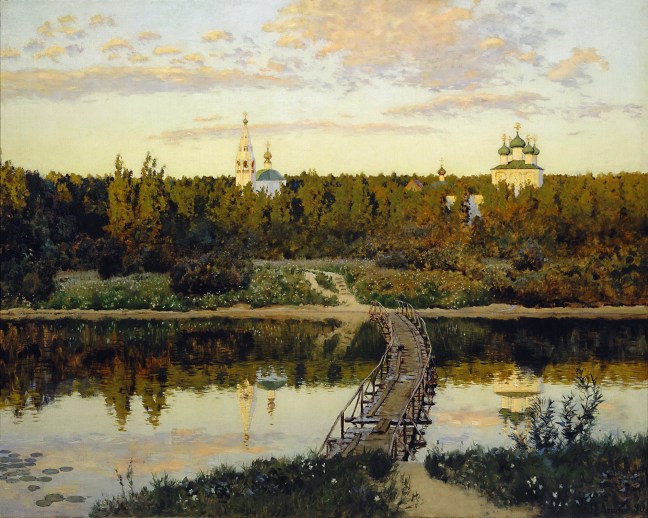
‘A Quiet Monastery’ – Isaac Levitan, 1890 – Wikimedia

.

Open, O doors and bolts of my heart,
that Christ the King of Glory may enter!
~ Dimitry of Rostov

.

Prayer is an invitation for what is already here to show itself up. It is not that you already know who you are, and that you-the person are begging for a supreme entity, or for an other, to come and soothe you, for an external, benevolent providence to shower you with its benefits. Remember that there is no other entity than the entity of your self, no other providence than the providence of recognising who you are. Nothing, in matters of peace and happiness, could ever enter into you that is not already there. So don’t make that mistake over and over again: to wait for someone knocking at your door, to hope for something to fulfil you, to expect a new element to enter your life. The benefit of life is not with something you receive, but in what you recognise yourself to be. So prayer is prior. It is not in reaching but in realising, not in expecting but in recognising, not in receiving but in noticing, and not in having or possessing, but in being.

So always pray as if you were utterly alone. Pray as if you couldn’t ask anything, anyone, any favour or event, to give you something that is not already there in you, as you, expressed as your very own being. Notice that nothing of worth could ever enter your house that is not already present, already eating at your table, already thinking the thoughts you think, already dreaming the dreams you dream. This is how Dimitry’s prayer ought to be uttered.

[…]

More reflections on a prayer by Dimitry of Rostov… (READ MORE…)

.

A Trail of Glory

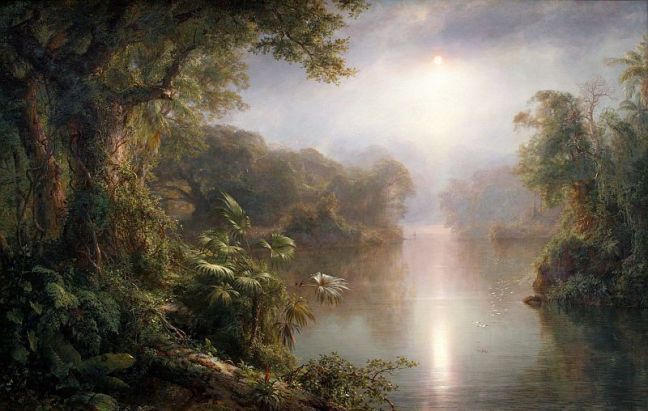
‘The River of Light’ – Frederic Edwin Church, 1877 – WikiArt

If you happen to feel your being one day, don’t let it go out of sight. Follow it everywhere it is. Let it be your only guide. Be gently intoxicated by it, by yourself, by who you are, truly, when you have relinquished this obsession of being a body, and a mind. This is your one and only duty, to stay there, with being, to abide in it, and let yourself be moved by its unmoving current. Don’t go off at a tangent. Don’t take a single step, unless you have with you, as you, this being that you are, and that you could crush at any time, with the single thought that you have your own, separate being. Remember it to be your ultimate identity, the widest circle of your self, without any border, limitless, unfettered by any condition whatsoever.

Feel it in you, as being you, when you go to apparent places. Being tends to stay at home and let your body do the moving. For being never goes anywhere — it is not the travelling type. This is how you can simply go to buy some bread in your street and live a captivating adventure, or explore the farthermost recesses of the earth while feeling quietly at home. Feel that you as being are housing the world, that being is the landscape in which your life is taking place. So be only concerned with the landscape and life will then flow of its own accord. Don’t start believing that you have a life of your own. That’s only the prerogative of the suffering self. No life can be lived happily with an architecture or a design outside being.

And remember that being is a love affair. A renouncing of your own limited self, for a marriage with the beloved truth of your being. A free, princely, bounteous bowing to the infinite. So don’t start making an effort to be, for any effort is an attempt from the part of a belief to reassess its position as a distant, separate, other being. That’s how your nature becomes unseen, when you have replaced it with your own fake one, with your own invented self. For being never hides, if you don’t let it disappear under the weight of your seeking it, of your being somebody that is lacking. So don’t let your being escape you. Don’t lose its trail of joy and glory. Don’t be the one fleeing, running away, desiring to be yourself, by yourself, and then seeking to bring yourself back to the happiness that you have lost, in so many, so many immoderate, superfluous, inappropriate ways. Seek your bliss in being — where it only lies.

.

~~~

Text by Alain Joly

Painting by Frederic Edwin Church (1826-1900)

~~~

.

Website:
Frederic Edwin Church (Wikipedia)

Suggestion:
Other ‘Ways of Being’ from the blog…

.

A Light to Yourself

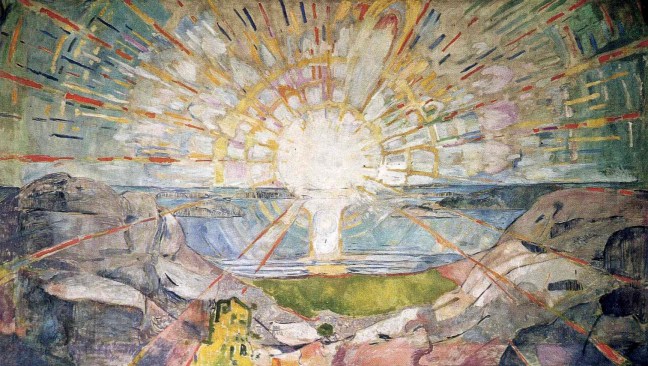
‘The Sun’ – Edvard Munch, 1911-16 – WikiArt

There will come a time when words will slow you down. When you will want to explore yourself on your own, without the help of a book or a teacher, free from explanation or guidance. You will want to follow your own trajectory, to be a grownup, and experience your beloved, impersonal, undivided self by yourself and through yourself. You will want, as Krishnamurti said, to “be a light to yourself“. You will find your own security there, in this light, at the source of your transparency, where you will find no division from where to be insecure. You will find your happiness bubbling from your infinite being, where no self can be located, and therefore no suffering. And you will be under the authority of your own being, that will show you the way, through a door eternally open and inviting. You will be on an eternal visit of yourself. And you will meditate, not to reach who you are, not to get there, but to rejoice in it, and give your whole attention to your beloved — though you already have her, have him, all day, on all occasions, near you, close, so very close to you. And you will feel her love as being so fully yours, that you will need no incentive, no set hours, to be being her own being. And you will see around you, and within you, so much beauty, that you will not have to look for it, other than by being with him, and within him. And you will be in need of no thought, of no TV show, to distract yourself from yourself, for how would you want to be distracted from being so wholly in love with the love of your life? So books will have become a bore to get you there, but you’d still read them as you read poetry. And a teacher will be of no use to you, but you’d still be eager for the company of a friend. And you’d go about your life with confidence, because you’re not alone to deal with it. Rather, your life will have become your being, and your being, your life. And at the same time, you will be alone, self-sufficient, in no need of anything, of anyone, to be fully yourself, to be happy. Therefore, you’d give yourself to all, to everything, you’d be a sharer of being, and a passionate lover of beings, and of things. Yes. That’s it. You’d be a light to yourself. A light to yourself.

.

~~~

Text by Alain Joly

Painting by Edvard Munch (1863-1944)

~~~

.

Websites:
Edvard Munch (Wikipedia)
J. Krishnamurti

Suggestion:
Other ‘Ways of Being’ from the blog…

.

Perfect Days

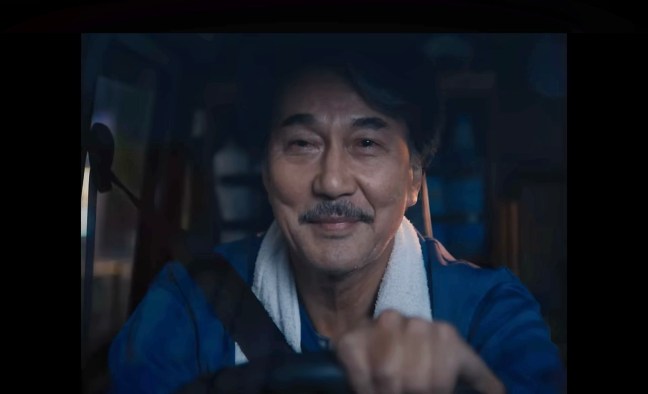
’Perfect Days’ – by Wim Wenders (with Koji Yakusho)

.

All my films deal with how to live.”
~ Wim Wenders

.

Why do we watch a movie or enjoy any piece of art but for the joy, happiness, or relief we derive from such activity? Well, sometimes we use a movie not so much to feel, but rather to stop feeling. We want to be alleviated from our sense of boredom, or be distracted from our constant worry, or have the lowest ambition to be rewarded with pleasure, plain simple pleasure which, if not delivered, will make us move on to something else. Film as an art form is ambiguous, for it has in itself an entertaining power which makes it the prey to our most suspect desires. Well, Wim Wenders, in this movie, wasn’t going to give way to that ubiquitous trap and fall. With ‘Perfect Days’, he made a movie in which there is no desire to be had, which offers no suspense, no excitement, no resolution of any kind, but from which you would never want to move away. A movie that describes the quiet, plain, orderly living of a man whose job is to clean public toilets in Tokyo.

Hirayama lives each and everyday as if it was a perfect day. For him, there is no possibility of failure in life. And he makes sure that boredom is an impossibility. So he cares. Hirayama cares about everything he does, and seems to be profoundly related to his modest home, to his morning toilet, and to the watering of his plants. He does what he has to do, with no judgment or resistance. He doesn’t mind. He feels his inner freedom. He has everything he needs, so he smiles at life and life smiles back at him. He breathes when he steps outside and looks at the sky as for the first time, the wonder of it all. Then he buys himself a can of coffee from a local vending machine, opens his van, sits, drinks a sip, chooses a song from a bunch of cassette tapes, lights the engine, drives, and listens to ‘The House of the Rising Sun’ by The Animals. For that’s where he is now, in the house of the rising sun, going to his work through the sprawling suburbs of Tokyo’s morning, undisturbed, confident, present.

[…]

A reflection on the film ‘Perfect Days’ by Wim Wenders… (READ MORE…)

.

A Gathering of Friends

‘Meal of Holy Communion’ (Agape) – Unknown author, 2nd to 4th AD – Wikimedia

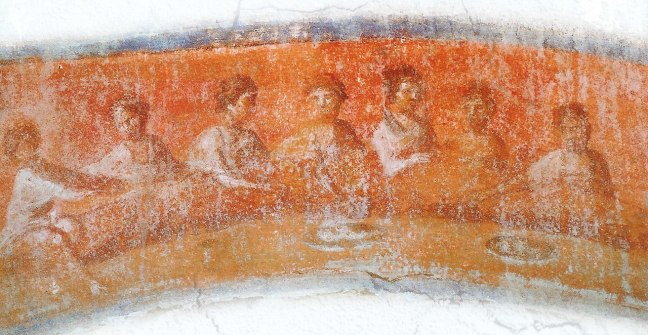
There’s been a gathering of friends lately. All gooey with being. It took place somewhere, in a place unknown, unlocated, kept somehow secret, where they all came to share wildly, and taste of a love supreme. You may want to know that place, to locate it, to find it as being somewhere where you can go and share some of that exquisiteness too. Well, now you have to think twice. For as the dictionary says, unlocated means ‘not surveyed or designated by marks, limits, or boundaries’. It is a place of no location. A place that has no geographical situation other than being here. A place that you cannot find within any noticeable limits but that englobes every known location. That place which you cannot find or reach, which has no known address, and which is kept secret behind the usual, well-trodden frontiers of your everyday experience, is yourself. Not your usual self, which you are well acquainted with. That one you have to be cautious of, or even warned against. No. Not that one. There is more to yourself. There is more than this located entity, with marks, limits, and boundaries. More than where your thoughts and beliefs have placed you in. There is a place in yourself that is not a place, that finds itself in no well-marked location, but that you could never not be in. Would you want to go there, that you would have to notice first that you are already in, already placed at the seat of honour, already warmed by its blazing hearth. This only is the heartfelt, spaceless, timeless location for all gatherings of friends. This is the land of your supreme heart, that you share with all living beings under the sky. There you have lived of all eternity without your knowing it. There you cannot go but only be. This is the event you are already signed in for, a retreat where you share the secret address of your deepest being with other fellow friends, and lit a bonfire of love. It may be a gathering of one or a hundred, in company of the wise or the ignorant, with the lighting of a sumptuous blaze or many a scattered sparkle or glitter, it doesn’t matter — there’s been a gathering of friends here and you as being were its gorgeous venue.

.

~~~

Text by Alain Joly

Fresco of Agape by Unknown Author (2nd to 4th AD)
(from Greek chapel, Catacomb of Priscilla, Rome)

~~~

.

Websites:
Catacomb of Priscilla (Wikipedia)
Agape (Wikipedia)

Suggestion:
– Other ‘Reveries’ from the blog…

.