The Straight Story

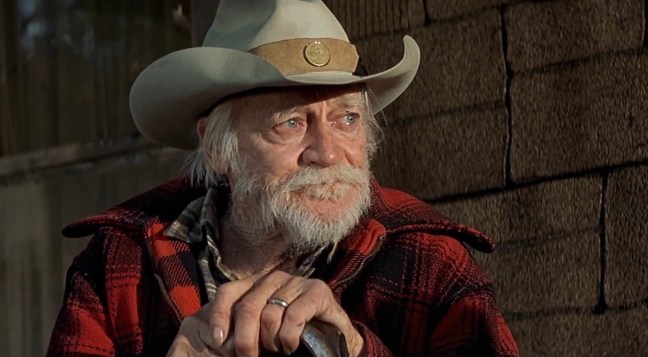
‘The Straight Story’ – by David Lynch (with Richard Farnsworth)

.

When I catch an idea for a film,
I fall in love with the way cinema can express it
.”
~ David Lynch

.

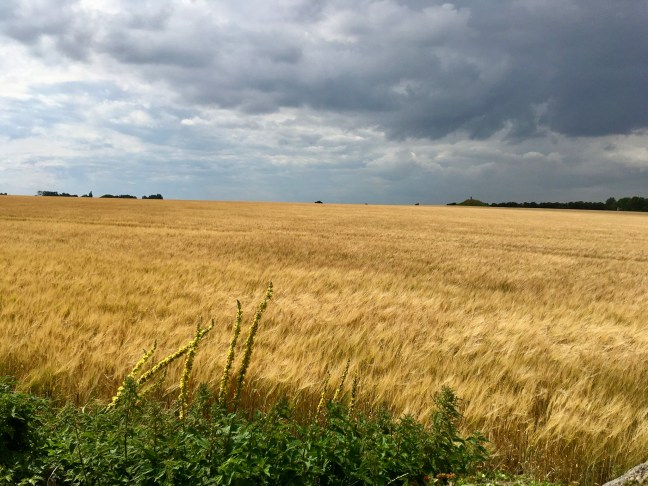
Have you ever seen a film made of love? Well, I have. And no further than this morning. A modest, not very well-known masterpiece by David Lynch, called ‘The Straight Story’. It is based on a true story: In 1994 in the United States, Alvin Straight — an old man — decides to pay a visit to his brother who has just suffered a stroke. They haven’t spoken for ages, out of an old rancour, so he wants to repair and reunite. With a clear mind, he embarks on a 390 kilometres journey from Laurens, Iowa, to Mount Zion in the Wisconsin, but he does it in his own inimitable way. On a riding lawn mower!… With bad hips and two sticks for help, and a refusal of doctors. With a maximum speed of about 8 kms per hour, and a trailer to pull. And with love as a luggage.

As often when it comes to starting a spiritual journey, it all begins with a fall and the subsequent realisation that something needs to be changed. And in order to make our quest a successful one, we have to make the journey just as important as the destination. And this is what Alvin does. His trip becomes an occasion for adventure. Everything he meets, he does with the eyes of wonder, and the now is the only time in which his travel takes place. Everything is important. Everything matters. The journey is not just a means to an end. We don’t reach infinity step by step anymore than we meet eternity in time. Every meeting with truth is made in truth’s home. And every encounter with our true nature is made within, in and as our innermost sense of being. No matter the extent of our understanding, in order to be, we have to be being. And Alvin, clearly, knows it all too well.

[…]

Some reflections on seeing this film by David Lynch… (READ MORE…)

.

Turner’s Moon

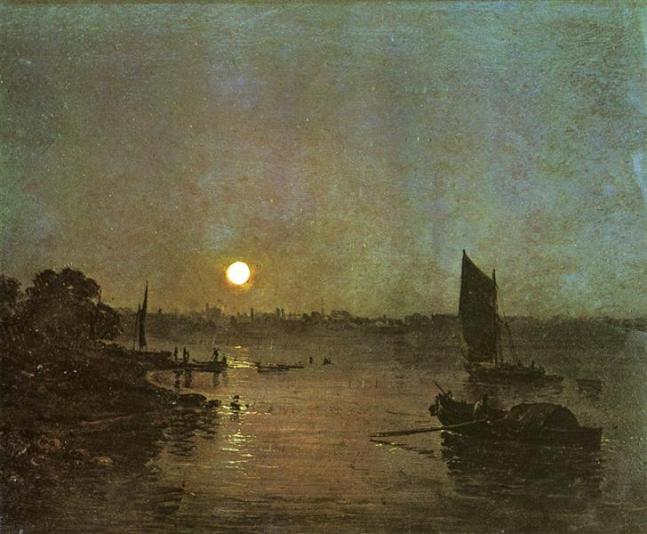
‘Moonlight, A Study at Millbank’ – J.M.W. Turner, 1797 – WikiArt

This text is directly inspired by an analogy used by the teacher of non-duality Rupert Spira. I found it to have such evocative power that words started to pour out and I couldn’t stop them. This text is therefore dedicated to Rupert and his timeless vision and teaching.

~~~

Sometime a painting just comes timely to move your heart. It is a gorgeous landscape painting, depicting a coastline and the sea, with boats and fishermen in the moonlight. At Millbank, Turner was painting in dark, subtle hues of black, blue, and purple browns, to define a night, leaving here and there traces of light, golden reflections on the water. In the wide expanse of the sky, he had left one portion of the painting untouched. Pure as white. Undarkened. For the painter had a view in mind. He was to paint a moon, bright and resplendent. And no moon was ever so bright.

This part of the scenery that wasn’t painted, it was you. You, before you were made a person, before the identification with thoughts, feelings, body, story, hurts, memories, projections, beliefs. The nature of the moon was that part of you that was left unseen, unexplored, but that had quietly illuminated you all along, giving you a self and an identity without your knowing, lending you a hidden strength for your bruised self, and bathing you in its unheard silence. It was the trusted one, the one reliable thing in a life of relentless changes and challenges. It was the peace of your true self, the precious being that had been covered up by the night of objective experience. This is the moon Turner had meant to convey.

[…]

A meditation on the evocative power of Turner’s painting… (READ MORE…)

.

Lectio Divina

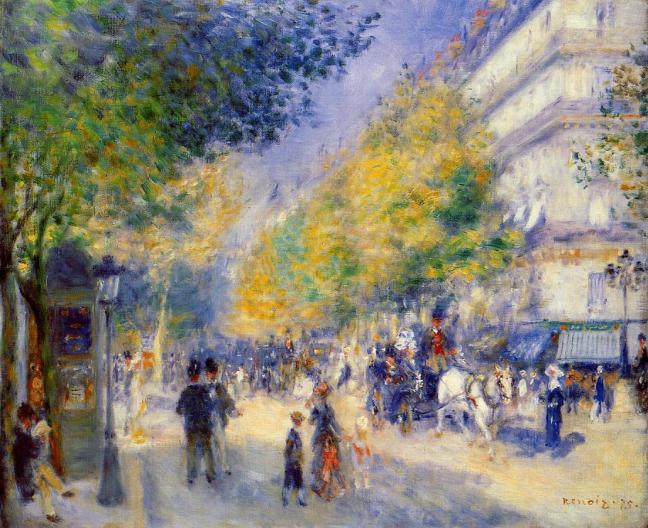
‘The Great Boulevards’ – Pierre-Auguste Renoir, 1875 – WikiArt

I have been feasting on some words recently. I was sitting leisurely on a cafe’s terrace, watching life coming and going, browsing through my phone with some ideas in mind. And there it came, and took me by surprise, like a koan suddenly unveiled, a pathway revealed without my knowing. There it came, taking the form of one single, simple phrase that seemed innocuous, by Saint Augustine:

Is any man skilful enough to have fashioned himself?
~ Augustine of Hippo

And that emptied my mind. It made me sink into no content, aware of all that is now; my self suddenly made a container for life. We all feel that we are so smart and powerful, or so stupid and powerless. That we have made ourselves what we are, and feel in consequence the pride or shame of it. That we have destroyed, or elevated ourselves. That we are responsible for our happiness, our success, our failure. That we have moulded our thoughts and actions, wilfully designed them. That our beliefs are believed. Our thoughts thought. Our words uttered by a ‘somebody’ here, inside the skull. But these are all beliefs, and beliefs are flawed from the start. Beliefs need a believer to believe them, and look as you may, you will never find such one behind your deeds. For the simple reason that there is no self behind our selfing. We have therefore never been in charge, never been truly responsible for collecting what we have collected, for misusing what we have misused, and for making the mistakes that we have made. Except in hindsight, in thoughts and beliefs, in cascades of randomly built illusions and memories in which we are caught and made blind. And these are what we have busied ourselves managing and arranging into a sensible self. And that self has gotten in the way of our living harmoniously.

[…]

The ‘Lectio Divina’ of a quote by Augustine of Hippo… (READ MORE…)

.

The Glorious Reality

Do nothing that may be unworthy of the
glorious reality within your heart and you
shall be happy and remain happy.”

~ Nisargadatta Maharaj

.

~

Quote by Nisargadatta Maharaj (1897-1981)

Photo by Alain Joly

~

.

Bibliography:
– ‘I Am That’ – by Sri Nisargadatta Maharaj – (Chetana Pvt.Ltd)

Website:
Nisargadatta Maharaj (Wikipedia)

Suggestions:
Beauty in Essence (other pointers from the blog)
Khetwadi Lane (Homage to Nisargadatta Maharaj)

.

The Ardent Disciple

We are strolling down a lane of a thousand gorgeous temples. Only we need to see it, to give ourself the gift of sightseeing. We need to open our life to this reality. But first, we must release this tension present in believing to be a self, and honour this temple of pure being that we are when all our beliefs and identifications have been met and dismantled. Then open your eyes. You are living in a beautiful, never yet visited land. Every fellow human being met, is a temple of consciousness. Every animal encountered, a temple of presence. Every living being that crosses our eyes, our ears, our touch, a temple of awareness, a reflection of our being. We are touring in a world of our self. Never in a distant, exotic land. Always in the comfort of our home as being. Forever linked to and as our deepest presence. We are visitors of presence, being both the presence that visits — as our self, and the presence that is visited — as apparent others.

Down this lane of presence, you will meet countless other temples. Every tree that stands majestic in your gaze, every flower that attracts you with its net of beauty, every fallen leaf on your path, every drop of rain landing on your skin, all temples of your own, scrumptious being. And every object surrounding you, a temple of isness. The clothes you are wearing are existing things. So is the watch at your wrist. Or the chair you are sitting on, or a pen, or a musical sound — the thousand fellow objects of your life. All sharing this same quality of presence, of isness. All temples that reflect the inner beauty or quality of your self, that can be met at every step. See them. Hear them. Touch them. Feel them as your own. Sense their making as your own. Honour them every time you can. They will tell you the story of your self. They are like sculptures of being in the temple of your life.

Don’t forget that every traveller or companion of life, is an altar of friendship, a temple for love. And every object distant or at hand, a recipient for beauty. And every felt presence, an echo of peace, and an occasion for happiness. All are hymns of the divine. All praises to god. But don’t stop here, for there is more to pray, or meditate on; more invitations to honour; more temples to enter; ever more heart openings to experience. Life is a dynamic thing. Bow to everything that shows up. Do not bypass the fact that behind every glance of most human beings you meet, and of many animals too, is also a temple with a cross of suffering. Be sensitive to it. That’s how you will come to exercise your compassion. And notice that within any word uttered by any conscious self, or behind any cry of a distant animal, is a sermon to learn from, by a priest in being. Listen to it carefully. That’s how you will come to exercise your humbleness, or your understanding. And in many actions or behaviours of many of your living friends battling through existence, you will be offered a lesson in equanimity, in courage. Be aware of it. Take it as the expression of your own living self, and an occasion for you to face your unmet challenges. These are the many temples placed at every step of your everyday life. A lane of temples to rest both your broken soul or your radiant being. Enjoy the sight. Be the ardent disciple of it all.

.

~~~

Text and photo by Alain Joly

~~~

.

Suggestion:
– Other ‘Reveries’ from the blog…

.

Where Eternity Hides

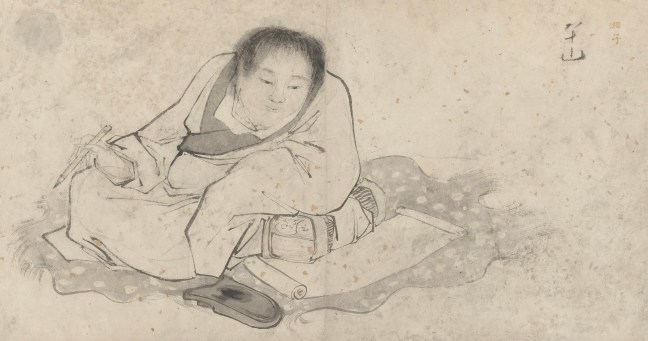
‘Daoist immortal Han Xiangzi’ – Zhang Lu, early 16th century – Wikimedia

I think that our search for the ultimate could find some relief in giving attention to what is small, unnoticed, humble. All the things unremarkable, unassuming, that we pass in life without a glance. You know these moments when we sit down doing nothing. All these things easy, like resting, breathing, eating, sleeping, that can be achieved without our forceful participation. These moments or actions are closer to god than we may think. They live in a grey area where they flirt with the non-objective and slip out of our attention to hide in the sublime, to rest in the blissful, unattached, forgotten. Their presence is made absence, like for the space between two thoughts. But don’t let them leave you. Strive to own them. This is where eternity hides. This is why presence is so much emphasised in spiritual matters; why, in Zen practice, students are encouraged to take pride in habitual, so-called boring or unimportant activities like washing dishes, serving tea, or chopping wood. Forget all your achievements of glory. Put aside your pointed quest for the sublime. Your selfish ride towards the selfless. Go for the minute, the nanoscopic. Take interest in the small and the ordinary. Have a passion for the shallow, like the sacred lotus does.

After all, god has made beauty the most accessible thing there is. And love is so close and intimate that it has been described to be nothing but our very self or being, our natural if forgotten identity. Presence is the most unassuming thing there is, almost as to be nothing. Happiness never comes when invited or provoked, and real beauty has never been seen showing off. But don’t be deceived here. Unassuming doesn’t mean not assuming. And what appears to be nothing can be revealed as the most blatant ‘something’ there is. All spiritual endeavour really boils down to seeing the unseen, and experiencing the non-objective. Your sense of simply being is the most shy presence you will ever encounter in your life, and yet you will find nothing more attractive than its discreet and humble presence. There is glory in simply being, without going for qualities, qualifications, objects, pretence. Silence is louder than noise, and truth more clamorous than any lie can be.

All that religions and spiritual traditions ever do is to proclaim this presence that is already here amongst us, as our very being, and to point towards all that is hiding it from our gaze. Simple-minded by nature, the mind has chosen to ignore it, entrenched as it is in all things objective. It has deemed it insignificant. But the so-called insignificant is simply where the mind cannot go, which is literally everywhere except in objective experience. That leaves for quite a wide field in the unknown, in the hidden, discarded as being too unremarkable to be made a conscious thing. This misjudgment is our mistake. This is our sin. For god is hiding in the small and the insignificant, in everything unremarkable to the mind. But it is not on account of its small size or nature that this presence is unreachable to the mind, but rather that the mind, as the belief in being a separate self, has taken all the place and hides the infinite from our eyes. Just as time, as an idea born of the mind, has taken all the place and veils eternity. This is the extent of the mind’s indulgence. But its conscious retiring or humbling will reveal the sheer glory of all that was left in the hidden. And in doing so will lift the veil on the real nature of our self. God’s being revealed.

.

~~~

Text by Alain Joly

Painting by Zhang Lu (1464–1538)

~~~

.

Website:
Zhang Lu (Wikipedia)

.

Other ‘Reveries’ from the blog…

.

The Poetic Genius

Job Confessing His Presumption to God’ (detail) – William Blake, 1803 – Wikimedia

.

I must Create a System, or be enslav’d by another Man’s;
I will not Reason and Compare: my business is to Create
.”
~ William Blake (‘Jerusalem’)

.

Artists, through their sensitivity to perception, their pointed quest towards beauty and harmony, are natural candidates for delving into the depth of reality and understanding their true nature. Many poets, painters, musicians, have been able to explore their being in ways that are traditionally the privilege of mystics. Indeed, they wrestle with eternity, and strive to find a way to convey it. William Blake was one such wrestler. He was a poet, painter and printer born in London in 1757. Although not recognised during his life, his art is bursting with creativity, intelligence, and vision. His profuse work, soaked with spiritual explorations, symbolic and personal mythologies, is not to be easily classified. Of William Blake, the 19th-century scholar William Michael Rossetti wrote that he was “a man not forestalled by predecessors, nor to be classed with contemporaries, nor to be replaced by known or readily surmisable successors“. Besides, his poetry is infused with pearls of the most profound non-dual understanding, which I invite you to explore here.

In his childhood, William Blake was fascinated by the work of great masters such as Raphael, Michelangelo, and Albrecht Dürer. He was educated at home, was given drawing lessons, and began writing poetry at an early age. Profoundly influenced by the Bible and Christianity, he was all his life gifted with visions and insights, from which he drew guidance and inspiration for his poetry and paintings. He was nevertheless not a follower, and developed his own vision and understanding. He was very critical of narrow-minded religiosity, or what he named the “general truth” or “general beauty“, writing uncompromisingly that: “To generalize is to be an idiot; To particularize is the alone distinction of merit“. William Blake wrote these enlightening verses about his religious endeavour and passion:

.
Trembling I sit day and night, my friends are astonish’d at me.
Yet they forgive my wanderings, I rest not from my great task!
To open the Eternal Worlds, to open the immortal Eyes
Of Man inwards into the Worlds of Thought: into Eternity
Ever expanding in the Bosom of God. the Human Imagination.”
~ ‘Jerusalem’ (Ch. 1, plate 5)

.
When will the Resurrection come, to deliver the sleeping body
From corruptibility? O when, Lord Jesus, wilt thou come?
Tarry no longer; for my soul lies at the gates of death:
I will arise and look forth for the morning of the grave:
I will go down to the sepulchre and see if morning breaks.
I will go down to self-annihilation and eternal death
Lest the Last Judgment come and find me unannihilate
And I be seized and given into the hands of my own selfhood.”
~ ‘Milton’ (Book the First)

[…]

An exploration of William Blake’s non-dual pearls and poetry… (READ MORE…)

.