Know Thyself

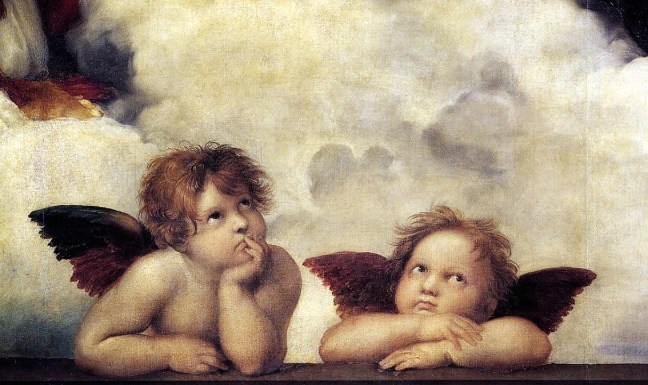
‘Putti, detail from The Sistine Madonna’ – Raphael, 1513 – WikiArt

.

γνῶθι σεαυτόν

.

Know thyself. Know who you are. That’s how simple it is. You may start from the far end, from a belief, a philosophy, an exotic term. You may call it religion, or spirituality, or non-duality — whichever name you want. You may go through the rugged path of belief, faith, practice, meditation, prayer, philosophy — all the names and concepts, the endless thinking about it, and the seeking that seems to never end. But now, when you stop and consider it all at last, you will come to the realisation that, deep down, it all comes down to that simple sentence. ‘Know thyself’. Not the knowing of your thoughts, ideas, opinions, feelings. Not your idiosyncrasies, or character, or outer shape, or preferences. None of that. To know oneself points directly to the knowing of your essence, of your innermost being, what you are made of at the core, when every other thing that can be pointed to has been discarded as superfluous. This is who you truly are. This maxim was once carved in golden letters on the front of the Temple of Apollo in Ancient Greece. That’s what this wisest of civilisations gave to the world as its supreme and most fundamental advice. ‘Know Thyself’.

So self-knowledge is the key. Of course, you may analyse it, take it apart, trace the endless chain of philosophers that gave their stand on this famous maxim, but I would not encourage you to do so. Sometimes, what’s really of crucial, definite importance resides at the simplest, closest address. The one you never truly considered for fault of being almost as nothing, a child’s play unworthy of your attention. Could it be that simple? That the meaning of the whole of life, the solution to our happiness, and the key to the whole riddle of existence could be found there, in the simple knowing of ourself? Let’s assume that it can and consider it seriously. Let’s embark on this shortest of journeys, the one going within, in the direction of our own self, where no distance is needed, no time necessary, and no special expertise required. This simple journey is the one of which the Ancient Greek poet and philosopher Ion of Chios wrote in the 5th century AD: “This ‘know yourself’ is a saying not so big, but such a task Zeus alone of the gods understands.”

[…]

A reverie that explores the path towards the knowing of our self… (READ MORE…)

.

The Flame without Smoke

©️ Krishnamurti Foundation India

.

Love is the only flame without smoke.”
~ J. Krishnamurti

.

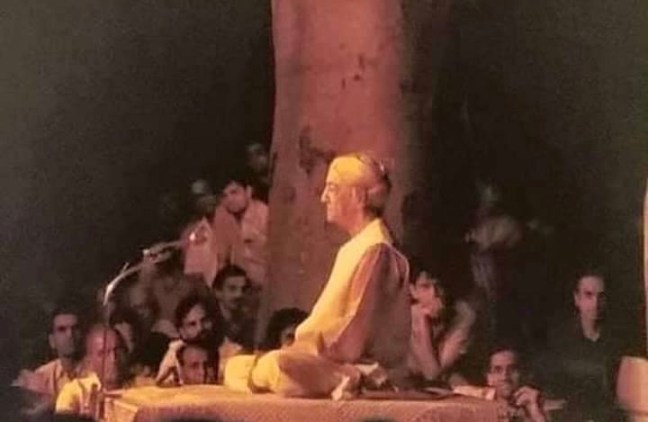
The flame and the smoke is an analogy Krishnamurti referred to sometimes. For him, the flame is this burning centre of being that “can never be expressed with words”, that “is beyond the clutches of time”, and that is often expressed as love. The smoke is of the mind. It is “the smoke of envy, of holding, of missing, of recalling the past, of longing for tomorrow, of sorrow and worry; and this effectively smothers the flame.” The smoke is often what we take to be the flame but is not. It is all that is passing, all the thoughts, feelings, perceptions — the smoke that we have gathered to form experience, and that we take to be ourself, our centre of being. This wilful, separate, time bound, suffering self has appropriated the feeling of being when it is in fact the very smoke that is veiling our true nature. Being only is that flame without smoke. It is our true identity and “the source of all happiness”.

I have gathered, over the years, on social medias, many of the most striking quotes by Krishnamurti, that popped up on my screen. These, I found, acted on me like little koans, that had the power to pierce the smoke of the mind, and reveal the subtlest truths. They are like candies which, when chewed upon carefully, reveal the flame of what we truly are. They are short and easy, but need to be taken seriously. They can crack open our resistance, and show us that flame without smoke. I share them here with you…

~~~

Do not pursue what should be,
but understand what is.”
~ J. Krishnamurti

~

Love is not at the end of time.
It is now, or it isn’t.
And hell is when it is not
…”
~ J. Krishnamurti

~

Thought is never free because it is based on knowledge,
and knowledge is always limited.”
~ J. Krishnamurti

~

It is essential to understand the seeker,
before you try to find out what it is he is seeking
.”
~ J. Krishnamurti

~

The ego is a ring of defence around nothing.”
~ J. Krishnamurti

[…]

Discover more of this selection of quotes by Jiddu Krishnamurti… (READ MORE…)

.

Unto the Ages of Ages

If people only knew. That they are so close. So close to living with the most profound peace in their heart. So close. So close to having a panoramic understanding of what it is to be who we are. So close to knowing the reason behind the word ‘God’. What it means. What it is, here, now, in this human life. If only they knew. If only we knew. How there is a joy that stands hidden just behind our everyday suffering. A joy, quiet and indestructible, that is present now, at the time of our indomitable sorrow. A joy that permeates our most stubborn feelings of despair. If only they knew. That silence is the very temple of their being, where the most sublime healing can take place. A silence where we can let everything go, to be the pristine self that we have always been. At last. Ah! If only they knew.

If only people knew. That life has an inherent, unnoticed simplicity. That the world that stands in front of them, is not quite the world they had in mind. If only we knew. That we own the beauty we see, we hear. That we hold the world, right here, close, so close to our being. That we were never parted from it. That it is our expression, and that we make it just the way we are. If only we had noticed. That love is not another feeling. Not something we choose to give or to hold back. That there is a love, so wide, so close, so natural. A love we cannot help. A love that is the structure of our self. Its profound nature. Ah! If only they knew. We. Us all. How it could change the dice. How it could make love our shared temple. To live in. Now. Here. If only we knew. How close it stands from us. If only. Ah!

And yet we know. Don’t we? We all know. We know that what we get is not the real deal. That this life is not quite the life we were meant to live. This is why we have hopes, dreams, expectations, projections. This is why we place love, friendship, happiness, beauty at the top of our list. We have that hint, that intuition. We know that the promise is here. That it stands close. So close. Ready to wash our eyes. Ready to speak its word to our ear. A word that we haven’t yet deciphered. Haven’t yet pronounced. That will bridge what we know with what we don’t know yet. And this word is ourself. What we are. A logos in our sky. That needs to be uttered once. Just once. A crossing of our bridge. To finally know what we knew. What we forgot. That which is eternally ours. Unto the ages of ages.

.

~~~

Text and photo by Alain Joly

~~~

.

Suggestion:
– Other ‘Reveries’ from the blog…

.

Fear and Trembling

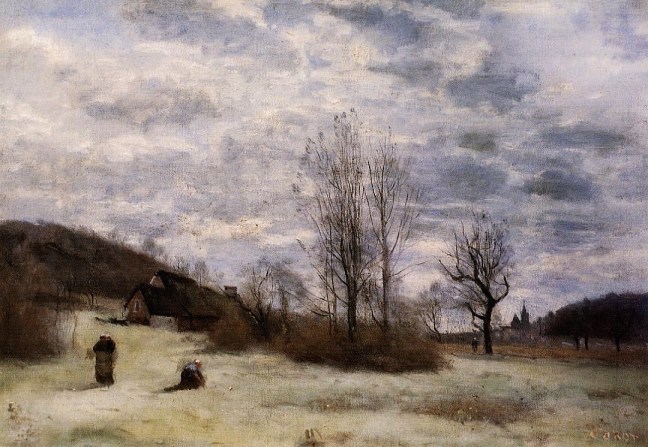
‘Plains near Beauvais’ – Camille Corot, 1860-70 – WikiArt

.

The fear of the Lord is a fountain of life,
to depart from the snares of death.”
~ Proverbs, 14:27

.

There is an expression that we may find puzzling, maybe slightly paternalist, condescending and outdated, but is well worth looking at. We find this expression mostly in Christianity and Islam, where the mentions ‘fear of God’, ‘fear of the Lord’, or the injunction ‘fear God’ are found far more than a hundred times in the Bible, or in the Quran. This fear is said to be one of the seven gifts of the Holy Spirit, along with wisdom, understanding, guidance, mightiness, knowledge, and devoutness. But why would we be afraid of what we longed for the most in our lives? We should be embracing it with ardour and ease. So what is this “fear of the Lord” that, in Proverbs 9:10, is said to be “the beginning of wisdom”? Why is it given such primary importance?

Maybe we fear god for the same reason that we fear death. We think that we are something, someone, a self that we appreciate and have a fondness for, that we love and want to cling to as something precious. We want it to continue. So we have elaborated strategies to keep our self padded with multiple pleasurable sensations through our various habits as thoughts, daydreams, pleasure oriented activities, routines, manipulations, avoidances, all these addictions that have come to form the main part of what we call our self. But these are vain distractions, for awareness as god seems to have in itself a momentum, a power to draw every thing and being to itself. So this pull can be felt as a threatening force from the limited point of view of a self that feels vulnerable, and finds temporary security in being something, even if this something is in final analysis the cause of its suffering. In Hebrews 10:31, it is said: “It is a fearful thing to fall into the hands of the living God.”

[…]

An essay that inquires into the notion of the fear of god… (READ MORE…)

.

The Carder of Innermost Souls

‘Portrait of a Sufi’ (part), 17th AD –Metropolitan Museum of Art – Public Domain

.

أنا الحق
Anā l-Ḥaqq
“I am the Truth.”
~ Mansur al-Hallaj

.

We all enjoy a good story. Here is one coming from far ago, in ancient Persia, where lived a man who became one of the most celebrated mystic, poet, and teacher of Sufism. Mansur al-Hallaj was born in 858 AD near Shiraz, in the Pars province of today’s Iran. He was considered an ‘al-Insān al-Kāmil’, which in the Islamic tradition is a honorific title meaning literally ‘the complete person’, a human being whose identity is merged with pure consciousness. Al-Hallaj is also known as the ‘Jesus of Islam’. He was tortured and publicly crucified for having pronounced the highly blasphemous statement: “I am the Truth”, which equals in Islam to saying ‘I am God’. The French scholar of Islam Louis Massignon wrote that al-Hallaj was “the most beautiful case of human passion that I had yet encountered, a life striving entirely towards a higher certainty.” The mystic’s last words were said to be:

.

Help me, O You only One,
to whom there is no second!
~ Al-Hallaj (‘I Am the Truth’)

.

From an early age, Mansur al-Hallaj was a devoted practitioner of truth. He grew up in a Sunni Muslim family and read the Quran at an early age, but he was irresistibly drawn towards the mystics. As a young man, he received the Sufi habit and moved to Basra in today’s Irak. After marrying, he began travelling extensively and made his first pilgrimage to Mecca, staying there for a year, facing the mosque in fasting and total silence. Although also the father of three children, he kept pursuing a life of devotion and started preaching to a growing number of followers. He became known as ‘ḥallāj al-asrār’, ‘the carder of innermost souls’, for his name ‘hallaj’ means ‘cotton-carder’. From that time on, he began writing exclusively in Arabic. His reverence for truth and the simplicity of his writing are here perceptible:

.

I have abandoned to the people
their religion and their customs
to dedicate myself to Thy love,
Thou my religion and my use.”
~ Al-Hallaj

.

”For your sake, I hurry over land and water;
For your sake, I cross the desert and split the mountain in two,
And turn my face from all things,
Until the time I reach the place
Where I am alone with You.”
~ Al-Hallaj (‘Perfume of the Desert’)

.

Know that Judaism, Christianity and Islam, like other religions,
are only denomination and appellation,
the goal sought through them never varies or changes.”
~ Al-Hallaj

.

[…]

.

The life and teaching of the ancient Sufi master Mansur al-Hallaj… (READ MORE…)

.

The Will of God

‘The Wind Blows’ – Hugo Simberg, 1897 – WikiArt

God’s will is what is happening now. Not as a body or an entity, not as a form or any kind of event. The reason is: form has already happened. Every object comes from the past. It has traversed at least a length of time to land in the field of awareness. Like a thought has. A thought is never now. It is the termination of something that took place a moment ago. It is an achieved result. But there is something in our experience that doesn’t come from the past, that hasn’t travelled any distance to be here, and that hasn’t moved through time to be now. So if you want to know what is God’s will, find the only thing in your life that is not a thing, that hasn’t yet taken form, and therefore needs neither space nor time to be. Find that which cannot be found, that which is formless, that which hasn’t travailed. For God’s will doesn’t come second, it cannot be a result, for such a thing would need a cause for itself to be. No. God’s will is first. As a ‘first’, it is in capacity to initiate, to create. But what is created is never itself God’s will, for it is already formed, with a life of its own. It is corruptible as form. So go to the essence, the origin. Find the incorruptible in yourself — that one uncreated thing — and take that only to be the will of God.

So we are in our essence uncreated. This is our identity, to be without form, forever here, forever now, eternally landed, therefore without a will of our own. For what would a separate will be but a thing already formed, an effect with already a cause; and therefore not the causeless, therefore not God’s will. So if we want our life to follow a divine trajectory, we have to give our utmost attention to who we are. That will condition the rest of our existence. That matters the most: that little name we give to ourself, that little identity. Start with the truth of who you are, and be only concerned with the tail of that star. Make yourself bright with it — that’s how to follow God’s will. Be that one that is in no capacity to be a follower. Stand as and for the truth of being and be concerned with nothing else but that. That is the only possible will you can afford. Any other kind of will is not your own, although it may appear to be. So don’t expect to have a will, for a will is but an appearance that has formed in yourself. Go to yourself first. Go for that part of yourself that has no will but God’s will. You will find there a will that encompasses all other wills — for what is a will but the will to be happy, rested, fulfilled? Only at the condition of being without a will of your own can you embrace the one will of your true identity as being. Being is in fact its own will, for it has as its DNA the purpose of all wills, which is the peace of living. From that peace firmly set in your heart, any will is the will of God.

.

~~~

Text by Alain Joly

Painting by Hugo Simberg (1873-1917)

~~~

.

Website:
Hugo Simberg (Wikipedia)

Suggestion:
Other ‘Ways of Being’ from the blog…

.
The Russian Dolls

‘Ornement, Matriochka, Babushka’ – Schwoaze – Pixabay

In fact, all we have to do is this: To open to our fact of just being. To let go of our acquired resistance, this tightness running in the background. It’s just an old habit. Our fear too — just an old habit born out of a concept. That concept runs something like this: we are a time-bound self that is separate and needs control and protection. Let this representation go. It’s not fundamental. It’s a narrative. It can be easily rid of. It is but a late creation in our timeless life as being. Just an idea lingering at the surface of our being, with no foundation. A simple belief that has once emerged. Just shake it off, it is utterly vulnerable and lonely, scared to be looked at and unmasked. So don’t let yourself be controlled by it. Don’t let your fear and resistance rule your life. Know better. I understand if you were your body, your mind, and your feelings — if they were being the whole of you — I see in that case how your fear and resistance could infiltrate you, take possession of you, and change you, ruin your innocence, harden you, damage you. I get the point. But you’re not. You’re not your body and mind, let alone your feelings. This is only an unchallenged, primal belief, which gave rise to the idea of you being a self separate from the world, a self which is then both the cause and the recipient for all your fears and resistances, for all your suffering, which then will continue the process: solidifying your idea of being a body; making your whole mind an asset of that body; giving rise to the idea of a self within that mind; which will in turn be a cradle for a whole array of consequential feelings; then god knows what feelings can make you do… Let all these Russian dolls go. Rest in that part of your self that is neither an idea, nor a concept, nor a representation, nor a thought. Go to the very heart. Start there. With Being. This is your illusory self’s weak point, where your primal belief cannot stand. This is what will disintegrate it. What will send you back to the truth of your being, and render your fears and resistances like these vain little clowns who are running around to disturb the show but never can. Be like the bigger doll, with infinite dimensions, in which all the other dolls fall back into place, unable to really act on your gorgeous being, powerless in diminishing it. Let the many dolls within your self be like humble and devoted attendants. Some of them dying of their natural death. Some of them appearing as having never been there in the first place. And some of them painted with the glorious qualities contained in the knowing of your own being.

.

~~~

Text by Alain Joly

Photo by Schwoaze in Pixabay

~~~

.

Suggestion:
– Other ‘Reveries’ from the blog…

.