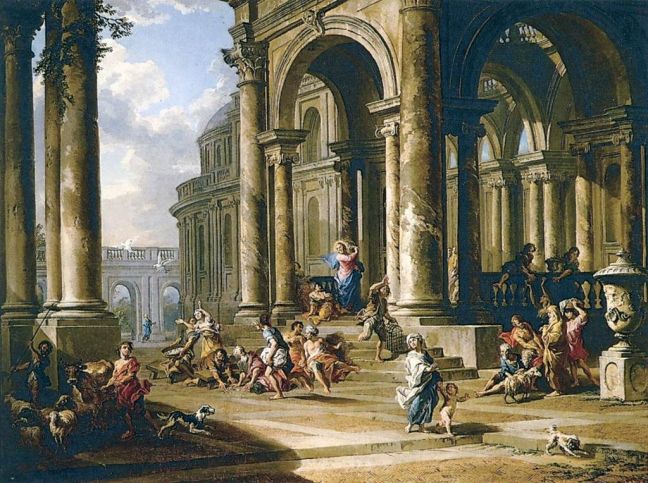
Cleansing the Temple

‘Expulsion of the Moneychangers from the Temple’ – Giovanni Paolo Pannini, 1724 – Wikimedia

Maybe this is where peace in fact resides. In the fact that peace or happiness can never be found, never be reached. It will be nowhere where you expect it, not in any objective appearance or event, not in any wish granted, not in any kind of alignment between what you want and what you have. You will never obtain what you want. Truth is not there, in what you wish. It doesn’t care for your egoistic projections, for your own private self-interest. Truth is not a mere good to be bargained for, or hoped for, or waited for, which, if not granted will disappoint you, and make you like a rejected lover, or a bruised self. Truth is not any kind of crude object. Remember Jesus who cast out the merchants in the temple. Were you really thinking that there was a physical Jesus actually chasing the merchants from the temple, on the ground of some kind of moral rule?

The merchants in the temple, it is you. It is all of us when we have decided to argue with reality, to buy our happiness with some kind of object obtained, to bargain or negotiate with some invented superior entity the responsibility of what is happening to us, to come to god with pockets full of expectations and desires, making peace a simple object to be bought in the market place of our likes and dislikes. “Wouldst thou be free from any taint of trade?” did Meister Eckhart ask. Imagine the relief that it is: to know or realise that you will not have what you want, that ‘what is’ is all there is, all that you will ever have. What a relief! What a load finally put down, and got rid of! All that you want, desire, expect, all that, will never ever be granted to you. You can forget it all. ‘What is’ is the deal. The grandiose enlightenment you were waiting for lies there, in what simply is! It will never get better than that! You have it all here, in front of you. That is the gift that was specially designed for you. Happiness resides in what you have, in what you are, here and now. This is the secret that Krishnamurti meant when he said: “I don’t mind what happens.”

[…]

On how truth is not an object to be bought in the marketplace… (READ MORE…)

.
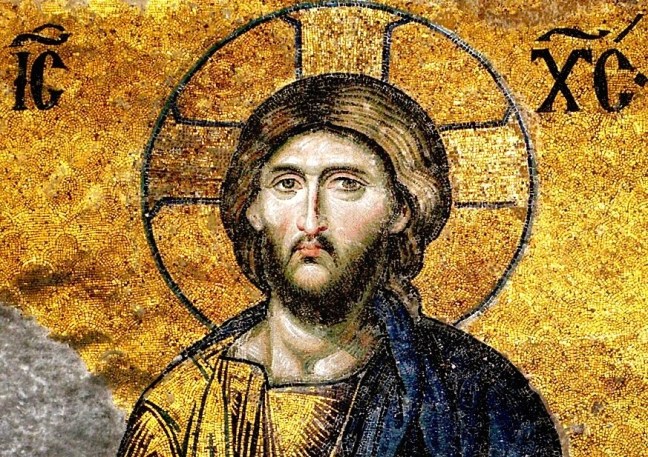
Christ (noun)

‘Christ Pantocrator mosaic in Hagia Sophia, Istanbul’ – Unknown, 13th AD – Wikimedia
. Sometimes, the simplest questions are the ones never asked. Like, for example: ‘What is ‘Christ’?’ Were we ever curious about it? To know why this word was chosen to represent what it represents. Don’t we want to know? A word that has lent itself to a whole religion, that has been used to name a person —Jesus — who was worshipped for millennias, who is nothing less but the son of God, and who claims to be the solution to the relief of our suffering, to our being cleansed of our faults, and to our being reborn, resurrected, and blessed eternally. Don’t we want to know, to approach it with an inquisitive mind? Just once? But it’s like we are being afraid. A sort of strange ‘fear of god’ that we have deep down, both as lovers of god or as atheists. Especially in religious matters, where it feels that we are often satisfied with a hazy understanding, a shaky belief, or a quick judgement, and are never prone to go deeper than that. ‘This is too big for us! Too remote! Where too much is at stake! So we’re not going to shake that boat! Not now!’ And so… This is how we keep a simple misunderstanding safe, how we keep an old stale belief alive, and how we keep at bay the truth of who we are… but we’re not going to do that now. Now is for truth. Now we have come to know at last! And one way to start an inquiry, in our highly conceptualised world, is to humbly dig for the etymology of the word that defines the thing we want to know about. That usually reveals some deeply buried secrets. So… ‘Christ’ comes from the Greek word ‘chrīstós’ meaning the ‘anointed one’. A meaning that is shared with the Hebrew word ‘mašíaḥ’, translated as Messiah. To be anointed is to be smeared or rubbed with oil, typically in a ceremonial way. It is a form of consecration, of elevation. It was used throughout history in multiple ways, for example as a form of medicine, or for the blessing of a king, or to attract the influence of the divine. But behind all the pompousness of it, is simply an act of redemption: We want to be happy, to be brought back to a state of health and harmony. It is the desire to elevate ourself from our conditioned ways of thinking and believing, and find the peace that we all think to deserve. It is the longing to be relieved from our suffering, and to rest at last in our own glorious being. […] An exploration of the meanings hidden in the word ‘Christ’… (READ MORE…) .

peace (noun)

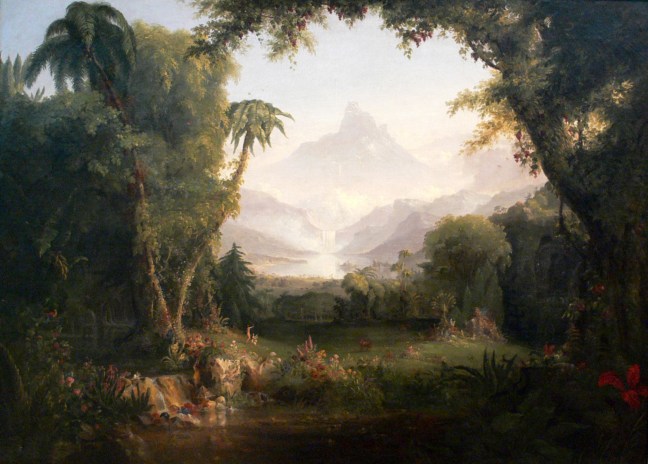
‘The Garden of Eden’ – Thomas Cole, 1828 – WikiArt

It is always revealing to reflect upon a certain word in the context of spirituality, and see how it came to appear and be chosen. Why this one and not another word. There are many synonyms to the word ‘peace’, amongst which tranquillity, calmness, or quietness, which all seem better suitable to an entity or an object than peace. Peace is profound. It stands on its own. Just its pronouncing deepens you, fills you with its referent. ‘Peace’. The word takes you somewhere else, makes you leave your habitual field of suffering, desiring, projecting, coping, aiming, all that renders life a battlefield. ‘Peace’. Peace is a mantra in itself. A prayer. An occasion to go within. It has the automaticity of something fundamental, inescapable, and the simplicity of something that everybody knows or has experienced.

The word ‘peace’ comes from the mid-12th century root ‘pes’, meaning ‘freedom from civil disorder’ or ‘absence of war’. Likewise, in the dictionary, the first meaning for peace is stated as ‘freedom from disturbance’. Peace is always negative. It is here when something else has receded or died down. It is revealed through an absence. After all, in common parlance, the word ‘peace’ has always been used to refer to the state of things that exists in the absence of conflict or disorder. The word was almost invented to refer to this moment when a war ends and one can return to the state of affairs that existed before the conflict started. It is never a new state or occurrence. It is what is usually here in the background and is disrupted by the incursion of movement, conflict, war, thought. The tiniest thing, as long as you believe it to be you, will disrupt your peace. Peace is a return. A recognition of something known but forgotten for a time, or rather eclipsed by the incursion of time. Peace is something that is always here in the background, waiting patiently for your return. Our mind as ego is the disruptive factor, the war in which we have decided to engage, and found ourselves caught and lost. Make it end and peace will come automatically. It is not a new state invented, but the pre-existing state of your deepest self as being, which only a quietening of your wrestling with the objective world will make apparent. Peace is the very foundation of your self. It is the cornerstone of the edifice of life, as is easily seen in nature, which seems to have peace as its very fabric.

[…]

An exploration of the meanings behind the word ‘peace’… (READ MORE…)

.

The Ultimate Absolution

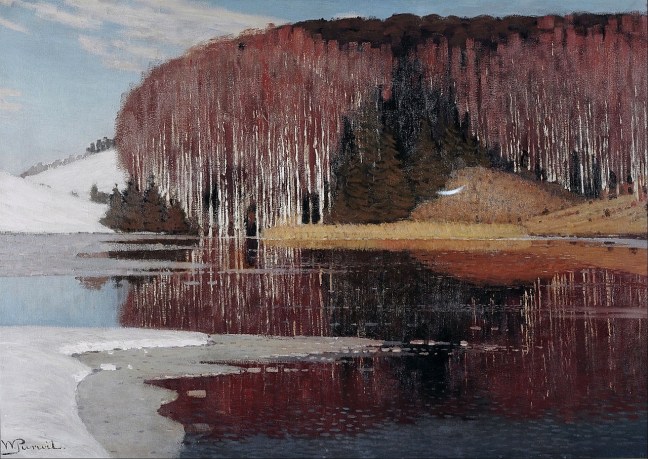
‘Spring Waters’ – Vilhelms Purvitis, 1910 – WikiArt

Isn’t it wonderful to discover that you cannot be destroyed? No matter the magnitude of your heartbreaks. No matter the betrayals and the dishonesties — all that is unforgivable in others or in yourself. No matter the untold suffering inflicted to your body or to your self. Isn’t it a blessing to notice that you cannot be broken no matter what? You can believe to be broken, sullied, doomed and punished for your sins. But in reality you are not and cannot be. You are as beautiful as you ever wished to be. Worse even. No quantity of imagination, no originality of a mind will ever prepare you to comprehend the pure and unsullied nature of your self, which equals to nothing but the beauty of your heart.

The only thing that can ever be hurt or sullied is a thought or a belief. You will be hurt in proportion to the extent of your identifications. The greater your illusion, and the sharper will be the pain when it is challenged, or diminished, or trampled. A belief is a living thing. It is not just a dead abstraction that can be easily ignored or overcome. A belief is as alive and sensitive as a self can be. We are made of that belief, we have clothed ourself with it and have become vulnerable to all that can undermine it. That’s how you become a sufferer. That’s how you can imagine to be sullied, diminished, destroyed. It is all contained in one single belief about yourself. And it can be released in one single act of contemplation: Seeing yourself as you are, and not as you imagine yourself to be.

[…]

An exploration into the true nature of forgiveness… (READ MORE…)

.

The Impossibility of Knowing

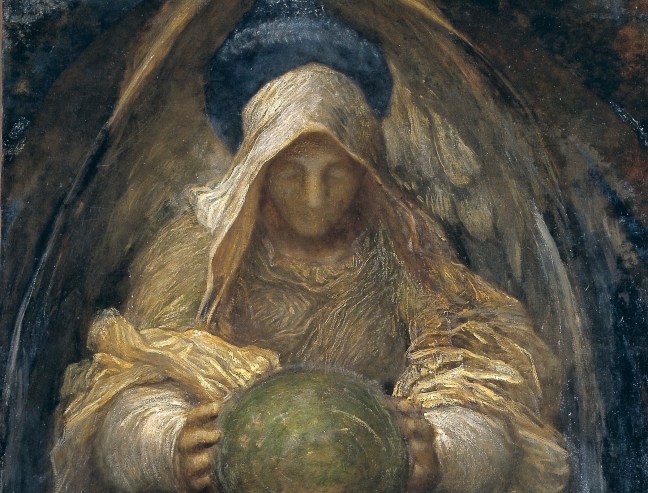
‘All Pervading’ (detail) – George Frederick Watts, 1887 – WikiArt

.

Beat on that thick cloud of unknowing
with a sharp dart of longing love,
and do not give up, whatever happens
.”
~ The Cloud of Unknowing (Anonymous)

.

Habit is a driving force in our lives, yet it doesn’t have good reviews: it is an object of critics. It is making us dull and repetitive. It is non-creative, indolent, designed for our self-protective needs. It is born out of fear, uncertainty. It is a shield for what we feel bullies and thwarts us, and is thereby blocking our sensitivity and vulnerability. Habit debases love. But habit is not the real culprit in this affair: it is a victim of the one more fundamental habit of knowing.

Humanity is steeped in apparent knowing. We all have a posture of knowing. To know is the great pretension. Games are invented to praise and reward the people who know. The injunction to know is overwhelming. It is the believed road to success and wealth. Not knowing is a humiliation. We could take pride in knowing anything, in being ignorant, in the most ridiculous things, only to save us from being suspected of not knowing. For knowledge is believed to be gold. But although conceptual knowledge is indeed of great value in our society, the posture of knowing is nevertheless the greatest impediment to seeing who we truly are, and how to live our lives free and happy.

We don’t speak here of knowledge in the sense of conceptual or relative knowledge. Most of the knowledge necessary for our body and mind to function in the world is valid and necessary, of course open to mistakes and misinterpretations, but is not what we are discussing here. We are investigating fundamental knowledge, or knowledge as essence, the primal act of being.

[…]

An essay on the articulation between knowing and not knowing… (READ MORE…)

.

Awareness is All

‘Conscious Capability’ – George Harvey (1806-1876) – WikiArt

.

The very fact of being aware of what is is truth.”
~ J. Krishnamurti

.

If you observe yourself carefully, awareness can be felt as a truly overwhelming presence. It is actually all there is, and that can be easily proved. Let’s take an experience like our current experience, since no other than this one present, living experience, has ever existed and will ever do. We cannot divide experience, make it into bits and pieces to be compared or analysed. Experience is not limited to its content. You cannot separate content from its recipient. That’s the first clue for our investigation: Experience is undivided, unbroken awareness.

But let’s not be too quick on this, and jump to an easy conclusion. Let’s look thoroughly at our experience. What are the things that occupy us? What is actually filling this presence of ours? Let’s take our thoughts for example. There seems to be a steady arrival of them in our mind. All kinds of thoughts. The organised ones and the messy ones. The scared, confused, barely audible ones, and the vindicative ones. The happy ones and the weeping ones. Some that are useful in the course of a day, and others utterly useless and gratuitous, that are here solely to soothe our broken sense of self, or escape from a dreadful, imagined reality. Let’s face it: most of our thoughts are actually mad thoughts owned by a barely identifiable owner.

[…]

Explore how the nature of our experience is made of awareness… (READ MORE…)

.

An Invitation from Silence

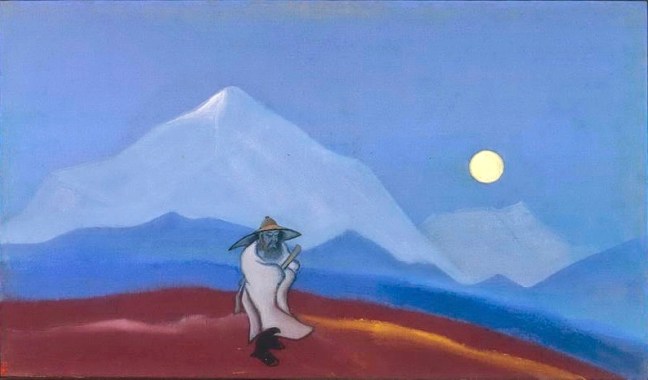
‘The Philosopher. Silence’ – Nicholas Roerich, 1940 – WikiArt

.

Of the unknowable only silence talks.”
~ Nisargadatta Maharaj

.

Silence is always called upon us. Once we have stopped engaging with our endless thoughts, once we have released the rage of our permanent search towards happiness, once the dance of our daily relentless activities has died down, then silence is here always present. Silence is here to re-collect us into itself. It is a never failing embrace, always available, always ready to mother us, always pregnant in and behind every one of our failures or pains, of our battles with ourself and with the world.

In a way, silence could be said to be the mother of a symphony of sounds. Silence is a sound enhancer, and by extension, a revealer of objectivity. But notice that we stop hearing anything when the space of silence is filled with an overcrowding of sounds. Any sound is then only participating in the general cacophony. This is the same with awareness. If our mind — this presence that we are — is filled to the brim with objective experiences, so as to seem to become itself a big object, it then becomes impossible for this mind to find any space within itself to experience objects as objects, and to notice that in which these are appearing. The space of awareness goes unnoticed with the pregnancy of objects, just as silence goes unnoticed with the cover of sounds.

[…]

A text that shows how silence is revealed as our very own being… (READ MORE…)

.