The Fantasy of a Self

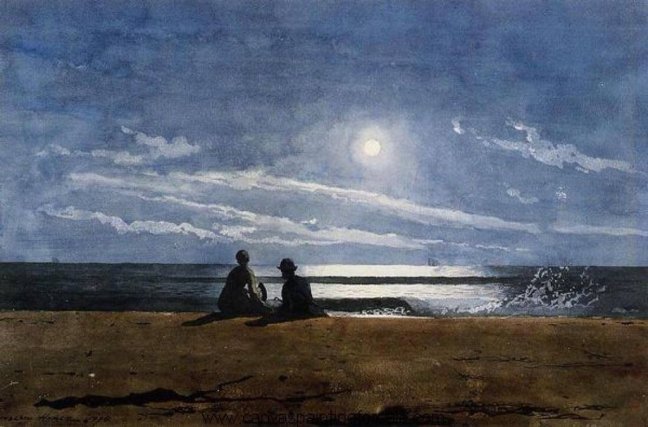
‘Moonlight’ – Winslow Homer, 1874 – WikiArt

We only ever land where we are. There is no escape from where we are. Where we are, is all there is. I mean this deepest place of ourself, from which we have never been separated, is the very thing which we have been looking for in a thousand distant places, in endless situations, in hopes and expectations, in projections, attachments, identifications. Our mind has been thirsting for this place of peace for as long as we can remember, and it has been escaping us with perfect consistency. For there is a rule attached to this place: we can’t find it outside of ourself. And the reason is: there is no place outside of ourself. Ourself — what we are here and now — contains all that we could long for. It is the home which we have left through our contant looking for it in the wrong direction. Our seeking is way too aggressive for its tender being. Our peaceful home lies in the nest that our being is, and this nest of being is where all existence finds its birth and takes its journey.

The problem with accessing our being — our peaceful home — is that we have introduced a self. We have posited a self that is separate from the peace it is looking for. And if peace is situated at a distance from ourself, therefore where we are is the place where peace is not. We have superimposed a self on our peaceful being, and in doing so have invited suffering, which is but the seeking for our lost peace or happiness. It all comes from the connivance of a few thoughts, feelings and sensations, which have set themselves up as a self. It is all part of a scheme on their part, and a gross one if you ask me. For how could something that is coming and going have a self? Something as flittering as a thought, or a sensation, could never produce a self. The self that we think we are, and that we feel is at a distance from experience, is fabricated. It is a product that we have elaborated to feel secure. But we cannot find security in a self. Security is rather the absence of a self, and the merging of ourself with experience, which is felt as oneness.

This self, without our noticing, has created untold damages, it has made life into a havoc. It has invented a within and a without, a here and there, a now and then, when there is in fact only a seamless experience. All these distinctions are of course necessary for our functioning in a world, but they are not the reality. And to ignore their reality is to transform them from a few peaceful, useful devices into brigands that have made experience either something to be feared and avoided, or desired and pursued. In other words, being a self has made experience into a dependence, a battlefield for our own imaginary benefit. But in fact, there is in reality only a now that is ever present and eternal, and a here that has no boundary, no limit, and is infinite. And there is a within that we will cease seing within, for after all thoughts and images are filtering experience to the point of making it their own creation. Thoughts are not just within. They are scattered all over the field of experience, colouring everything we see or hear. And the without will cease being without. For where could without be if not in our intimate experience. So the trees, the houses, and the dog we meet in the street are part of our very own being, for there is only one being out of which they could make an appearance. Where would another being than our being be? To posit another being than our being, or a without without, or a within within, or a there, or a then, is to be absent to our true being or nature, and to live in a world scattered about and fragmented, where reigns every bit of suffering and conflict. But to live as the One renders without within, within without, there here, then now, and our being just only one being. The rest is but a fantasy which we can either buy and suffer from, or borrow and play with.

.

~~~

Text by Alain Joly

Painting by Winslow Homer (1836-1910)

~~~

.

Website:
Winslow Homer (Wikipedia)

Suggestion:
Other ‘Ways of Being’ from the blog…

.

Anatomy of a Desire

You must not desire the truth. You must let the truth desire you. For truth has the greatest desire, the most efficient one, to which yours is but a pale copy. It is the desire to be itself alone, unaccompanied, unsoiled. In the fulfilment of that desire, truth will swallow you, will undress you and render you transparent, nonexistent, naked. You’d be inspired to let go, to give in, to trust that desire which is so greater than yours. For your desires are small, inadequate, vile, selfish. They won’t get you where you truly want to be. They will miss the mark. Every time.

So don’t desire truth. Don’t make it like something you can possess. Truth is in fact already possessing you, the only one in command. So undress your being of the superfluous. The superfluous is all the beliefs attached to yourself, that makes you a self that feels separate, an entity in a body, delineated by its thoughts and feelings, that looks up to experience, and betrays its profound suffering through its constant desire for fulfilment.

Notice that your desire has no true owner. The one that desires is not really there. It is but an idea, a desperate attempt to feel that you are complete. But you won’t feel complete by means of desiring, for desire is already the sign of your incompleteness. The problem with being a desirer is that it places you ahead of your natural identity as being. It is a position of ignorance with a plan and a hope. The desirer is a made-up entity whose unacknowledged goal is to consolidate itself. So don’t make truth like a projected goal to be achieved. The desired object of enlightenment, or realisation, was never intended. It was in fact all for the desirer, to strengthen your false identity as a self, to adorn the temple of separation, to attach yourself to another idea. Liberation is not in desiring to be liberated.

[…]

Continue this exploration of desire in matters of truth… (READ MORE…)

.

The Intimacy of Experience

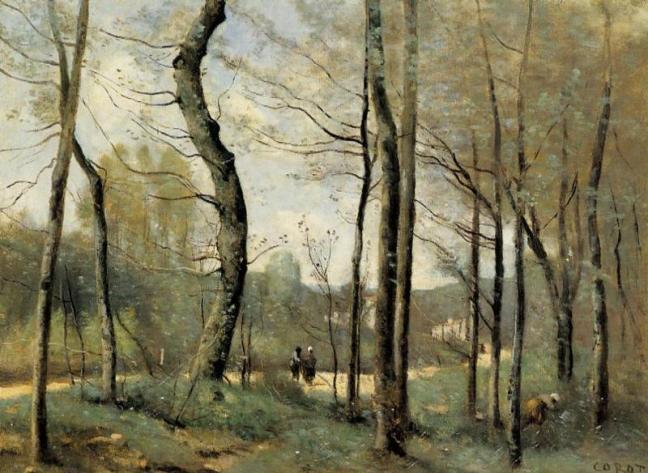
‘First Leaves, near Nantes’ – Camille Corot, 1855 – WikiArt

.
I will tell you where to be
. Be where every experience feels an equally good experience. Don’t be attached to judgment and comparison. These are the mind’s favorite tools and activities. The mind tricks you to believe that experience is an uneven ground. That according to the content of your experience, you will be gifted with either happiness or suffering, peace or conflict, harmony or disorder. So the experience you are having becomes extraordinarily important. We become dependent on what happens to us, and come to dread it. So we retire into the secure place of our habitual self, with its cortège of worry, control, expectation, and manipulation.

There is a place in us where you don’t find experience to be such a determining factor. Where you will not let experience determine you, fix you, limit you. You won’t be shaped by its content. You won’t be made into something, someone, with qualities and flaws, to be judged, evaluated, compared with — the likeness of experience — in fact, just another object. The mind is a manufacturer of objects, entities, persons, fixing the insubstantial nature of your being into a self to be moulded and made either happy or miserable. To be made happy by an experience is to be cheated on by it: we are being manipulated, and made to believe an illusion. To let experience make us miserable is sheer deceitfulness, it is us being easily dazzled by the treachery and artifice of objects.

[…]

Continue this exploration of the nature of experience… (READ MORE…)

.

A Holy Formula

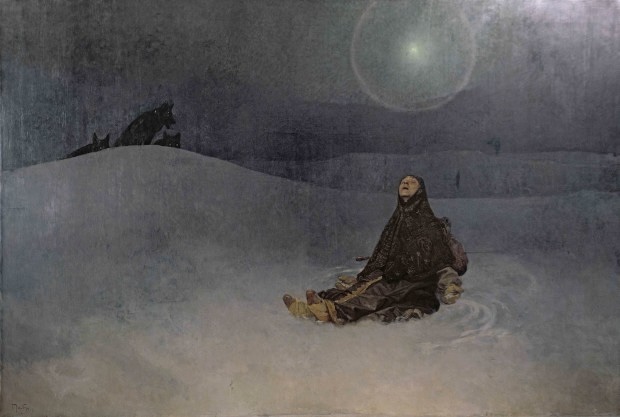
‘Woman in the Wilderness’ – Alphonse Mucha, 1923 – Wikimedia

.

Consciousness is an internal relationship to the whole.”
~ David Bohm

.

You cannot suffer when the world in which you live is discovered to be you. That’s mathematical. A formula that will work magic in your life. For you don’t live separated from everything else. You are not limited to your body, and the world is not something that is distinct from you, at a distance from you. You discover that the jump was made long ago, that you have been the totality already from the beginning of ages, eternally one with it, and that there never was an inch that separated you from the world you live in. That’s how you are complete, by knowing no separation, by entertaining no difference, and therefore having no preference. So you cannot be lacking anything, and suffering is always only the lacking of something, which is born of separation. So stay there, in your inseparable essence, in your world of completeness. Notice that this is what you are, or rather what there is, when you stop fantasising yourself being somebody. You never had an existence of your own. You are the flowering of something deeper. If you ignore or overlook this simple truth, well… then the trouble begins, all the travail of life, and the never ending seeking for fulfilment. This never was about you. Life is bigger, wider than that, and you are here only to honour that and to live by its gorgeous rules.

Then you enter into sacredness. You leave the limitations of being somebody — a projection, an idea that thought has sculpted over time — for a merging with infinity, with who you truly are. This is what sacredness is: an entering into your true self. A visiting of the truth of your being. The anointing of your self with its reality. This entering is a sanction from truth. It is the death of an old idea which you have entertained, for a ride into unknowing. It is a ceremony in which you are being elevated to a reality that you have been blind to. You are being sanctified, or made true. You were already that, already living as that reality, already tasting of that firmament, but were distracted. You were drawn to be something, insisted in being exclusively yourself, by yourself, so you have ignored it. You missed the chance to know yourself truly. You worked too hard to be what you are not. You lacked passivity. Not that you don’t have to do anything to come to this understanding. But rather, this understanding is nothing you do. It is here in you, as you, without your doing anything about it. It doesn’t need your participation, or rather it needs your non-participation, your staying away, your keeping quiet. Your abandonment. The hardest thing of all.

Then you enter into holiness. You taste of your true home, which happens to be the home of god. You are made holy, which means whole, uninjured, healthy. You realise where you are, what you are, the stone you are made of. You notice your true body — the consciousness of everything. You connect with a reality that could never be transgressed or violated. A reality which you could only fall in love with, for it is your beloved self, which you have lost sight of, and are now reunited with, consecrated in, and which you would never want to leave, or not live by. You are made of the same golden dust that the stars are made of. I don’t mean just your body, but what you are at the core, the essence of your self, what you happen to be when you say simply ’I am’. You are made into “an internal relationship to the whole”, as David Bohm expressed so beautifully. And you will struggle to see the world as a collection of different parts, or to see yourself as one such part amongst many others. The One will come to be your only experience. But you will be defeated again and again. You will come to feel a part again. You will be seduced to be somebody time and again. You will want to feel separated again, to win another last adventure or advantage for yourself. You know: your little devil wanting to be the likes of god. But keep going. Keep going. Until one day, it may dawn on you: you are no more.

.

~~~

Text by Alain Joly

Quote by David Bohm (1917-1992)

Painting by Alphonse Mucha (1860-1939)

~~~

.

Websites:
David Bohm (Wikipedia)
Alphonse Mucha (Wikipedia)

Suggestions:
– Other ‘Reveries’ from the blog…
– A page from the blog dedicated to David Bohm: ‘Insights into Wholeness’…

.

The Adventure of Thought

‘Head with Flowers’ (part) – Odilon Redon, 1907 – WikiArt

Thoughts are a strange thing. For they seem to be both indelibly ours and strangers passing in our sky. We have an ambivalent relationship to them. Sometimes they are part of us like a lover can be, so intricately woven to our being that they seem to have been sculpted out of our very essence. On other occasions, we see them from afar, unwanted, a despicable thing that we judge unworthy — thieves that have come to set us on a wrong course, rendering us unrecognisable to ourself. We have a love-hate relationship to our thoughts. We love the ones we judge to be good and worship them, befriend them, glorify them, and hate the ones that come to upset us, the bad ones that we refuse to endorse, or have a responsibility for. The ones that we leave scared and alone, ready to multiply and threaten our very being. They are like the obeying soldiers of our wounded self, the dark agents of our fears and of our rancour.

Thoughts end up being prey to our likes and dislikes, treated like objects are, judged as being often disloyal, incompetent, insufficient. We seem to be separated from them, to have little to do with them. But thoughts have been supremely important to us. In a way, they have created us, through our identifying with them. They have formed the limits of our self as a separate entity. In fact, thoughts are thinking us. We are the prey to their conditioned making, and are at the mercy of their limited expression. So we are most of the time reduced to being ourself a thought, a thought thinking itself out, and believing that it is representing nothing less but what we are at the core. Yet we are truly far from the mark. Thoughts have deluded us, have drifted from their being a simple tool to stealing our very identity by faking the appearance of a self separated from its thoughts, when that self is in fact just a magnified, engrossed, elaborated thought that bears no resemblance to what we truly are. Thoughts thrive on confusion, they flourish and fatten on the prosperous soil of ignorance.

But try to go beyond thoughts, to pass them by, to ignore them as being unimportant and move on, deeper, towards the very centre of your self. Notice the sense of being that is here before them, and that hosts them in last analysis. Touch the silence behind thought. Embrace who you are before you associate with things. Go to the place where no identification is possible, where you are free from conceptualisation, where thoughts have become unrelated to yourself, lost entities that have no relationship whatsoever to your truest being. You will begin to disconnect thoughts from yourself, to render them innocuous, and stop looking to them for your security or identity. You will discover a way of living where thoughts are scarce and rarify. You will have no room for thoughts. You will have disencumbered yourself, and will stop being blind to what is. For you will notice that your being extends to all possible things, and all times and places. It is a presence so unified that thoughts are being gradually expelled from your deepest being by losing their unifying justification. They become redundant to your self. They become what they should never have ceased being: a wonderful tool at the service of unity, a practical thing that is but the expression of the one. You will have stripped them of their being an impostor. That’s how you stop being a thought. Because you don’t need one to be yourself.

.

~~~

Text by Alain Joly

Painting by Odilon Redon (1840-1916)

~~~

.

Website:
Odilon Redon (Wikipedia)

Suggestion:
– Other ‘Reveries’ from the blog…

.

The Russian Dolls

‘Ornement, Matriochka, Babushka’ – Schwoaze – Pixabay

In fact, all we have to do is this: To open to our fact of just being. To let go of our acquired resistance, this tightness running in the background. It’s just an old habit. Our fear too — just an old habit born out of a concept. That concept runs something like this: we are a time-bound self that is separate and needs control and protection. Let this representation go. It’s not fundamental. It’s a narrative. It can be easily rid of. It is but a late creation in our timeless life as being. Just an idea lingering at the surface of our being, with no foundation. A simple belief that has once emerged. Just shake it off, it is utterly vulnerable and lonely, scared to be looked at and unmasked. So don’t let yourself be controlled by it. Don’t let your fear and resistance rule your life. Know better. I understand if you were your body, your mind, and your feelings — if they were being the whole of you — I see in that case how your fear and resistance could infiltrate you, take possession of you, and change you, ruin your innocence, harden you, damage you. I get the point. But you’re not. You’re not your body and mind, let alone your feelings. This is only an unchallenged, primal belief, which gave rise to the idea of you being a self separate from the world, a self which is then both the cause and the recipient for all your fears and resistances, for all your suffering, which then will continue the process: solidifying your idea of being a body; making your whole mind an asset of that body; giving rise to the idea of a self within that mind; which will in turn be a cradle for a whole array of consequential feelings; then god knows what feelings can make you do… Let all these Russian dolls go. Rest in that part of your self that is neither an idea, nor a concept, nor a representation, nor a thought. Go to the very heart. Start there. With Being. This is your illusory self’s weak point, where your primal belief cannot stand. This is what will disintegrate it. What will send you back to the truth of your being, and render your fears and resistances like these vain little clowns who are running around to disturb the show but never can. Be like the bigger doll, with infinite dimensions, in which all the other dolls fall back into place, unable to really act on your gorgeous being, powerless in diminishing it. Let the many dolls within your self be like humble and devoted attendants. Some of them dying of their natural death. Some of them appearing as having never been there in the first place. And some of them painted with the glorious qualities contained in the knowing of your own being.

.

~~~

Text by Alain Joly

Photo by Schwoaze in Pixabay

~~~

.

Suggestion:
– Other ‘Reveries’ from the blog…

.

That Flickering Flame

‘Mary Magdalene with Oil Lamp’ (part)  – Georges de la Tour, 1630-35 – WikiArt

The simple feeling of being — away from the contingencies of being a separate self enthralled, or assailed by objective experience — that feeling, that wee flame, needs to be attended at all costs, watched over patiently, and finally protected. Otherwise it will wither in no time, pushed by the winds of our egocentric activities, wiped out by our stubborn beliefs. Being can be such a shy being. But always remember: it is eager to shine; it is eager to warm your life up with its soft, tender flame. And it will bring you that little light you need, to find your way through the maze of existence. That flickering light is stronger than you think. At first, it might appear to be hesitant, wavering as if to die with any sudden burst of a boastful thought, or the surging of a distressing feeling. But look closer. For the apparent flickering of that little, intermittent flame is yours. You are that angry shadow threatening to shut its light off yourself. You are that cold gust ready to send its warmth far and away from your life, and leave you freezing like a lonely being. So be yourself that shyness, that hesitancy. Watch that you don’t come to disturb the flame of your self. Be that flickering entity, always ready to retire and fade your cumbersome presence off that joyous fire of being. That’s the extent of your attending: your not being there, your acceptance to die or surrender, your willing to fragilise that imposant self which you have identified yourself with along the way — that invention of yourself. That is all this wee flame needs to set fire to your existence, to inflame your being as to show it to be indestructible, and to shed a bright light on your true nature as being infinite and eternal — not that shy, fragile, flickering, coming and going presence. For presence is a wildly enthusiastic blaze if you let it be. It can burn you in a second, so as to render you inexistent. It is a firestorm that will scatter you in a thousand fluttering ashes, to leave you as you truly are: A peaceful being. A flame of happiness. Shining brightly like an ebullient sea of love. See what a little attending can do — a little nurturing! The humble succouring of a wee, flickering flame…

.

~~~

Text by Alain Joly

Painting by Georges de La Tour (1593-1652)

~~~

.

Websites:
Georges de La Tour (Wikipedia)
Magdalene with the Smoking Flame (Wikipedia)

Suggestion:
Other ‘Ways of Being’ from the blog…

.