The Taste of Being

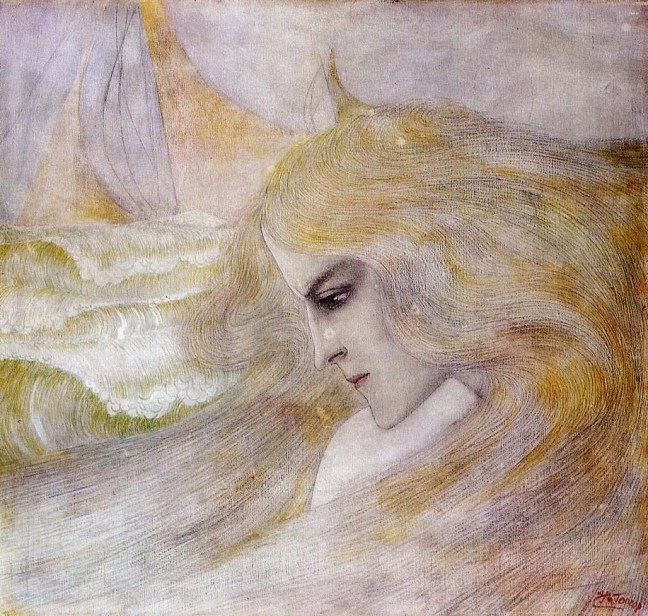
‘Oceanide’ – Jan Toorop, c.1893 – WikiArt

In life, you would never cross a friend or a beloved without smiling at him, giving her a greeting, at least an acknowledgement, or reaching for his hand. That’s the same with your inner being, with that beautiful, friendly presence that is the core of what you are. You’ve got to notice her, to be friendly. It doesn’t take very much, in the middle of your day, to smile at that quiet inner being, to acknowledge that it is here, no matter the hustle and bustle you may go through. It takes no time at all, to see that you are not alone, not a self separate from everything else, not a loner, that you’ve got a friend here for you, that longs to be seen as your very identity and being. After all, how long does a gaze take ? How easy is a passing attention? How little is a momentary taste of your quiet essence, lying just below any of your sufferings or worries, just before your many losses or shortcomings, mixed right within the script of your daily activities and thinking?

Only it is a shy presence, so you have to make the first move. You have to go and look for her in the crowd, amongst the ten thousand things of experience. Once you see him, once you catch his firm gaze, you will come to see only him, only that, at the expense of everything else in experience that now appears to be caught in that same all-pervading gaze. You will see how quickly you come to enjoy your friend after a time. Awareness has a natural eagerness for you. It is inclined to have you in its warm embrace. So you will fancy holding her hand a little longer, won’t be satisfied with a gaze or a smile. You will go for a cuddle, or a long warm hug, to get to taste of his loving presence. You will feel this taste to be more than a crush, or a quick passing relationship. You will feel drawn to stay there, to move in, to have her as the marrow of your self, to bring him so close so there is only him, only her, only that, but no you.

There comes a time when you won’t need to go very far to meet your beloved, for she is everywhere you are. You will notice that every experience you have is pervaded by his presence. So you don’t have to move with her, for you have already been married with this presence for ages upon ages. In fact, it is all you are, and there is none beside it, not even your own illusory self which you have come to believe in, and whose reality you take for granted. Now you begin to see that your beloved is not your beloved, but your very own self and identity. The moment you see that, you will lose him. You will remain alone. You will stop needing, begging, pretending. There won’t be any remembering who you are, because who you are will have been established without a shadow of doubt. You will be yourself the beloved you had previously pushed at a distance, to be sought or realised. You won’t be aggrandised by his or her presence anymore. This inner presence is so much your own self and identity, that you will happily surrender all your multiple identities to that one identity, and acquire the humility that goes with being only one being. There is no beloved but you, no other beloved than you. Let all your many sensations and perceptions melt into that one identity of your being. The taste of being is the pinnacle of experience, and its most refined, sought after savour. You come to taste it when there is here, in yourself, as yourself, only one being, one friend, one beloved, and one taste.

.

~~~

Text by Alain Joly

Painting by Jan Toorop (1858-1928)

~~~

.

Website:
Jan Toorop (Wikipedia)

Suggestion:
Other ‘Ways of Being’ from the blog…

.
The Coveted Jewel

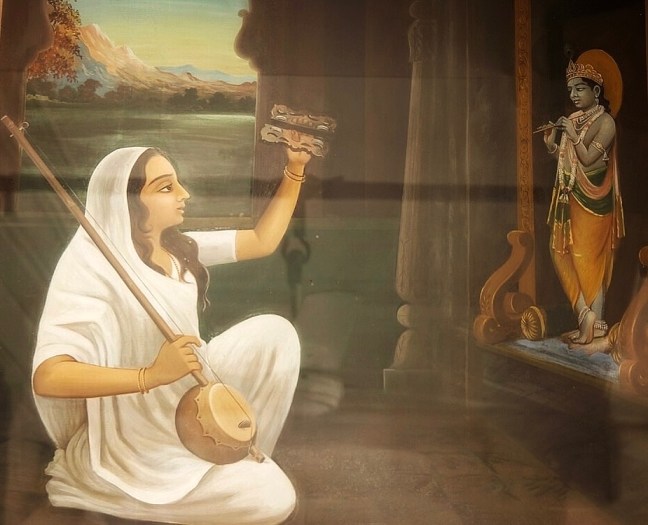
‘Meera and Krishna’ – City Palace Museum, Udaipur – Wikimedia

With god, or with our utmost being, one shouldn’t be too clinical. Presence is better seen, better felt, as our beloved. That’s how you have truth nearer, when you’re in love with it, and want to bring it close, so very close to you. Because its most intimate essence is not at a distance from you, but has merged in you, and as you, from the eternal now, so that you could remember him on all occasions, and feel her, feel him, as the very core of your eternal being. So your beloved is already hugging you, forever holding you in its infinite, most loving embrace. That’s where you draw your unabated search from, for who wouldn’t do anything, anything at all, to seek to reunite with the love of his life. And how could you not cross the most ruthless torrent to marry the intimate essence of her wondrous being. So go through love. Seek her in your tender heart, where she has been aching for your presence. Look for him in your innermost bosom, where only he longs to surrender. And feel the pang of separation, for it is itself the pathway to your beloved.

And there is more to it: love is uncompromising. So you won’t fancy being separated, won’t like finding yourself away from the warmth of your beloved. So your gaze will never wander far and away from your lover’s tender eyes. And you won’t find difficult to spot her even in the wildest display of experiences and activities, where objects come to assail you. You won’t be easily seduced by another than your beloved, for who would want to leave the bliss of a shared love for the chill contained in seeking an outside pleasure, far so far away from your lover’s beating heart. But be careful now, for this love for the beloved is a unique love. Beware! You can never love your loved one as an other. Love is indivisible. The love you feel is always only the expression of your own silent being. So you will have to let your lover go, not because you separate from her, but rather because you merge your being with his being, and in so doing become one being. This one beingness of the lover and the beloved is the truth of eternal love. Love cannot be split in two, and the love you feel for the beloved — for any beloved — doesn’t belong to you. Love is a burning flame that consumes itself into itself. For there is always ever one mind, one love, one being, regardless of the number of apparent lovers. This is what makes love the most coveted jewel of our lives. Because you disappear, and in that disappearing, you find your gorgeous, luminous, infinite self.

.

~~~

Text by Alain Joly

~~~

.

Suggestion:
Other ‘Ways of Being’ from the blog…

.
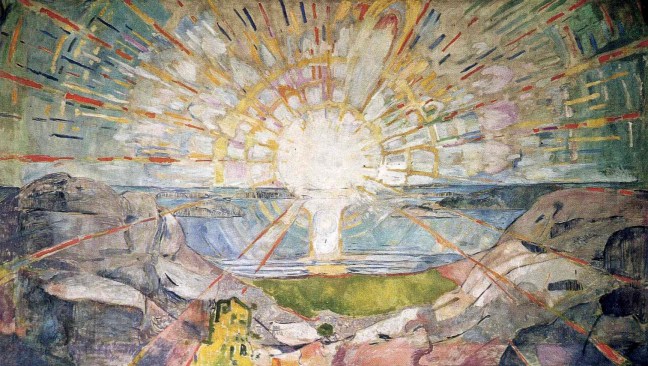
A Light to Yourself

‘The Sun’ – Edvard Munch, 1911-16 – WikiArt

There will come a time when words will slow you down. When you will want to explore yourself on your own, without the help of a book or a teacher, free from explanation or guidance. You will want to follow your own trajectory, to be a grownup, and experience your beloved, impersonal, undivided self by yourself and through yourself. You will want, as Krishnamurti said, to “be a light to yourself“. You will find your own security there, in this light, at the source of your transparency, where you will find no division from where to be insecure. You will find your happiness bubbling from your infinite being, where no self can be located, and therefore no suffering. And you will be under the authority of your own being, that will show you the way, through a door eternally open and inviting. You will be on an eternal visit of yourself. And you will meditate, not to reach who you are, not to get there, but to rejoice in it, and give your whole attention to your beloved — though you already have her, have him, all day, on all occasions, near you, close, so very close to you. And you will feel her love as being so fully yours, that you will need no incentive, no set hours, to be being her own being. And you will see around you, and within you, so much beauty, that you will not have to look for it, other than by being with him, and within him. And you will be in need of no thought, of no TV show, to distract yourself from yourself, for how would you want to be distracted from being so wholly in love with the love of your life? So books will have become a bore to get you there, but you’d still read them as you read poetry. And a teacher will be of no use to you, but you’d still be eager for the company of a friend. And you’d go about your life with confidence, because you’re not alone to deal with it. Rather, your life will have become your being, and your being, your life. And at the same time, you will be alone, self-sufficient, in no need of anything, of anyone, to be fully yourself, to be happy. Therefore, you’d give yourself to all, to everything, you’d be a sharer of being, and a passionate lover of beings, and of things. Yes. That’s it. You’d be a light to yourself. A light to yourself.

.

~~~

Text by Alain Joly

Painting by Edvard Munch (1863-1944)

~~~

.

Websites:
Edvard Munch (Wikipedia)
J. Krishnamurti

Suggestion:
Other ‘Ways of Being’ from the blog…

.

The Great Replacement

You can always add to experience. You can always have more thoughts. Or different ones. More refined ones. Changes can always occur and always will. You can always fall down to the lowest of the lowest, and judge yourself undeserving. And that is more thoughts about yourself. You can always imagine anything. This is endless, all this activity. It will never stop. It will never reveal any truth worth of the name. It will keep going, headlessly, aimlessly, meaninglessly, like an illusion feeding on itself in order to give itself a seeming reality. Go anywhere in your objective experience, be it your feelings, your sensations, your perceptions, your body, the world out there, none of these will bring an inch of the happiness you are desperately running after. This enterprise is doomed to bankruptcy. It will leave you broke, feeble, mortal, prone to regular fits of unhappiness. It will leave you with not a penny of certainty, not a pebble of solidity, and a very little share of that life-giving energy which you are naturally entitled to. So what are we going to do now? We cannot stop thinking, feeling, perceiving, doing. We need a new comer in the picture. A special adviser. A rock of solidity in our changing sea of uncertainty. Who is going to win the game? When we have turned round and around the table for a new name, a new shareholder, another hope, another fake answer, another bout of shaking certainty, then maybe, it might dawn on us that:

The prodigal son is already at home. Everything we need is present within and without, here and there, now and then, enveloping our vey experience with its all pervading knowing. This something cannot be named, cannot be emptied of itself, and will not make the slightest effort for you. It was here all along, ignored, unnoticed, yet having the dimension of a sky, the solidity of a rock, and the certainty of something that was here before the coming of universes beyond universes. It is like discovering in yourself the wisest of gurus present at hand, in all circumstances. It is your eternal refuge waiting for you to come in. But beware now, for that unfailing refuge, that wisest of gurus, that beloved amongst the beloveds, is you. It is you, you understand? Not something to be reached. Not something far and away. You have nowhere to go, nothing to be, no time to wait for, except being your own unfailing, wise, beloved self. You are it all. Here. Now. Whatever. Whenever. Wherever. Release that old, worn out Chief Operating Officer of yours, and replace it with being. Look around now and relax. Being is all there is.

.

~~~

Text and photo by Alain Joly

~~~

.

Other ‘Ways of Being’ from the blog…

.
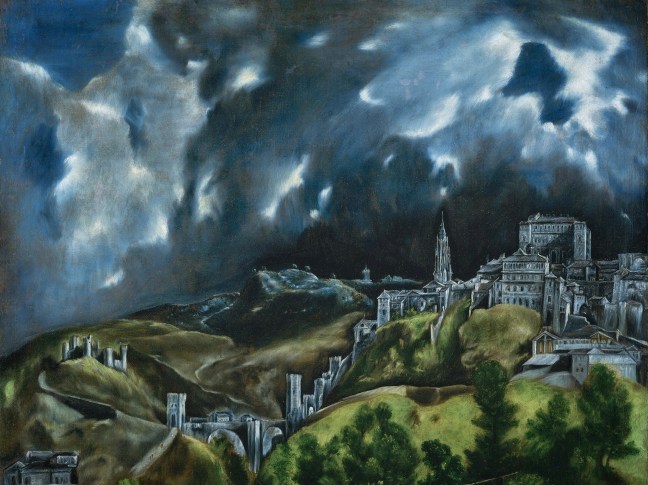
The Mystical Doctor

‘View of Toledo’ – El Greco, 1596 (Metropolitan Museum of Art) – Wikimedia

.During the night of 2 December 1577, in the city of Toledo in central Spain, a priest was imprisoned by a group of Carmelites who were refusing Teresa of Ávila’s reformation projects for their Order. He was jailed for 9 months in a monastery under brutal conditions. He was publicly beaten at least weekly, confined in a cell of barely 10 by 6 feet, with only a little light passing through a hole during the day, with bread and scraps of salt fish for a meal, and no change of clothes. But his burning love of god, along with his unfailing devotion and clarity of mind, allowed the 35 years old friar to compose, along with other shorter poems, the greater part of a sumptuous poem — ‘The Spiritual Canticle’ — about a bride’s search for her beloved. The poem, symbolising the soul seeking union with god, and inspired by the ‘Songs of Songs’ of the Bible, starts with these eloquent lines:.

Where have You hidden Yourself,
And abandoned me in my groaning, O my Beloved?
You have fled like the hart,
Having wounded me.
I ran after You, crying; but You were gone
.”
~ ‘The Spiritual Canticle’

The name of this priest and poet was John of the Cross, a Spanish Catholic mystic born in 1542 near Ávila, to whom we owe some of the brightest exposition of truth in the Christian world. Thomas Merton, who held him in very high esteem, presented him as “one of the greatest as well as the safest mystical theologians God has given to His Church.” John of the Cross was born in a poor family of Jewish converts to Catholicism, and received a simple education. He entered the Carmelite Order, made his First Profession when 21, and met Teresa of Ávila a few years later, of whom he remained a faithful associate all his life. Although not a scholar, his studies in theology and philosophy allowed him to quote abundantly from the Bible, and be acquainted with the work of St. Thomas Aquinas.

Although I have chosen to quote here only from the poem ‘The Spiritual Canticle’, John of the Cross is the author of many other poems, among which the renowned ‘The Dark Night’ — better known as ‘The Dark Night of the Soul’ — and ‘The Ascent of Mount Carmel’. His poems have a rich and powerful imagery and are considered to be masterpieces of Spanish poetry. Although they transpire with beauty and meaning, they are not to be readily understood. This is why John of the Cross wrote precise and extensive commentaries on them, some soaring pieces of teaching whose beauty and profundity is sometimes breathtaking. The most exquisite poetry is here going hand in hand with both a great depth of understanding, and the sweetest accents of devotion. The commentaries were written in prose but are here occasionally presented in a free verse form when they lent themselves to it. I am sharing the 1909 translation made by David Lewis, with corrections by Benedict Zimmerman. Listen with what tender accents of poetry and longing the bride is here conversing with her bridegroom, and how a suffering soul who has tasted of the divine is longing for “the secret chamber of God”, which is nothing but the pure consciousness that is hiding in our innermost being:

.
O you soul, then, most beautiful of creatures,
who so long to know the place where your Beloved is,
that you may seek Him, and be united to Him,
you know now that you are yourself
that very tabernacle where He dwells,
the secret chamber of His retreat where He is hidden.
Rejoice, therefore, and exult, because all your good
and all your hope is so near you as to be within you;
or, to speak more accurately, that you can not be without it.”
~ ‘The Spiritual Canticle’, 1.8 (Commentaries)

[…]

Discover the rich poetry and commentaries of John of the Cross… (READ MORE…)

.

The Dark Night

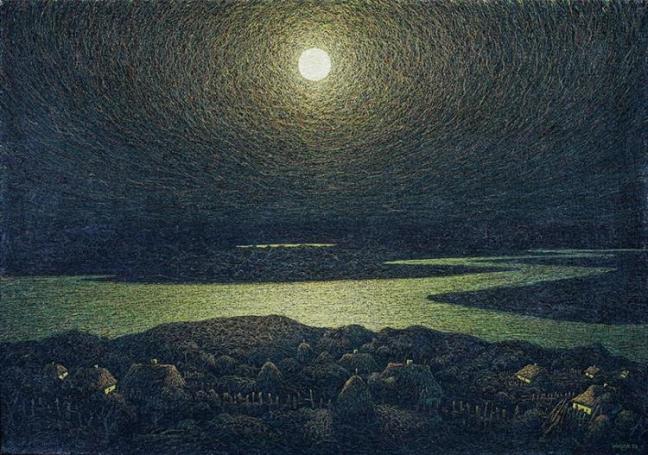
‘Night’ – Ivan Marchuk, 1981 – WikiArt

.

Being human is a complicated gig.
So give that ol’ dark night of the soul a hug.
Howl the eternal yes!

~ Friedrich Nietzsche

.

There is a poem that fed the imagination of many prestigious writers and philosophers like T. S. Eliot, Simone Weil, or Thomas Merton. Many a spiritual seeker has found in it a guiding lamp for the harsh ascent towards divine union. Its name: the ‘Dark Night of the Soul’, a short poem written by the 16th-century Spanish mystic and poet John of the Cross. It refers to the unknowable nature of both the goal and the path, and how such darkness would allow us to merge with the presence of god in ourself. As John of the Cross wrote: “In the dark night of the soul, bright flows the river of God.” I am presenting here the translation by Edgar Allison Peers. Following the poem is a short text that I wrote, words that the poem has evoked in me, the inspiration that it invoked…

.

On a dark night,
Kindled in love with yearnings — oh, happy chance! —
I went forth without being observed,
My house being now at rest.

[…]

.

Read this famous poem by John of the Cross and a few more words… (READ MORE…)

.

The Fountain of Dark Silence

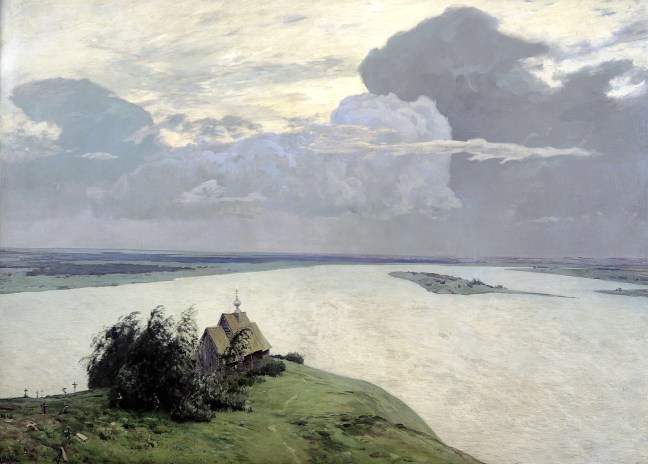
‘Above the eternal tranquility’ – Isaac Levitan, 1894 – WikiArt

.

There is a fountain inside you.
Don’t walk around
with an empty bucket
.”
~ Rumi

.

Dorothy Walters is my newly invited guest on ‘The Dawn Within’. The ‘fountain’ refers here to this deep source at the core of our being, this “fountain of dark silence”, as Dorothy wrote in one of her poems. Dorothy experienced a profound Kundalini awakening in 1981, at the age of 53, which she described as “God moving through your body”, “the Beloved within“, “the goddess above all other goddesses”, or a “relentless agony of ascent”. This was her first expression of the ‘fountain inside’, a fountain of bliss in which she dipped again and again until, as she beautifully expresses in one poem:

“… nothing is left of us
but a fine ash
at the core
and then that, too, melting
to a nothingness,
a no place,
only a marker
where a somebody,
a something
once was.”
(Marrow of Flame)

Profoundly transformed by her experience, Dorothy began writing numerous spontaneous poems which are the direct expressions of the beauty and freshness of this inexhaustible source. They have been gathered in her website “Kundalini Splendor”, and in her numerous books.

Dorothy spent most of her youth as a lover of language and books. She took a PhD in English and American literature and taught both classical and contemporary literature at university. She had a life-long interest in some of the great poets and philosophers like W.B. Yeats, Carl Jung, Joseph Campbell, and later on Rumi, Hafiz, Mirabai and Kabir, which had a deep influence on her poetry. She also helped to found one of the earlier women’s studies programs in the U. S. and directed it for many years. She continues sharing and writing on the subject of Kundalini awakening to this day. After an extended residence in San Francisco, Dorothy now lives and writes in Colorado. I have selected here a few of her poems, which are like the “raw honey of God”. I hope you will enjoy…

~~~

Turn me to gold.”
~ Kabir

~~~

Preparing to Meet the Goddess

Do not think of her
unless you are prepared
to be driven to your limits,
to rush forth from yourself
like a ritual bowl overflowing
with sacramental wine.

Do not summon her image
unless you are ready to be blinded,
to stand in the flash
of a center exploding,
yourself shattering into the landscape,
wavering bits of bark and water.

Do not speak her name
until you have said good-bye
to all your familiar trinkets –
your mirrors, your bracelets,
your childhood adorations –
From now on you are nothing,
a ghost sighing at the window,
a voice singing under water.

(from ‘Unmasking the Rose’)

[…]

Discover more of Dorothy Walter’s beautiful poems… (READ MORE…)

.