‘I Am with You Always’

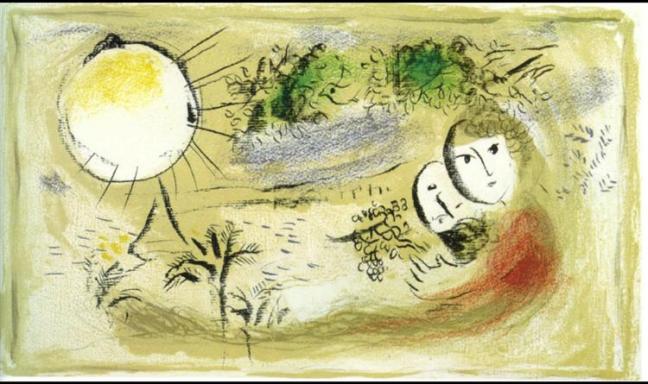
‘The rest’ – Marc Chagall, 1968 – WikiArt

There is no ambiguity with God. This has been said in a thousand different ways, in every corner of every page of the Bible for example, that God is with us, that there is in us, as us, a presence hidden in plain sight, that won’t let go of us ever. That it is the very making of ourself, our sublime identity — what we live our life with and could never depart from. We couldn’t doubt it in the least, for with just the right kind of looking, and with no effort whatsoever, we could see it, feel it, sense it, that we are that, and not truly our body or mind, let alone our thoughts, our story, our problems, our suffering. “I am with you always, to the end of the age”, that’s from ‘Matthew 28:20’. So there is no worry to be had. We are not alone. That’s just an impression, an invention, that we are separate, insecure, fragile. In fact, we couldn’t be without it. In ‘Zephaniah 3:17’, they say “The Lord your God is in your midst”. That’s what they mean, that our mind finds its ground in this very presence, in this being of ours that is in fact borrowed from God’s being. In ‘1 Corinthians 3:16’, they are even more specific, clearer on that subject, “God’s Spirit dwells in you”. It couldn’t be plainer and clearer. Why don’t we listen?

And we profit from an inbuilt, intrinsic protection in our life. After all, haven’t we gone through illnesses and floods, through a thousand aches, and is not death itself called eternal rest? Haven’t we lived in the constant grip of desire and worry, hassled by a quiet, ever going despair? And yet, are we not beautiful now as we are, after having gone through all this? Are we not pristine beings, untouched by it all, made of this unsurpassable, never changing awareness of being? In ‘Isaiah 41:10’, God is reported to have said: “I will strengthen you, I will help you, I will uphold you with my righteous right hand.” And in ‘Zephaniah 3:17’, it is written that God is the “mighty one who will save”. They wouldn’t say that if they don’t mean it. But we won’t be saved in an hypothetical future, at the time of death. We are being saved now, kept virgin of every objective experience, if we are willing to look. Furthermore, there is an inner peace that has landed in and as our very being since time immemorial. This inner peace expresses itself as joy or love, which we have experienced even amongst our ignorance. Isn’t life worth living for these fleeting moments of joy? And isn’t love our most precious, cherished, sought after experience, that seems to be a miracle beyond understanding? In ‘Zephaniah 3:17’, they say, clothed in the most exquisite poetry: “He will rejoice over you with gladness; he will quiet you by his love; he will exult over you with loud singing.”

So, as is advised in ‘1 Chronicles 16:11’, “Seek the Lord and his strength; seek his presence continually!” Which means we ought to stay with that part of ourself that lies peacefully below the hustle and bustle of existence, before everything that can be pointed at and named, and that is therefore not truly ourself. But God is not happy with only being our being, with filling us with its own infinite being. This presence is also made of the gorgeous fabric of love. This is where love finds its reality, in the innocence of our being, in awareness. So if we love, this love is not our own. We have not manufactured it, let alone directed it. “We love because he first loved us”, it is said in ‘1 John 4:19’. This is what our being feels like, when it is kept pure, unsoiled by our attachment to experience. Love is what we feel when we have relinquished everything in ourself that is mistakingly taken to be us, but is not. In ‘1 John 4:19’, we are being reminded of this eternal truth, that “God is love, and whoever abides in love abides in God, and God abides in him.” And this love, this being of God, is not something that can be had. It lives and breathes only through our being it. The world of things, of objectivity, cannot apprehend it, “cannot receive, because it neither sees him nor knows him”, as is said in ‘John 14:17’. So we are it, not have it, not know it. As long as we believe to be an entity, a something, a someone, we have separated ourself from our reality as God or consciousness. Yet everything, everyone, is eternally made of this being, which is God’s being, and finds its identity and essence as that. After all, didn’t God make that very clear, when saying in ‘Jeremiah 23:24’, “Do I not fill heaven and earth?” To which God could have added: I am all beings and all things, their secret identity, their essence which is only spirit. As I have said and proved a zillion times: ‘I am with you always’.

.

~~~

Quotes taken from the Bible

Text by Alain Joly

Painting by Marc Chagall (1887-1985)

~~~

.

Website:
Marc Chagall (Wikipedia)

Suggestion:
– Other ‘Shreds of Infinity’ from the blog…

.
Four Variations on Love

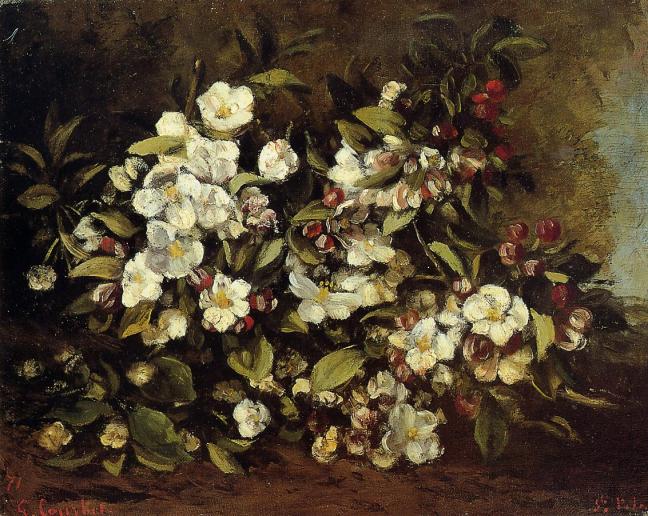
‘Branch of apple blossoms’ – Gustave Courbet, 1871 – WikiArt

.

God is love, and he who dwells in love
dwells in God and God in him.”
~ The Bible (1 John, 4:16)

.

I have been reading Meister Eckhart’s sermon n°5 lately, in the translation by Clare de B. Evans, from an old publication named simply ‘Meister Eckhart’. It’s a sermon dedicated to love and its many aspects. At the very beginning, Meister Eckhart sums up the nature of love in four magistral sentences that had a deep effect on me. So I decided to write down some of my take and understanding on each of these quotes by the Meister and present them to you. I hope they will be of interest…

.

‘God is love’. That is so, inasmuch as all that can love,
all that does love, he compels by his love to love him.”
~ Meister Eckhart

It is greatly convincing to think that we can love someone or something. That there is something inside us, a quality or emotion, that can spring out of our mind and body and direct itself towards an object, a someone loved, a something loved, and that this love is a personal affair. Well now the question arises: What is it in us that can love, and what is this other that is loved? Notice first that there is nothing in you that can love but love itself. Our mind is in no capacity to love. Rather love happens, shows up naturally, when our mind is set aside for a while — for our thoughts, most of our thoughts, have the power to defeat love, to render it unfelt, dormant, as if inexistent. So if you love anything, anyone, it is not because of him, or her, or it. It is because you have been freed from yourself as a private, separate self or mind, and that in this freedom, love can arise, unfettered, can stretch its dormant limbs, and shine in all directions. After all, have you ever been in love with someone without at the same time loving everyone, everything, around that one? Love is an awakening, an opening. And in that opening, in that crack, reality shows its profound nature. Love is the profound, intimate nature of everything. So when you love someone, there is nothing there, and nobody, no other, that can be loved, except the essence that this one is. Therefore you can only ever love the essence. And you could not love the essence of anything if you were not yourself the essence of everything. That’s how you are compelled, when you love anything, to love god first, which is the essence of both the lover and the loved.

[…]

More reflections on some Meister Eckhart’s statements about love… (READ MORE…)

.

A Course in Abandonment

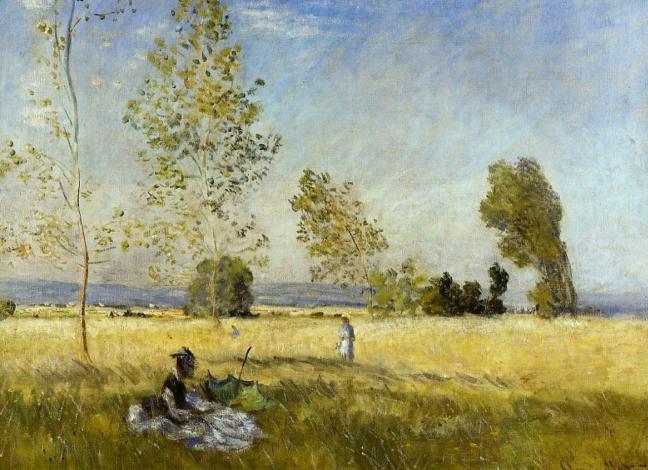
‘Meadow at Bezons’ – Claude Monet, 1874 – WikiArt

.

You only have to receive everything and let it happen.
Everything is directing you, straightening you out, carrying you.
Everything is a banner, a litter, a comfortable vehicle.
Everything is God’s hand; everything is God’s earth, air and water
.”
~ ‘Abandonment to Divine Providence’ (Muggeridge)

.

Truth is its own advocate. No matter where or when or in what obscure circumstances an expression of truth has been composed, it will find its way out into the light. This is what happened to a small book allegedly written by the French Jesuit priest Jean-Pierre de Caussade (1675-1751). Written in the first half of the eighteenth century, it remained unpublished until 1861, before being praised for its quality and lyricism, and appeared in multiple editions over time. It is known by the title ‘Abandonment to Divine Providence’. Jean-Pierre de Caussade was the author of many letters of spiritual instruction, and some of them appear in his book along with a treatise in self-abandonment. This latter text particularly ignited attention and was in style and quality so far removed from the other ‘letters’ that it became apparent that the author could not have written it.

[…]

Discover this eighteenth century treatise on abandonment… (READ MORE…)

.

The Beatitudes

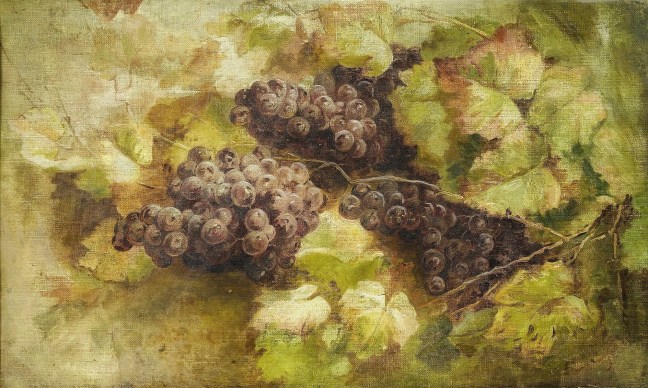
‘Still Life with grapes’ – Giovanni Segantini, 1899 – Wikimedia

.

The Beatitudes is the name given to eight blessings that Jesus pronounced at the beginning of his ‘Sermon to the Mount’ in the Gospel of Matthew (5:3-10). Each of these blessings begins with the Latin word ‘beātī’ (from ‘beātus’ meaning ‘happy’, ‘wealthy’), translated here as ‘blessed’. They are short and bold little sayings that I have come across lately, eight ways to be blessed, eight blessings on the path to our true being, each the recipient of some profound meaning which I have endeavoured to develop here. I hope you enjoy the reading…

Seeing the multitudes, he went up onto the mountain. When he had sat down, his disciples came to him. He opened his mouth and taught them, saying,
~ Matthew, 5:1-2 (World English Bible)

.

Blessed are the poor in spirit,
for theirs is the kingdom of heaven
.”
~ Matthew, 5:3

You’ve got to be empty. Not to indulge in your thoughts, feelings, and experiences, making them the owners of your kingdom. You’ve got to be empty. To not be seduced by every passing colours. To stop being a possessor, forever looking for what could enrich you. You’ve got to be empty. To not be involved, endlessly busying yourself with everything you have gathered to exist, looking in them for an identity. You’ve got to be empty, to stay away, to keep alone. To be the one disinterested, self-sufficient, which means finding peace in the essential of what you are. That essential is ‘being’. Simply being, devoid of anything that this being could be, or have, or think, or feel. Then this being will enrich you in its austerity, it will clothe you in nakedness, it will fill you in emptiness. Being is all you will ever own, for the simple reason that it is all you are. Nothing else is but being. This is the only asceticism worth living. Be blessed with that inner poverty.

[…]

My reading on Jesus’ eight blessings from the Beatitudes… (READ MORE…)

.

The Heart Sutra

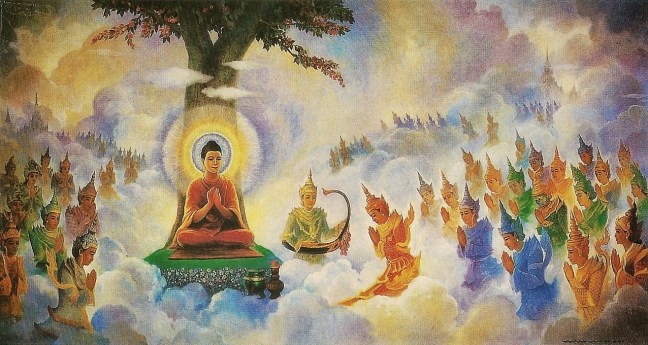
‘Buddha preaching Abhidhamma in Tavatimsa’ – Wikimedia Commons

.

प्रज्ञापारमिताहृदय

心經

བཅོམ་ལྡན་འདས་མ་ཤེས་རབ་ཀྱི་ཕ་རོལ་ཏུ་ཕྱིན་པའི་སྙིང་པོ

.

There is a text that came from the dawn of ages, whose author is unknown, but which has been widely accepted, practised, and chanted in Mahāyāna Buddhism as a condensed exposé of the teaching of Buddha. Although known and praised as the ‘Heart Sutra’, its original Sanskrit name translates as ‘The Heart of the Perfection of Wisdom’. If the Sutra’s main teaching asserts that all phenomena is ‘Śūnyatā’, a term widely translated as emptiness, its wide implications extend to many other aspects in the understanding of our true nature. Originally translated in Chinese by a 9th century Buddhist monk called Prajñā, the text exists in a shorter and longer version. I am sharing here the standard long version that provides an elegant and story-like context to the main teaching. I have also chosen to give to the many Sanskrit terms their original meaning or context. Following the Sutra is a short text that I wrote, some words that the text has evoked in me. I hope that this presentation will give justice to the profundity of this text, and that you will enjoy the reading.

~

Form is emptiness, emptiness is form.”
~ The Heart Sutra

[…]

Discover this milestone of Buddhist literature: the ‘Heart Sutra’… (READ MORE…)

.

The Way of Love

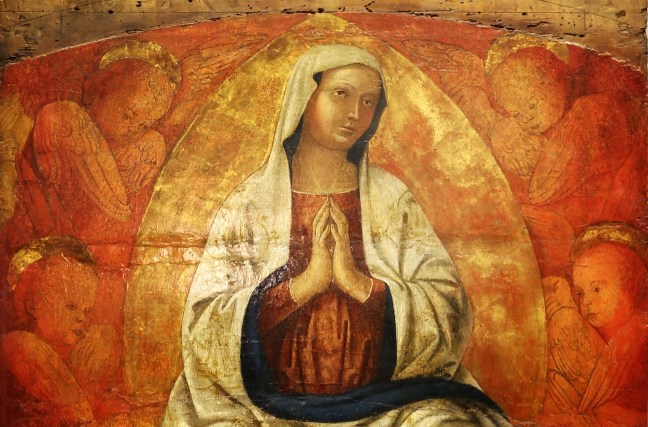
‘Madonna in Gloria’ (part) – Antoniazzo Romano – WikiArt

One of the oldest and most beautiful poem about love is found in the New Testament. This is a very human and touching piece, for both its modernity and universality. It was co-written 2000 years ago by Sosthenes and Paul. Paul, born Saul of Tarsus (5 – 64/65 AD), was one of Jesus’ apostles, who disseminated his teachings and founded some of the first Christian communities in Asia Minor and Europe. The poem is excerpted from the book ‘1 Corinthians 13’, and is presented here in the ‘World English Bible’ translation. This soaring piece presents all the qualities found in love. Some of its verses became famous over the years. The quote “Through a glass darkly”, (not appearing in this translation) inspired the title of a film by Ingmar Bergman and many other artworks in fields as diverse as poetry, plays, novels, songs, essays or television series. Many other verses of the poems were also quoted in similar works. Behind its apparent simplicity, I find the poem to have a profound meaning that confers it the quality of a prayer. I hope you will enjoy

.

If I speak with the languages of men and of angels,
but don’t have love, I have become
sounding brass, or a clanging cymbal.

If I have the gift of prophecy, and know
all mysteries and all knowledge;
and if I have all faith, so as to remove mountains,
but don’t have love, I am nothing.

If I dole out all my goods to feed the poor,
and if I give my body to be burned,
but don’t have love, it profits me nothing.

Love is patient and is kind; love doesn’t envy.
Love doesn’t brag, is not proud,
doesn’t behave itself inappropriately,
doesn’t seek its own way, is not provoked,
takes no account of evil; doesn’t rejoice in
unrighteousness, but rejoices with the truth;
bears all things, believes all things,
hopes all things, endures all things.
Love never fails.

But where there are prophecies,
they will be done away with.
Where there are various languages,
they will cease.
Where there is knowledge,
it will be done away with.

For we know in part, and we prophesy in part;
but when that which is complete has come,
then that which is partial will be done away with.

When I was a child, I spoke as a child,
I felt as a child, I thought as a child.
Now that I have become an adult,
I have put away childish things.

For now we see in a mirror, dimly, [through a glass darkly]
but then face to face.
Now I know in part,
but then I will know fully,
even as I was also fully known.

But now faith, hope,
and love remain — these three.
The greatest of these is love.

~ 1 Corinthians 13:1-13 (World English Bible)

.

~~~

Poem by Sosthenes and Paul the Apostle (1st century AD)

Painting by Antoniazzo Romano (1430-1510)

~~~

.

Websites:
1 Corinthians 13 (Wikipedia)
Paul the Apostle (Wikipedia)
Bible Gateway
Antoniazzo Romano (Wikipedia)

.

The Dark Night

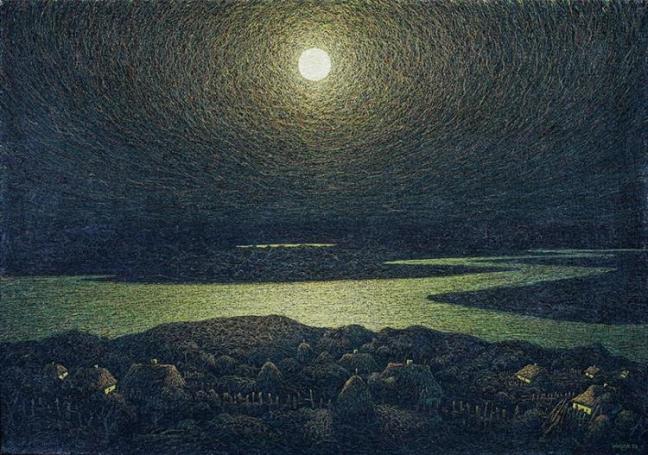
‘Night’ – Ivan Marchuk, 1981 – WikiArt

.

Being human is a complicated gig.
So give that ol’ dark night of the soul a hug.
Howl the eternal yes!

~ Friedrich Nietzsche

.

There is a poem that fed the imagination of many prestigious writers and philosophers like T. S. Eliot, Simone Weil, or Thomas Merton. Many a spiritual seeker has found in it a guiding lamp for the harsh ascent towards divine union. Its name: the ‘Dark Night of the Soul’, a short poem written by the 16th-century Spanish mystic and poet John of the Cross. It refers to the unknowable nature of both the goal and the path, and how such darkness would allow us to merge with the presence of god in ourself. As John of the Cross wrote: “In the dark night of the soul, bright flows the river of God.” I am presenting here the translation by Edgar Allison Peers. Following the poem is a short text that I wrote, words that the poem has evoked in me, the inspiration that it invoked…

.

On a dark night,
Kindled in love with yearnings — oh, happy chance! —
I went forth without being observed,
My house being now at rest.

[…]

.

Read this famous poem by John of the Cross and a few more words… (READ MORE…)

.