Lectio Divina

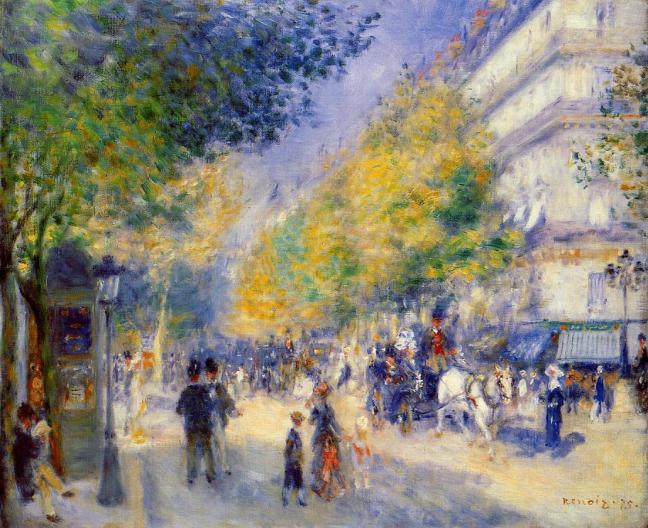
‘The Great Boulevards’ – Pierre-Auguste Renoir, 1875 – WikiArt

I have been feasting on some words recently. I was sitting leisurely on a cafe’s terrace, watching life coming and going, browsing through my phone with some ideas in mind. And there it came, and took me by surprise, like a koan suddenly unveiled, a pathway revealed without my knowing. There it came, taking the form of one single, simple phrase that seemed innocuous, by Saint Augustine:

Is any man skilful enough to have fashioned himself?
~ Augustine of Hippo

And that emptied my mind. It made me sink into no content, aware of all that is now; my self suddenly made a container for life. We all feel that we are so smart and powerful, or so stupid and powerless. That we have made ourselves what we are, and feel in consequence the pride or shame of it. That we have destroyed, or elevated ourselves. That we are responsible for our happiness, our success, our failure. That we have moulded our thoughts and actions, wilfully designed them. That our beliefs are believed. Our thoughts thought. Our words uttered by a ‘somebody’ here, inside the skull. But these are all beliefs, and beliefs are flawed from the start. Beliefs need a believer to believe them, and look as you may, you will never find such one behind your deeds. For the simple reason that there is no self behind our selfing. We have therefore never been in charge, never been truly responsible for collecting what we have collected, for misusing what we have misused, and for making the mistakes that we have made. Except in hindsight, in thoughts and beliefs, in cascades of randomly built illusions and memories in which we are caught and made blind. And these are what we have busied ourselves managing and arranging into a sensible self. And that self has gotten in the way of our living harmoniously.

[…]

The ‘Lectio Divina’ of a quote by Augustine of Hippo… (READ MORE…)

.

peace (noun)

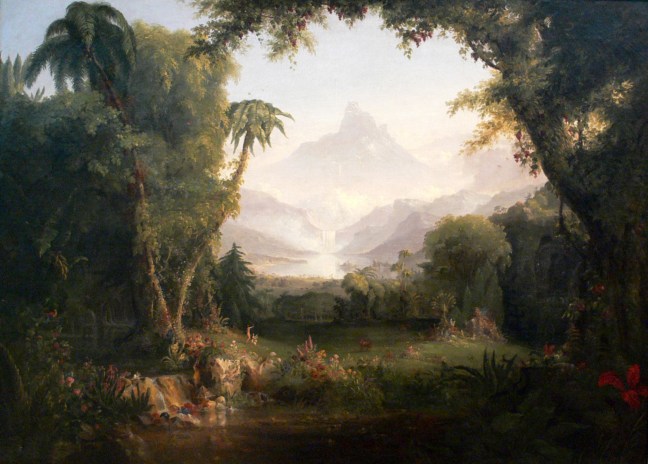
‘The Garden of Eden’ – Thomas Cole, 1828 – WikiArt

It is always revealing to reflect upon a certain word in the context of spirituality, and see how it came to appear and be chosen. Why this one and not another word. There are many synonyms to the word ‘peace’, amongst which tranquillity, calmness, or quietness, which all seem better suitable to an entity or an object than peace. Peace is profound. It stands on its own. Just its pronouncing deepens you, fills you with its referent. ‘Peace’. The word takes you somewhere else, makes you leave your habitual field of suffering, desiring, projecting, coping, aiming, all that renders life a battlefield. ‘Peace’. Peace is a mantra in itself. A prayer. An occasion to go within. It has the automaticity of something fundamental, inescapable, and the simplicity of something that everybody knows or has experienced.

The word ‘peace’ comes from the mid-12th century root ‘pes’, meaning ‘freedom from civil disorder’ or ‘absence of war’. Likewise, in the dictionary, the first meaning for peace is stated as ‘freedom from disturbance’. Peace is always negative. It is here when something else has receded or died down. It is revealed through an absence. After all, in common parlance, the word ‘peace’ has always been used to refer to the state of things that exists in the absence of conflict or disorder. The word was almost invented to refer to this moment when a war ends and one can return to the state of affairs that existed before the conflict started. It is never a new state or occurrence. It is what is usually here in the background and is disrupted by the incursion of movement, conflict, war, thought. The tiniest thing, as long as you believe it to be you, will disrupt your peace. Peace is a return. A recognition of something known but forgotten for a time, or rather eclipsed by the incursion of time. Peace is something that is always here in the background, waiting patiently for your return. Our mind as ego is the disruptive factor, the war in which we have decided to engage, and found ourselves caught and lost. Make it end and peace will come automatically. It is not a new state invented, but the pre-existing state of your deepest self as being, which only a quietening of your wrestling with the objective world will make apparent. Peace is the very foundation of your self. It is the cornerstone of the edifice of life, as is easily seen in nature, which seems to have peace as its very fabric.

[…]

An exploration of the meanings behind the word ‘peace’… (READ MORE…)

.

Where Eternity Hides

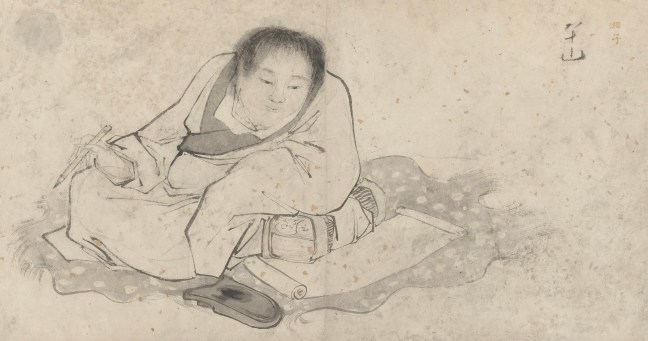
‘Daoist immortal Han Xiangzi’ – Zhang Lu, early 16th century – Wikimedia

I think that our search for the ultimate could find some relief in giving attention to what is small, unnoticed, humble. All the things unremarkable, unassuming, that we pass in life without a glance. You know these moments when we sit down doing nothing. All these things easy, like resting, breathing, eating, sleeping, that can be achieved without our forceful participation. These moments or actions are closer to god than we may think. They live in a grey area where they flirt with the non-objective and slip out of our attention to hide in the sublime, to rest in the blissful, unattached, forgotten. Their presence is made absence, like for the space between two thoughts. But don’t let them leave you. Strive to own them. This is where eternity hides. This is why presence is so much emphasised in spiritual matters; why, in Zen practice, students are encouraged to take pride in habitual, so-called boring or unimportant activities like washing dishes, serving tea, or chopping wood. Forget all your achievements of glory. Put aside your pointed quest for the sublime. Your selfish ride towards the selfless. Go for the minute, the nanoscopic. Take interest in the small and the ordinary. Have a passion for the shallow, like the sacred lotus does.

After all, god has made beauty the most accessible thing there is. And love is so close and intimate that it has been described to be nothing but our very self or being, our natural if forgotten identity. Presence is the most unassuming thing there is, almost as to be nothing. Happiness never comes when invited or provoked, and real beauty has never been seen showing off. But don’t be deceived here. Unassuming doesn’t mean not assuming. And what appears to be nothing can be revealed as the most blatant ‘something’ there is. All spiritual endeavour really boils down to seeing the unseen, and experiencing the non-objective. Your sense of simply being is the most shy presence you will ever encounter in your life, and yet you will find nothing more attractive than its discreet and humble presence. There is glory in simply being, without going for qualities, qualifications, objects, pretence. Silence is louder than noise, and truth more clamorous than any lie can be.

All that religions and spiritual traditions ever do is to proclaim this presence that is already here amongst us, as our very being, and to point towards all that is hiding it from our gaze. Simple-minded by nature, the mind has chosen to ignore it, entrenched as it is in all things objective. It has deemed it insignificant. But the so-called insignificant is simply where the mind cannot go, which is literally everywhere except in objective experience. That leaves for quite a wide field in the unknown, in the hidden, discarded as being too unremarkable to be made a conscious thing. This misjudgment is our mistake. This is our sin. For god is hiding in the small and the insignificant, in everything unremarkable to the mind. But it is not on account of its small size or nature that this presence is unreachable to the mind, but rather that the mind, as the belief in being a separate self, has taken all the place and hides the infinite from our eyes. Just as time, as an idea born of the mind, has taken all the place and veils eternity. This is the extent of the mind’s indulgence. But its conscious retiring or humbling will reveal the sheer glory of all that was left in the hidden. And in doing so will lift the veil on the real nature of our self. God’s being revealed.

.

~~~

Text by Alain Joly

Painting by Zhang Lu (1464–1538)

~~~

.

Website:
Zhang Lu (Wikipedia)

.

Other ‘Reveries’ from the blog…

.

Meditation Time

Okay. Now find a good place for yourself and sit down comfortably. Close your eyes. You are about to engage in your daily meditation. But don’t meditate today. For meditation was never meant to be an activity that a self performs. It never was for the person. Meditation is a space of supreme humility in which you notice your own redundancy as a self. It is the natural and unequivocal place of being in which no meditator is necessary, or even wanted. Your presence as a self will prevent it. It will sabotage your meditation. And this beautiful, selfless presence that you are will retreat in the background, unable to truly flower, crushed by the pretence contained in your wilful act of meditating. There is nothing to attain in this moment. Nothing to achieve. So forget about being a meditator.

Don’t meditate today. Why should you? Let your own presence reveal itself to you. Let it gently notice itself, rather than you striving to notice it. You are already a master of presence, so why should you be meditating? Be contented with only being as you are. That will suffice. See that the meditator in you has now shrunk to the size of a little voice erring purposelessly in the infinite space of your presence. Feel that you are but a dead, brittle leaf falling to the ground of your true being, pushed by the winds of understanding, attracted by the inescapable laws of truth. Notice that your meditation has no need for a meditator. See that your natural self as being doesn’t even comprehend the necessity of meditation. To meditate literally means to ‘contemplate’, ‘measure’, ‘assess’ [what is already here]. This is the ultimate meaning hidden behind that word.

So don’t meditate today. Why should you? Who told you so? Be the one that is beyond the possibility of meditation. Be seated in your unreserved, natural self, where you are already bathing under the sun of your own being. And should you feel an emotion, be reminded that it is but a brisk shower of rain falling in the wide expanse of your nature. And should you feel the limits of your body and sense perceptions, be reminded that they are but a wild and beautiful land appearing in your infinite self, that awaits your ploughing, and seeks your nurturing. Meditation is that space of being which you are of all eternity. It will never leave you, nor can it do so. This ultimate, eternal being is the warm bath of your self, already achieved, and in no need to be practiced. And the meditator has been irrevocably absorbed in it, diluted in this small death.

.

~~~

Text and photo by Alain Joly

~~~

.

Suggestion:
– Other ‘Reveries’ from the blog…

.

The Perpetual Retreat

I don’t know if you have ever been to a deep, meaningful spiritual retreat. And have found it ending, feeling yourself thrown out, returned into the common world of strife and wilderness, the cacophony of it all, trains, airports, and finally the habitual streets of your life. That moment is when you have to be a little watchful. For nothing has ended really. The peace experienced in your retreating into the heart of your true self is your real deal. And these peaceful days were placed here to remind it to you, to bring back this good old memory to yourself. So don’t crush it right away on the pretence that you are now back to your pseudo life of normality, where it is expected that you will be assailed by visions of separation, and returned to your good old suffering self. Please don’t do that. Know better. No retreat has ever ended except in your own imagination. You are now an attendee placed at day one of another beautiful and challenging retreat that starts afresh, loaded with promises, and ready to invite you in its grip. That grip is the feeling of being in yourself, which you can retreat to at any time, in any place, and anyhow. This is the ticket for entering your perpetual retreat. The longest and cheapest retreat you have ever been invited to. And you are being the glorious participant of it. That lucky one. — And there is more to it. You will be upgraded. You will become your own teacher, the teacher of your never ending retreat, always available, in all circumstances. For your sweet being hasn’t suddenly retreated at the end of the week. It is here. It is now. Continually present. Faithful to all dimensions of life, including the most apparently unconducive ones. He will guide you all along, if you’re willing to listen to her, and receive its presence at the heart of your self. Being is your infatigable teacher. Being is the new place for your retreat. It is the time for its sacred attendance. And it is placed at the perpetual height of your self. Keep going there. Make your life into a perpetual retreat, where you are at once the teacher, the participant, and the staff of that beautiful event that your life is, and in the exquisite venue that the world is.

.

~~~

Text and photo by Alain Joly

~~~

.

Suggestion:
– Other ‘Ways of Being’ from the blog…

.

The Ultimate Absolution

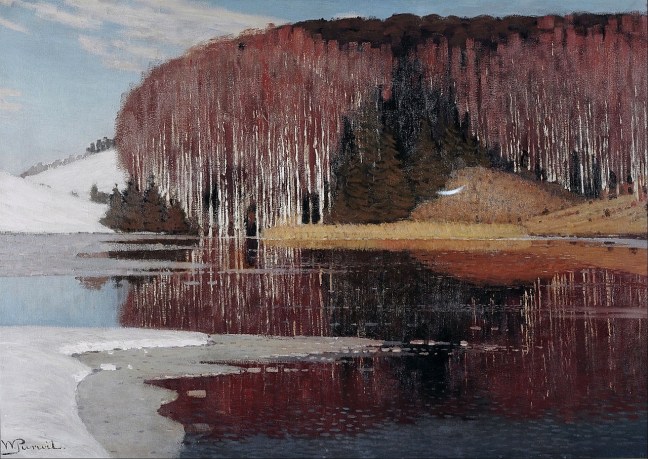
‘Spring Waters’ – Vilhelms Purvitis, 1910 – WikiArt

Isn’t it wonderful to discover that you cannot be destroyed? No matter the magnitude of your heartbreaks. No matter the betrayals and the dishonesties — all that is unforgivable in others or in yourself. No matter the untold suffering inflicted to your body or to your self. Isn’t it a blessing to notice that you cannot be broken no matter what? You can believe to be broken, sullied, doomed and punished for your sins. But in reality you are not and cannot be. You are as beautiful as you ever wished to be. Worse even. No quantity of imagination, no originality of a mind will ever prepare you to comprehend the pure and unsullied nature of your self, which equals to nothing but the beauty of your heart.

The only thing that can ever be hurt or sullied is a thought or a belief. You will be hurt in proportion to the extent of your identifications. The greater your illusion, and the sharper will be the pain when it is challenged, or diminished, or trampled. A belief is a living thing. It is not just a dead abstraction that can be easily ignored or overcome. A belief is as alive and sensitive as a self can be. We are made of that belief, we have clothed ourself with it and have become vulnerable to all that can undermine it. That’s how you become a sufferer. That’s how you can imagine to be sullied, diminished, destroyed. It is all contained in one single belief about yourself. And it can be released in one single act of contemplation: Seeing yourself as you are, and not as you imagine yourself to be.

[…]

An exploration into the true nature of forgiveness… (READ MORE…)

.

‘Consummatum Est’

‘Consummatum Est’ – Jean-Léon Gérôme, 1867 – Wikimedia

I happened to visit a church recently, and was intrigued by one single sentence placed just under the main crucifix, which read in French as: “Tout est consommé”. I had never heard this particular formulation before. These words appear in the Gospel of John (19:30), and have been translated into “It is finished” in modern English. These are the very last words uttered by Jesus on the cross before he relinquished his bodily existence, and was resurrected as pure being. In Latin, it runs as “Consummatum Est’.

Consummatum Est

All is consummated, which means all is finished, accomplished, brought to completion. It means we are wholly with the ‘highest’, nothing is left that lingers in separation. All that is other than god, other than the very presence or being that we are, has been consummated, put into the fire of consciousness, eaten, devoured, transformed into its very essence. The truth of it has been exposed, and the objects — all that seems to have its proper existence — have been revealed to be of one single essence. The ten thousand things have been digested, transformed into the truth of their being. They have been revealed as the One. The illusion of multiple existence has been seen for what it is: one being giving no room for an other. Anything that stood as separate or ‘other’, has been consummated into the fire of emptiness. Not a barren emptiness, but a living one, a fertile emptiness, teeming with possibilities, with creativity. Everything that was objective has been devoured into supreme subjectivity, which is nothing but the feeling of being, in which all existing things have found their home, have dissolved their separate identities, have bargained their many names for the Nameless. The many have been revealed as being one. Therefore whole, complete, in need of no ‘other’, or ‘better’, or ‘more’. The many shadows of obscurity or illusion have returned into the light of their essential being. They have disappeared, have relinquished their illusory separateness, incompleteness, or ignorance to return into the truth of their ultimate being as oneness, fullness, or understanding. The shadow of existence always shows up as many. But the pure light of being is revealed as one. This is an end, a finish line, because there is no more to be revealed, no more to be added, understood, analysed, enquired. This is a natural completion, a form of creative death, which means the realisation of the very nature of death as the living aliveness of pure being. It is whole, therefore unattached, innocent, incapable of being sullied or diminished, immune to death, and open to the infinite. Finally, you come to the understanding that this consumption is the sublime alchemical process, the transfiguration through which suffering is metamorphosed into peace, separation into oneness, and death into eternal life. This is the realisation, awakening, or resurrection of our true essence that was buried under, or veiled by, our illusory sense of self and the constant toil of life in the forms of suffering and death. In other words, you have been crucified on the altar of ultimate being. ‘Consummatum Est’.

.

~~~

Text by Alain Joly

Painting by Jean-Léon Gérôme (1824-1904)

~~~

.

Websites:
Jean-Léon Gérôme (Wikipedia)
‘Consummatum Est’ – Painting (Wikipedia)

Suggestion:
Other ‘Ways of Being’ from the blog…

.