The Adventure of Thought

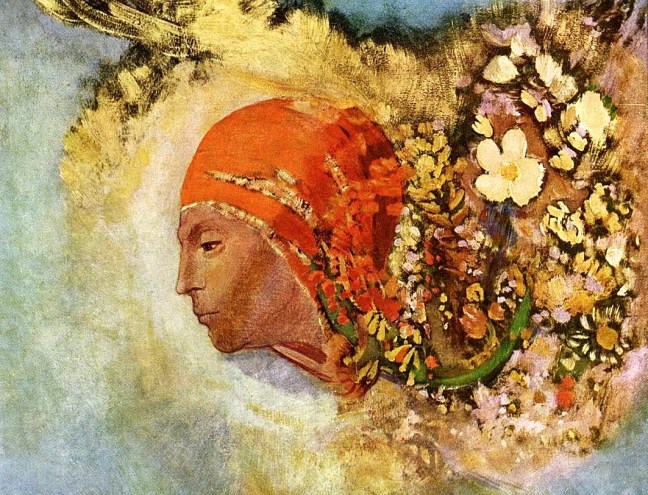
‘Head with Flowers’ (part) – Odilon Redon, 1907 – WikiArt

Thoughts are a strange thing. For they seem to be both indelibly ours and strangers passing in our sky. We have an ambivalent relationship to them. Sometimes they are part of us like a lover can be, so intricately woven to our being that they seem to have been sculpted out of our very essence. On other occasions, we see them from afar, unwanted, a despicable thing that we judge unworthy — thieves that have come to set us on a wrong course, rendering us unrecognisable to ourself. We have a love-hate relationship to our thoughts. We love the ones we judge to be good and worship them, befriend them, glorify them, and hate the ones that come to upset us, the bad ones that we refuse to endorse, or have a responsibility for. The ones that we leave scared and alone, ready to multiply and threaten our very being. They are like the obeying soldiers of our wounded self, the dark agents of our fears and of our rancour.

Thoughts end up being prey to our likes and dislikes, treated like objects are, judged as being often disloyal, incompetent, insufficient. We seem to be separated from them, to have little to do with them. But thoughts have been supremely important to us. In a way, they have created us, through our identifying with them. They have formed the limits of our self as a separate entity. In fact, thoughts are thinking us. We are the prey to their conditioned making, and are at the mercy of their limited expression. So we are most of the time reduced to being ourself a thought, a thought thinking itself out, and believing that it is representing nothing less but what we are at the core. Yet we are truly far from the mark. Thoughts have deluded us, have drifted from their being a simple tool to stealing our very identity by faking the appearance of a self separated from its thoughts, when that self is in fact just a magnified, engrossed, elaborated thought that bears no resemblance to what we truly are. Thoughts thrive on confusion, they flourish and fatten on the prosperous soil of ignorance.

But try to go beyond thoughts, to pass them by, to ignore them as being unimportant and move on, deeper, towards the very centre of your self. Notice the sense of being that is here before them, and that hosts them in last analysis. Touch the silence behind thought. Embrace who you are before you associate with things. Go to the place where no identification is possible, where you are free from conceptualisation, where thoughts have become unrelated to yourself, lost entities that have no relationship whatsoever to your truest being. You will begin to disconnect thoughts from yourself, to render them innocuous, and stop looking to them for your security or identity. You will discover a way of living where thoughts are scarce and rarify. You will have no room for thoughts. You will have disencumbered yourself, and will stop being blind to what is. For you will notice that your being extends to all possible things, and all times and places. It is a presence so unified that thoughts are being gradually expelled from your deepest being by losing their unifying justification. They become redundant to your self. They become what they should never have ceased being: a wonderful tool at the service of unity, a practical thing that is but the expression of the one. You will have stripped them of their being an impostor. That’s how you stop being a thought. Because you don’t need one to be yourself.

.

~~~

Text by Alain Joly

Painting by Odilon Redon (1840-1916)

~~~

.

Website:
Odilon Redon (Wikipedia)

Suggestion:
– Other ‘Reveries’ from the blog…

.

The Greatest Trick

In fact, the understanding of our true nature is the simplest thing on earth. We have to, repeatedly, not be doing anything. The problem is: we cannot help but doing something, hoping something, trying something, anything, to get us where we think we should be. Where we are is never enough; never somewhere we should go to. What we are is not satisfying; we have to attain something that is better, no matter what. Even being, we think that we have to be being it — as if we were not already being. In all analysis, there is in fact such a thing as ‘nothing to do’ in spirituality, but only at the point when we are already not doing anything. If we are doing something, well, then we are doing something. This doing is an expression of our belief in not being ‘there’ yet, in our incompleteness, in our striving to get somewhere, to be someone. Then we have de facto missed all possibility of realisation: for we are already established in doing, in efforting. At this point, it is too late to not be doing anything. We need to revise our judgement.

We have been overtrained in doing. Maybe this doing is in fact what we have become — the essence of our self as a seemingly separate entity. We are born the moment we have the impulse of doing something, of being a doer, a knower. This is our original mistake, what we should never have been doing. We think we have to be somebody; to be nobody is a curse, a shame, an emptiness that we have to fill at all cost, even at the cost of losing ourself. So there is comfort in being a self, a somebody, in achieving something, in doing anything at all. The fact that we should be suffering for it, and be limited by it, well that’s the nature of existence, are we told. We are willing to pay that price for doing something, for being somebody. So let me do. Let me be. That’s how to feel ‘I am’ for now. That’s the story which was handed down to us. That’s how we have been regimented by society. And we have by now rehearsed it long enough, to perfection. We think that we’re not doing it when the doing has already been achieved. We are in fact implementing doing all the time while believing we are not doing it. This is the greatest trick that was ever performed on us.

[…]

A playful reflection into the question of the doer… (READ MORE…)

.

The Falling of a Feather

The most extraordinary thing about this understanding is that nothing needs to perish inside you in order to access your essential being. Not a supposed self that might be getting in the way of your realisation. Not some kind of entity that you painstakingly have to dismantle before you can access the truth of your being. There is nothing to dismantle. Not a single little thing. That apparent, undesirable self is made of the fully formed self that is yet to be revealed. So don’t be fooled. Don’t even be interested in that limited self that you have bought into. There is no such self. Just a few random thoughts hanging around, and being amused by the trick they have played on you. Don’t give that self even a second glance. What kind of spiritual seeker would you be, wasting your precious time and energy on a self that has not even the beginning of a reality? Don’t get involved with any single idea about yourself.

So don’t fiddle with yourself, get busy suppressing, controlling, practicing, re-ordering. No toughness is required. No crime needed here, and not a bit of violence necessary. Only the noticing that the self you imagined yourself to be is not here. Believe me, there is an awful amount of effort that you can spare yourself. The path is already all cleared. Your true nature is in plain view just as you are. See that what you are looking for is no more than the quiet and gentle falling of a feather of awareness on your experience as it presents itself. Nothing more. A non-happening. The letting go of an idea. So be vigilant. Keep your heart open. See how wide your vision is already. Get accustomed to the light of simply being. You may need time to make it your default experience. But don’t forget that non-violence always prevails with God’s grace. But could you expect any less coming from such a loving being?

[…]

Meditating on the gentleness of the recognition process… (READ MORE…)

.

Turner’s Moon

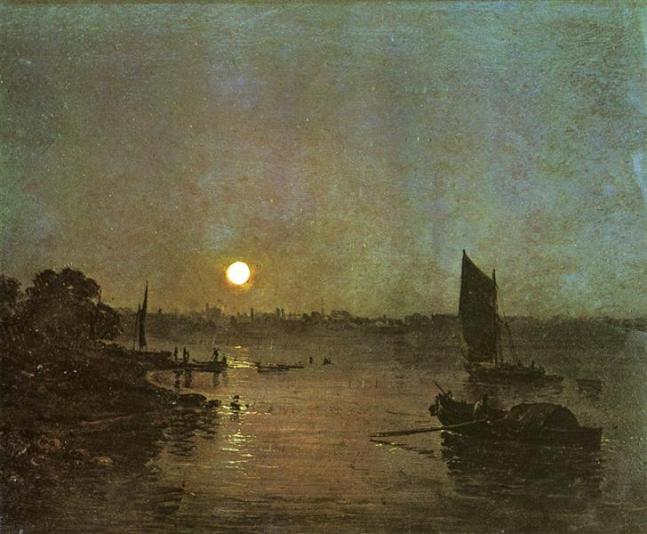
‘Moonlight, A Study at Millbank’ – J.M.W. Turner, 1797 – WikiArt

This text is directly inspired by an analogy used by the teacher of non-duality Rupert Spira. I found it to have such evocative power that words started to pour out and I couldn’t stop them. This text is therefore dedicated to Rupert and his timeless vision and teaching.

~~~

Sometime a painting just comes timely to move your heart. It is a gorgeous landscape painting, depicting a coastline and the sea, with boats and fishermen in the moonlight. At Millbank, Turner was painting in dark, subtle hues of black, blue, and purple browns, to define a night, leaving here and there traces of light, golden reflections on the water. In the wide expanse of the sky, he had left one portion of the painting untouched. Pure as white. Undarkened. For the painter had a view in mind. He was to paint a moon, bright and resplendent. And no moon was ever so bright.

This part of the scenery that wasn’t painted, it was you. You, before you were made a person, before the identification with thoughts, feelings, body, story, hurts, memories, projections, beliefs. The nature of the moon was that part of you that was left unseen, unexplored, but that had quietly illuminated you all along, giving you a self and an identity without your knowing, lending you a hidden strength for your bruised self, and bathing you in its unheard silence. It was the trusted one, the one reliable thing in a life of relentless changes and challenges. It was the peace of your true self, the precious being that had been covered up by the night of objective experience. This is the moon Turner had meant to convey.

[…]

A meditation on the evocative power of Turner’s painting… (READ MORE…)

.

The Ultimate Absolution

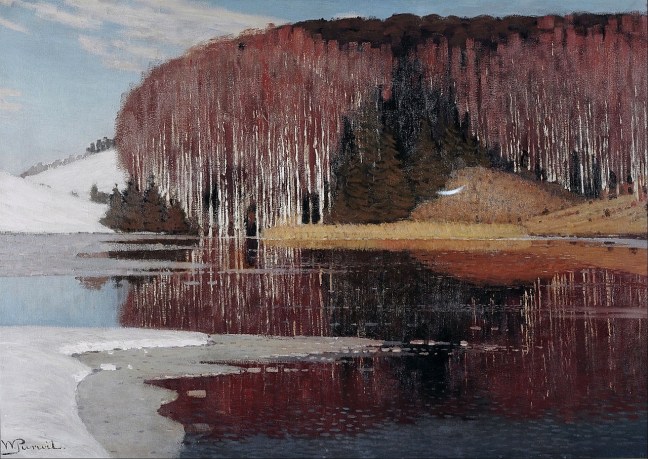
‘Spring Waters’ – Vilhelms Purvitis, 1910 – WikiArt

Isn’t it wonderful to discover that you cannot be destroyed? No matter the magnitude of your heartbreaks. No matter the betrayals and the dishonesties — all that is unforgivable in others or in yourself. No matter the untold suffering inflicted to your body or to your self. Isn’t it a blessing to notice that you cannot be broken no matter what? You can believe to be broken, sullied, doomed and punished for your sins. But in reality you are not and cannot be. You are as beautiful as you ever wished to be. Worse even. No quantity of imagination, no originality of a mind will ever prepare you to comprehend the pure and unsullied nature of your self, which equals to nothing but the beauty of your heart.

The only thing that can ever be hurt or sullied is a thought or a belief. You will be hurt in proportion to the extent of your identifications. The greater your illusion, and the sharper will be the pain when it is challenged, or diminished, or trampled. A belief is a living thing. It is not just a dead abstraction that can be easily ignored or overcome. A belief is as alive and sensitive as a self can be. We are made of that belief, we have clothed ourself with it and have become vulnerable to all that can undermine it. That’s how you become a sufferer. That’s how you can imagine to be sullied, diminished, destroyed. It is all contained in one single belief about yourself. And it can be released in one single act of contemplation: Seeing yourself as you are, and not as you imagine yourself to be.

[…]

An exploration into the true nature of forgiveness… (READ MORE…)

.

Hide-and-Seek

The spiritual search is really only a process of hide-and-seek. When we are lost and unhappy, we seek some relief. Our sense of a peaceful self, which is our true nature, eludes us, is not felt — so we embark into the search for a happy life. The process is clear and evident: when our true nature is hidden, we are naturally engaged in seeking. We try to uncover it, to dispel the confusion. When it is revealed, we bask in it, enjoy our find, treasure it. We don’t keep running about, busying ourself, pretending we’re a seeker. That would make what we have found leave. That would put her off. That would make it flee. That would cover its presence again.

What would you say — when you were playing hide-and-seek as a kid — if your little friend, after having found you, would go on seeking you everywhere intently? If he left you here standing, unchecked? How would you feel? Well, that would put you off. You would resume the game, go back home, leave him to his folly. This is the same with awareness, with your inner sense of being. You seek it when it’s not there, when it’s covered, hidden. But when it is felt, when you are being reunited with your own precious sense of being, then it is time to suspend all activity and celebrate. Remember the giggles when you found your hidden friend — your big open eyes — the joy of it all — the taste of this reunion. This is also how you should be at the moment of re-union with you true sense of self. Enjoy it. Live the moment. Stay there — in that joy.

[…]

A playful exploration of the ‘hide-and-seek’ nature of self-inquiry… (READ MORE…)

.