At Heaven’s Gate

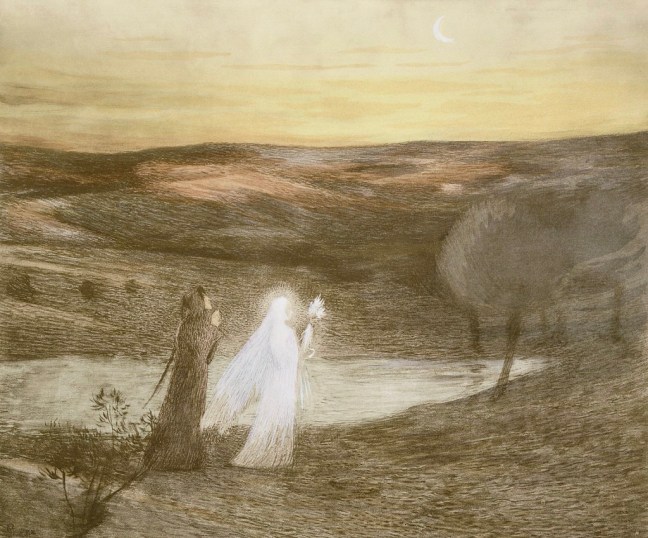
‘Dante rencontre Béatrix’ – Henri-Jean Guillaume Martin, 1898 – Wikimedia

There is a guard posted at the entrance of the Kingdom of Heaven. Mind you it’s a gentle guard, open, benevolent, understanding, but she has her ways. Not everybody can enter. You need to fulfil some precise requirements. She has seen it all — people wanting to enter with all their heavy luggage. Trunks after trunks of thoughts, beliefs, hopes, memories, loaded with cumbersome feelings. People have such unreasonable faith! That’s when she smiles gently:
— Well, you need to empty yourself… It’s not the way to qualify for happiness. Besides I guess that with such a heavy load on your back, you must be coming with your share of suffering. Suffering is not wanted here. It’s a no go. You cannot enter with it. Sharpen your vision first.
— But… are you some kind of select, private club? Can I not come as I am? With all my sore feelings and my crap?
— Mmm, technically you can, but you must first present us with a correct identity. We need to know who you are — without your feelings and your crap, as you said. Without your sorrow and self-pity, without your dreams and hopes, all your fears and concerns, your prayers and righteousness. Without all the things that situate you and render you like a self which you never were. You need to know who you are before all that you think define you. Did you ever look at it?

[…]

A playful interaction and dialogue recorded at Heaven’s Gate… (READ MORE…)

.

Masters of Knowing

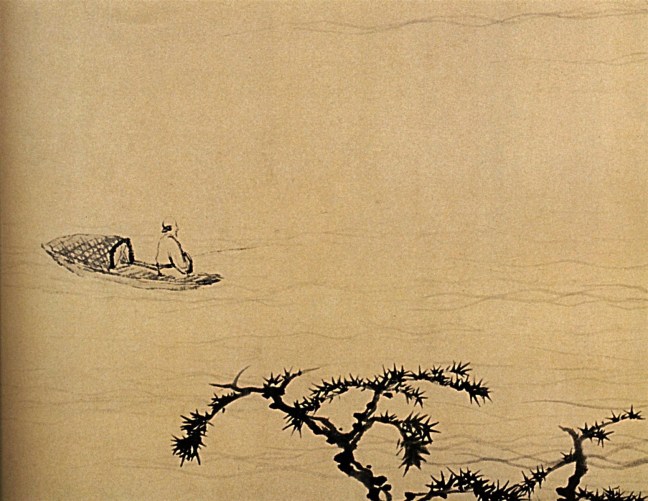
‘At the discretion of River’ – Shitao, 1656-1707 – WikiArt

It seems to me that, at some point, we have to cease worrying about our lives. There will always be something to worry about, to be concerned with, to hope, regret, project, expect, envy. This is an endless, futile road with no visible finish line. And it also seems to me that, at some point, we have to question our constant spiritual reading, listening, this position of being forever a stranger, one who needs to know, to gain his or her position as being. Not that there is no beauty in reading an expression of truth from a talented seer, or listening to a perfect line of reasoning that brings you to the open field of your eternal self. Not that there is no necessity of seeing oneself as a humble beginner in matters of truth. Not at all. But we must come to the simple realisation that we have it all exposed in front of us, in our everyday, every moment experience of being. We are innate specialists of being.

Any sincere and thorough looking at our simple sense of being, any visit to the temple of our presence, always at hand, always on the map of the now, always accessible, contains in itself treasures of learning and understanding. This is our place of abiding — this being. Our cherished home. Never at a distance. Not a painstaking enterprise. Not requiring the perfect set-up or circumstances, the right number of retreats, the sufficient amount of reading, or the many hours spent on the cushion — for being is always present, always on display, in no need of practice or effort whatsoever. Being has the naturalness of something that can never leave us. It is closer than our blood and breath. So we have to abide by its rules, and notice it rather than seek to attain it.

[…]

Continue reading this praise to being’s intrinsic, evident nature… (READ MORE…)

.

A Tangible Now

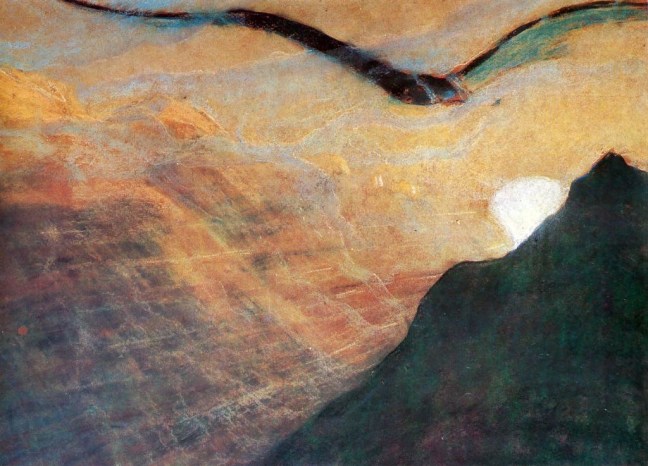
‘News’ – Mikalojus Konstantinas Ciurlionis, 1905 – WikiArt

Everything that we truly have is now. In the unplanned. In the unprojected. Only we have to be very still to see it, to comprehend that truth. Not busy. To be busy is to plan, project, think, believe, fear, suffer. All these can never experience the now. For the sufferer and the believer have left the still, untouched, virgin presence of the now to venture into the past or the future. And in doing so, have somewhat died. They have stopped being. The reason for this is that being can only thrive in and as itself. That’s what makes it eternal, infinite, unformed, whole. To move from it, to have the slightest impulse away from it, is to trade being for becoming, eternity for time, infinity for limitation, and wholeness for separation. This is what makes the now into an unknown, unlived passage between two ideas: ‘that which was’, and ‘that which will be’. Both being some phantoms that we have invented to make one single thought about ourself viable. A thought that has separated itself from the true reality of being. A thought whose only purpose is to bridge ‘that which was’ to ‘that which will be’, and whose fate is to forever seek in the future its lost happiness. We are enclosed in our own fake self and reality. And the now has been lost, replaced by time and becoming. And the peace of being has been buried, replaced by a self that thinks itself separate and lacking, therefore suffering.

So this is the new world we have invented for ourself. This is the new situation. We are now looking to possess, attain, and reach. The now has been made into something negligible, not worth anything, a mere ‘obligatory passage’. We have killed the wide expanse of the now, and have jumped into a train of thoughts. We have deserted vastness and freedom for the prison of a mind. We have made ourselves merchants, mere traders of objects with an idea in view. Our feelings, our body, our sense perceptions, have come to define us. We have come to believe that we are what we are not. And we have, in consequence, become blind to what we truly are. We live in a fantasised world, forever running and rushing between beliefs and concepts, filling the space of being until it has become indiscernible, crowding the now with the whole paraphernalia of time. This is how the now is trampled. This is how its noblesse is sullied over and over again. For the loss of the now is our loss. It is therefore important, and some vital enterprise, to return to the now its forgotten grandeur, and to restitute its position at the very centre of our lives.

The now is not a fleeting moment in time, but the solid presence of the eternal. It cannot be known as an object — which would make it finite, situated, graspable — but as the very being of the very nature of ourself. The now is made of our presence. We are filled with it. The now is foundational. It is the unseen ground and walls of our being. The now isn’t one of the innumerable bricks of time. But time is refracted in the now as one of its many possibilities. The now is the space in which the whole of life unfolds its many mysteries. And its presence cannot be dissociated from that which we are in essence. We can try as we may, we will never be ‘not now’. Our being is forever stretched in and as the eternal and unlimited field of the now, curling up its true body in and as the own, ungraspable body of the now. We will never experience the now as ticking in our life at regular intervals. For it is the very life that we are made of and that refracts itself as a thousand experiences. It is hosting ourself, lending its structure to the very structure of our being. It can be felt as the tangible aspect of the intangibility of time. It is the only thing we have. It is had in us before even the concept of time appears, let alone the past and the future; let alone the body and the world; let alone thoughts, feelings, and the sense perceptions that give our many experiences their contours and qualities. Time is the now having limited itself to accommodate the limitations of thought. And space is the now having limited itself to accommodate the limitations of the world as sense perceptions. Behind all that is fleeting and overwhelming in the flow of experience, ‘now’ is the only solid, peaceful, tangible ground we have.

.

~~~

Text by Alain Joly

Painting by Mikalojus Konstantinas Ciurlionis (1875-1911)

~~~

.

Website:
– Mikalojus Konstantinas Ciurlionis (Wikipedia)

.

Other ‘Reveries’ from the blog…

.

The Shallow Well

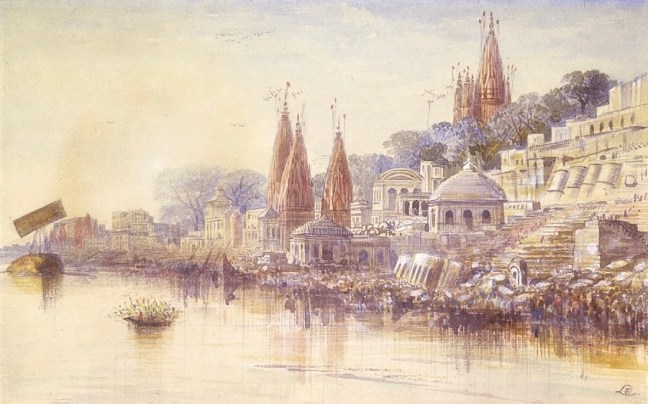
‘View from the Ganges of the burning ghats’ – Edward Lear, 1873 – Wikimedia

We are but a layer. Our sense of identity has been downgraded to being just a thought whose presence is by now so habitual and pregnant that it is likened to our very self. This shallow well, this dubious layer, seems to be all that we have access to, and our thoughts and feelings have been upgraded to ridiculously important and all-consuming proportions. We have the identity of a thought imbued with itself, satisfied as it is to block the view to any deeper reality. It is ironical that the wonder and blessing of truth can be so effectively buried under the thin layer of a single thought about ourself. A thought that is so pervasive and convincing that few are the ones who have even the idea or curiosity of digging beyond it. But try it. A little probing works wonder.

Try to localise the shallow well of your illusory self. If you have to live your life from its vantage point, you might as well have a security check before embarking in such a serious journey. Is this all we are, this shallow thought that’s tossing itself about in our head? Is this all we are, this little body at the mercy of any impending death? Why such fatuous view about ourself? Was this beautiful mind of ours — that can behold the moon and the starry sky, that can fathom the silence and embrace the vision of beauty, the infinite expanse of love — was this mind created only to end up being likened to a thought? It really is a mystery that we have come to be satisfied with a shallow well, when we have at our hand the infinite and largely unexplored field of consciousness: that thing in us that is responsible for our very experiencing and without which no thing or being could ever exist or appear.

The idea we have about ourself is not our real self. We are satisfied with a vague representation, with a limited understanding. We don’t go all the way. We feel it okay to live our whole life — even build empires — without knowing who we are. But this essential knowledge of ourself should really be where we start our journey from. And a good look is worth many books of spiritual knowledge. We only have to notice that we have misplaced our focus. We have been seduced by the objectivity implied in the functioning of our sense perceptions. We feel we have to reach for ourself in the same way, and so we create this dubious sense of self as a projected idea. This mesmerisation is the shallow well — or shadow well — where we do nothing but go round and round in repeated circles of self-assumed ignorance. Only step aside once and you will realise that this thin paper-like layer of yourself is but a bundle of accumulated beliefs.

Only step aside once and you will realise that your self is a deep, unfathomable well that cannot be seen unless you merge with it and become of it. Feel your being as being that emptiness with no end. Be the aware quality behind your very seeing and hearing. Be this divine threshold of pure awareness. Don’t take refuge inside a shallow well. Realise its hidden depth. Relinquish the whimsical thought that stands in the way. Move just below or beyond this idea of and about yourself. There is some courage needed in this small death, but the reward is the path taken from limitation to freedom, from suffering to happiness, from death to immortality, from shallowness to infinity, from lie to truth, from pretending to truly being.

.

~~~

Text by Alain Joly

Painting by Edward Lear (1812-1888)

~~~

.

Website:
– Edward Lear (Wikipedia)

.

Other ‘Ways of Being’ from the blog…

.

The Brush of Ecstasy

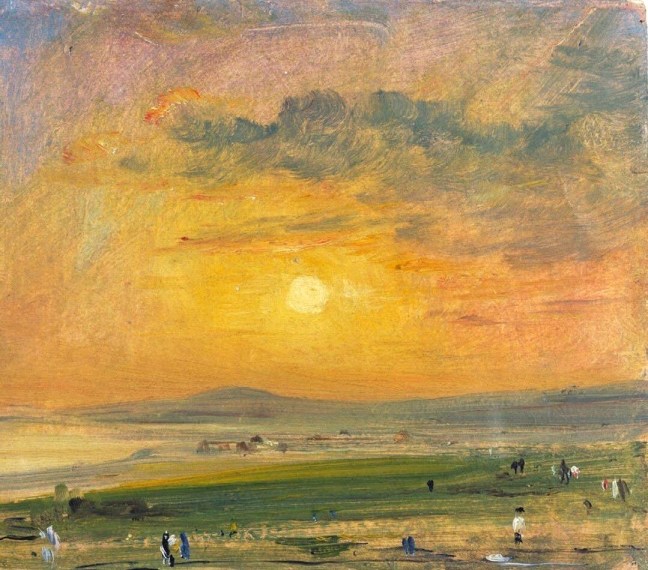
‘Shoreham Bay, Evening Sunset’ – John Constable, 1828 – WikiArt

.

There is a hidden ecstasy in your being;
Only you have — to access it — to ignore
The clamour of your endless thoughts,
Wildly thinking themselves to death;
To leave them behind, so far behind,
A thing of secondary importance,
Not that first, foolish, imaginary role.

Ecstasy has its own special requirements:
One is postponing all future goals and attainments
And envisaging yourself only in the now
Where peace can be seen to thrive,
Far and away from imagination,
Settled within the hard ground of being
Where is built a temple for yourself.

And stay there, don’t mingle with the body,
Don’t make it an essential — not more
Than necessary — it’s a fake friend;
Then, when you have built a home
Secure from the turmoil of feelings
Free from all that come to lure you into their net;
When you are — as to say —
Outside your usual self,
As the etymology concedes;
When you have recognised the world
As your own inseparable body;
When you have opened wide all windows,
Extricated yourself from the grip of time;
When you have habituated yourself
To the pure light of just being;
Then — and only then —
And only perhaps

Then might a brush of ecstasy
Come upon you — gently but noticeably;
Only beware of too much of it
Lest it will send you back to some
Old, stale beliefs about yourself — stay humble.

Then might a brush of ecstasy
Come upon you — that will make you
Leave your own dated sense of self,
And adopt that quiet remoteness of being
As your new, unmistakable home.

.

~~~

Text by Alain Joly

Painting by John Constable (1776-1837)

~~~

.

Website:
– John Constable (Wikipedia)

Suggestion:
– Voices from Silence (other poems from the blog)

.

The Impossibility of Knowing

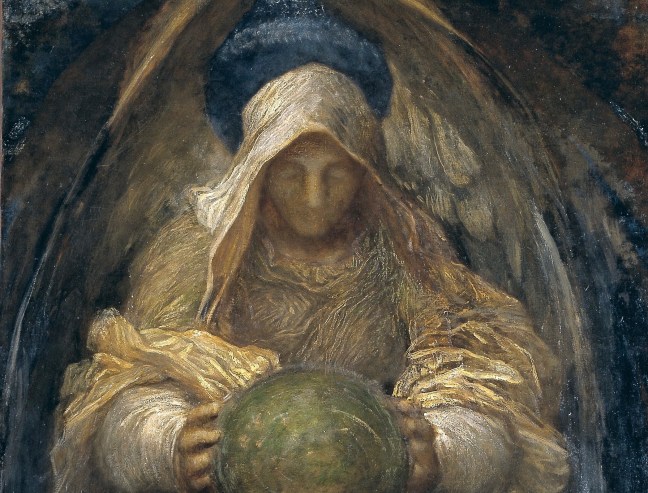
‘All Pervading’ (detail) – George Frederick Watts, 1887 – WikiArt

.

“Beat on that thick cloud of unknowing
with a sharp dart of longing love,
and do not give up, whatever happens
.”
~ The Cloud of Unknowing (Anonymous)

.

Habit is a driving force in our lives, yet it doesn’t have good reviews: it is an object of critics. It is making us dull and repetitive. It is non-creative, indolent, designed for our self-protective needs. It is born out of fear, uncertainty. It is a shield for what we feel bullies and thwarts us, and is thereby blocking our sensitivity and vulnerability. Habit debases love. But habit is not the real culprit in this affair: it is a victim of the one more fundamental habit of knowing.

Humanity is steeped in apparent knowing. We all have a posture of knowing. To know is the great pretension. Games are invented to praise and reward the people who know. The injunction to know is overwhelming. It is the believed road to success and wealth. Not knowing is a humiliation. We could take pride in knowing anything, in being ignorant, in the most ridiculous things, only to save us from being suspected of not knowing. For knowledge is believed to be gold. But although conceptual knowledge is indeed of great value in our society, the posture of knowing is nevertheless the greatest impediment to seeing who we truly are, and how to live our lives free and happy.

We don’t speak here of knowledge in the sense of conceptual or relative knowledge. Most of the knowledge necessary for our body and mind to function in the world is valid and necessary, of course open to mistakes and misinterpretations, but is not what we are discussing here. We are investigating fundamental knowledge, or knowledge as essence, the primal act of being.

[…]

An essay on the articulation between knowing and not knowing… (READ MORE…)

.

The Direct Path

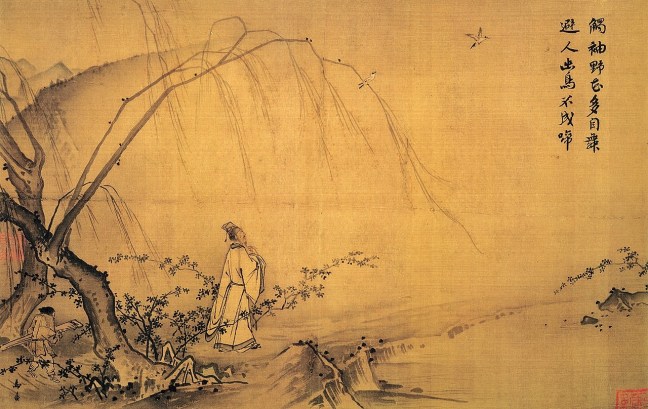
‘Walking on a Mountain Path in Spring’ – Ma Yuan, 1190 – WikiArt

We are such complex beings, always confused by endless choices and directions, caught as we are in the repeated convolutions of our thought patterns. Because we see ourselves as an intricate network of thoughts and feelings, we are naturally engaged in finding the solutions for our life conundrum in that same dark cavern of thought. But mistakingly and unfortunately so. For this is a labyrinth from which we can never come out. It has been designed for our loss and suffering. It has been masterly laid down by ignorance, for the sole and only purpose of perpetuating itself. If you want my advice: stay away if you can. But if you are already trapped and caught, well don’t worry: there is a way out. And it might be an easier one than you think.

The problem with thought is that it is constantly crowning itself as the chief master in all deeds and endeavours. It is doing so well in so many fields that its influence overflows beyond its natural area of competence. It is forever engaged in a process of belief and identification. It has persuaded itself that it represents the body, and is by now certain to be a person — a ‘he’ or ‘she’ who commands. It has put the load of finding happiness on itself, and is driving the body out in the world in a constant search for new objects and circumstances, all with the aim to obtain the precious package. And since it has come all the way here, it might as well seek to bring to itself not only happiness but also peace, freedom, love, justice, beauty, and the likes.

This is how we get lost — along that avenue of thought. Along that deceptive, inefficient, never ending seeking. This is madness — this labyrinth we have created for ourself. Thought and its acolytes as feelings, images, body, hope, desire — all that joyous team — out on a mission to find happiness. The danger of such an endeavour is to be found in the thin line down the page on the contract, that stipulates the side effects of such a folly: namely that this mistaken avenue will produce suffering in the forms of all the fears, violence, hatred, confusion, and sorrow that this endeavour brings with itself. And we won’t be able to heal these unfortunate ailments with more of the same as we failingly try to. Suffering can never be overcome using the tools that brought it in the first place. We have to find another way out of this labyrinthine maze and mess.

The good news is that you don’t have to follow every shallow, intricate alleys of this labyrinth, which is understood by now to be only a dark prospect. You are not doomed. Happiness was never meant to be such a dreary, sweaty enterprise. Right there, in the middle of the maze, in your darkest moment of loss and despair, is the secret chamber of peace, and the gate to the freedom you have sought for so long. Right there is the hidden, direct path out of it all. The short cut through the maze. Right here and right now. When you have slowed down and looked for once from the position of the one that has been here, present in all eternity, just below the threshold of your labyrinthine thoughts and feelings, and in fact mingling with them. This is the abode of rest which magically appears when thoughts, feelings, images, body, hope, desire, and world, have been put in their right place. This direct path is not a path. It is ‘it’. It is that very place or thing — which is not a place, not a thing — of your wildest dreams. It is this one silent watcher that precedes what you take to be your self, and presides over your golden destiny as being. The One that is so easily overlooked and missed — so discreet and transparent is it. Thinner than a breath. Space-like. Peaceful. Blissful. Blessed. As simple and direct as your deepest, most intimate sense of being. Just ‘I’. Yes, plainly just ‘I’.

.

~~~

Text by Alain Joly

Painting by Ma Yuan (1160-1225)

~~~

..

Websites:
– Ma Yuan (Wikipedia)
– On a Mountain Path in Spring

Suggestion:
– Other ‘Reveries’ from the blog…

.