The Immeasurable

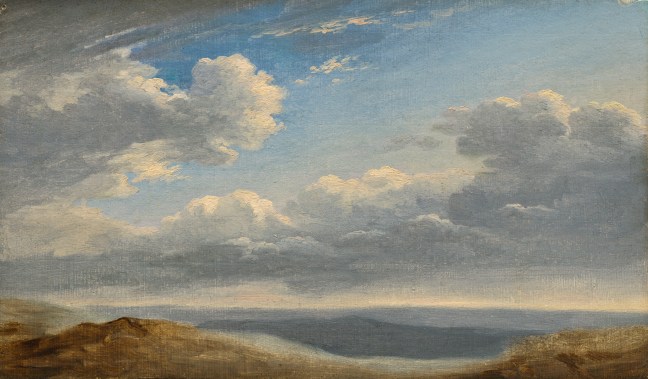
‘Study of Clouds over the Roman Campagna’ – Pierre-Henri de Valenciennes, 1782 – Wikimedia

There is a vast empty field of knowing within our experience, if we’re looking for it. It is vast not in regard to its sheer dimension, for it has none. Its vastness comes from its being without dimension, limit or edge. It is behind or before everything that we have taken to be ourself, including our body, our thoughts, our alleged self. It is here, motionless, massive, lending its very essence to everyone and everything. It’s easy to miss it, for it has not the objective quality that everything has in experience. We live in a field of objects that we can see, hear, touch, measure, be aware of. We are so fond of them that we have made ourself an object too, pretending to be our body, our mind, our thoughts. We have such a fascination for objects that we have become blind to that which holds them, and pervades everything. We are blind to our own essence, to our vastness, limitlessness — to that which makes objects experienced.

The consistency of objects around us has only the consistency of that which is aware of them. Objects do not own their own private essence, and neither do we. They find their essence and habitation in that which knows them. So we live in a world that is not defined by its edges, its limits. We should always understand that we live in vastness. That our world is empty of its own essence, and is only the expression of our being aware of it. It will never have another substance than the substance of knowing. So we live in emptiness, in infinity. The body may have its limits and constraints, but we do not.

We are devoid of what binds and limits our body-mind-world. So we should live our life as if there were around us only an empty knowing. Try it, to live as if unconstrained, unlimited, expanded. See that this is the truth of your being, this being not limited by time or place, this being free. Don’t engage your thoughts as if they were objects, but see them as an emanation of the silence they are made of. Thoughts are variations of silence. They are silence’s oscillations. If we are unaware of that silence, thoughts will come to veil it. If we see silence as our own nature, they will be messengers of its eloquent wisdom.

So the reality of thoughts is only the reality of the silence that holds them. Just as objects have only the reality of the knowing that knows them. And just as we ourself have only the reality of our nature as pure knowing — not as a body, nor as a mind, nor as anything limited. Limitation too is borrowed from the infinity that holds it and allows it, as eternity holds time. Where would an idea of time be, if it wasn’t within the eternity out of which it can be divided in past, present, future? Where would an idea of place be, if it wasn’t in the very infinity that permits it to exist? The structure of time and space is only for the convenience of a body and mind. We ourself have no such convenience, no such limits.

The world has beauty for it borrows its essence from the beauty and purity of that which holds it, and builds its form and structure with bricks after bricks of empty being. Emptiness is the body of this world of beings and things, which it moulds or shapes with its creative fullness. For emptiness can only exist in the fullness of being. We are only because of our being ‘being’. We are full of our own being, which is revealed as the being of everyone and everything. So there is in ourself and of ourself only an immensity. We are immense when we cannot be measured or limited in any way by our thoughts, body, or self. If we notice that this is so, that we are made of that immensity, that we are immeasurable, then we will lend to the world that same immensity of ourself, and we will notice between everyone and everything an impenetrable likeness. This likeness is born of the oneness that is the secret core of everything, and of all apparent multitude.

.

~~~

Text by Alain Joly

Painting by Pierre-Henri de Valenciennes (1750-1819)

~~~

.

Website:
Pierre-Henri de Valenciennes (Wikipedia)

Suggestion:
– Other ‘Reveries’ from the blog…

.

Salvation

‘Storm by a Lake’ – Pierre-Henri de Valenciennes, 1780 – WikiArt

Many religions have spoken of salvation, but the idea of being ‘saved’ is not fancied by most people. We don’t like it. People have their self-esteem. They want to feel that they can be responsible for themselves, that they have the resources to overcome whatever needs to be overcome in their life. They don’t want to rely on a god, or an external agency, or even a power. They don’t like to be put down, don’t fancy being a poor thing in need of being saved.

The good news is that there is no such external power or entity. We have it all in and as ourself, as our own being. Nothing exists or stands beyond or aside our being. This simple being that we are, which we are made of, which we draw our very existence from, is the only thing that has a reality. We won’t find a reality at a distance of our own being. The idea that there is a reality other than our own reality as being is only a belief. We won’t find a power beyond our own power, that could come to save us. This world of ourself was perfectly designed. It was made whole and one, so that we hold within ourself our own resource, our salvation, everything needed to live a gorgeous, peaceful, meaningful life.

So the idea of a salvation took us on the wrong track. It had us waiting, hoping, praying, expecting, while at the same time abhorring the idea of needing help. It gave us the idea or impression that we were an entity, a person with its own personal, separate being. It manipulated us to think that we were our story, and that we needed to be fixed, aggrandised, improved, saved. For after all, let’s be honest, we do need to be rescued from a peril. We do need to be delivered from the danger of suffering, of separation, loneliness, conflict. We do need to save ourself from our belief, idea, concept that we are squeezed in our body-mind, and limited by it.

With such an idea in mind, we have but the semblance of a life, but not life itself. We have been simulating having a life, pretending to know who we are, and then acting as if everything is as it should, as if suffering couldn’t be avoided, as if it were intrinsic to living. We have in fact ourself created the idea of a salvation, of a person at a loss, needing help. But the truth is, there is really no such a thing as salvation. Salvation is implied, or contained in being. Salvation means ending a belief. It means not taking ourself to be what we are not. It is the returning to our natural state of simply being.

This conceptualisation of our being into being a self, an entity, a separate being, is the road towards separation, isolation, suffering, conflict, and therefore salvation. It is our wrongdoing, our ‘sin’. But the sinner is an entity that we have created. We have made a sufferer, a sinner where there was only the peace of being. Through this creation of an illusory self, we have invited separation, duality, and have divided being into a self separate from other selves and things. We have given the world a reality independent of our own, and have made the glory of being into a self that has retired into the limits of the body-mind.

Our salvation is in the sin itself, in its ending. It is in being, before the birth of the idea that being requires being something, or someone. Before our identification with our body and mind, which has made suffering and conflict our daily companions. So salvation is always only an acknowledgment, a noticing. It is the knowing of our being as it is, and not as we have made it, through belief and habit. This is how we are doomed, in being a self separate from everything. And this is how we are saved, in being only being. This understanding does save for it tells to a mortal that he is immortal, and it assures a suffering self that she is blessed with a peaceful being. A sin is an unfortunate addition to plainly being. It is a simple exaggeration. We have created, invented a sinner where there was nothing but our gorgeous, infinite being.

But this is something that can be reversed. Salvation is natural, already here, achieved, contained in and as our own being. Salvation is being. The one in need of being saved is not there, has no reality other than in our mind. The idea of salvation or deliverance itself must go. It had found its use and meaning when we were but the thought of being someone. When this idea of being someone goes, when the qualification withers, being stays behind, resplendent, in no need of being saved whatsoever.

All this, the whole spiritual enchilada, is only a convenient story for the poor me. Deliverance is achieved in being. The sinner is an illusory superimposition on being, which is intrinsically already free. We have limited being, have made it an impotent thing. So there is ultimately no sinner, and no salvation. This is why we say that God is forgiving, because there is always at hand the realisation that there is in ourself, in being, no room or possibility for an entity separate from experience, and therefore for a sinner. In this discovery of our being whole, and One, is the birth of a love and a peace that is beyond understanding, beyond any making. In fact, we have been saved and safe all along. 

.

~~~

Text by Alain Joly

Painting by Pierre-Henri de Valenciennes (1750-1819)

~~~

.

Website:
Pierre-Henri de Valenciennes (Wikipedia)

Suggestion:
– Other ‘Reveries’ from the blog…

.
The Word ‘God’

‘Italienische Landschaft’ – Pierre-Henri de Valenciennes – WikiArt

Long before any idea of a God, before any belief or possibility of a deity, of a divine command, God is already here, hiding within yourself. Or rather you yourself have just come hiding God. It means, don’t make God into an idea, a form, a projection born of your fears, of your eagerness for peace or relief. God is not ahead of you, or before you, or above you. God is not an entity, or anything that would not be your own.

God wouldn’t be God if it were an idea, a conceptual form far away from your self. For God is not something abstract, vague, distant. God is resplendent. God is shining. Not in a far away, unreachable place. God is brightly here, just as you are. You are, because of God. Because God is, you are. God is the very essence and quality of your being.

There is nothing above or beyond your being. It seems that there is, because you have limited your being by giving it a qualification. You have found it better to clothe your being with something. Then God goes hiding. Or you yourself are hiding your own divine self or essence, the possibility of your being only being. For there — in being — is the key to god.

In that being, God is. God is doing your being. That’s the extent of the presence of God in your life. In that, there is not even the possibility of a belief in God. In that, you feel God’s presence every time you feel your own presence, which makes God very present indeed in your life. In that, a belief in God would in fact trample God. It would make it an entity. A distant thing. A poor meaning. Not God at all.

Who do you think is ‘doing’ your being right here, right now? Think of that for a while. What is this being that I am? What is this I am that I am? Answer that in verity, through your actual experience, and God won’t be a secret to you anymore. God will cease being distant. You will be yourself made of the presence of God. No belief in God could ever match that.

But remember that once God’s being is recognised to be your being, then you won’t find room anymore to have your own personal being. Your own being will be lost to God. Now there is only God, which actually means there is no God at all. The idea of God is for when you have distanced yourself from God, when you don’t know yourself — that you are God’s being. In recognising yourself as God’s being, you will have lost both your being, and the idea of a God. It is a form of death.

So think twice before you say that you want to know God, or to know yourself. For this knowledge will leave you with being only. There won’t be a you. And there won’t be a God. There will be the purity of being, which is the everlasting life in death, which is to live as the One. You will lose your apparent doership, the control that you think you have, every objective identity that you believe makes you.

But in that loss is the finding of yourself, of who you are. In that loss is the end of your suffering, and the discovery of your nature as peace. This finding of your essence is the meaning behind the word ‘God’. In finding God, you will have rid of God, and of yourself. What is left is more than any word can tell. More than the word ‘God’ could ever convey. There would be no word at all. Except you. You would be the living word for ‘God’. 

.

~~~

Text by Alain Joly

Painting by Pierre-Henri de Valenciennes (1750-1819)

~~~

.

Website:
Pierre-Henri de Valenciennes (Wikipedia)

Suggestion:
– Other ‘Reveries’ from the blog…

.