An Impeccable Death

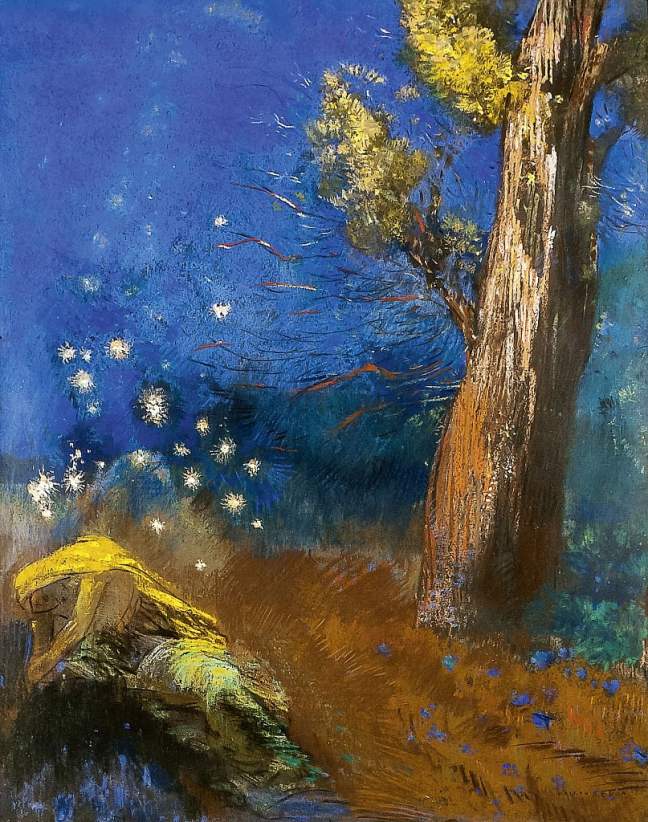
‘The Death of Buddha’ – Odilon Redon, circa 1899 – Wikimedia

It is striking to think that the day when we die is always today. It is not happening tomorrow, will not take place in the future. Death is for now. This is where and when it takes place. In the present. In presence. The death of the body, its ending, may take place in the future, but is not death. It doesn’t have the implications, the magnitude of it. The death of the body is like a wave that ceases to undulate, to imagine its difference, its conflicting attributes, and finally breaks before we notice that it is not what we are, that there is here, before it, as our very making and identity, an ocean of peace. This ocean is what death is — before we imagine to be a self that thinks itself separate.

We have been moulded in and as a presence that was never born and could never die. This inability to exist or appear as something distinct, or different, is real death. This incapacity to cease or find an ending at our being, is true ending. It is a place where we can never go. This place of being has no objectivity. It is nothing that we can be or project ourself to be. It is pure being, done, final, already perfected, unattached, a free fall. It is a death so complete that it has no object. It is not the death of something, of an object, of an entity — for such death is not truly death. It is the realisation that we are not what we have believed ourself to be. That there is not here an entity, a self that could be dying, that has an existence of its own. That realisation, and above all what is left here to be and live by, truly is death. And in that death is contained, concentrated, achingly shining, the whole of life.

So death is now. It is happening now without our noticing. It is achieved — our death, the one that we fear, that we have pushed away, that we don’t want to envisage, envision, is done, gone through already. It’s a matter of noticing what is — that we are not here, that nothing was born, that it would be curious to die, that what we are has no other attributes than being. How would you put to death something that is without attributes or qualities? How would you end something that was never born? Moreover, no appearance, or thing, or body, could ever die without it being the expression or the modulation of something untouched by death. That something exists deathless is the sine qua non for the existence of death itself. That’s why life itself thrives through the exercice of death. What is deathless is our being. It is being — that which we all share in, which we call eternity, or the infinite, for it is one, and being one, it cannot be measured, qualified, or put to death. That’s how we are immortal — through only being, which we share as the experience of love. Death is when we cannot die anymore. It is obliterating objectivity — therefore our existence as an entity. An impeccable death comes at this price.

.

~~~

Text by Alain Joly

Painting by Odilon Redon (1840-1916)

~~~

.

Website:
Odilon Redon (Wikipedia)

Suggestion:
Other ‘Ways of Being’ from the blog…

.
The Birth of Personhood

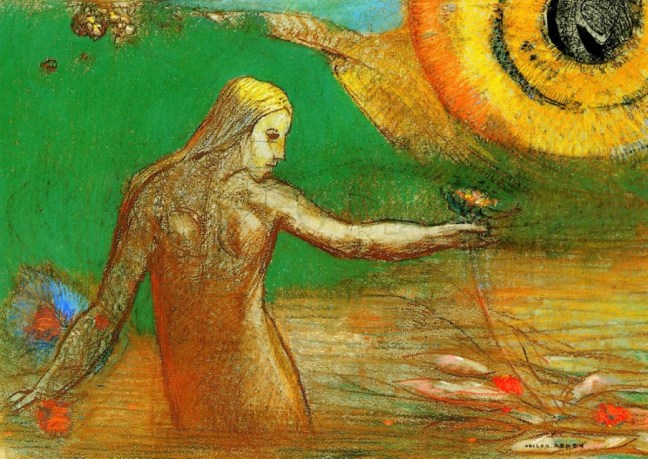
‘Flower of Blood’ – Odilon Redon, 1895 – WikiArt

It is consciousness — not body, not thoughts — that gives us the impression that we are a person with a continuity. There is absolutely no chance that a bundle of thoughts, feelings, and bodily sensations, could give us that impression. We borrow our personhood to consciousness, to the fact of being aware — to this light that creates us in the darkness that are otherwise thoughts, feelings, body. Our sense of continuity belongs to consciousness, to presence — that portion of ourself that is empty, unchanging, not objective, but full to the brim with itself. Our thoughts are but isolated events that are changing over the course of time, and so are our feelings and bodily sensations. The content of our mind is like a passing, unpredictable weather. So continuity in that area is absurd. Our essential self is to be found in and as being. What makes us is in that which is unmade. That impersonal part of ourself is what paradoxically gives us the chance of being a person. We are therefore nothing but empty, undivided being playing ‘being a person seemingly characterised by body and thoughts’. We have got it all upside down: Our person is not prior to consciousness. Consciousness is prior to our person, and the sine qua non of our existence or appearance.

Our thoughts are far away from each other, inconsistent, contradictory, confused, hesitant. They are not the voice of our self, are incapable of forming an identity of any kind. Our identity is to be found somewhere else, in something that we cannot get hold of, or limit, or name. The only thing that could link the different events of thoughts, feelings, sufferings, bodily sensations, and perceptions — all that for us constitute our self, a person with a name and form — is the presence of consciousness. We owe the impression that we are something solid, a real person, to emptiness, silence, stillness. So our person is actually non-existent, or rather has its existence in that which stands unseen between the happenings or events that we think make us. So our story, our thoughts, our body, become evanescent, losing their reality, disappearing within the experience of our massive sense of being — its coming to our attention. Being is seen to be the nature of ourself, which we had imagined in passing, isolated, impermanent, objective events and qualities. And believe me, that makes for a beautiful, gorgeous person — the one we have always wanted to be! A person is infinity being born.

The fact that there is a certain coherence in being a body-mind, and that we are able to live a life, is nothing but the expression of a play, a ‘lila’ as the Hindus are saying. We are nothing but a character in the hands of an actor. A body-mind is the little necessary to carry our wider identity to its term. In fact, all that we seemingly are — a person with an apparent life — is just the vehicle for a bigger quest. We are pretending a body-mind, so that we can realise our divine being. We are carrying infinity on our back, on the back of the finite, giving it the seeming, temporary life of an entity progressing in time and space. But this story, this appearance of a life, is but an excuse, something marginal that serves a wider purpose. We are meant to carry God on our shoulders for a while. At first unknowingly. Until we know God knowingly. Until God has acquired enough substance, and has sufficiently widened Its being in our life. Until God can in return carry us on Its own shoulders. And move us. And swallow us. Then, we find the security and courage to surrender ourself in God’s solid being and be like God Itself. We transfer our being in and as God’s being. And die there.

.

~~~

Text by Alain Joly

Painting by Odilon Redon (1840-1916)

~~~

.

Website:
Odilon Redon (Wikipedia)

Suggestion:
Other ‘Ways of Being’ from the blog…

.
The Chariot and the Charioteer

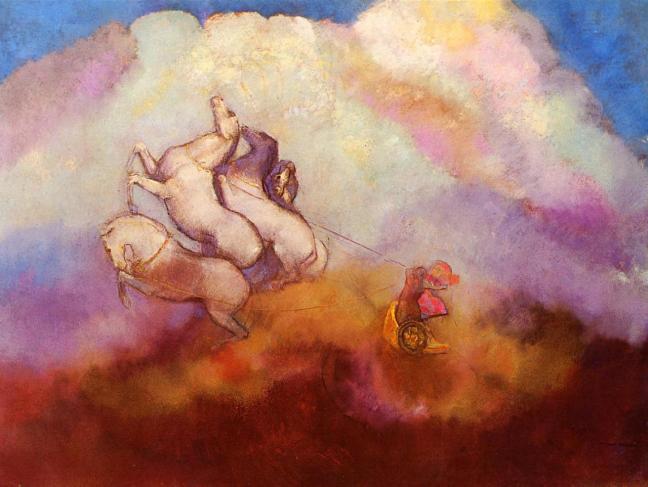
‘Pantheon’ – Odilon Redon, 1910 – WikiArt


The mental and the material are really here, 
But here there is no human being to be found. 
For it is void and merely fashioned like a doll, 
Just suffering piled up like grass and sticks
.”
~ Visuddhimagga (The Path of Purification)


Free will is a tentacular issue. It permeates our life in a very intimate way, like very few things do. Any action that we might engage in, any decision we take, any thought we think, bear at their core the question of their ownership. If we believe in free will and don’t exercise it for all sorts of psychological reason, then the road is open to guilt, shame, regret, self-loathing. Could things have been any different? What if I had not made that choice? What if I had taken a different decision, if I had been more courageous, if I had followed my heart? Well, it is not any different if I feel I have exercised my free will; I could be left with the same regrets. Is it even possible to not exercise our free will, if we leave aside the unchangeable circumstances we are in? Is not free will our nature no matter what? Or conversely, can we ever, at all, exercise our free will? Maybe there is no such thing. Who is here, deep down, to exercise free will? Is there not only a flow of life on which we superimpose a continuous stream of hectic, frantic thinking? What is it?

I was watching a mountain torrent the other day during one of my walks. How miraculous to see the water flow down unquestionably, directed left or right, split up by a stone. If you had been a water drop placed here, it is left, but more there and it is right. Who could imagine such a droplet having any kind of choice? The river would sometimes divide itself in three little currents, forming islands. Sometimes you could be dragged sideways in a stagnant little pool, or rushed about in a forceful cascade. What struck me was the absence of resistance, and the fact that no matter the direction, no matter where you were dragged into, how slow or fast, smooth or jumpy, water was water and you would find yourself downstream at exactly the same place than any other drop of water that you might have judged as having a more harmonious or lucky course. Are we not such a drop carried, or literally swept along, in the stream of life? […]

An exploration into the nature and reality of free will… (READ MORE…)