Lectio Divina

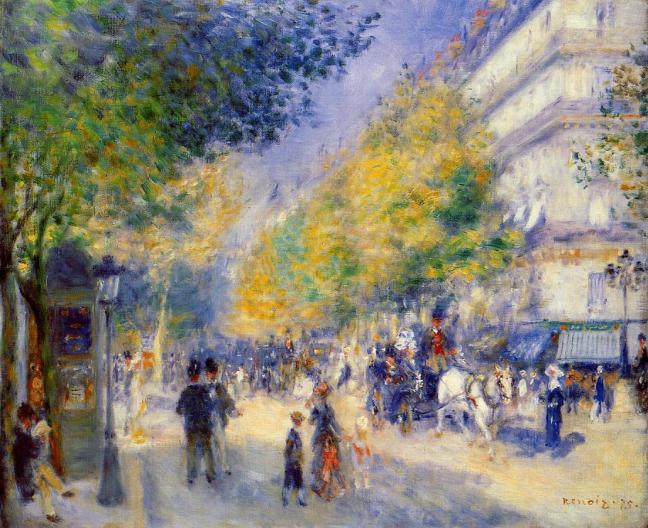
‘The Great Boulevards’ – Pierre-Auguste Renoir, 1875 – WikiArt

I have been feasting on some words recently. I was sitting leisurely on a cafe’s terrace, watching life coming and going, browsing through my phone with some ideas in mind. And there it came, and took me by surprise, like a koan suddenly unveiled, a pathway revealed without my knowing. There it came, taking the form of one single, simple phrase that seemed innocuous, by Saint Augustine:

Is any man skilful enough to have fashioned himself?
~ Augustine of Hippo

And that emptied my mind. It made me sink into no content, aware of all that is now; my self suddenly made a container for life. We all feel that we are so smart and powerful, or so stupid and powerless. That we have made ourselves what we are, and feel in consequence the pride or shame of it. That we have destroyed, or elevated ourselves. That we are responsible for our happiness, our success, our failure. That we have moulded our thoughts and actions, wilfully designed them. That our beliefs are believed. Our thoughts thought. Our words uttered by a ‘somebody’ here, inside the skull. But these are all beliefs, and beliefs are flawed from the start. Beliefs need a believer to believe them, and look as you may, you will never find such one behind your deeds. For the simple reason that there is no self behind our selfing. We have therefore never been in charge, never been truly responsible for collecting what we have collected, for misusing what we have misused, and for making the mistakes that we have made. Except in hindsight, in thoughts and beliefs, in cascades of randomly built illusions and memories in which we are caught and made blind. And these are what we have busied ourselves managing and arranging into a sensible self. And that self has gotten in the way of our living harmoniously.

[…]

The ‘Lectio Divina’ of a quote by Augustine of Hippo… (READ MORE…)

.
The Impossibility of Knowing

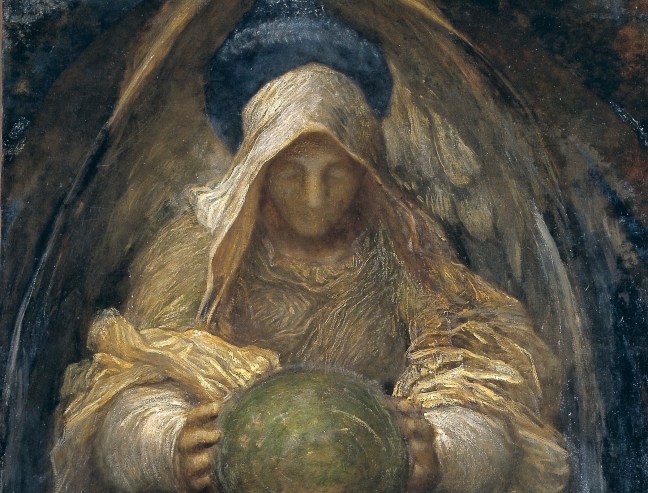
‘All Pervading’ (detail) – George Frederick Watts, 1887 – WikiArt

.

Beat on that thick cloud of unknowing
with a sharp dart of longing love,
and do not give up, whatever happens
.”
~ The Cloud of Unknowing (Anonymous)

.

Habit is a driving force in our lives, yet it doesn’t have good reviews: it is an object of critics. It is making us dull and repetitive. It is non-creative, indolent, designed for our self-protective needs. It is born out of fear, uncertainty. It is a shield for what we feel bullies and thwarts us, and is thereby blocking our sensitivity and vulnerability. Habit debases love. But habit is not the real culprit in this affair: it is a victim of the one more fundamental habit of knowing.

Humanity is steeped in apparent knowing. We all have a posture of knowing. To know is the great pretension. Games are invented to praise and reward the people who know. The injunction to know is overwhelming. It is the believed road to success and wealth. Not knowing is a humiliation. We could take pride in knowing anything, in being ignorant, in the most ridiculous things, only to save us from being suspected of not knowing. For knowledge is believed to be gold. But although conceptual knowledge is indeed of great value in our society, the posture of knowing is nevertheless the greatest impediment to seeing who we truly are, and how to live our lives free and happy.

We don’t speak here of knowledge in the sense of conceptual or relative knowledge. Most of the knowledge necessary for our body and mind to function in the world is valid and necessary, of course open to mistakes and misinterpretations, but is not what we are discussing here. We are investigating fundamental knowledge, or knowledge as essence, the primal act of being.

[…]

An essay on the articulation between knowing and not knowing… (READ MORE…)

.

The Wisdom of Humility

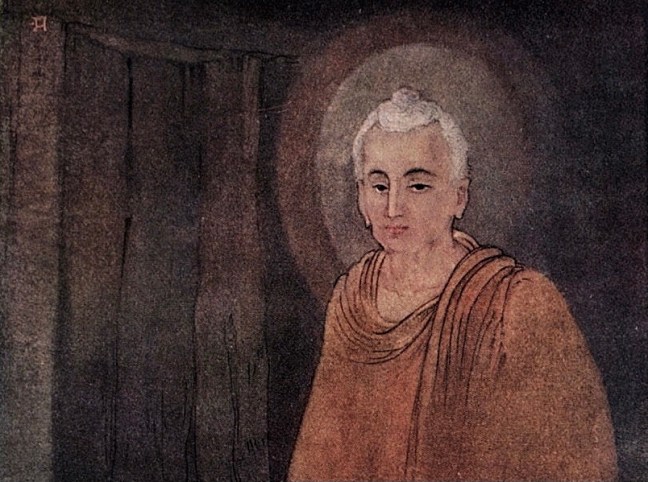
‘Buddha as mendicant’ (Part) – Abanindranath Tagore, 1914 – Wikimedia

.

To look into and understand the meaning and implications of being truly humble, of that state of humility which we often hear about — but rarely fully understand — is a precious thing. The word ‘humble’ finds its roots in the Latin ‘humilis’ which means ‘lowly’, literally ‘on the ground’ (from ‘humus’ meaning ‘earth’). Its etymology covers both the more active aspect contained in being ‘humiliated’, or being ‘humbled’, and the one that refers to the state, or quality, of being ‘selfless’. The first one gives the primary importance to the self that we are, to this separate entity that we believe to be, and which needs to be rendered humbler, smaller, lower. But why would we want to do that? Why, if it wasn’t for our deep intuition that this self is illusory, false, and is ultimately preventing our true identity of peace and happiness to be recognised and realised? 

This inherent peace contained in just ‘being’ refers to the second aspect of the word. Being humble is being without self, without the belief of being separate from objective experience. We are not this restless entity that wants to achieve, to aggrandise itself, and needs to be rendered low. We are rather this pure being whose very nature is complete, and already, unconditionally humble. Otherwise, why would Shiva or Buddha be portrayed as a mendicant? Therefore, the solution to our chronic state of suffering and conflict does not lie in having more, or less, or better ‘self’, but in realising, and living from, this deep and already achieved peace that we are. This realisation, and the action that is born of it, is what true humility is about. This simple phrase from the Bible made it crystal clear long ago: “When pride comes, then comes disgrace, but with humility comes wisdom.” (Proverbs 11:2)

I am sharing here a few quotes that will further explore this deep and essential question:

~~~

In a space of humility,
no conflict is possible
.”
~ Éric Baret (‘Let the Moon be Free’)

~

Humility contains in itself the answer to all the great problems of the life of the soul. It is the only key to faith with which the spiritual life begins: for faith and humility are inseparable. […] If we were incapable of humility we would be incapable of joy, because humility alone can destroy the self-centeredness that makes joy impossible.”
~ Thomas Merton (‘Seeds of Contemplation’)

[…]

Discover many more quotes on this question of humility… (READ MORE…)

.

A Thing of Beauty

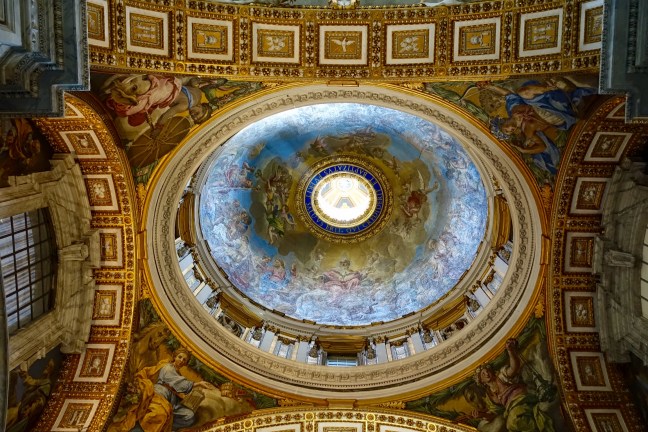
‘Saint Peter’s Basilica’ – Rome (Vatican)

Isn’t the world the most extraordinary place? I’ll explain. Take a tree. A single tree, with its roots spreading and fiddling deep into the soil. And its erected trunk that divides itself into branches, and a thousand twigs, and a whole foliage of leaves. The shadow it gives. The home that it is for birds and little animals. And the shelter. And a thing of beauty. To be admired, listened to, touched, felt. The roughness of its bark under your fingers. And the presence. There are millions — most certainly trillions — of such trees that spread over the world to form groves and vast forests. Extending their sheltering embrace to countless beings. And to you too, today. A tree! The strangest thing there is. To look at one is to be taken into a well of wonder. Feel that amazement. See where it takes you. You will be surprised.

[…]

A reflection and meditation on the beautiful world that we are… (READ MORE…)

.

The Flowers of St. Francis

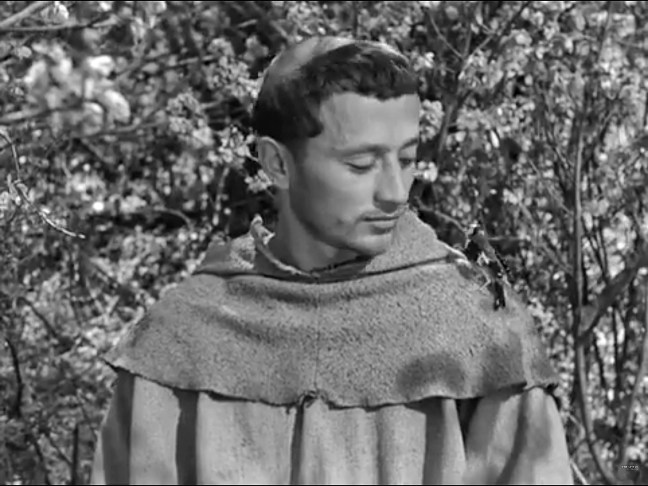
Brother Nazario Gerardi – ‘The Flowers of St. Francis’

.

Praise be to you, O Lord, and to all your creatures. 
Especially Brother Sun, through whom you light our days. 
He is beautiful and radiant and resplendent, 
and derives all meaning from you
.”
~ Canticle to the Sun

.

The deepest realisations and expressions of truth in Christianity have sometimes come from words and understanding, as was the case with Meister Eckhart, but it is, by far, not the most common path. Many a man or a woman have come to embrace God’s being through the expression of profound love and surrender. Such a path was trodden by Francis of Assisi, and has been splendidly shown in Roberto Rossellini’s 1950 film ‘The Flowers of St. Francis’. And if all one knew of Francis of Assisi was through watching this supremely elegant film, one would know what needs to be known, one would meet the essential — the essence — of this man’s life, of anybody’s life when it is lived from love and humility. One would know of the pure joy of being, of trust in life’s bounty, of care and attention for every beings on earth.

Showing only a moment of Francis’ life, the film is more a parable on the qualities that were emphasised throughout his life and teachings, than the real description of his life’s journey. Through a succession of simple vignettes, we are exposed to a panoply of Francis’ various expressions of love. We are shown a man who lived with his heart, and a life that has been made into a prayer to god. We are shown that prayer is but an act of love. We are shown people coming together around a common faith in God, their daily life and turmoils, their behaviours. Francis of Assisi encouraged his disciples to access or express god’s being by being oneself an example of the presence of god. And by making this presence shine in all their daily activities, so that the brightness of god can be harvested by everybody around. These expressions are in the film like the little flowers of St. Francis. A whole bouquet of them.

Praise be to you, O Lord, 
for Sister Moon and all the stars, 
which you cause to shine clear and bright
.”
~ Canticle to the Sun

[…]

A homage to Francis of Assisi through Roberto Rossellini’s movie… (READ MORE…)

.

The Surreptitious Thief

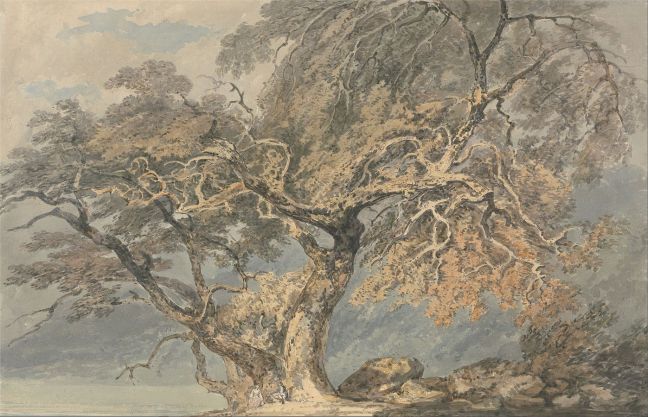
‘A Great Tree’ – J.M.W. Turner, 1796 – WikiArt

.

Follow knowledge like a sinking star,
Beyond the utmost bound of human thought
.”
~ Alfred, Lord Tennyson (from ‘Ulysses’)

.

What better way is there to realise the illusory nature of something than to study its existence? So a study of the ego is really the most interesting and valuable thing to engage in. For two reasons. One, because you are attempting to describe, evaluate, and understand something that simply doesn’t exist in the form you had imagined. Therefore such a study will naturally push you to discover what lies in the place left vacant. Two, because the presence of the ego has been responsible for the near totality of man’s suffering and the mischief he has done in his desperate attempt to alleviate this suffering or cover it up. Only imagine the beneficial consequences when it is found illusory and therefore impotent. 

But what truly is the ego? This word has been used in a variety of ways, and with various understanding. In psychology, it is understood to mean a sense of being a self, a ‘person’ that is real as such and is the foundation for a healthy personality, and its subsequent functioning. In the spiritual realm, and more specifically in non-duality circles, it is often named by the general term of ‘separate self’. The ego or the separate self is the ‘person’ or ‘entity’ that we feel is present inside ourself, but whose presence is not real, but only assumed. It is a belief that we have ceased to question. Simply a derivative, a bundle of thoughts, feelings, and memories that we have shaped into a form, and from which we derive the existence of a particular being, or person, in command inside the skull. 

[…]

An exploration into the nature of the ego or separate self… (READ MORE…)

.

I have Called You by My Name

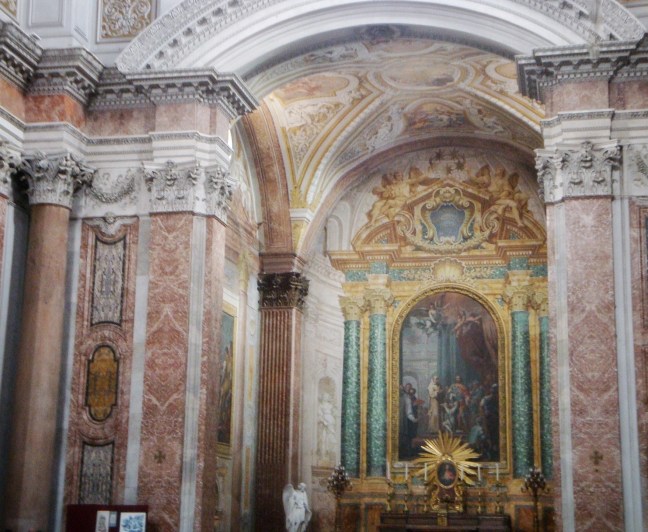
‘Basilica of St. Mary of the Angels and the Martyrs’ in Roma

.

I – luminous, open, empty Awareness – 
am the truth of your Being and am 
eternally with you, in you, as you, 
shining quietly at the heart of all experience. 
Just turn towards Me, and acknowledge Me, 
and I will take you into Myself
.”
~ Rupert Spira

.

In some of the religious texts of the world, the subtlest expressions of truth are so deeply buried in the text that they have become unintelligible. The limitations of translation, the analogies and metaphors borrowed, the time in which these texts appeared, the audience for which they were written, the veneer of poetry or story-telling, all these concur to add multiple layers of confusing elements to the original idea. And these texts have also served such inappropriate religious purposes in the course of history that they are, for all these many reasons, rejected or misunderstood by many. The Christian Bible is one such text. 

I have here attempted to find exquisite passages from the Bible, where the veneer is cracking and the hidden meanings shine more brightly. For a clearer understanding, I have selected two excerpts by Rupert Spira that will help focusing on one possible expression of truth and how it comes to be hidden behind the most innocent line in the Old Testament. They make for a necessary and beautiful introduction. They are borrowed from a video called ‘The Memory of Eternity’ in Buckland Hall, Dec. 2018. I hope you enjoy, for when we come to these texts with the right perspective or understanding, they come shining with a new glow of truth…

~

Our mind is just a temporary limitation or localisation of the only mind there is, infinite consciousness or god’s infinite being. So our mind is permeated with the memory of eternity, permeated by the memory of its origin. Why? Because it is made of it, although it is a limited version of it. So in everybody’s mind, there lies this memory of its own eternity. And that memory is felt by a person as the longing for happiness, or the longing for love. When we long for happiness, or we long for love, we are desiring to be divested of everything that limits us. We are designed to go back to our wholeness, our fullness, our sense of fulfilment, or completion. That’s why everybody longs for happiness or love. What people do to find happiness or love varies. But the actual longing itself is because there lives in everybody’s heart a memory of our eternity, the knowledge of our origin, or in religious language, a trace of God’s mind.

There is this beautiful line in the Old Testament, in the Book of Isaiah, where Isaiah says (Isaiah speaking on behalf of God): “I have called you by my name. You are mine.” I have called you by my name. I have planted my name in your mind. The name your mind gives to itself — that is the name ‘I’ — is the name of ‘me’. So the ‘me’ (God is saying) the ‘me’ in ‘you’ is in fact the ‘me’ in ‘me’. I have called you by ‘my’ name. That makes the ‘you’ of ’you’, ‘mine’ — or ‘me’. […] Everybody’s experience is permeated by what they call ‘I’. Experience is limited and individual, but the ‘I’, the self that permeates all experience doesn’t share the limits of experience. So Isaiah is saying that ‘I’ is God’s mind in our mind. It’s not even God’s mind in our mind. All there is to our mind is God’s mind, with a limit attached to it. That’s what seems to make it ‘me-the person’. But the ‘me’ of ‘me-the person’ is infinite consciousness.”
– Rupert Spira (‘The Memory of Eternity’ – Buckland Hall, Dec. 2018)

[…]

Read some beautiful expressions of truth from the Bible… (READ MORE…)

.