The Impeded Buddhas

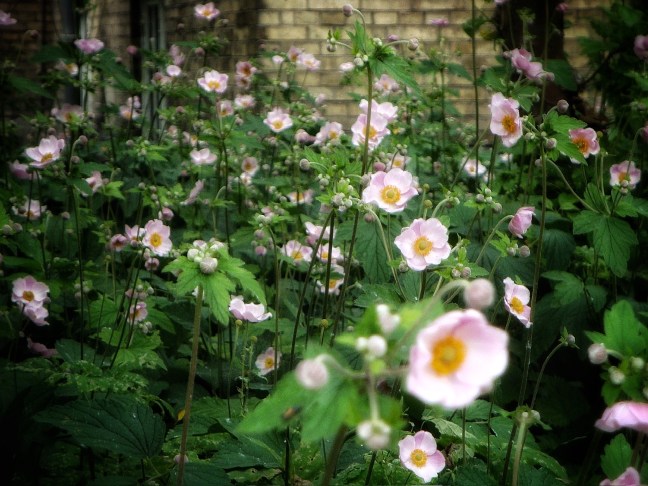
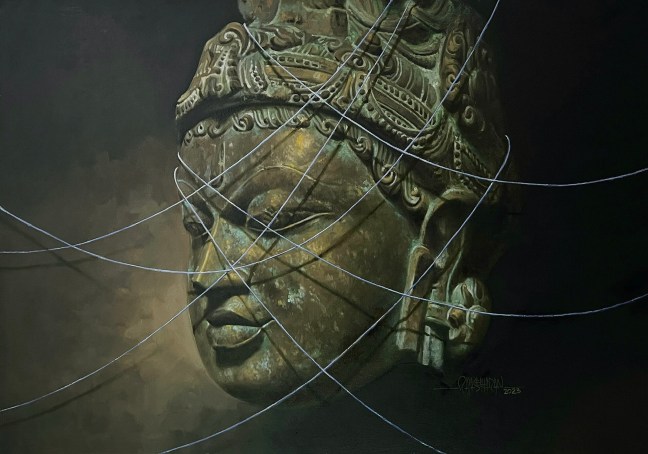
Holy Thread’ – by Rajasekharan Parameswaran – Wikimedia

This is what we want against all odds. No matter what. All of us. We want that love, that piece of eternity, although we may not voice it that way. Yet everything tells us that we will never get it. We can’t have it. It is not something to be had, and we know it. We have experienced its elusiveness a thousand times. But that knowledge doesn’t appease our seeking. This indefatigable quest is ingrained in our system. Something deep inside us is missing, is not quite completed. There is an insufficiency, a suffering that sets us on this path of longing. And this seeking has become such an intimate part of our lives, and has taken so many banal, inconspicuous forms, that it is not often noticed or recognised as such. But the fact is: all that we are truly looking for in our life is this deep, abiding peace, which ultimately comes from love. This is our path. Our journey. To get to that point where we don’t have to suffer and strive.

The problem comes with defining our search precisely. We are being too vague about it. Most of the time, it is not taken seriously. So we stroll about, taking divergent, contradictory roads. We are only interested in bits and pieces. A little happiness here and there will do. Our quest remains a fearful one, and mostly consists in avoiding difficulties, in being attached to what we have, and in acquiring little pleasures. But all we do through this, is to battle with happiness. In fact, the whole of our life is made of that, of this frustrated happiness, this thwarted love. Everything we do — including our most unkind, insensitive, foolish, ignorant actions — we do out of our deep, inner desire for happiness. In a way, we are all spiritual seekers. We are all engaged in the same frantic battle to be happy, at peace, rested, unafraid. We are all brothers and sisters in arms. We may do it in the most clumsy, mindless way, and be punished for it. Or we may be gifted with a thirsty, pointed mind, and all the tools necessary to meditate and recognise our true nature. So this seeking is not for a few elected, but extends to humanity’s tireless striving for betterment.

In fact, we are all — without our realising — accomplished Buddhas, beings of light. But we have chosen to identify with our shortcomings, our failures, our reactive patterns, our sorrows, all the inner waste that life produces along the way. Their objective nature makes them easier to associate with. Unfortunately, by doing so, we have troubled our innate clarity, have limited our infinite nature, and have soiled our innocence. We have become ignorant of who we are. We have confused our luminous, peaceful being with a few passing, trifling occurrences. We have all made the same mistake. Our self is the story of a disillusionment, of a shrouded delight to just be. We are all impeded Buddhas. Paradoxically, our nature as peace and happiness, because of its being veiled by our prejudiced sense of self, is the reason for our feeling incomplete, inadequate, and is in consequence the cause of our suffering. So most of our seeking is a direct product of our natural predisposition towards peace and happiness. Our disentangling from this false, unfortunate association may take us on various roads of varying difficulty and intensity. But the truth behind it all is that everyone — everyone — we meet on our journey is our equal partner in this most sacred quest. This recognition would go a long way in establishing some measure of love in our wounded world.

.

~~~

Text by Alain Joly

Painting by Rajasekharan Parameswaran (born 1964)

~~~

.

Website:
Rajasekharan Parameswaran (Wikipedia)

Suggestion:
– Other ‘Reveries’ from the blog…

.
One Sublime Being

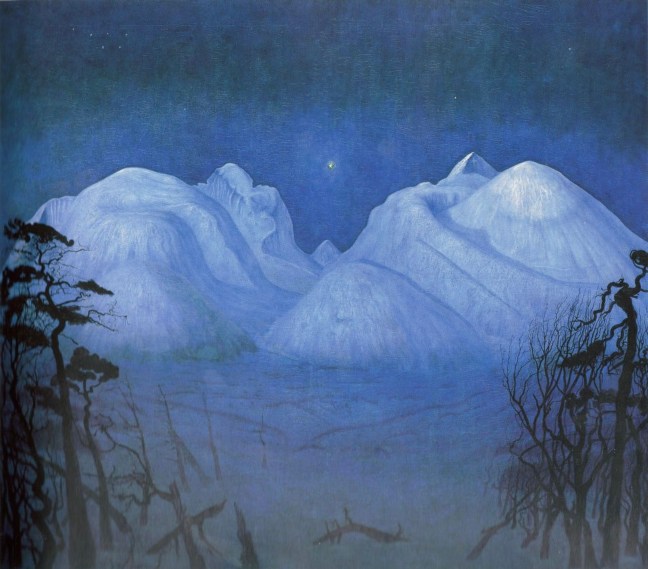
‘Winter Night in Rondane’ – Harald Sohlberg, 1913 – WikiArt

The body-mind is not an apparatus that stands on its own. It is an instrument of awareness. It is supposed to bear and implement the innate qualities of its owner as pure, unlimited being. This is why it has pain and suffering: When all such qualities have failed to be transmitted. When awareness is being short-circuited. Suffering is the complaint of God that is inbuilt in the body-mind system. It is God’s intelligence revealing itself to ourself when we have become blind to our true nature. So we have to align ourself to the depth contained in the knowing of our being, to be ourself that vastness, and allow it to shine in our experience. This is the golden avenue to peace: to be ourself an expression of the divine being that is lending itself to our constitution, lending its body to the body of our bones, blood, and skin, and lending itself as a container for our thoughts, sensations, and perceptions.

We never had a solid body with a life of its own. A dying body is not just a body that fails to sustain itself. It is consciousness calling itself back to itself, and in that process making the body-mind instrument ever more soft and porous, leaving it ever more shining, ever more acquiring the qualities of its essence as pure being. It is also a mind that is made less ambitious, losing its carapace of wanting, needing, seeking, expecting — the suffering that it all implies. A mind that is slowly giving itself in, to return to where it never left, and espouse its natural receptacle as pure awareness. This is how death comes to be so readily accepted. In the course of this transition. In the gift that death is in last analysis. For your body is not your body. It is God’s being in disguise. As for your mind, it is but God’s infinite mind borrowed. So you never truly lose your body. You never truly lose your self. And you are not confined to your body-mind in this life. You just come to realise the presence of another truer, finer body. A body that extends itself to the width and length of the world. And you notice that your mind is not restrained to the perimeter of your skull, but hosts unbridled, measureless, the world that is your body, with its infinity of variables. This is how body, mind, world, God, life, death are discovered to be one sublime being, bound together by the vital fluid of love.

.

~~~

Text by Alain Joly

Painting by Harald Sohlberg (1869-1935)

~~~

.

Website:
Harald Sohlberg (Wikipedia)

Suggestion:
Other ‘Ways of Being’ from the blog…

.

Isn’t Life a Simple Thing?

We as an apparent body and mind are nothing but the conditions met for the apparition of a world and all the resulting experiences that take place within it. We are simply housing the thoughts, feelings, and sense perceptions necessary to enact experience, and give it a shine of reality. But the essential of what we are is neither in thoughts, nor in feelings, nor in sense perceptions. The essential of a mind is made of consciousness. Awareness is its structure and its backbone, without which there would be nothing left. If it wasn’t for its awaring quality, our mind would be no mind. Our thoughts would crumble and disappear to never reappear. Our feelings and sensations would suddenly blacken and decay in an instant, to be never formed again. And the world would be swallowed back into infinity, if it wasn’t for the consciousness that gave it its essence and knowability. Look as you may, you won’t find a mind of your own anywhere. At best, just a few scattered thoughts, and the momentary and illusory appearance of a self.

Observe carefully. A few thoughts can never make a mind; and neither could some random feelings. You couldn’t own the necessary self that you need to function in a world, without some inseparable and indispensable measure of knowing. So it is all about knowing. It is all about being conscious. Awareness holds it all together — your body; your thoughts and feelings; your world as sense perceptions. All of these come into existence at the only condition that an ‘awareness’ is present. If awareness goes, you go. If consciousness goes, everything with you go. The world goes. No bodies viable. No flower fields. No Milky Way. Everything falling apart. Universe shut black. Just a mess! That’s the power of consciousness! Far from being a mere function of the body, awareness is what holds the body and the world together. It is the essence of everything. It is the indispensable matrix. It is the ocean in which the waves and currents of thoughts, sensations, and world are dancing. And it has no home where to rest but itself. In fact, it is itself a resting place for all apparent minds, bodies, things, selves that make up a world. Consciousness gives existence with its being, allows relationship with its knowing faculty, and brings the consolidation of happiness with its loving nature. Then it returns into itself and stays there, in utter peace and completeness — replete with itself. And when you have seen it all as it is, and yourself as you are — indivisible being — then might come simply a swell of awe. God, isn’t life a simple thing?

.

~~~

Text and photo by Alain Joly

~~~

.

Suggestion:
Other ‘Ways of Being’ from the blog…

.

A Loss and a Gain

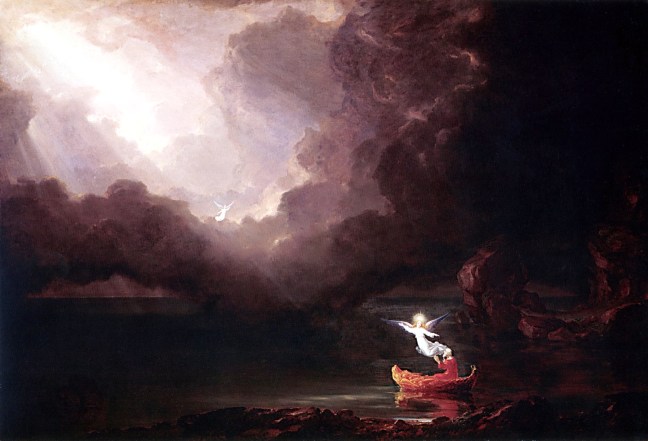
‘The Voyage of Life: Old Age’ – Thomas Cole, 1842 – WikiArt

Well, at some point in our lives, we may start to make a rapid calculation. It may dawn on us that if we had counted on this body and mind to represent us right through the end of life, well… let’s be blunt on this: that’s certainly not our best investment. Old age will make it clear that, after a certain time, if we wait long enough, everything begins to go wrong with our bodies — and so with our minds. We-our body are losing it. New pains arise. Strength diminishes. Memory capacity fades. And disease is lurking. There are threats accumulating, to say the least. We have to come to terms with this plain fact of existence: we will never go back to where we were. We cannot keep holding on to our body, continue having faith in it. This constant hoping for a better body, or a healthier mind, has to end, and this is now. In a way, it really is something to laugh about — a sort of cosmic joke. How could we have been so naïve? This simple and inescapable fact shows — if we needed that kind of confirmation — that this body and mind is not the place for a healthy sense of being. We need to find a way out of this faulty understanding.

We find health in our innermost being. That is the answer. And the body is not this being. It doesn’t represent it. It is not its temple. The body exists but it is not being. Only being has the right and capacity to be. The body is at best a distant vassal. A tool. It is not the home of our being, but rather, it finds its home in being. It rests there. It can borrow its qualities. It can make Being its beloved teacher, if it is wise and humble enough to espouse Being’s extraordinary traits. Then the body and its companion as mind might feel enlarged. They might find their true essence as infinity and eternity. They might acquire a soft and gentle making — less heaviness. And the body-mind will be lit with a strange transparency. It will slowly give up its hard matter-like making in favour of a more airy essence. It might surrender itself slowly while still being alive. Then the natural flaws of its ending will have very little meaning — not something to be afraid of. For its death has already been achieved in love — its true essence. Then its apparent shortcomings and loss will be found to be the supreme gain of life itself. We enter a new kingdom, where death can never be death. It is simply the extinction of everything that wasn’t truly ours in the first place. It is a gentle clarification, and the revelation of our essence. “You may die, my dear body, you may fail and disappear, with your companion-mind, but I will meet you on the burning ground and see you rise again as ‘I’”. This is the meaning of old age and death. This is the gift of our apparent failures. To be raised and revealed as essence. See… we won’t lose it.

.

~~~

Text by Alain Joly

Painting by Thomas Cole (1801-1848)

~~~

.

Website:
Thomas Cole (Wikipedia)

.

Other ‘Ways of Being’ from the blog…

.

The Sadness of Life

The sadness of life is this –
the emptiness that we try to fill
with every conceivable trick of the mind
.”

~ J. Krishnamurti

.

~~~

Quote by J. Krishnamurti (1895-1986)

Photo by Alain Joly

~~~

.

Bibliography :
– ‘Krishnamurti’s Notebook’ – by J. Krishnamurti – (Krishnamurti Publications of America, US)

Website:
J. Krishnamurti

Suggestions:
Beauty in Essence (other pointers from the blog)
A Day at Brockwood Park (Homage to J. Krishnamurti)

.

The Great Mystery

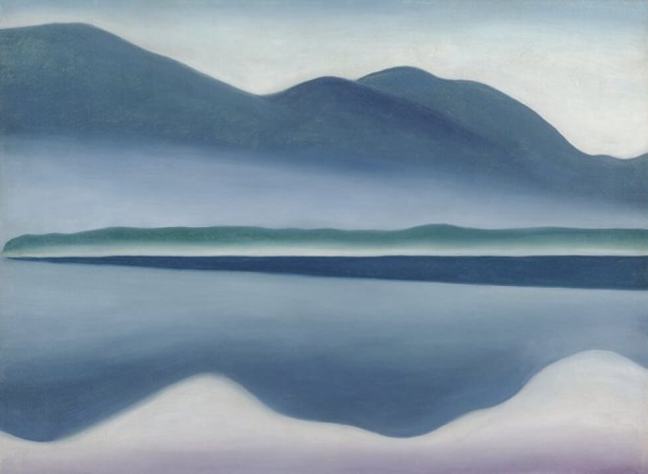
‘Lake George’ – Georgia O’Keeffe, 1922 – WikiArt

Bernardo Kastrup is my newly invited guest on ‘The Dawn Within’. Bernardo is a Dutch philosopher and computer scientist who is reflecting on the questions related to mind and matter. His field of study is the nature of empirical reality — of the world we see — which our culture has defined to be fundamentally outside consciousness and made out of matter, with consciousness or mind being a product of that matter. Bernardo Kastrup is tirelessly challenging that idea through his proposition that ”reality is essentially mental” and that “matter is nothing more than the extrinsic appearance of inner experience.” 

Bernardo has worked for the European Organization for Nuclear Research (CERN) and the Philips Research Laboratories (where the ‘Casimir Effect’ of Quantum Field Theory was discovered). His writings and essays have been shared in his website  Metaphysical Speculations’, in his ‘numerous books’, and in many ‘thought provoking videos on YouTube’. His ideas have also been featured in scientific or philosophical magazines.

As an invitation to discover Bernardo Kastrup’s work and ideas, I have selected here a short essay, a few excerpts, and a poem that I hope will unravel this great mystery that lies beyond the nature of our every day reality and world. I hope you will enjoy…

~

I argue that we do not need to postulate a whole universe outside consciousness – outside subjective experience – in order to make sense of empirical reality. The implication is that all reality, including our bodies and brains, are in consciousness, not consciousness in our bodies and brains.”
~ From Bernardo’s article ‘My philosophy and quantum physics

[…]

Explore Bernardo Kastrup’s work on the nature of reality… (READ MORE…)

.

This is Meister Eckhart

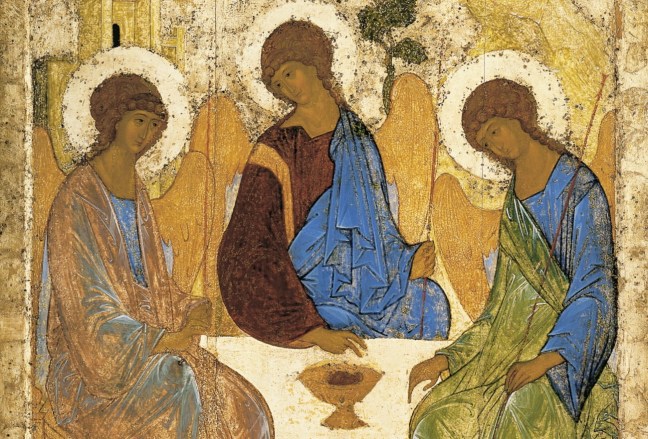
‘Trinity’ – Andrei Rublev, 1410-1420 – WikiArt

.

The eye wherein I see God 
is the same eye wherein God sees me; 
my eye and God’s eye are one eye, 
one vision, one knowing, one love
.”
~ Meister Eckhart

.

In the Middle Ages, in the heart of Europe and of the Christian faith, rose a voice of such richness and profusion, of such dumbfounding wisdom and precision of thought, that it is a duty for all serious seekers to be reminded of it. The name shines with a polish of spiritual mastery and authority: Meister Eckhart. Eckhart von Hochheim OP was born in 1260 near Gotha in central Germany. OP stands in Latin for Order of Preachers, which is a mendicant order of the Catholic Church — better known as the Dominican Order — of which Meister Eckhart was a monk and a leader. His teaching and sermons left a deep impression but he was so ahead of his time and of the general understanding of his pairs, that his work went into oblivion only to reappear in the 19th century. His voice and light could not possibly be left unnoticed. He is now accepted as one of the most profound and eminent theologians, philosophers, and mystics of all times.

Little is known about his family and early life. From 1295 onwards, he held many posts of responsibility in various states of central Germany, and as far as Cologne or Strasbourg. Among others, he was a Prior of the Dominicans, managing tens of convents, and was later made Provincial of Saxony. He also travelled around Europe and more specifically to Paris where he studied Aristotle and the Platonists. With the degree of Master of Arts, he later on became a professor of theology at the school of Dominicans in the French capital and was invited as a magister — equal to the doctorate — for two consecutive years. At this time in Europe, during the Avignon Papacy, Christianity was prey to many tensions and confusion, the Inquisition was blowing a wind of suspicion and terror, as a result of which many new groups and movements were forming in search of new avenues of practice and understanding. It goes without saying that Meister Eckhart was a coveted source of wise counsel in these times of darkness. 

Let’s say it plainly: Meister Eckhart was a scholar, but it is as a preacher that he is most remembered. His sermons in the vernacular German were highly unusual for the time and took many a liberties with the conventional church rituals and dogmas. He stated: “When I preach, I usually speak of detachment and say that a man should be empty of self and all things.” […]

.

Blessed, supremely blessed, are they who are installed in the eternal now, 
transcending time and place and form and matter, 
unmoved by weal or woe or wealth or want, 
for in so far as things are motionless they are like eternity
.”
~ Sermon 16 

.

An exploration into the teachings of Meister Eckhart… (READ MORE…)

.