Overflowing Questions

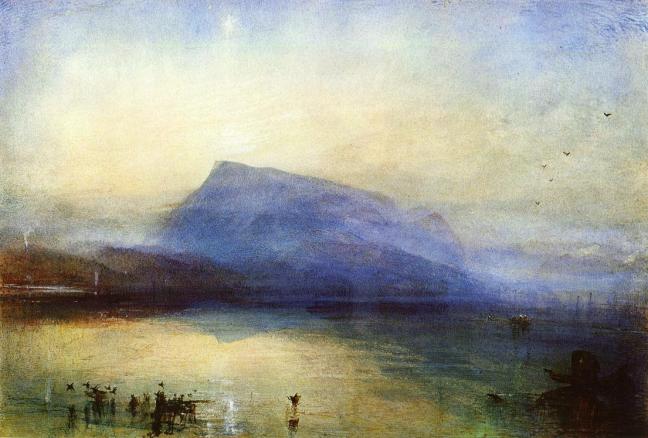
‘Edge of a Lake (Souvenir of Italy)’ – Camille Corot, c.1855-60 – WikiArt

Wouldn’t you like to have a knowledge which cannot be surpassed, which amounts to everything? That has in its core the truth of living, the philosopher’s stone from which everything springs, and to which all appearances owe their existence to? Actually, don’t you already long for it, and have done so for as long as you can remember? Is it not what you secretly hope for in your life? To have this knowledge, this direct access to the peace of your being? To have it here at hand, like a secret bond which you can find under and within every difficult situation, every outrage, every burst of suffering? And wouldn’t you love to harvest what this intimate knowledge contains? Its most reliable sense of joy, of contentment, and see yourself plentiful, complete, enough, in an absence of need? Wouldn’t that be great? To uncover it, and let it find its natural place in you, and as you, easily, without your doing very much about it? Wouldn’t that be great? Would anything be more valuable to you? Would that not be worth a life? Any life?

And what if you were told that you are not this bunch of objects which you have believed yourself to be — these endless qualifications, and the myriad of thoughts and feelings to which you have tied yourself with? Wouldn’t that give you freedom, a sense of release? To be unattached, not bound to your body-mind, at least not in a fundamental way? Wouldn’t that be healing, to be not the body but what holds it in its embrace? Wouldn’t that be soothing, to be not the mind but that which lends it the space to wander about? What is to you more elating and convincing than finding yourself naturally, effortlessly, in a place of health and vigour? The body’s ailments? The mind’s silly wanderings? Well, what if they were not really yours? Wouldn’t you like to find out, what would be their fate when left alone? What could be their trajectory when you rest peaceful in your own healthy, infinite body of awareness? Wouldn’t that be great to make this discovery? To have the final answer behind all that has been troubling you for so long?

And what if you were to uncover some even bigger findings? That behind your long, busy, eventful, suffering life, there has been a stillness, a silence which couldn’t be stirred or broken? And that nothing truly ever happened in your life? That it has been just a passing dream? What would be the implications of that ? And what if you were to find out that the world is just only clothed by the awareness of it? That it is not there in the way you had imagined so far? And that behind it all was also dawning the certainty, the knowing of your immortal, undefeatable nature? Wouldn’t that be wonderful? To see, feel, touch the truth of it with your hands, that death is a myth? That it is not there? Not in the least? Wouldn’t that be extraordinary? That things do die but not you? That body does become ashes but not you — not that which you truly are? That mind withers away but not you — not your primal being which you have to concede is eternal, is infinite? Wouldn’t that take your breath away? Wouldn’t that blow your mind?

.

~~~

Text by Alain Joly

Painting by Camille Corot (1796-1875)

~~~

.

Website:
Jean-Baptiste-Camille Corot (Wikipedia)

Suggestion:
– Other ‘Reveries’ from the blog…

.
The Impossible Deed

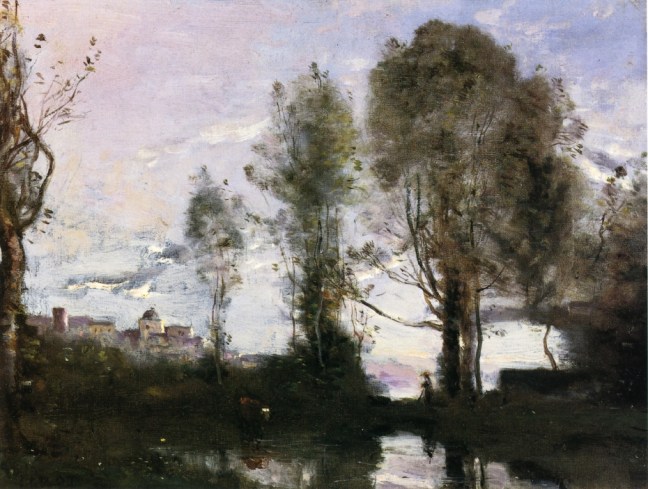
‘Pond in the wood’ – Albrecht Durer, 1496 – WikiArt


We are used to knowing
. We have been trained in it, brainwashed with it, and drained by it. Knowing has been privileged at the expense of being. So we have become expert knowers, professional doers, but at being, we are infants, clumsy, penniless. We are without a self worth the name. We are homeless without knowing it. We are without a solid ground — a trembling, uncertain little thing living in the wilderness of objects, battling in the haziness of beliefs, having no place to truly be, to truly rest. We are a wanderer of ignorance, a nescient soul lacking the elementary knowledge of its own being.

But OK, I will give us that. I understand this urge to know. Knowing gives us a bright, shiny sense of self. A fantastic ego. It is rewarding. Being gives nothing, is completely unproductive. At least, so we think. But this knowing of our being is not any kind of knowledge. The will to know the ‘I’ is a sacred will, a holy endeavour. If we want to know ourself, we will come to know it. This is a desire that cannot be left unfulfilled. This knowledge cannot resist any serious enquiry. It will give in sooner than we think. But it is a hard one to desire. The difficulty resides in wanting to know. We shy away from that desire. There is something there we’d rather stay away from. We would rather know beforehand what we have to know, and remain on shallow land. We don’t want to rock the boat of our being. After all, this is where we stand. We don’t want to be swept away from our cherished ideas and beliefs, and be deprived of the security we have so dearly earned. We would rather stay a seeker of the known.

But try it now — to know yourself. And do it with your mind, with your usual knowing faculty. Go there, at the heart of your self. Decide it. Make it your goal: to know who or what you are. It doesn’t matter where you begin. But go not to the periphery, to that which you can know as an object. Go to the heart of your self, to that thing which you have called ‘I’ all your life. What is this ‘I’ that you are being all the time? This ‘I’ is never visited. But now is the day. Go there. Find out what it is. See that you will meet there like an impassable, impenetrable wall. You will find closed doors. All your knowing, your ego, your accumulations: this has made a blocking stone. This has barred the entry, has prevented all true seeing, all knowing worthy of the name. Feel that you cannot go there with your mind. But this impossibility is gold. So keep at it. Keep pushing. Don’t be shy. Use both shoulders if needed. Give it all the strength you have. It will recede. I promise you. Everything can be known. This is no exception.

Notice that what you come against is yourself. This impossibility of knowing the ‘I’ lies in your belief in being an entity. The knower is the obstacle, the impassable wall that bars the way. To know yourself is an impossible deed. You can never know who you are, because who you are is only contained in ‘you are’ — in the feeling of ‘I am’, of being. We are so unaware of our being. Being has been forgotten, relegated in the background, replaced by a knower, a doer, a busy self that insists on knowing who he or she is. But to know ourself, the knower has to first realise itself as being. To know is to be, and to be knowingly. This knowledge dips its reality in being. There is no knowing ourself without being first. Knowing here is only achieved through being, which is the knowing of ‘I’ without a knower. The will to know dissolves into being, which is the only knower there is and will ever be.

This knowledge is found in and as the being of the one who wants to know. You can only know who you are by being it, or rather by simply and only being. In that field of self-knowledge, being is knowing. Being is the knowing done without a knower, and therefore without an object known. It is a pure, unalloyed knowing. Everything you ever wanted to know, to be, attain, achieve, all the content of every sacred book, all happiness, all longings, is found in being, in that which you already are. Your amness is the gate code cracked. You will find who you are on the other side of knowing, which is being. And it is delivered with peace, which is the nature of being. This knowledge is the only knowledge that doesn’t take place in duality. It is achieved in the oneness implied in plainly being. So this impossible deed has now been transformed as the infinite being that we were all along, but had veiled through our insistence in being a knower of the known. We don’t know who we are with our knowing faculty. Ourself is the only thing we cannot know as an object. We know our identity through the fact of simply being. There is no other knowing than being. Being is what we are, without a single ripple of a knower knowing. Know that and you will be reborn as the unborn.

.

~~~

Text by Alain Joly

Painting by Albrecht Dürer (1471-1528)

~~~

.

Website:
Albrecht Dürer (Wikipedia)

Suggestion:
– Other ‘Reveries’ from the blog…

.
Of Dimitry’s Prayer

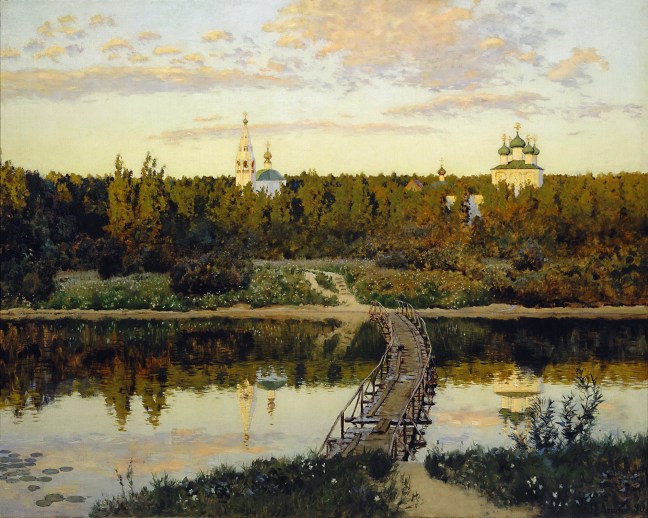
‘A Quiet Monastery’ – Isaac Levitan, 1890 – Wikimedia

.

Open, O doors and bolts of my heart,
that Christ the King of Glory may enter!
~ Dimitry of Rostov

.

Prayer is an invitation for what is already here to show itself up. It is not that you already know who you are, and that you-the person are begging for a supreme entity, or for an other, to come and soothe you, for an external, benevolent providence to shower you with its benefits. Remember that there is no other entity than the entity of your self, no other providence than the providence of recognising who you are. Nothing, in matters of peace and happiness, could ever enter into you that is not already there. So don’t make that mistake over and over again: to wait for someone knocking at your door, to hope for something to fulfil you, to expect a new element to enter your life. The benefit of life is not with something you receive, but in what you recognise yourself to be. So prayer is prior. It is not in reaching but in realising, not in expecting but in recognising, not in receiving but in noticing, and not in having or possessing, but in being.

So always pray as if you were utterly alone. Pray as if you couldn’t ask anything, anyone, any favour or event, to give you something that is not already there in you, as you, expressed as your very own being. Notice that nothing of worth could ever enter your house that is not already present, already eating at your table, already thinking the thoughts you think, already dreaming the dreams you dream. This is how Dimitry’s prayer ought to be uttered.

[…]

More reflections on a prayer by Dimitry of Rostov… (READ MORE…)

.

The Unknowable

‘I don’t know anything about myself’. That’s where to be in life — in this position of not knowing. We are always piling up informations about ourself. We are so eager to. That’s our money. Knowledge is our currency. But see what knowledge has done to us. This constant knowing that I am this, and I am that. This knowledge hurts us, brings shame on us, or regrets, judgement, suffering, hope, belief — it fills us with what we are not. I understand that you so want to fill yourself up, that you fear being nothing. But try it. Try it once — to not know anything about yourself, which is a position of truth. You can know about anything in life, but see that you can never know yourself as an object. If you know something — anything — about yourself, this thing is in fact what you are not.

Therefore know that what you are has to be kept thoroughly empty. Believe me. Don’t fill it up ever. Yourself must be left unknown, pristine. This is from where you can fully watch and listen, from where you may invite anything and anybody in: In yourself — which is not yourself — and which you cannot know. I know, you have been told on other occasions, to know yourself. But they in fact meant: Know yourself as that which is spotless, innocent, untouchable, and absolutely unknowable. Keep it that way. Don’t crowd it with ideas or beliefs. Don’t think that you know it. You can’t. Keep yourself virgin of knowledge, and invite anything or anybody you meet along the way in that place of emptiness, in that clean spot of sacredness. That’s the place to be in, the place which you borrow from God’s being and which you can never know. This is the place of no suffering, of no shame or regrets, of no hope, and of no thing to battle with. This is what happens when you don’t know yourself: you don’t judge, you have no contempt — for you know that the other is as yourself, unknowable.

That’s the beauty of it, that I cannot know anything about myself. I remain free — free of accumulation, free of being something. Therefore open, available, fearless, which means peaceful and contented. But it is not something you should do or stop doing. Just notice it, that you yourself is the only thing in the picture which you cannot know, that you yourself is the unknowable element of your living experience, the one thing that you cannot touch in any way. Anything that you may do about yourself will be a corrupting factor. For what you are doesn’t need to be changed or improved. In fact you cannot, so you might as well not start in the first place. Stay away. Keep your deepest self or being as that unknowable portion of yourself. Leave it as it is: uncorrupted and incorruptible. Experience the space and freedom that you acquire as you take your stand as that deeply cherished and unknowable self. Be unknown to yourself.

.

~~~

Text by Alain Joly

Photo by Elsebet Barner

~~~

.

Suggestion:
Other ‘Ways of Being’ from the blog…

.

The Impossibility of Knowing

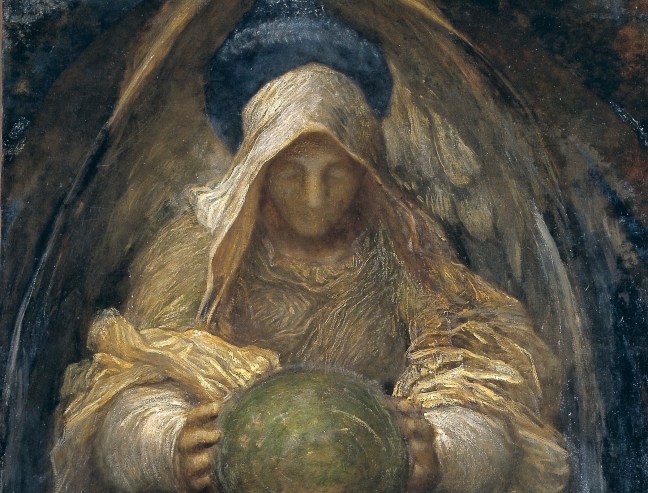
‘All Pervading’ (detail) – George Frederick Watts, 1887 – WikiArt

.

Beat on that thick cloud of unknowing
with a sharp dart of longing love,
and do not give up, whatever happens
.”
~ The Cloud of Unknowing (Anonymous)

.

Habit is a driving force in our lives, yet it doesn’t have good reviews: it is an object of critics. It is making us dull and repetitive. It is non-creative, indolent, designed for our self-protective needs. It is born out of fear, uncertainty. It is a shield for what we feel bullies and thwarts us, and is thereby blocking our sensitivity and vulnerability. Habit debases love. But habit is not the real culprit in this affair: it is a victim of the one more fundamental habit of knowing.

Humanity is steeped in apparent knowing. We all have a posture of knowing. To know is the great pretension. Games are invented to praise and reward the people who know. The injunction to know is overwhelming. It is the believed road to success and wealth. Not knowing is a humiliation. We could take pride in knowing anything, in being ignorant, in the most ridiculous things, only to save us from being suspected of not knowing. For knowledge is believed to be gold. But although conceptual knowledge is indeed of great value in our society, the posture of knowing is nevertheless the greatest impediment to seeing who we truly are, and how to live our lives free and happy.

We don’t speak here of knowledge in the sense of conceptual or relative knowledge. Most of the knowledge necessary for our body and mind to function in the world is valid and necessary, of course open to mistakes and misinterpretations, but is not what we are discussing here. We are investigating fundamental knowledge, or knowledge as essence, the primal act of being.

[…]

An essay on the articulation between knowing and not knowing… (READ MORE…)

.

To Know Better

.

Knowledge about yourself
binds, weighs, ties you down
.”
~ J. Krishnamurti (‘Notebook’)

.

Humility is the mother of all virtues. For it places us in the right attitude of not knowing, not arguing. To know is to be situated, to have a perspective, a point of view. To know implies to be a person, to be apart, external. And it also implies to suffer. It’s so easy to know, to boast, to show off. We don’t want to be unmasked as ignorant. To know has become a reflex. To know is to claim ‘I am here’, ‘I count for something’, ‘I need fulfilment’. Therefore to know is to fear death. To know is to project, to be the hostage of time, of becoming. ‘What if I don’t become anything?’ To know is to posit a person that needs and lacks. To know is to lock ourself in a world of finite things. It is to exist only in the limits of our own self-created boundaries. To know is to block creativity. To know is to dismiss god, life, for not being competent. It is to invite the big rock of our conditioned thoughts, feelings, and memories, and in doing so, conceal all other entrances or exits. No flow is possible.

Have you ever felt these moments when you don’t know? When you taste the presence of your own absence? When you discover your sense of separation to be imaginary? At the moment you feel one with all beings and things, you are bound to be in the unknown, to not know. How could you possibly know to be anything, when you are merged with presence, with experience? You don’t have the necessary distance to do so. And this absence of distance is the experience of your sweet self. Don’t be the one who knows, but the one who is the knowing. Don’t affirm yourself, but be affirmed in the knowing presence that you are. By just being, you will know everything that needs to be known. You will have everything that needs to be had. And it will be offered to you on the silver plate of love, beauty, and happiness. You cannot know better.

.

~~~

Text and photo by Alain Joly

Quote by J. Krishnamurti (1895-1986)

~~~

.

Bibliography :
– ‘Krishnamurti’s Notebook’ – by J. Krishnamurti – (Krishnamurti Publications of America, US)

Website:
J. Krishnamurti

.

Other ‘Ways of Being’ from the blog…

.

Jñāna, the Song of the Self

Without me here, to know experience, 
how could this experience be?

~ Aitareya Upanishad, I,3,11


It happened long ago, during a morning stroll behind my house. I was contemplating my deep sadness and my desire to change, when a simple intuition came uninvited. I felt that it was possible to change and I had the power to initiate it. I felt that this change, this cure for my unhappiness was to be found in myself. I felt that it was all happening here, in this me-presence, and that the necessary tools were all provided in me. No reliance on any external authority. It was the intuition, not that I-the little me with its conditioning could do it, but that there is an inward process for accessing this change, this seeming transformation, in other words, happiness. And this process could be implemented, carried out through the tools of thinking, logic, understanding, which are my natural inclination. I had just discovered the very nature of the path of knowledge.

So I’d like today to make an attempt at better understanding this path of knowledge which has been named ‘Jñāna’ in the tradition of India. It is an interesting word which shows the family ties with many of our European languages. In Sanskrit, the word means ‘knowledge’, the root ‘Jñā’ being close to our English word ‘know’, or the Greek ‘gnosis’, the French ‘connaître’, all words that convey the idea of ‘knowledge’. Jñāna is one of the three main pathways towards realising our true nature, namely the path of knowledge, which involves the process of thinking, the path of love, ‘Bhakti’ in India, which involves feeling, and the tantric path, which involves the senses and thereby the so-called external world. It seems to me that there is some value in understanding the nature of each pathways and seeing how they can blend in our daily living and Sadhana.

An exploration into Jñāna, the path of knowledge (READ MORE…)