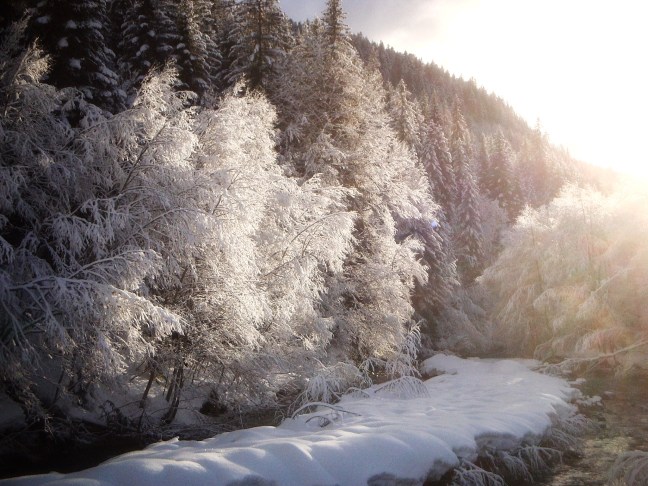
The Face of the Infinite

For many things in life, we are exigent, demanding. We won’t let things be as they are. We are picky — we want more and better. We expect, hope, resist, desire, and are rarely satisfied. We are seekers of advantageous situations, and have a good idea of what they can be. Yet when it comes to ourself, to knowing who or what we are, we lose all inquisitiveness. We take ourself for granted. We may want to be more loving, less violent, have more of the good qualities, and less of the bad ones, but who is the ‘I’ that desires these things, we don’t want to know. Maybe we have an intuition that there is great danger in uncovering our true identity. After all, it was never talked about, a sort of family secret that society doesn’t want you to interfere with. Even religion is not clear about it, that encourages you to rather follow, pray, and submit yourself to God, but not to know who you are. At least not in a clearly stated way. You may know about anything you want, but please keep yourself out of it. In fact, ‘Know Thyself’ is the least encouraged commandment in this world of ours, and that alone should be enough to fuel our curiosity.

So who am I? What is my identity? What is this last part of my experience that is yet to pioneer and fully settle in? Which has remained untouched, virgin of our constant and fanatic rummaging? Which hasn’t yet been recognised for the simple reason that it is not a place we can know, let alone go to? It is so ourself that it cannot be seen, felt, experienced as something objective, or as an entity. This land of ourself has slipped out of our attention. We are blind to our eternal home. We have left behind us, untackled, unidentified, in the darkness of our wilful mind, the vibrant sky of our being. So what is my true identity? What is this unchanging substance that is the formless form of my being? In other words, what am I identical with, or the same as? ‘Same’, in its most ancient etymology, has the meaning of ‘one’. So we can rule out all the separate, isolated objects that we project ourself to be — that includes our body and our mind, and the many thoughts we’re thinking. Our identity is not in something which we identify with, but in the expression of oneness — the one being that is by definition free from all identification. This identity with the One has been achieved from time immemorial. We don’t need to come back to it, to rehearse it, or affirm it. Our identity has dissolved into the One, which is identified with no other than itself.

Where does unity or oneness live in my experience? In what portion of my conscious being can I feel an absence of otherness? Where do I find in myself no distinction, variation, or divergence, not even a breach that would differentiate me from reality? Where am I wholly and only being? What is it that I truly am, with no intervention of a past or a future? Where is this within that is also without? What is this ‘I’ that I could never ever cease to be? Who am I when all objectivity and multiplicity have died down? Where do I find an absence of ‘me’ in myself? Or rather, where do I find a sense of ‘me’, in me, that is not already the ‘me’ of everything and everyone? Where am I when every remnant of a seeking mind has left? Where do I find an individuality that is not universality? Where could I not find God’s presence in my experience? Where is this ‘where’, where I can never say where, what, when, how, why to what I am? And lastly, where have now all my questions dissolved? Only settle for a living, silent answer. Any other verbal or conceptual answer at this point would ruin it all. It would be like slamming the door in the face of the infinite.

.

~~~

Text and photo by Alain Joly

~~~

.

Suggestion:
– Other ‘Reveries’ from the blog…

.
An Abundance of Being

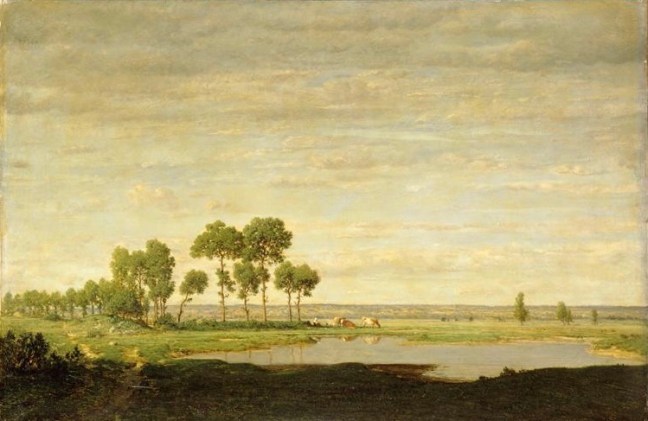
‘Spring’ – Theodore Rousseau, 1852 – WikiArt

There is a subtle recognition that takes place on the way back to yourself, when you stop keeping your mind at the level of avoidance or entertainment. At that binary level you are unrecognisable. You live in a world of your own, in which nothing represents who you are. You live in your mind, pushed around by a never-ending storm of endless reactions and pursuits, unaware of what you are — or even that you are. You are surrounded by opinions and beliefs that limit you, and plunge you into a self-made ignorance. You live in a bubble where illusions have formed the world in which you are caught, and to which you have given yourself up. In there you are as it were hidden from the gaze of god, and the awareness of your divine making or reality is eluding you.

As there is no sense of belonging there, you may feel cut off, lonely, lacking an essential part of yourself. You are suffering from having deviated from your inborn identity. You have forgotten who you are, and are roaming from thought to thought, and from experience to experience, in search of something that will finally complete you. And the tragedy is that you will never find it in the place where you look, for that place is precisely what is separating you from your real self. That place is imaginary, for it is the stage of your misunderstanding. You live in a vacuum, in your world of misunderstanding. All your life takes place within the limits allotted by your false beliefs about life. Where there is only a seamless reality, you have created an illusory boundary between yourself and reality. You have missed that you were yourself that reality. You have lost faith. You committed the sin of being a somebody, and in doing so have pushed reality out of sight, at a distance from you, making it, through the senses, the world in which you live, when you are yourself the reality in which the world appears, and from which it borrows its thousands forms. You have given birth to duality when there was none. Out of oneness, you have invented separation, and have invested all your life in this falsity.

But there is more to it. In veiling your true nature, you have made god unknown to you, and rendered yourself unknown to god. This is why you have religion and the need for a belief in god. But the reality that you have unknowingly pushed away through your desire in being a self separate from it, that reality is in fact what you have been longing for all your life, to complete you. And this completeness is nothing but god coming to live in you, as you, and electing your being as its being, while you yourself recognise God’s being as being your being. That’s how you know god, and are known by god. Simply by being only being, by purifying your identity to its ultimate, indescribable, indestructible, unsoiled essence. So nothing lives away from yourself. You contain it all. You are the receptacle for the spectacle of life. And knowing this will place you right where god has its gaze. It will place you in God’s being, which is the only place where you can be known or seen by god. So knowing yourself is knowing god, and god knowing you, without there being a god or a you. Being only suffices. God is where and when there is an abundance of being.

.

~~~

Text by Alain Joly

Painting by Theodore Rousseau (1812–1867)

~~~

.

Website:
Theodore Rousseau (Wikipedia)

Suggestion:
– Other ‘Reveries’ from the blog…

.
Know Thyself

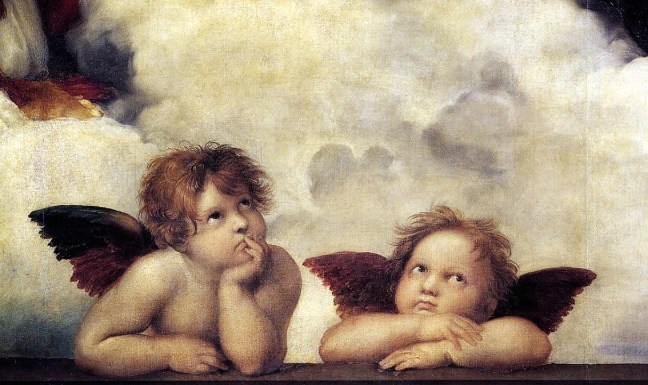
‘Putti, detail from The Sistine Madonna’ – Raphael, 1513 – WikiArt

.

γνῶθι σεαυτόν

.

Know thyself. Know who you are. That’s how simple it is. You may start from the far end, from a belief, a philosophy, an exotic term. You may call it religion, or spirituality, or non-duality — whichever name you want. You may go through the rugged path of belief, faith, practice, meditation, prayer, philosophy — all the names and concepts, the endless thinking about it, and the seeking that seems to never end. But now, when you stop and consider it all at last, you will come to the realisation that, deep down, it all comes down to that simple sentence. ‘Know thyself’. Not the knowing of your thoughts, ideas, opinions, feelings. Not your idiosyncrasies, or character, or outer shape, or preferences. None of that. To know oneself points directly to the knowing of your essence, of your innermost being, what you are made of at the core, when every other thing that can be pointed to has been discarded as superfluous. This is who you truly are. This maxim was once carved in golden letters on the front of the Temple of Apollo in Ancient Greece. That’s what this wisest of civilisations gave to the world as its supreme and most fundamental advice. ‘Know Thyself’.

So self-knowledge is the key. Of course, you may analyse it, take it apart, trace the endless chain of philosophers that gave their stand on this famous maxim, but I would not encourage you to do so. Sometimes, what’s really of crucial, definite importance resides at the simplest, closest address. The one you never truly considered for fault of being almost as nothing, a child’s play unworthy of your attention. Could it be that simple? That the meaning of the whole of life, the solution to our happiness, and the key to the whole riddle of existence could be found there, in the simple knowing of ourself? Let’s assume that it can and consider it seriously. Let’s embark on this shortest of journeys, the one going within, in the direction of our own self, where no distance is needed, no time necessary, and no special expertise required. This simple journey is the one of which the Ancient Greek poet and philosopher Ion of Chios wrote in the 5th century AD: “This ‘know yourself’ is a saying not so big, but such a task Zeus alone of the gods understands.”

[…]

A reverie that explores the path towards the knowing of our self… (READ MORE…)

.