Offerings of Praise

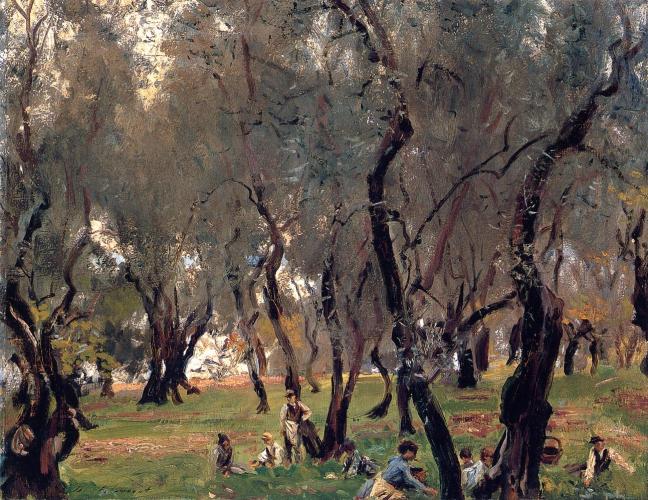
‘The Olive Grove’ – John Singer Sargent, 1908 – WikiArt

I don’t know if you have ever been in a gathering of truth seekers. Men and women willing to learn the truth of their being. Rendered humble enough to go through this discipleship. Battling to overcome their suffering. Journeying through the opening of their heart. Relinquishing their endless identities. Embracing infinity and friendship. If you haven’t, then I’ll leave this blessed and prominent ancient Christian theologian Ephrem the Syrian speak for it. Describe it in its own poetical terms. Tell you what it is like. Literally. And if you have, well then you have.
.

Who has ever beheld gatherings of people
whose sustenance is the giving of praise?
Their raiment is light,
their countenance full of radiance;
as they ruminate
on the abundance of His gift
there burst forth from their mouths
springs of wisdom;
tranquility reigns over their thought,
truth over their knowledge,
reverence over their enquiry,
and love over their offering of praise
.”

~ Ephrem the Syrian (Hymns on Paradise, IX:28)

.

~~~

Quote by Ephrem the Syrian (c.306-373)

Painting by John Singer Sargent (1856-1925)

Additional text by Alain Joly

~~~

.

Bibliography:
– ‘Hymns On Paradise’ – St. Ephrem the Syrian (trans. Sebastian Brock) – (St Vladimir’s Seminary Press)

Websites:
Ephrem the Syrian (Wikipedia)
John Singer Sargent (Wikipedia)

Suggestion:
Beauty in Essence (other pointers from the blog)

.
A Light to Yourself

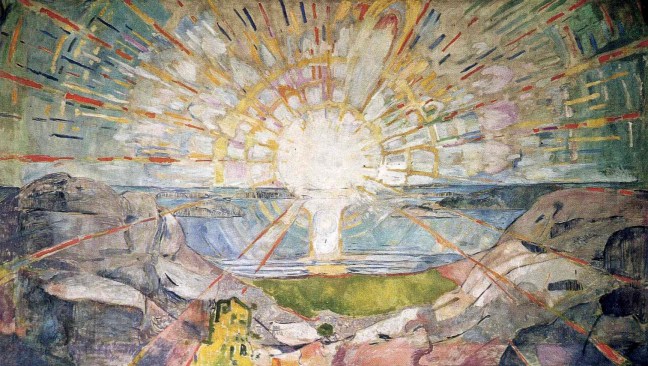
‘The Sun’ – Edvard Munch, 1911-16 – WikiArt

There will come a time when words will slow you down. When you will want to explore yourself on your own, without the help of a book or a teacher, free from explanation or guidance. You will want to follow your own trajectory, to be a grownup, and experience your beloved, impersonal, undivided self by yourself and through yourself. You will want, as Krishnamurti said, to “be a light to yourself“. You will find your own security there, in this light, at the source of your transparency, where you will find no division from where to be insecure. You will find your happiness bubbling from your infinite being, where no self can be located, and therefore no suffering. And you will be under the authority of your own being, that will show you the way, through a door eternally open and inviting. You will be on an eternal visit of yourself. And you will meditate, not to reach who you are, not to get there, but to rejoice in it, and give your whole attention to your beloved — though you already have her, have him, all day, on all occasions, near you, close, so very close to you. And you will feel her love as being so fully yours, that you will need no incentive, no set hours, to be being her own being. And you will see around you, and within you, so much beauty, that you will not have to look for it, other than by being with him, and within him. And you will be in need of no thought, of no TV show, to distract yourself from yourself, for how would you want to be distracted from being so wholly in love with the love of your life? So books will have become a bore to get you there, but you’d still read them as you read poetry. And a teacher will be of no use to you, but you’d still be eager for the company of a friend. And you’d go about your life with confidence, because you’re not alone to deal with it. Rather, your life will have become your being, and your being, your life. And at the same time, you will be alone, self-sufficient, in no need of anything, of anyone, to be fully yourself, to be happy. Therefore, you’d give yourself to all, to everything, you’d be a sharer of being, and a passionate lover of beings, and of things. Yes. That’s it. You’d be a light to yourself. A light to yourself.

.

~~~

Text by Alain Joly

Painting by Edvard Munch (1863-1944)

~~~

.

Websites:
Edvard Munch (Wikipedia)
J. Krishnamurti

Suggestion:
Other ‘Ways of Being’ from the blog…

.

Perfect Days

’Perfect Days’ – by Wim Wenders (with Koji Yakusho)

.

All my films deal with how to live.”
~ Wim Wenders

.

Why do we watch a movie or enjoy any piece of art but for the joy, happiness, or relief we derive from such activity? Well, sometimes we use a movie not so much to feel, but rather to stop feeling. We want to be alleviated from our sense of boredom, or be distracted from our constant worry, or have the lowest ambition to be rewarded with pleasure, plain simple pleasure which, if not delivered, will make us move on to something else. Film as an art form is ambiguous, for it has in itself an entertaining power which makes it the prey to our most suspect desires. Well, Wim Wenders, in this movie, wasn’t going to give way to that ubiquitous trap and fall. With ‘Perfect Days’, he made a movie in which there is no desire to be had, which offers no suspense, no excitement, no resolution of any kind, but from which you would never want to move away. A movie that describes the quiet, plain, orderly living of a man whose job is to clean public toilets in Tokyo.

Hirayama lives each and everyday as if it was a perfect day. For him, there is no possibility of failure in life. And he makes sure that boredom is an impossibility. So he cares. Hirayama cares about everything he does, and seems to be profoundly related to his modest home, to his morning toilet, and to the watering of his plants. He does what he has to do, with no judgment or resistance. He doesn’t mind. He feels his inner freedom. He has everything he needs, so he smiles at life and life smiles back at him. He breathes when he steps outside and looks at the sky as for the first time, the wonder of it all. Then he buys himself a can of coffee from a local vending machine, opens his van, sits, drinks a sip, chooses a song from a bunch of cassette tapes, lights the engine, drives, and listens to ‘The House of the Rising Sun’ by The Animals. For that’s where he is now, in the house of the rising sun, going to his work through the sprawling suburbs of Tokyo’s morning, undisturbed, confident, present.

[…]

A reflection on the film ‘Perfect Days’ by Wim Wenders… (READ MORE…)

.

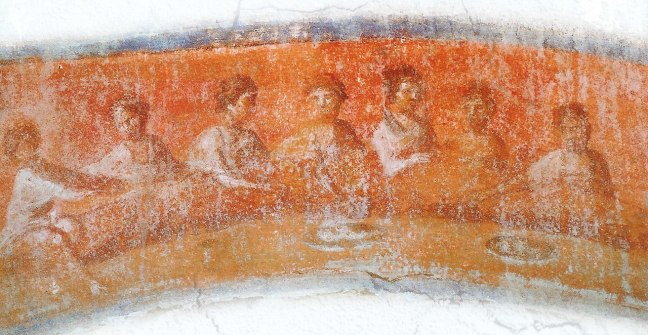
A Gathering of Friends

‘Meal of Holy Communion’ (Agape) – Unknown author, 2nd to 4th AD – Wikimedia

There’s been a gathering of friends lately. All gooey with being. It took place somewhere, in a place unknown, unlocated, kept somehow secret, where they all came to share wildly, and taste of a love supreme. You may want to know that place, to locate it, to find it as being somewhere where you can go and share some of that exquisiteness too. Well, now you have to think twice. For as the dictionary says, unlocated means ‘not surveyed or designated by marks, limits, or boundaries’. It is a place of no location. A place that has no geographical situation other than being here. A place that you cannot find within any noticeable limits but that englobes every known location. That place which you cannot find or reach, which has no known address, and which is kept secret behind the usual, well-trodden frontiers of your everyday experience, is yourself. Not your usual self, which you are well acquainted with. That one you have to be cautious of, or even warned against. No. Not that one. There is more to yourself. There is more than this located entity, with marks, limits, and boundaries. More than where your thoughts and beliefs have placed you in. There is a place in yourself that is not a place, that finds itself in no well-marked location, but that you could never not be in. Would you want to go there, that you would have to notice first that you are already in, already placed at the seat of honour, already warmed by its blazing hearth. This only is the heartfelt, spaceless, timeless location for all gatherings of friends. This is the land of your supreme heart, that you share with all living beings under the sky. There you have lived of all eternity without your knowing it. There you cannot go but only be. This is the event you are already signed in for, a retreat where you share the secret address of your deepest being with other fellow friends, and lit a bonfire of love. It may be a gathering of one or a hundred, in company of the wise or the ignorant, with the lighting of a sumptuous blaze or many a scattered sparkle or glitter, it doesn’t matter — there’s been a gathering of friends here and you as being were its gorgeous venue.

.

~~~

Text by Alain Joly

Fresco of Agape by Unknown Author (2nd to 4th AD)
(from Greek chapel, Catacomb of Priscilla, Rome)

~~~

.

Websites:
Catacomb of Priscilla (Wikipedia)
Agape (Wikipedia)

Suggestion:
– Other ‘Reveries’ from the blog…

.