Demons and Angels

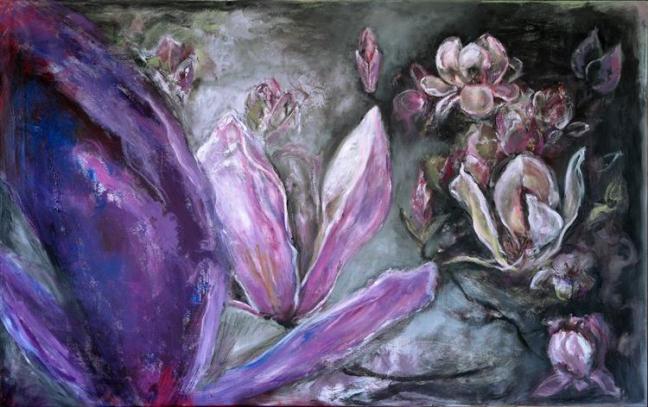
‘Magnolias’ – Carmen Delaco, 2022 – WikiArt

We are only ever made of thoughts. Sometime, thoughts come elaborate, with clearly defined words, perfect punctuation, following their due purpose. And sometime not. Sometime, they come as lightnings, striking us with a belief, an old stale repetitive assumption. Sometime, they linger unsaid, not pronounced, sneaking in but making untold damages. Sometime they don’t even need to be expressed. They have taken us over, have made a puppet of our life, tearing it apart in every mindless direction. All these thoughts are like little devils, unseen demons, unnoticed burglars stealing our identity. We have been brought to our knees, at the mercy of every one of their injunctions. We have been made just a collection of them, and nothing but an assumption. An idea of ourself. A self literally made up by the constant assault of thoughts, and by our believing them — belief being yet another thought.

Look in every direction you may. Notice here the coming of a hope, of a longing that takes form, but is yet just a thought. And when a worry comes, that this longing may never be fulfilled, it is just another thought that comes dancing with it. Attend to your expectations, to how you now imagine a future event. See how this evocation of the future comes as just another thought in your mind, for there is only ever thinking about the future. The future doesn’t exist, is always only imagined by a random thought. A regret, a desire, a fear, any bout of suffering or satisfaction, any feeling, comes wrapped in and as a thought. Thoughts are everywhere in our world. Even our body, our action, our world, are coloured and shaped by a thought or an image that condition their being perceived. A habit is a thought that took root and grew confident, unchecked, and many of our conditionings were once thoughts that have formed to become the established norm. As long as there is a thought somewhere in the system, that comes to define us, to give us a stand, an identity, that identifies with the body, that separates from the world, that gives a fleeting joy, or a tenacious pain, then we are not alone. We are not independent. We are not being our own identity. We have given it all up to thoughts, and have lost our being in them.

So go behind it all. Go before everything that appears for a while and recedes. Go before every worry, every hope, every mindless desire, behind every dull satisfaction that lingers lazily, every fear that strikes and leaves its trail inside you. Go to the place in you before every thought. Visit that portion of yourself where thoughts are of no consequence, where they are made trivial, ridiculous in their powerlessness. Go where distance is not, for thought as time has created the gap between yourself and your true nature, a gap where hides every shades of conflict and suffering in yourself — which are again thoughts. And go where you discover yourself to be unbreakable, unsoilable, eternal, for death too is another of your endless thoughts, maybe the most perverse one, but one that doesn’t stand being seriously investigated. Notice that thought is always some kind of thing, and that there is one place in yourself that a thing, that a thought, will never touch, or affect, or change: it is that portion of emptiness in yourself, which is only full of itself, and is therefore inaccessible to a thought — any thought. That placeless place is your peaceful being, your identity, who you truly are. To stand as that will freeze dead all the many thoughts whose only function was to give you support or approval, identity or escape, or contentment. These are burglar- or demon-thoughts, that come to lie to you, and try to impose their views on everything and on yourself. But a thought that is starting its journey from that virgin place of being is but a devotee and an angel, respecting your true identity and carrying in its wings the offering of your being, which is love. It is but a servant of the higher intelligence of truth. In general, demons are many, and angels are but a few.

.

~~~

Text by Alain Joly

Painting by Carmen Delaco (born 1976)

~~~

.

Website:
Carmen Delaco (WikiArt)

Suggestion:
– Other ‘Reveries’ from the blog…

.

One Sublime Being

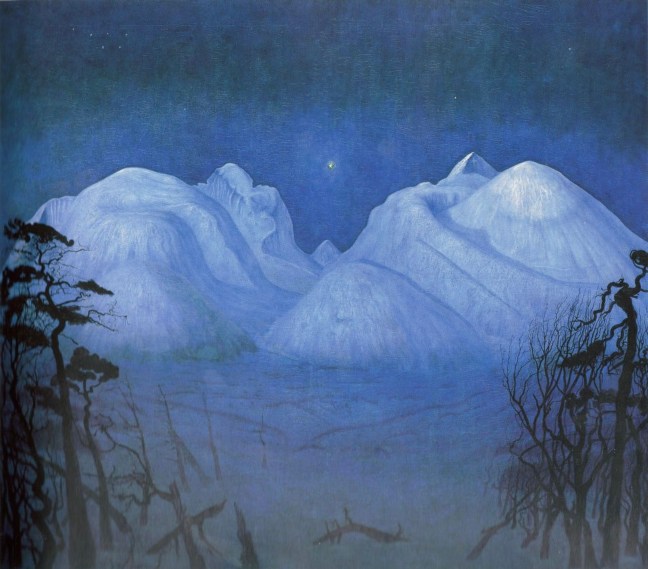
‘Winter Night in Rondane’ – Harald Sohlberg, 1913 – WikiArt

The body-mind is not an apparatus that stands on its own. It is an instrument of awareness. It is supposed to bear and implement the innate qualities of its owner as pure, unlimited being. This is why it has pain and suffering: When all such qualities have failed to be transmitted. When awareness is being short-circuited. Suffering is the complaint of God that is inbuilt in the body-mind system. It is God’s intelligence revealing itself to ourself when we have become blind to our true nature. So we have to align ourself to the depth contained in the knowing of our being, to be ourself that vastness, and allow it to shine in our experience. This is the golden avenue to peace: to be ourself an expression of the divine being that is lending itself to our constitution, lending its body to the body of our bones, blood, and skin, and lending itself as a container for our thoughts, sensations, and perceptions.

We never had a solid body with a life of its own. A dying body is not just a body that fails to sustain itself. It is consciousness calling itself back to itself, and in that process making the body-mind instrument ever more soft and porous, leaving it ever more shining, ever more acquiring the qualities of its essence as pure being. It is also a mind that is made less ambitious, losing its carapace of wanting, needing, seeking, expecting — the suffering that it all implies. A mind that is slowly giving itself in, to return to where it never left, and espouse its natural receptacle as pure awareness. This is how death comes to be so readily accepted. In the course of this transition. In the gift that death is in last analysis. For your body is not your body. It is God’s being in disguise. As for your mind, it is but God’s infinite mind borrowed. So you never truly lose your body. You never truly lose your self. And you are not confined to your body-mind in this life. You just come to realise the presence of another truer, finer body. A body that extends itself to the width and length of the world. And you notice that your mind is not restrained to the perimeter of your skull, but hosts unbridled, measureless, the world that is your body, with its infinity of variables. This is how body, mind, world, God, life, death are discovered to be one sublime being, bound together by the vital fluid of love.

.

~~~

Text by Alain Joly

Painting by Harald Sohlberg (1869-1935)

~~~

.

Website:
Harald Sohlberg (Wikipedia)

Suggestion:
Other ‘Ways of Being’ from the blog…

.
A Loss and a Gain

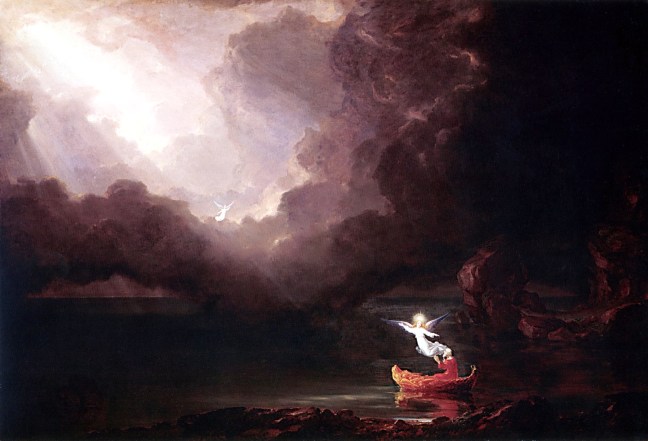
‘The Voyage of Life: Old Age’ – Thomas Cole, 1842 – WikiArt

Well, at some point in our lives, we may start to make a rapid calculation. It may dawn on us that if we had counted on this body and mind to represent us right through the end of life, well… let’s be blunt on this: that’s certainly not our best investment. Old age will make it clear that, after a certain time, if we wait long enough, everything begins to go wrong with our bodies — and so with our minds. We-our body are losing it. New pains arise. Strength diminishes. Memory capacity fades. And disease is lurking. There are threats accumulating, to say the least. We have to come to terms with this plain fact of existence: we will never go back to where we were. We cannot keep holding on to our body, continue having faith in it. This constant hoping for a better body, or a healthier mind, has to end, and this is now. In a way, it really is something to laugh about — a sort of cosmic joke. How could we have been so naïve? This simple and inescapable fact shows — if we needed that kind of confirmation — that this body and mind is not the place for a healthy sense of being. We need to find a way out of this faulty understanding.

We find health in our innermost being. That is the answer. And the body is not this being. It doesn’t represent it. It is not its temple. The body exists but it is not being. Only being has the right and capacity to be. The body is at best a distant vassal. A tool. It is not the home of our being, but rather, it finds its home in being. It rests there. It can borrow its qualities. It can make Being its beloved teacher, if it is wise and humble enough to espouse Being’s extraordinary traits. Then the body and its companion as mind might feel enlarged. They might find their true essence as infinity and eternity. They might acquire a soft and gentle making — less heaviness. And the body-mind will be lit with a strange transparency. It will slowly give up its hard matter-like making in favour of a more airy essence. It might surrender itself slowly while still being alive. Then the natural flaws of its ending will have very little meaning — not something to be afraid of. For its death has already been achieved in love — its true essence. Then its apparent shortcomings and loss will be found to be the supreme gain of life itself. We enter a new kingdom, where death can never be death. It is simply the extinction of everything that wasn’t truly ours in the first place. It is a gentle clarification, and the revelation of our essence. “You may die, my dear body, you may fail and disappear, with your companion-mind, but I will meet you on the burning ground and see you rise again as ‘I’”. This is the meaning of old age and death. This is the gift of our apparent failures. To be raised and revealed as essence. See… we won’t lose it.

.

~~~

Text by Alain Joly

Painting by Thomas Cole (1801-1848)

~~~

.

Website:
Thomas Cole (Wikipedia)

.

Other ‘Ways of Being’ from the blog…

.