The Ways of Being

Have you ever tried to live just above yourself? Now look. There is a whole set of activities going on down below, but you don’t need to get involved. It’s all conditioned reactions anyway, so don’t get entangled with any of it. You know this ceaseless activity: The ‘thoughts’ and the ‘felts’. Perceptions mesmerising you with their belly dancing. They will precipitate you down. They will be your fall. As for the body, it can take care of itself for the biggest part. Attend to it only when it’s required. To go to the dentist or to the cinema. To give the mind a vehicle. Fair enough. These are the contingencies of life. Feed the body well though. And give it something to do to keep the joints going, or for pure enjoyment. Joy is not some kind of negligible. It’s a necessity of life.

So bodily activity doesn’t need your full involvement. Stay aloof. Enjoy the show. As for the rest, you can be with being. You know this place that’s immobile, that never changes. Trust it. It will keep you safe. Stay there, just above yourself as it were. And don’t think that you are being haughty or bourgeois in this. Being is not that sort of being. It is not really above. It mingles with the lowly too. Actually it is everywhere. It cannot be taken apart. It’s the very fabric of experience. Only give it a little attention, and it will take you with itself. It will invite you at its home. Beautiful. Spacious. Silent. Well situated. You wouldn’t want to be anywhere else. You can bring there all your messiness. She doesn’t mind. Even these noisy and shameful friends of yours. But give them a warning though. They might not be served their usual cheap wine. Being has its ways. Her friendliness is contagious. Your friends might fall in love. They might shrink eventually and disappear. And make ‘being’ their home… move there for ever… even marry her… and be happy hereafter. You know the whole story that goes with it…

.

~~~

Text and photo by Alain Joly

~~~

.

Other ‘Ways of Being‘ from the blog…

.

How Difficult is That?

Isn’t this strange to have that constant race towards being when we are already fully being, and furthermore, doing it with absolute perfection? We keep projecting another better being than our present being, which we have judged not enough, un-sufficient, un-perfected. But we couldn’t be being any more or better than we are now already doing. What would I want to be but what I am? Why this be-coming? It is such a plain, inescapable evidence: I am this awaring presence. Presence, or being, is my natural abode. This is who I am.

Yet I’ve had all sort of ideas about it. And fanciful ones, believe me! That this presence was a me-person located inside a body. That it was an idea, a point of view that needed nurturing and developing as I — the me located inside this body — desired it. And if ‘I’ couldn’t do so, that would make this ‘me-majesty’ a sad, upset little ‘me’. And that sad little ‘me’ would go on living the life of a body located in space, projecting all the beings and things it senses as representing an ‘other’, a ‘world’ out there in which he roams about alone, gets scared, and craves, until he finally dies. That’s the end of ‘sad little me’. Body dies, he dies.

Hell no. That’s not the way it is. God forbid. There is no sad little me. That’s not there. It’s an idea, an image with no reality. I am not sad. I am not small. Not located. I am presence itself. I am this sweet, loving, sensitive, subtle knowing of everything that presents itself in this field. I am this field of knowing. This tenderness taking all in. I am the big, soft, loving eye of knowing. Knowing is my home. As for the rest, I am homeless. I don’t need to crave, grab, grip, grapple, grabble. None of that. God forbid. I am free. Unattached. Deep diving into the very substance of my self. Experience is my constituent and I am in love with every bit of it.

How difficult is that?

.

~~~

Text and photo by Alain Joly

~~~

.

Other ‘Ways of Being‘ from the blog…

.

The Guard and the Prison Breaker

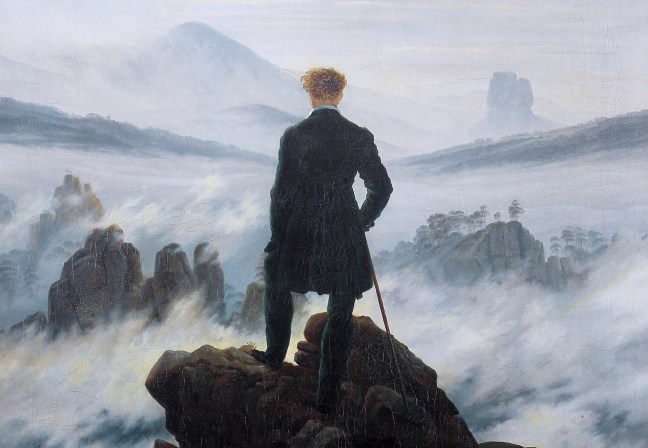
‘The Wanderer Above the Sea of Fog’ (part) – Caspar David Friedrich, 1818 – WikiArt

.

Without freedom there is no self-knowing 
and without self-knowing there is no meditation
.”
~ J. Krishnamurti 

.

Few sensations are as boisterously exhilarating as freedom is. Freedom is something that we all love to feel. To be freed! Freed from all weights and limitations. Freed from everything that bullies us and pins us down. But most of the time, this feeling is experienced from the vantage point of the little thought in our head that thinks it runs the show. This entity thinks that its freedom comes from being separate, and from its capacity to do what it wants. This is what being free means to most people. But is this really what freedom is, where freedom lies? In expressing all that comes from the lack and desperation of a limited, vindicative little self? If that is so, then this freedom takes us nowhere but in the already known boundaries of our self. How could that account for the power and magnitude of this feeling? Freedom cannot be so small and contrived. What is it then? Where is true freedom to be found? 

Freedom can never be fully felt within the conglomerate of our thoughts, feelings and perceptions, between the four walls of our prison cell. We may feel some occasional bursts of pleasure but this is not the real deal. If you search for freedom through that portion of yourself that is fleeting, fragile, untrue, you will by definition prevent the advent of any meaningful freedom. You will have limited freedom, something to be achieved, something to be added that becomes just another object, another aim in view. And don’t forget that this limited freedom can never be achieved anyway, for we in truth can never do what we want. And of what advantage would it be to follow the clumsy, limited, fanciful ideas of a mind that stands on false premises. Because of this impossible claim, we feel bitter, sad, violent, jealous, regretful. Let’s move away from such dangerous idea. 

[…]

An inquiry into the question of freedom… (READ MORE…)

.

The Song of Ashtavakra

Photo by Nick Kenrick.. on Foter.com / CC BY-NC-SA

I’m sharing here the Ashtavakra Gita, in the translation of John Richards. This is a famous song and landmark of non-duality in India. It has been composed in Sanskrit as a dialogue between the eminent sage Ashtavakra and his brilliant disciple Janaka, also king of Mithila. It was allegedly written around the third Century BC although some scholars dated it in the eighth Century AD, at the period of Shankara. The author is unknown and the characters are borrowed from the ancient epics of India. ‘Ashtavakra’ means ‘eight bends’, for he has a deformed body. This is a short work of 300 verses, and was one of the favourites of Ramakrishna and Ramana Maharshi. In this dialogue, the process of enlightenment is easily dealt with, for Janaka is, in Ramesh Balsekar’s words, “a superbly ‘ripe’ disciple, one who is just waiting for that one quick spark of initiation into Truth that brings about sudden enlightenment.” The dialogue quickly moves to be an exposition of truth by two equally enlightened beings. Yet, a process is here at work, between the guru and his disciple, between truth and the slow movement towards full understanding, between the one reality and the many roads and aspects that lead to a total and definitive grasp of it…

.

अष्टावक्रगीता

.

Chapter I

Instruction on Self-Realisation

King Janaka asks the question that provoked Ashtavakra’s plain and direct exposition of truth…

Your real nature is as the one perfect, free, 
and actionless consciousness, the all-pervading witness 
– unattached to anything, desireless and at peace. 
It is from illusion that you seem to be involved in samsara
.”

.

Janaka asked:

How is knowledge to be acquired? How is liberation to be attained? And how is dispassion to be reached? Tell me this, sir.

Ashtavakra replied:

If you are seeking liberation, my son, shun the objects of the senses like poison. Practise tolerance, sincerity, compassion, contentment and truthfulness like nectar.

You are neither earth, water, fire, air or even ether. For liberation know yourself as consisting of consciousness, the witness of these.

If only you will remain resting in consciousness, seeing yourself as distinct from the body, then even now you will become happy, peaceful and free from bonds.

You do not belong to the brahmin or any other caste, you are not at any stage, nor are you anything that the eye can see. You are unattached and formless, the witness of everything – so be happy.

Righteousness and unrighteousness, pleasure and pain are purely of the mind and are no concern of yours. You are neither the doer nor the reaper of the consequences, so you are always free.

You are the one witness of everything, and are always totally free. The cause of your bondage is that you see the witness as something other than this.

[…]

Continue reading the beautiful teaching of Ashtavakra… (READ MORE…)

.

The Gentle Manner

“Let the Awareness function.
Then the mind becomes quiet. 
Motives disappear; 
tranquility pervades the whole being. 
In that state alone does the perception of Truth come. 
And it comes naturally. 
It is there. 
It is revealed in a gentle manner.”

~ J. Krishnamurti 

.

~~~

Quote by J. Krishnamurti (1895-1986)

Photo by Alain Joly

~~~

.

Bibliography :
– ‘Krishnamurti’s Notebook’ – by J. Krishnamurti – (Krishnamurti Publications of America, US)

Website:
J. Krishnamurti

Suggestions:
Beauty in Essence (other pointers from the blog)
A Day at Brockwood Park (Homage to J. Krishnamurti)

.

The Cave

As the innermost Self of all, 
he dwells within the cavern of the heart
.”
~ Mundaka Upanishad, Hymn II.1.9


I had this thought landing in my mind some time ago, that “now I might as well retire, take refuge into the cave of awareness”. This made me think of the retiring into caves, as monks and anchorites do in some spiritual traditions. Retiring from the world, falling into solitude can be useful to withdraw from the entanglement with the ten thousand things of experience. It allows a space in which we can be watchful, and have the leisure to deepen our understanding. In the Hindu concept of Ashrama, which represents the four different stages of life, two are dedicated to some form of withdrawal from the the world: Vanaprastha, which in Sanskrit literally means ‘retiring to the forest’, and Sannyasa, which means ‘to put down everything’. The western word ‘anchorite’ has a Greek origin which means ‘to withdraw’, and ‘monk’ comes from ‘monachos’, which means ‘solitary’.

But what does this withdrawal from the world mean, in deep analysis? All the religious concepts of renunciation, solitude, poverty must point to something deeper than just a physical attitude. Because no matter how thick the walls of renunciation may be, a strong sense of being a ‘person caught in the entanglements of its own re-created world’ can and certainly does survive any physical retirement, be it in a forest, a monastery, or a desert. So this retiring has to be a metaphor. In reality, the true retiring resides inside, where we for a time take our stand as the witness, the presence behind all objective experience. The Indian word ‘sādhu’, which also refers to a person living a form of renunciation, has more ambivalence. Its rich meaning goes from ‘not entangled’ to ‘leading straight to a goal, hitting the mark, unerring’, to simply ‘peaceful, excellent, virtuous’. There is much more here than just withdrawing.


The Lord is the supreme Reality.
Rejoice in him through renunciation
.”
~ Isha Upanishad, Hymn 1


So the cave, metaphorically speaking, is awareness, the peaceful presence at the core of our experience. This place need not be a remote one, except in the first stages of our understanding, when we need to disentangle our true self from the parasites of a busy and confused mind, or indeed an equally busy and confused world. But, in a way that is truly paradoxical, when you reach the deep, unfathomable cave of consciousness, the inside suddenly turns out to be the outside. The true cave turns out to be no cave at all. It turns out to be the world, the entirety of our experience. As Rupert Spira says: “This empty ‘nothing’ turns out to be the fullness of everything.”

The walls of the cave are made out of our daily experience. The world is the cave and it is placed at an infinite distance. Be careful here, ’infinite’ doesn’t mean ‘far away’, it means ‘at no distance at all’. The world is ourselves. The cave of consciousness where we have retired is ourselves. Not the little self for whom retiring was a separate action with an aim at hand, but rather a new self englobing everything, the whole world. And this world is not a cave of separation, it is the totality playing with itself. And believe me, the infinite possibilities for celebration, the number of possible games to be enjoyed are here if we are only willing to play. Not entering any caves, but giving ourselves – literally – to the non conceivable, the non fathomable, and to the ten thousand things of experience.


~~~

Text by Alain Joly

Painting by Joseph Wright (1734 – 1797)

~~~


Painting: A Cavern, Evening. 1774 – Joseph Wright – [Public Domain] WikiArt

Websites:
Rupert Spira
Joseph Wright (Wikipedia)


The Deepest Acceptance

It is truth that liberates, 
not your effort to be free
.”
~ J. Krishnamurti

The question of ‘surrender’ is one that is often misunderstood. Surrender implies, in everyday language, something that the mind does, even remotely, in order to give itself to a reality that seems inescapable. It often comes down to a form of resignation, a giving up, something passive at its core, which brings more delusion and suffering. So what is true ‘surrender’, in a non-dual context? I have gathered here many quotes and pointers on this subject, from various spiritual teachers and poets of the eternal and the infinite. I hope that this will bring some clarity into that which Jeff Foster calls the deepest acceptance…


~~~


People often think that surrender means to renounce wealth, sexuality, or objects. Such a renunciation might be useful but it could also be a hindrance. Real surrender takes place when we cease to take ourself for a separate entity, an object. This renunciation seems, at first sight, limited in scope and too simple, but it is, in fact, the ultimate surrender. Such a giving up has no purpose, it comes from the deep understanding that our true nature, consciousness, is free from all limitations. From this perspective, surrender means to see the limitations for what they are: mere concepts superimposed onto our real being, which is limitless.”
~ Francis Lucille (‘Eternity Now’)

~

You may discover that when there is no resistance to totally being in hell, that heaven opens up and samsara reveals its true nature as nirvana. But the catch is, if you are embracing hell as a strategy to get you to heaven, that doesn’t work. Only the complete absence of wanting what is to be different in any way pops the imaginary bubble of separation. No one can do this. It is like dying or falling asleep. It is the absence of any doing, the absence of control, the absence of effort, the absence of any concern about what happens. It is a letting go, a dissolving, a relaxing. This letting go begins with letting go even of the need to let go, for the need to fall asleep keeps us awake, just as the imperative to surrender is a form of holding on and seeking control. True surrender is the absence of resistance even to holding on if that is how life is showing up in this moment. Surrender is the absence of trying to surrender.”
~ Joan Tollifson

Continue the exploration on the question of ‘surrender’ (READ MORE…)