The Fate of Me

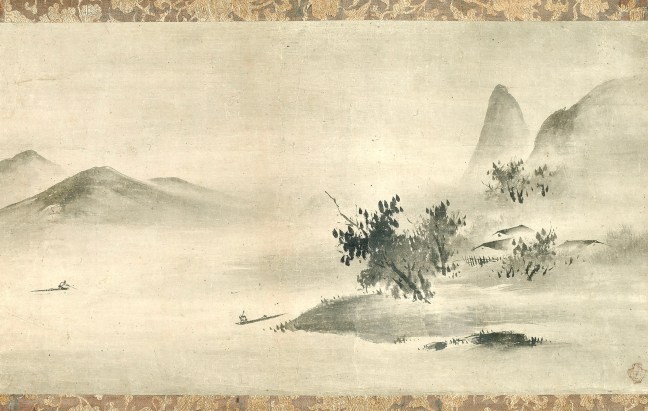
‘Ink Landscape’ – Kanō Motonobu, 16th AD (Art Institute of Chicago) – Wikimedia

.

I saw you rise so many times,
Invade the space of my being,
To occupy my whole presence,
Take everything, leaving nothing,
Not a corner of emptiness
Where I could recognise my self.

I saw you rise so many times
Acquire my whole, my essential
To leave me lost, truly yearning
For that silence now filled by you;
To leave me sad, truly longing
For the one here just before you.

I saw you rise so many times
T’was impudent, how did you dare
Burying light in obscurity,
Dimming joy with your avid search,
Thinking it right to lead my life
When you are but a malign ghost.

But more than once, you did vanish
I’ll tell you why, listen to this:
I found you had no consistence
The reason is: you are not found
Your reality imagined
Your existence: your insistence.

Look at yourself, you are not here
You’re not the one you claim to be
You’re just a thought that’s tossed about
In an ocean of presence;
That sea is not a place to be
When you are but a lump of salt.

.

~~~

Text by Alain Joly

Painting by Kanō Motonobu (1476–1559)

~~~

.

Website:
Kanō Motonobu (Wikipedia)

Suggestion:
Voices from Silence (other poems from the blog)

.

Hide-and-Seek

The spiritual search is really only a process of hide-and-seek. When we are lost and unhappy, we seek some relief. Our sense of a peaceful self, which is our true nature, eludes us, is not felt — so we embark into the search for a happy life. The process is clear and evident: when our true nature is hidden, we are naturally engaged in seeking. We try to uncover it, to dispel the confusion. When it is revealed, we bask in it, enjoy our find, treasure it. We don’t keep running about, busying ourself, pretending we’re a seeker. That would make what we have found leave. That would put her off. That would make it flee. That would cover its presence again.

What would you say — when you were playing hide-and-seek as a kid — if your little friend, after having found you, would go on seeking you everywhere intently? If he left you here standing, unchecked? How would you feel? Well, that would put you off. You would resume the game, go back home, leave him to his folly. This is the same with awareness, with your inner sense of being. You seek it when it’s not there, when it’s covered, hidden. But when it is felt, when you are being reunited with your own precious sense of being, then it is time to suspend all activity and celebrate. Remember the giggles when you found your hidden friend — your big open eyes — the joy of it all — the taste of this reunion. This is also how you should be at the moment of re-union with you true sense of self. Enjoy it. Live the moment. Stay there — in that joy.

[…]

A playful exploration of the ‘hide-and-seek’ nature of self-inquiry… (READ MORE…)

.

A Place of Thankfulness

This is where I’m big. When I’m following my unique fate as presence. When I’m fully being my self, embodying it as it were. This is where I cannot be led astray. This is where I cannot be persuaded of my dying. This is where life becomes a princely road towards this beloved castle of being. You become immovable. You cannot be displaced. Where would you go? Where would you be?

Do you really need a direction? Follow the motorway of being. It will be your universal compass. Everlastingly pointing to your self, where you cannot be lost. No matter what, or how, or when, or where. It will find you in times innumerable, that will all have their origin as you. It will take you to countless places, that will all have their being in you. Congealed inside you. Resting. Yet like waves dancing softly, swiftly. Your life will find its being in being. It will move in that which cannot be moved. Are you still afraid now? Are you still dreading this unknown course of your life? Think again! There is no wrong direction in being. There is nothing threatening or dangerous in being. Presence is a soft bed. This is your king size armchair, from where life is enjoyed and cherished. This is your place of thankfulness.

.

~~~

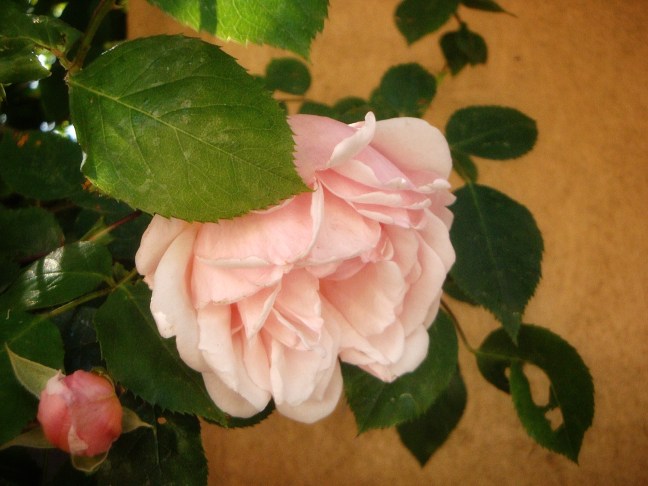
Text and photo by Alain Joly

~~~

.

Other ‘Ways of Being’ from the blog…

.

The Contemplative Mind

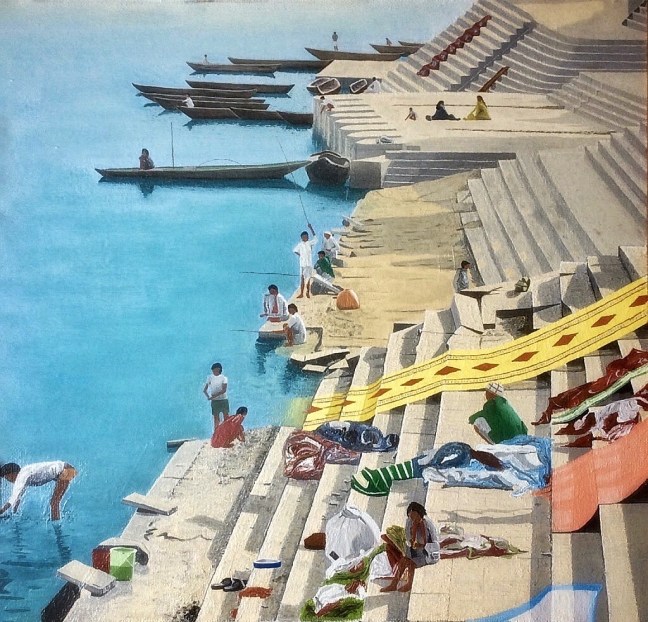
Contemplation is a place of leisure and space. It is, as its etymology conveys, a ‘place for observation’. It has space within itself. It is a temple, which in Latin means an ‘open and consecrated space’. It is a sacred spot. A place where you find yourself meditating without having initiated it. It means that you — your Self — are on an equal footing with the objects of experience. You have not been absorbed, or engulfed by them. You are rather with them, hosting them all, embracing them in your emptiness. You see life from the standpoint of your temple of being. This is the position where from things acquire beauty and meaning. This is how you contemplate — by looking at everything from within the position of your Self. This is like being at the beach. The beach is a threshold, as are the front stairs that lead to the Ganges in Benares. This is when or where the city life is left behind and we come to be on vacation, on a holy-day — which is always a holy ground — to have leisure, freedom. To meet a certain form of death. To face the emptiness of the sea, the river, and the sky in front of us. We know intimately, or have the intuition of this place in ourself — this threshold, this passage from a dull and empty sense of acquired fullness, to the fullness of emptiness which is nothing but our natural, god-given state and being. This is the temple from which objective experience ought to be contemplated. This is where the contemplator is felt to be the contemplated. Contemplation then becomes a prayer. And such a prayer asks for nothing but the fact of being. This is the place of convalescence, where you come to heal from the world, from yourself. This is where you come to paint, to produce a new world out of your Self. This is where you get healed by this new vision, where your life finds a reorganisation, a new standpoint, a new temple where you can breathe at last and be content. Contemplation is completion. Sitting in an empty boat, or amongst dirty laundry, and be taken far out of yourself into your newly discovered sense of Self. This is a cleansing process, both of yourself and of the world. This is the contemplative mind.

.

~~~

Painting and text by Alain Joly

~~~

.

The painting was made from an original black & white photograph by Bjørn Weinreich.

Bibliography:
– ‘Benares, A Sacred City in North India’ – by Bjørn Weinreich and Ulla Mørch – (Denmark, 1983)

.

Other ‘Ways of Being‘ from the blog…

.

To Know Better

.

Knowledge about yourself
binds, weighs, ties you down
.”
~ J. Krishnamurti (‘Notebook’)

.

Humility is the mother of all virtues. For it places us in the right attitude of not knowing, not arguing. To know is to be situated, to have a perspective, a point of view. To know implies to be a person, to be apart, external. And it also implies to suffer. It’s so easy to know, to boast, to show off. We don’t want to be unmasked as ignorant. To know has become a reflex. To know is to claim ‘I am here’, ‘I count for something’, ‘I need fulfilment’. Therefore to know is to fear death. To know is to project, to be the hostage of time, of becoming. ‘What if I don’t become anything?’ To know is to posit a person that needs and lacks. To know is to lock ourself in a world of finite things. It is to exist only in the limits of our own self-created boundaries. To know is to block creativity. To know is to dismiss god, life, for not being competent. It is to invite the big rock of our conditioned thoughts, feelings, and memories, and in doing so, conceal all other entrances or exits. No flow is possible.

Have you ever felt these moments when you don’t know? When you taste the presence of your own absence? When you discover your sense of separation to be imaginary? At the moment you feel one with all beings and things, you are bound to be in the unknown, to not know. How could you possibly know to be anything, when you are merged with presence, with experience? You don’t have the necessary distance to do so. And this absence of distance is the experience of your sweet self. Don’t be the one who knows, but the one who is the knowing. Don’t affirm yourself, but be affirmed in the knowing presence that you are. By just being, you will know everything that needs to be known. You will have everything that needs to be had. And it will be offered to you on the silver plate of love, beauty, and happiness. You cannot know better.

.

~~~

Text and photo by Alain Joly

Quote by J. Krishnamurti (1895-1986)

~~~

.

Bibliography :
– ‘Krishnamurti’s Notebook’ – by J. Krishnamurti – (Krishnamurti Publications of America, US)

Website:
J. Krishnamurti

.

Other ‘Ways of Being’ from the blog…

.

Prayer to the Higher Self

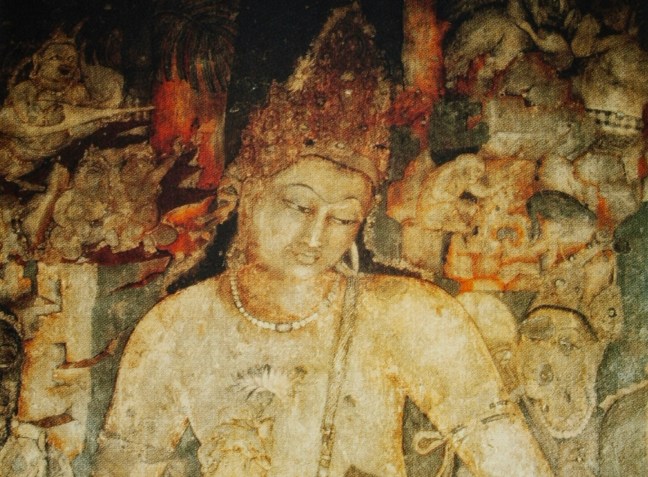
‘Bodhisattva Padmapani, cave 1, Ajanta, India’ – Unknown author, 450-490 CE – Wikimedia

.
This prayer is a beautiful expression of longing from a student to the Master, which the title reveals to be the Higher Self. It is excerpted from a long Sanskrit poem attributed to Adi Shankara in the 8th century, whose original title is the ‘Vivekachudamani’, which translates as the ‘Crest-jewel of discrimination’. The text was used as a teaching manual of Advaita for centuries. I found this prayer to be a very moving and humble call for self-knowledge. It is found in verses 35 to 40, and opens to 540 more verses of elaborate teaching of non-duality…

.

“I submit myself to thee, Master,
friend of the bowed-down world
and river of selfless kindness.
Raise me by thy guiding light
that pours forth the nectar of truth and mercy,
for I am sunk in the ocean of the world.
I am burnt by the hot flame of relentless life
and torn by the winds of misery:
save me from death,
for I take refuge in thee,
finding no other rest.

Sprinkle me with thy nectar voice
that brings the joy of eternal bliss,
pure and cooling,
falling on me as from a cup,
like the joy of inspiration;
for I am burnt by the hot, scorching flames
of the world’s fire.
Happy are they on whom thy light rests,
even for a moment,
and who reach harmony with thee.

How shall I cross the ocean of the world?
Where is the path? What way must I follow?
I know not, Master.
Save me from the wound of the world’s pain.”

.

~~~

Prayer by Adi Shankara (788-820)

Translated by Charles Johnston (1867-1931)

~~~

.

Something must be said of the painting above. It is one of many paintings found in a series of Buddhist caves near Ajanta, in Central India, excavated between the 2nd century BC and the end of the 5th AD. The caves served as a retreat for monks until the 7th century, before being abandoned and forgotten. They house sculptures and paintings on their walls that narrate the many lives of the Buddha. Speaking of their subjects, the art specialist Ananda Coomaraswamy wrote: “We don’t know what to admire more: either their technique, which is already so perfect, or the intensity of emotion they contain, their lives seeming very close to our own; for they are as modern in design as they are in feeling. […] The grace of their movements, their serene self-control, the love with which their every gesture is imprinted, their profound sadness creates an unforgettable impression.”

Here is another prayer composed by Adi Shankara, ‘In the Morning I Remember’…

Here is a homage to Adi Shankara: ‘Shankara the Great’, on the blog…

Bibliography:
– ‘In the Light of the Self: Adi Shankara and the Yoga of Non-dualism’ – by Alistair Shearer – (White Crow Books)
– ‘Adi Shankaracharya: Hinduism’s Greatest Thinker’ – by Pavan K. Varma – (Tranquebar)
– ‘The Crest-Jewel of Wisdom’ – by Shankaracharya (Trans. Charles Johnston) – (Pinnacle Press)
– ‘The Ajanta Caves’ – by Benoy Behl – (Thames & Hudson Ltd)

Websites:
Adi Shankara (Wikipedia)
Vivekachudamani (Wikipedia)
Charles Johnston (Wikipedia)
Ajanta Caves (Wikipedia)
Ananda Coomaraswamy (Wikipedia)

.

A Mountain Walking

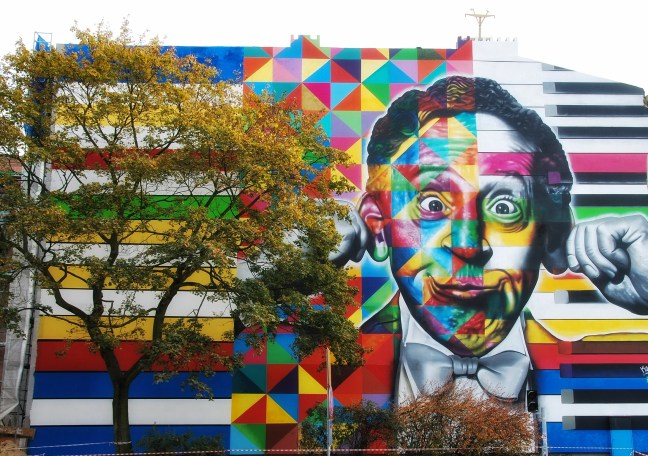
Arthur Rubinstein mural, Lodz – Eduardo Kobra, 2014 – Wikimedia

.

People are always setting conditions for happiness…
I love life without condition
.”
~ Arthur Rubinstein

.
Thank you, Master Arthur Rubinstein. For you did it all for me tonight. No need for convoluted meditation postures. That effortless demeanour of yours in front of the piano was enough. All your thousand nuances of lows and heights, of patience and haste, of a suspended note, or a subtle release, all were concurring to deepen me. For it is all about profundity, isn’t it? About keeping a pointed inner eye on a vast array of forms dancing in and out of ourself, while staying like an unmovable rock. The play was prodigious in its complexity and nuances, but the maestro behind it all was at rest. Voraciously still. A fullness was produced at every empty second, as his fingers were slowly racing on the keyboard towards that never moving, never ending melodious symphony of presence. He was boiling life, and the fumes of it were like curls after curls of beauty. And yet all was kept in its pristine simplicity and humility. No effect and no affect. ‘A mountain walking’, to use that koan like image by Zen master Dōgen. That’s what art can truly do. It can take your breath away to never return it back in the way you have known it.

And the maestro is not busy in a cage of his own. He doesn’t perform. He has space, leisure. And he listens. Shhhh… Rubinstein’s listening, walking at his own pace, slowly mountaineering. Loving it all. You see it in his imperceptible smile. Or the minute rise of a couple of muscles above his eyelids. And in the glance exchanged with the conductor. Oh that glance! Rubinstein is not alone. He is conversing with Chopin; co-composing this Piano Concerto No 2. He is conversing with an oboe, or with a clarinet. Meditating with a line of supporting violins. And the maestro is teaching. He’s teaching you how to listen — not to the notes — but to yourself. This is where the notes acquire their meaning and purpose. This is where listening truly takes place. This is how you become a mountain walking. This is where is revealed the essential of life, of a piece of music, of anything. And this is where you find joy. Enjoying is all that the maestro is doing, and he gives it to you. That’s how an audience breaks in rapture, in screams and applauds of thankfulness. You are grateful because the maestro broke your heart, again and again, until you can be served one thing only: yourself. Your own gentle, pliable, undefeatable self. Hurrah!

.
~~~

.
Mountains do not lack the qualities of mountains.
Therefore they always abide in ease and always walk.
You should examine in detail
this quality of the mountains walking.
[…]
If you doubt mountains’ walking,
you do not know your own walking
.”
~ Zen Master Dōgen (Mountains and Waters Discourse, Trans. by Kazuaki Tanahashi)

.

~

I have found that if you love life, life will love you back…”
~ Arthur Rubinstein

~

At every concert I leave a lot to the moment. I must have the unexpected, the unforeseen. I want to risk, to dare. I want to be surprised by what comes out. I want to enjoy it more than the audience. That way the music can bloom anew. It’s like making love. The act is always the same, but each time it’s different.”
~ Arthur Rubinstein

~

Yes, I am very lucky, but I have a little theory about this. I have noticed through experience and observation that providence, nature, God, or what I would call the power of creation seems to favor human beings who accept and love life unconditionally, and I am certainly one who does with all my heart.”
~ Arthur Rubinstein

~

It is simply my life, music. I live it, breathe it, talk with it. I am almost unconscious of it. No, I do not mean I take it for granted — one should never take for granted any of the gifts of God.”
~ Arthur Rubinstein

.

~~~

Quotes by Arthur Rubinstein (1887-1982)

and Dōgen Zenji (1200-1253)

Text by Alain Joly

~~~

.

Listen to Arthur Rubinstein playing Chopin’s ‘Piano Concerto No 2 in F minor, Op 21’ (with conductor Andre Previn & London Symphony Orchestra), which he recorded one last time, for posterity, when he was 88 years old in an empty Fairfield Hall, only months before becoming blind…

Read the ‘Mountains and Waters Discourse’ by Zen Master Dōgen…

Bibliography:
– ‘My Many Years’ – by Arthur Rubinstein – (Renaissance Literary & Talent)

Websites:
Arthur Rubinstein (Wikipedia) 
Frederic Chopin (Wikipedia) 
Dōgen (Wikipedia) 

.