Twisted Rainbow

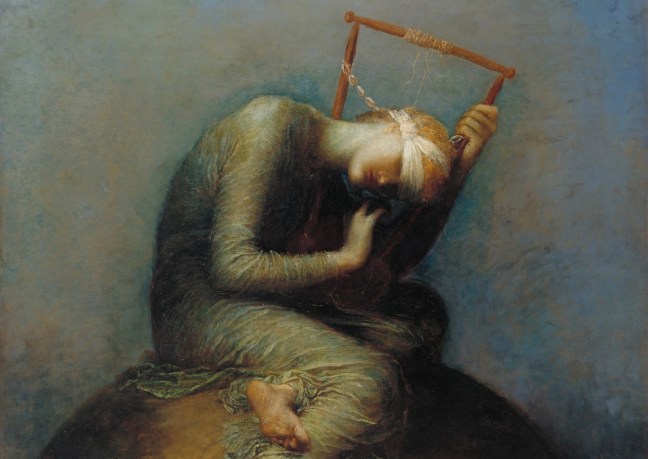
‘Hope’ (detail) – George Frederick Watts, 1886 – WikiArt

Unhappiness is a strange thing, for against all appearances, and under serious investigation, it is not really found. We are making it up as we go along. In fact, there is no such thing as an absence of happiness. Yet we are nurturing this absence with great consistency, designing our so called unhappiness with care, through our thoughts, our memory, our attachments, our stubborn persistence. But only try to experience its effects outside your thoughts and feelings, in the absence of your mind, and you’d have to confess that you can’t find here anything like a misery. The reason is: unhappiness is not a thing in itself. It is veiled happiness. It is the covering up of your innate peace. It is past residues and future expectations tossing the tranquillity of the now. But all such disturbances, discomforts, or distresses, are always only temporary events, passing weathers distracting us from what is always here, always faithful, always to be trusted: the peace contained in simply being. This peace is in fact the very making and backbone of our lives, its solid background. It could never leave you no matter how hard you may try. Its not being felt is a form of snobbery. You have missed your innate joy in reason of your not looking in the right place. You have neglected your true, natural being for wanting to be somebody. You have been scorning yourself out of vainglory. In fact, unhappiness is but the simple mourning of a loved one who is missed: our true self. It is but a distraction from the boredom of our ignorance. Or a warning for a wrong turn taken.

Unhappiness is not found in physical pain, or in the natural grief following a loss. These are all compatible with happiness, as is a shared, compassionate sorrow. These are wise and healthy responses to life situations and challenges. Unhappiness is of a different nature. It is more like a habit or an indulgence. Often, we would rather be unhappy than shatter a well-rehearsed idea of ourself, in which we have invested our most cherished identity. Unhappiness is also the result of a fallacy, and a form of delusion. It is a shadow which we nourish through our belief in being a person caught between seeking and resisting, and the reward of fulfilment. Unhappiness is only as real as our limited self is. One will follow the other both in death and in birth. So really, unhappiness is a self-inflicted pain. In a way, we could say that it is a sin. It is ourself being driven away from our happy, forgotten nature, and bound to the suffering self which we have identified ourself with. It is our twisted rainbow in the sky of ignorance, that appears naturally without being truly there. It is created by the rain of all our renouncements, of our constant search for security and approval, through accumulation and avoidance. So next time you meet some measure of unhappiness in your life, don’t believe it. Don’t be caught up and allured by its convincing appearance. See through it until you find its referent. See that unhappiness is not real as affliction or suffering. It only exists as the sum of all that hinders the happiness which is the nature of your self as being. Your misery may in fact only be a passing, unassuming thought, maybe an innocent, unchallenged belief, or just a feeling hovering about, which you are taking too seriously. Not very much really. Hardly enough to send you far and away from the delight of simply being.

.

~~~

Text by Alain Joly

Painting by George Frederic Watts (1817-1904)

~~~

.

Websites:
George Frederic Watts ( Wikipedia)
Hope (Watts) (Wikipedia)

Suggestion:
– Other ‘Reveries’ from the blog…

.
Of Dimitry’s Prayer

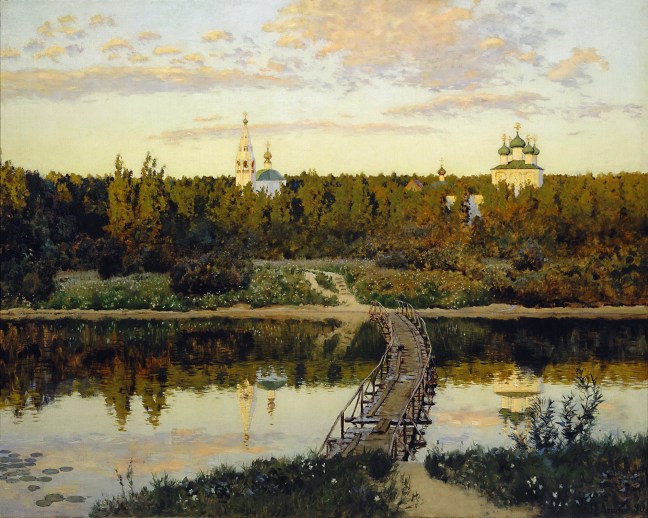
‘A Quiet Monastery’ – Isaac Levitan, 1890 – Wikimedia

.

Open, O doors and bolts of my heart,
that Christ the King of Glory may enter!
~ Dimitry of Rostov

.

Prayer is an invitation for what is already here to show itself up. It is not that you already know who you are, and that you-the person are begging for a supreme entity, or for an other, to come and soothe you, for an external, benevolent providence to shower you with its benefits. Remember that there is no other entity than the entity of your self, no other providence than the providence of recognising who you are. Nothing, in matters of peace and happiness, could ever enter into you that is not already there. So don’t make that mistake over and over again: to wait for someone knocking at your door, to hope for something to fulfil you, to expect a new element to enter your life. The benefit of life is not with something you receive, but in what you recognise yourself to be. So prayer is prior. It is not in reaching but in realising, not in expecting but in recognising, not in receiving but in noticing, and not in having or possessing, but in being.

So always pray as if you were utterly alone. Pray as if you couldn’t ask anything, anyone, any favour or event, to give you something that is not already there in you, as you, expressed as your very own being. Notice that nothing of worth could ever enter your house that is not already present, already eating at your table, already thinking the thoughts you think, already dreaming the dreams you dream. This is how Dimitry’s prayer ought to be uttered.

[…]

More reflections on a prayer by Dimitry of Rostov… (READ MORE…)

.

A Holy Formula

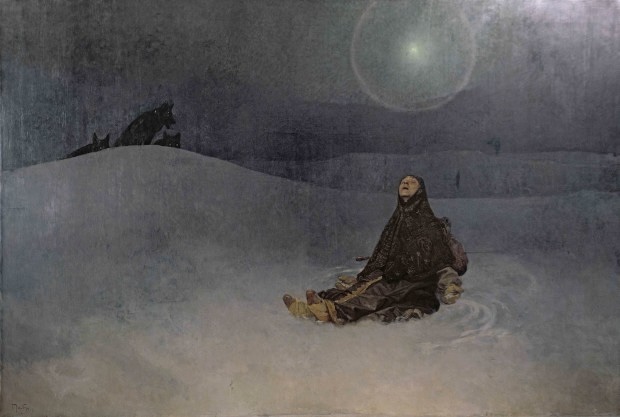
‘Woman in the Wilderness’ – Alphonse Mucha, 1923 – Wikimedia

.

Consciousness is an internal relationship to the whole.”
~ David Bohm

.

You cannot suffer when the world in which you live is discovered to be you. That’s mathematical. A formula that will work magic in your life. For you don’t live separated from everything else. You are not limited to your body, and the world is not something that is distinct from you, at a distance from you. You discover that the jump was made long ago, that you have been the totality already from the beginning of ages, eternally one with it, and that there never was an inch that separated you from the world you live in. That’s how you are complete, by knowing no separation, by entertaining no difference, and therefore having no preference. So you cannot be lacking anything, and suffering is always only the lacking of something, which is born of separation. So stay there, in your inseparable essence, in your world of completeness. Notice that this is what you are, or rather what there is, when you stop fantasising yourself being somebody. You never had an existence of your own. You are the flowering of something deeper. If you ignore or overlook this simple truth, well… then the trouble begins, all the travail of life, and the never ending seeking for fulfilment. This never was about you. Life is bigger, wider than that, and you are here only to honour that and to live by its gorgeous rules.

Then you enter into sacredness. You leave the limitations of being somebody — a projection, an idea that thought has sculpted over time — for a merging with infinity, with who you truly are. This is what sacredness is: an entering into your true self. A visiting of the truth of your being. The anointing of your self with its reality. This entering is a sanction from truth. It is the death of an old idea which you have entertained, for a ride into unknowing. It is a ceremony in which you are being elevated to a reality that you have been blind to. You are being sanctified, or made true. You were already that, already living as that reality, already tasting of that firmament, but were distracted. You were drawn to be something, insisted in being exclusively yourself, by yourself, so you have ignored it. You missed the chance to know yourself truly. You worked too hard to be what you are not. You lacked passivity. Not that you don’t have to do anything to come to this understanding. But rather, this understanding is nothing you do. It is here in you, as you, without your doing anything about it. It doesn’t need your participation, or rather it needs your non-participation, your staying away, your keeping quiet. Your abandonment. The hardest thing of all.

Then you enter into holiness. You taste of your true home, which happens to be the home of god. You are made holy, which means whole, uninjured, healthy. You realise where you are, what you are, the stone you are made of. You notice your true body — the consciousness of everything. You connect with a reality that could never be transgressed or violated. A reality which you could only fall in love with, for it is your beloved self, which you have lost sight of, and are now reunited with, consecrated in, and which you would never want to leave, or not live by. You are made of the same golden dust that the stars are made of. I don’t mean just your body, but what you are at the core, the essence of your self, what you happen to be when you say simply ’I am’. You are made into “an internal relationship to the whole”, as David Bohm expressed so beautifully. And you will struggle to see the world as a collection of different parts, or to see yourself as one such part amongst many others. The One will come to be your only experience. But you will be defeated again and again. You will come to feel a part again. You will be seduced to be somebody time and again. You will want to feel separated again, to win another last adventure or advantage for yourself. You know: your little devil wanting to be the likes of god. But keep going. Keep going. Until one day, it may dawn on you: you are no more.

.

~~~

Text by Alain Joly

Quote by David Bohm (1917-1992)

Painting by Alphonse Mucha (1860-1939)

~~~

.

Websites:
David Bohm (Wikipedia)
Alphonse Mucha (Wikipedia)

Suggestions:
– Other ‘Reveries’ from the blog…
– A page from the blog dedicated to David Bohm: ‘Insights into Wholeness’…

.

A Story of Lack

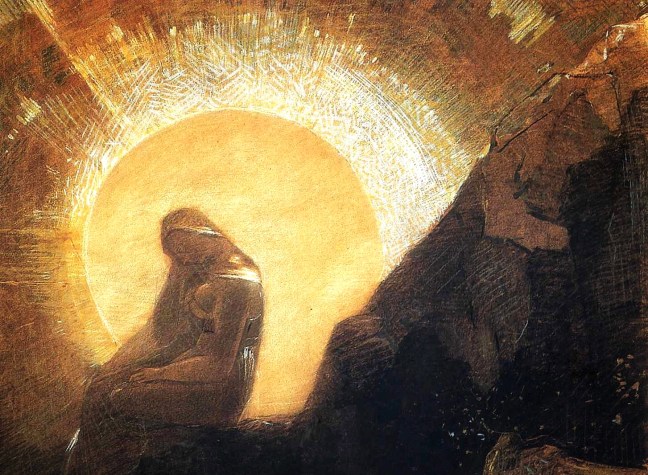
‘Melancholy’ (Part) – Odilon Redon, 1876 – WikiArt

.
When the ‘I’ is divested of the ‘I’, only ‘I’ remains.”
~ Ramana Maharshi

.
Don’t run in the other direction. Don’t take a sense of lack for a need. For this is what we do, when we sense in ourself an insufficiency, we want to fill it up, by all means necessary. We think it important to grant its wanting, its craving. But a lack is never a need. A lack is a fact that needs no repairing and no repairman. By bowing or giving allegiance to it, we submit ourself. We give up all power of understanding. We place ourself at the level of that lack. We become small. We don’t respect it. For this is not to respect it, to obey a random sense of lack. For lack comes as the supreme teacher, and our genuine bowing to it rather takes the form of listening. This is how we bow to a teacher, how we respect it, fulfil its function: by listening to it. So we listen. We stay motionless and invite its teaching. We don’t run away in the other direction.

[…]

A story about how a sense of lack can be the real teacher… (READ MORE…)

.