On Passing Away

We think that most of our life is taking place in the field of body, thoughts, feelings, and sense perceptions — all of these making a self and a world, and the myriads of experiences that come as a result. This is what our life seems to be for the most part. But look again. Because in fact, no. It is not like this. That’s where the misunderstanding lies. Most of our human experience — not to say the whole of it — is spent in being. In emptiness. In vastness. Of course there is a body here that can be sensed. And feelings can be felt. And objects perceived. And thoughts are occurring all the time. And with them a sense of a separate self has been born. And all this joyous team seems to have acquired reality, and has in consequence been cursed with a measure of drama and suffering. But much was missed along the way. For in fact, none of these really took the place we imagined. None of it is taking any place, any space, or occupying any length of time. For the whole space of experience is already occupied by our sense of being. Life in its totality is made of one indivisible reality that fills our experience to the brim. This reality as being precedes experience — experience being nothing but being manifesting itself within itself.

So this is an announcement for the deceased self that we have been engrossed in all this time. Body, thoughts, feelings, senses, will continue their existence, but will lose their identity as a self. Custody will be returned to whom it always and forever belonged: pure, unlimited being. In its quality of the only inheritor of the feeling of being, ‘I’ or consciousness is now made the one true identity for all selves, and the only essence or ‘is-ness’ for all objects of experience. For we are in fact eternity, which our presence as a time-bound self has veiled. We are in truth the infinity of being, which our insistance in being a separate being has limited. And we are in reality peace itself, which our relentless seeking for happiness has sent in the hidden. There never was a self, and there never was a world. Not in the way we have imagined it. Not with the reality we have conferred to them. Being has drowned them long ago; and has given them the only reality to which they are entitled to belong. That’s how anyone, and anything, and any experience can be made to rest in peace: In giving in to being. In passing away.

.

~~~

Text and photo by Alain Joly

~~~

.

Suggestion:
Other ‘Ways of Being’ from the blog…

.
Where Eternity Hides

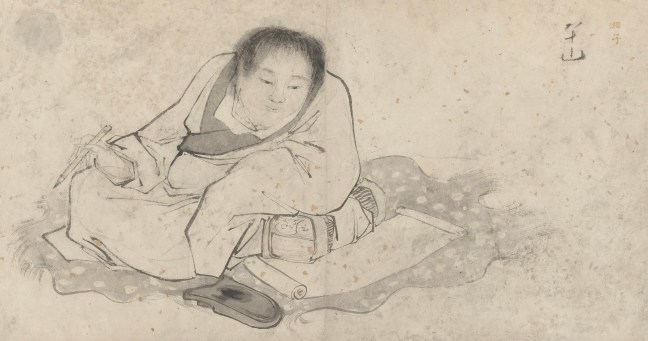
‘Daoist immortal Han Xiangzi’ – Zhang Lu, early 16th century – Wikimedia

I think that our search for the ultimate could find some relief in giving attention to what is small, unnoticed, humble. All the things unremarkable, unassuming, that we pass in life without a glance. You know these moments when we sit down doing nothing. All these things easy, like resting, breathing, eating, sleeping, that can be achieved without our forceful participation. These moments or actions are closer to god than we may think. They live in a grey area where they flirt with the non-objective and slip out of our attention to hide in the sublime, to rest in the blissful, unattached, forgotten. Their presence is made absence, like for the space between two thoughts. But don’t let them leave you. Strive to own them. This is where eternity hides. This is why presence is so much emphasised in spiritual matters; why, in Zen practice, students are encouraged to take pride in habitual, so-called boring or unimportant activities like washing dishes, serving tea, or chopping wood. Forget all your achievements of glory. Put aside your pointed quest for the sublime. Your selfish ride towards the selfless. Go for the minute, the nanoscopic. Take interest in the small and the ordinary. Have a passion for the shallow, like the sacred lotus does.

After all, god has made beauty the most accessible thing there is. And love is so close and intimate that it has been described to be nothing but our very self or being, our natural if forgotten identity. Presence is the most unassuming thing there is, almost as to be nothing. Happiness never comes when invited or provoked, and real beauty has never been seen showing off. But don’t be deceived here. Unassuming doesn’t mean not assuming. And what appears to be nothing can be revealed as the most blatant ‘something’ there is. All spiritual endeavour really boils down to seeing the unseen, and experiencing the non-objective. Your sense of simply being is the most shy presence you will ever encounter in your life, and yet you will find nothing more attractive than its discreet and humble presence. There is glory in simply being, without going for qualities, qualifications, objects, pretence. Silence is louder than noise, and truth more clamorous than any lie can be.

All that religions and spiritual traditions ever do is to proclaim this presence that is already here amongst us, as our very being, and to point towards all that is hiding it from our gaze. Simple-minded by nature, the mind has chosen to ignore it, entrenched as it is in all things objective. It has deemed it insignificant. But the so-called insignificant is simply where the mind cannot go, which is literally everywhere except in objective experience. That leaves for quite a wide field in the unknown, in the hidden, discarded as being too unremarkable to be made a conscious thing. This misjudgment is our mistake. This is our sin. For god is hiding in the small and the insignificant, in everything unremarkable to the mind. But it is not on account of its small size or nature that this presence is unreachable to the mind, but rather that the mind, as the belief in being a separate self, has taken all the place and hides the infinite from our eyes. Just as time, as an idea born of the mind, has taken all the place and veils eternity. This is the extent of the mind’s indulgence. But its conscious retiring or humbling will reveal the sheer glory of all that was left in the hidden. And in doing so will lift the veil on the real nature of our self. God’s being revealed.

.

~~~

Text by Alain Joly

Painting by Zhang Lu (1464–1538)

~~~

.

Website:
Zhang Lu (Wikipedia)

.

Other ‘Reveries’ from the blog…

.

Anything at All

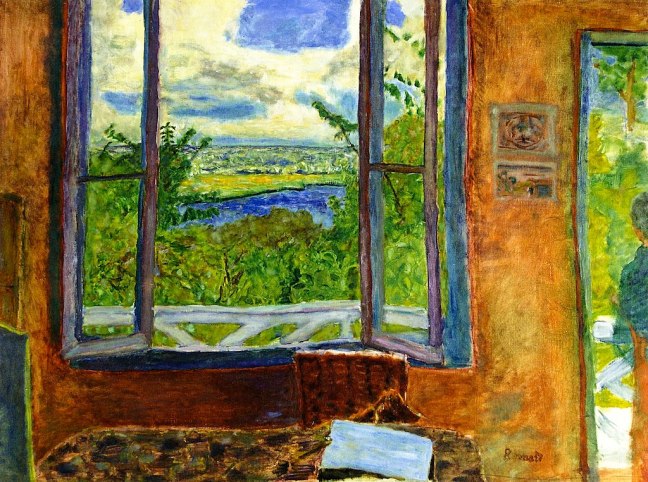
‘Fenêtre ouverte sur la Seine’ – Pierre Bonnard, 1911 – Wikipedia

Isn’t it humbling to realise that whatever experience you or anybody may have, whatever experience there is anywhere, anyhow, from any thing, at any time, in any dimension of life, will come down to being just this, this pure and impersonal sense of being that is the source and essence of all selves and things. You may live a child’s experience deep in the Amazon forest or a tree standing proudly in the Californian air. You may be a woman or a man in Paris, Kathmandu, or a lost, forgotten village in Greenland. You may live rich and imbued with yourself or excruciatingly poor, sleeping on a pavement somewhere, forgotten from all. You may be an ant living the life of an ant, in a scrumptious colony of fellow ants, or a dignified elephant leading the herd, the matriarch in her world. You may be an expression of utmost violence or anger, or lingering in total peace and appreciation of the world. Or an energetic horse running in the morning dew, or a distant owl hooting quietly before falling asleep. Or maybe a wave crashing in the ocean, or a whale flapping the water, or a little anchovy swimming in the big silver mass of its shoal. Or a soaring eagle, or any wild flower of any wild mountain meadow, or that heavy stone there, resting in a river bed. Or the lamp at your bedside. You may be anything that stands, sits, lies, flies, swims, exists, loves, suffers, ages or dies. You may be the majestic suns and planets of the universe dancing around, following their laws and trajectories. You may be god himself, or the goddess herself. The thousands and thousands expressions of devotion towards the divine, any human being lost in prayer. You may be just a thought. One word ushered at a lover’s ear. Or a gentle wind. Or a wonder. Or a tear. Or a sigh. Or nothing at all. A dream. Empty space. Anything. You may be anything at all. — And this is eternity. And the infinite is at your door. Here. Now. Love expressing itself. Being being ignited. Sameness. God’s presence felt.

.

~~~

Text by Alain Joly

Painting by Pierre Bonnard (1867-1947)

~~~

.

Website:
Pierre Bonnard (Wikipedia)

Suggestion:
Other ‘Ways of Being’ from the blog…

.
The Poetic Genius

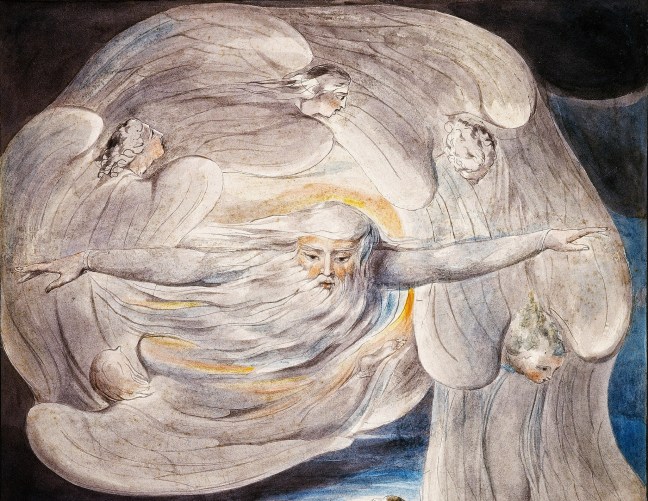
Job Confessing His Presumption to God’ (detail) – William Blake, 1803 – Wikimedia

.

I must Create a System, or be enslav’d by another Man’s;
I will not Reason and Compare: my business is to Create
.”
~ William Blake (‘Jerusalem’)

.

Artists, through their sensitivity to perception, their pointed quest towards beauty and harmony, are natural candidates for delving into the depth of reality and understanding their true nature. Many poets, painters, musicians, have been able to explore their being in ways that are traditionally the privilege of mystics. Indeed, they wrestle with eternity, and strive to find a way to convey it. William Blake was one such wrestler. He was a poet, painter and printer born in London in 1757. Although not recognised during his life, his art is bursting with creativity, intelligence, and vision. His profuse work, soaked with spiritual explorations, symbolic and personal mythologies, is not to be easily classified. Of William Blake, the 19th-century scholar William Michael Rossetti wrote that he was “a man not forestalled by predecessors, nor to be classed with contemporaries, nor to be replaced by known or readily surmisable successors“. Besides, his poetry is infused with pearls of the most profound non-dual understanding, which I invite you to explore here.

In his childhood, William Blake was fascinated by the work of great masters such as Raphael, Michelangelo, and Albrecht Dürer. He was educated at home, was given drawing lessons, and began writing poetry at an early age. Profoundly influenced by the Bible and Christianity, he was all his life gifted with visions and insights, from which he drew guidance and inspiration for his poetry and paintings. He was nevertheless not a follower, and developed his own vision and understanding. He was very critical of narrow-minded religiosity, or what he named the “general truth” or “general beauty“, writing uncompromisingly that: “To generalize is to be an idiot; To particularize is the alone distinction of merit“. William Blake wrote these enlightening verses about his religious endeavour and passion:

.
Trembling I sit day and night, my friends are astonish’d at me.
Yet they forgive my wanderings, I rest not from my great task!
To open the Eternal Worlds, to open the immortal Eyes
Of Man inwards into the Worlds of Thought: into Eternity
Ever expanding in the Bosom of God. the Human Imagination.”
~ ‘Jerusalem’ (Ch. 1, plate 5)

.
When will the Resurrection come, to deliver the sleeping body
From corruptibility? O when, Lord Jesus, wilt thou come?
Tarry no longer; for my soul lies at the gates of death:
I will arise and look forth for the morning of the grave:
I will go down to the sepulchre and see if morning breaks.
I will go down to self-annihilation and eternal death
Lest the Last Judgment come and find me unannihilate
And I be seized and given into the hands of my own selfhood.”
~ ‘Milton’ (Book the First)

[…]

An exploration of William Blake’s non-dual pearls and poetry… (READ MORE…)

.

The Glory of ‘I Am’

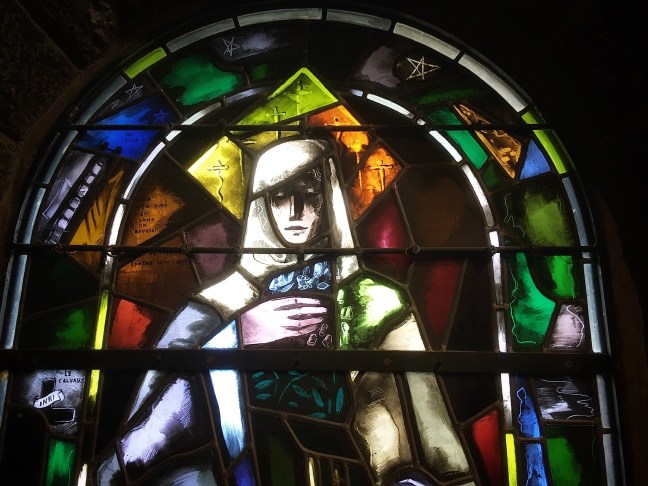
Stained glass by Adeline Hébert-Stevens in Church of Passy, France

First, you have to dig. You have to dig beneath every thing that qualifies you. You have to find that pure ‘I am’ hidden under all that this ‘I am’ is or can be. You have to find the raw substance of that which you are referring to when you say simply ‘I am’. What is this pure, unqualified ‘I am’? Over the years, piles over piles of experiences, beliefs, conditioning, have acquired substance and have overwhelmed this simple experience of ‘I am’. This substance has mutated into an apparent self, and ‘I am’ has been buried under it, and made into a collection of ‘I am this’, ‘and this’, ‘and this’, ‘and also this’. So that we can never ever truthfully feel ‘I am’ anymore. It is gone. ‘I am’ is gone with the wind of endless qualifications.

So we have now to resurrect that ‘I am’. To un-qualify it. To strip it bare of its qualities, of its acquired competences and idiosyncrasies. We have to purify the wine of our self, distil it to its essence. An essence that was never lost but only diluted, made secondary and unimportant, when it is in fact the only thing there is. This essence is simply the realisation of an emptiness that is the core of our being, that we never had the guts to look at, or enquire into, but which a simple question and a good-will to find out, could simply reveal with a dumbfounding ease and precision.

[…]

A celebration of the purity of being, before it becomes qualified… (READ MORE…)

.

A Tangible Now

‘News’ – Mikalojus Konstantinas Ciurlionis, 1905 – WikiArt

Everything that we truly have is now. In the unplanned. In the unprojected. Only we have to be very still to see it, to comprehend that truth. Not busy. To be busy is to plan, project, think, believe, fear, suffer. All these can never experience the now. For the sufferer and the believer have left the still, untouched, virgin presence of the now to venture into the past or the future. And in doing so, have somewhat died. They have stopped being. The reason for this is that being can only thrive in and as itself. That’s what makes it eternal, infinite, unformed, whole. To move from it, to have the slightest impulse away from it, is to trade being for becoming, eternity for time, infinity for limitation, and wholeness for separation. This is what makes the now into an unknown, unlived passage between two ideas: ‘that which was’, and ‘that which will be’. Both being some phantoms that we have invented to make one single thought about ourself viable. A thought that has separated itself from the true reality of being. A thought whose only purpose is to bridge ‘that which was’ to ‘that which will be’, and whose fate is to forever seek in the future its lost happiness. We are enclosed in our own fake self and reality. And the now has been lost, replaced by time and becoming. And the peace of being has been buried, replaced by a self that thinks itself separate and lacking, therefore suffering.

So this is the new world we have invented for ourself. This is the new situation. We are now looking to possess, attain, and reach. The now has been made into something negligible, not worth anything, a mere ‘obligatory passage’. We have killed the wide expanse of the now, and have jumped into a train of thoughts. We have deserted vastness and freedom for the prison of a mind. We have made ourselves merchants, mere traders of objects with an idea in view. Our feelings, our body, our sense perceptions, have come to define us. We have come to believe that we are what we are not. And we have, in consequence, become blind to what we truly are. We live in a fantasised world, forever running and rushing between beliefs and concepts, filling the space of being until it has become indiscernible, crowding the now with the whole paraphernalia of time. This is how the now is trampled. This is how its noblesse is sullied over and over again. For the loss of the now is our loss. It is therefore important, and some vital enterprise, to return to the now its forgotten grandeur, and to restitute its position at the very centre of our lives.

The now is not a fleeting moment in time, but the solid presence of the eternal. It cannot be known as an object — which would make it finite, situated, graspable — but as the very being of the very nature of ourself. The now is made of our presence. We are filled with it. The now is foundational. It is the unseen ground and walls of our being. The now isn’t one of the innumerable bricks of time. But time is refracted in the now as one of its many possibilities. The now is the space in which the whole of life unfolds its many mysteries. And its presence cannot be dissociated from that which we are in essence. We can try as we may, we will never be ‘not now’. Our being is forever stretched in and as the eternal and unlimited field of the now, curling up its true body in and as the own, ungraspable body of the now. We will never experience the now as ticking in our life at regular intervals. For it is the very life that we are made of and that refracts itself as a thousand experiences. It is hosting ourself, lending its structure to the very structure of our being. It can be felt as the tangible aspect of the intangibility of time. It is the only thing we have. It is had in us before even the concept of time appears, let alone the past and the future; let alone the body and the world; let alone thoughts, feelings, and the sense perceptions that give our many experiences their contours and qualities. Time is the now having limited itself to accommodate the limitations of thought. And space is the now having limited itself to accommodate the limitations of the world as sense perceptions. Behind all that is fleeting and overwhelming in the flow of experience, ‘now’ is the only solid, peaceful, tangible ground we have.

.

~~~

Text by Alain Joly

Painting by Mikalojus Konstantinas Ciurlionis (1875-1911)

~~~

.

Website:
Mikalojus Konstantinas Ciurlionis (Wikipedia)

.

Other ‘Reveries’ from the blog…

.

The Mystic Heart of Sport

‘The national game’ – Arthur Streeton, 1889 (Art Gallery of New South Wales) – Wikimedia

.
Brendan McNamee
is my newly invited guest on ‘The Dawn Within’. Brendan is an independent scholar and lecturer with a PhD at the University of Ulster in Ireland. He is the author of numerous books and essays on a wide range of writers, including John Banville, Michel Houellebecq, Gerald Murnane, Elizabeth Bowen, Sean O’Casey, Flannery O’Connor, W B Yeats and others. I’d like to present here one of his essays called ‘The Mystic Heart of Sport’. My attention was one day drawn to this eloquent title, while browsing through the platform ‘Academia’.

The text speaks about sport in general, using here the example of football, and mingling its wonderful argument with quotes by William Blake, Meister Eckhart, or W. B. Yeats. Brendan McNamee shows that “the conflict” on the football pitch is “between gods and mortals”, between “time and eternity”, both “inextricably entwined”. At its best, a game of football can give birth to “moments that justify sport at its best being called ‘poetry in motion’. Moments of sheer grace” when “skill and spontaneity join hands and, momentarily, dancer and dance are one.” I hope you will enjoy Brendan’s skilful writing and exposition as much as I have…

.

Eternity is in love with the productions of time.”
~ William Blake

.
~~~

The Mystic Heart of Sport

.
In The Hitchhiker’s Guide to the Galaxy Arthur Dent makes the startling discovery that white mice, rather than being the objects of experiments carried out by humans, were in fact carrying out experiments on humans. I wonder if a similar principle might be applied to sport. Take any high-stakes football match. Passions run high. The passion, on the parts of both players and spectators, is primarily for victory. The players receive a huge ego (and cash) boost, and from the fans’ point of view, a win for their team is, by some mysterious process of osmosis, a win for themselves. This lust for victory is so intense that the other source of sporting joy, the quality of the game itself, is often relegated to a secondary position, rendered lip service, of course, but seen really as essentially a means to an end. This, I would contend, is topsy-turvy. I want to argue here that it is the lust for victory that should serve the game, not the other way around, and that this order of things reflects a wider truth about life itself.

[…]

Discover Brendan McNamee’s skilful essay on the mystic of sport… (READ MORE…)

.