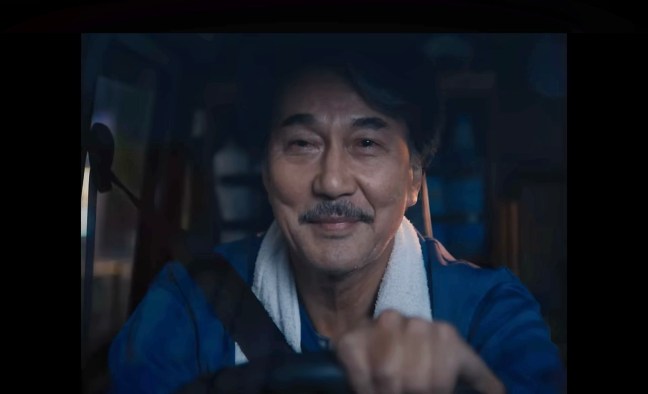
Perfect Days

’Perfect Days’ – by Wim Wenders (with Koji Yakusho)

.

All my films deal with how to live.”
~ Wim Wenders

.

Why do we watch a movie or enjoy any piece of art but for the joy, happiness, or relief we derive from such activity? Well, sometimes we use a movie not so much to feel, but rather to stop feeling. We want to be alleviated from our sense of boredom, or be distracted from our constant worry, or have the lowest ambition to be rewarded with pleasure, plain simple pleasure which, if not delivered, will make us move on to something else. Film as an art form is ambiguous, for it has in itself an entertaining power which makes it the prey to our most suspect desires. Well, Wim Wenders, in this movie, wasn’t going to give way to that ubiquitous trap and fall. With ‘Perfect Days’, he made a movie in which there is no desire to be had, which offers no suspense, no excitement, no resolution of any kind, but from which you would never want to move away. A movie that describes the quiet, plain, orderly living of a man whose job is to clean public toilets in Tokyo.

Hirayama lives each and everyday as if it was a perfect day. For him, there is no possibility of failure in life. And he makes sure that boredom is an impossibility. So he cares. Hirayama cares about everything he does, and seems to be profoundly related to his modest home, to his morning toilet, and to the watering of his plants. He does what he has to do, with no judgment or resistance. He doesn’t mind. He feels his inner freedom. He has everything he needs, so he smiles at life and life smiles back at him. He breathes when he steps outside and looks at the sky as for the first time, the wonder of it all. Then he buys himself a can of coffee from a local vending machine, opens his van, sits, drinks a sip, chooses a song from a bunch of cassette tapes, lights the engine, drives, and listens to ‘The House of the Rising Sun’ by The Animals. For that’s where he is now, in the house of the rising sun, going to his work through the sprawling suburbs of Tokyo’s morning, undisturbed, confident, present.

[…]

A reflection on the film ‘Perfect Days’ by Wim Wenders… (READ MORE…)

.
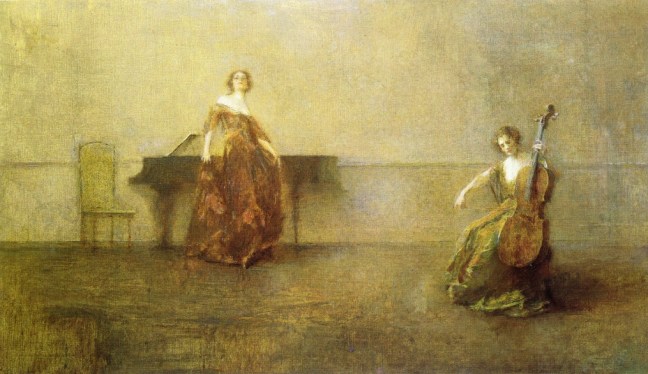
‘Agnus Dei’

‘The Song and the Cello’ – Thomas Dewing, 1910 – WikiArt

There is a prayer that was once addressed to our deepest self. This is a song of mourning for the life that we cannot get hold of, for the self that we cannot truly be. This mourning is the story of our wrestling with life, of our puny self, a self that is elusive, fragile, fearful, and has been plagued with suffering. So this prayer is a plea addressed to the one that can save us from our intolerable pain. But it is not intended to God. It is intended to ourself, to that part of ourself that appears to be soft, uncertain, constantly seeking affirmation, but is in fact holding the key to the peace we are so desperately looking for.

This self is called, in the Christian tradition, the ‘lamb of God’, and refers to Jesus as ‘Christ’. It is the one for whom John the Baptist had this exclamation: “A man who comes after me has surpassed me because he was before me”. (John 1:30) This self is called a ‘lamb’ because it is destined to die in the embrace of being. Being is its only reality, its rock-like ground and certainty, the one that ‘surpassed me’ because it was ‘before me’. The self that we believe ourself to be is a fragile construction, and a vulnerable entity. It is afraid of dying, of having no solid ground, and is pleading for one.

Lamb of God, who takes away the sins of the world, have mercy on us.” This plea is a liturgical prayer used in every Catholic Mass, borrowed from a passage in the New Testament (John 1:29). This prayer, called in Latin ‘Agnus Dei’, was used by many of the greatest composers for a number of choir pieces. In 1967, an American composer named Samuel Barber, at the time battling with depression, decided to adapt his 1938 ‘Adagio for Strings’ into a choral work. His ‘Agnus Dei’ is a gorgeous expression of a longing for God, a longing that is the one longing of all humanity, the desire for peace, the unceasing quest for a happy living.

[…]

Exploring the meaning behind a choir song by Samuel Barber… (READ MORE…)

.

The Straight Story

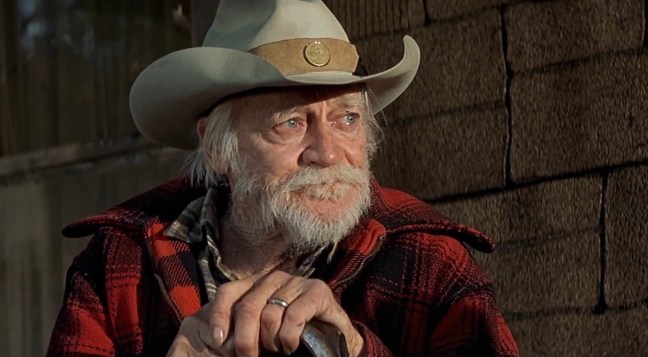
‘The Straight Story’ – by David Lynch (with Richard Farnsworth)

.

When I catch an idea for a film,
I fall in love with the way cinema can express it
.”
~ David Lynch

.

Have you ever seen a film made of love? Well, I have. And no further than this morning. A modest, not very well-known masterpiece by David Lynch, called ‘The Straight Story’. It is based on a true story: In 1994 in the United States, Alvin Straight — an old man — decides to pay a visit to his brother who has just suffered a stroke. They haven’t spoken for ages, out of an old rancour, so he wants to repair and reunite. With a clear mind, he embarks on a 390 kilometres journey from Laurens, Iowa, to Mount Zion in the Wisconsin, but he does it in his own inimitable way. On a riding lawn mower!… With bad hips and two sticks for help, and a refusal of doctors. With a maximum speed of about 8 kms per hour, and a trailer to pull. And with love as a luggage.

As often when it comes to starting a spiritual journey, it all begins with a fall and the subsequent realisation that something needs to be changed. And in order to make our quest a successful one, we have to make the journey just as important as the destination. And this is what Alvin does. His trip becomes an occasion for adventure. Everything he meets, he does with the eyes of wonder, and the now is the only time in which his travel takes place. Everything is important. Everything matters. The journey is not just a means to an end. We don’t reach infinity step by step anymore than we meet eternity in time. Every meeting with truth is made in truth’s home. And every encounter with our true nature is made within, in and as our innermost sense of being. No matter the extent of our understanding, in order to be, we have to be being. And Alvin, clearly, knows it all too well.

[…]

Some reflections on seeing this film by David Lynch… (READ MORE…)

.

Turner’s Moon

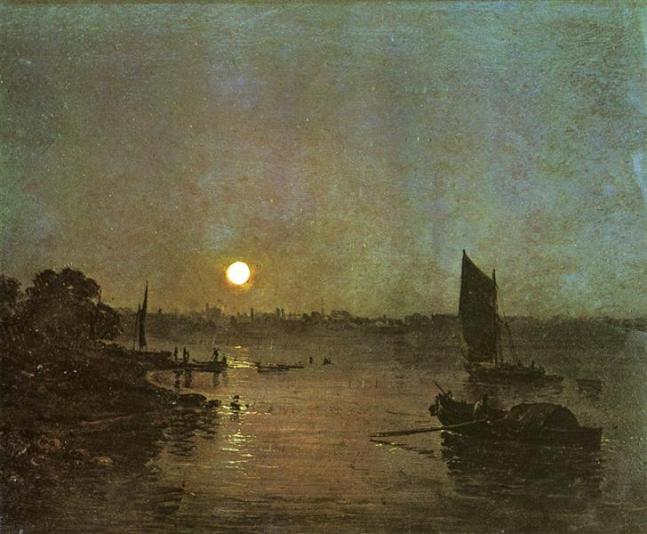
‘Moonlight, A Study at Millbank’ – J.M.W. Turner, 1797 – WikiArt

This text is directly inspired by an analogy used by the teacher of non-duality Rupert Spira. I found it to have such evocative power that words started to pour out and I couldn’t stop them. This text is therefore dedicated to Rupert and his timeless vision and teaching.

~~~

Sometime a painting just comes timely to move your heart. It is a gorgeous landscape painting, depicting a coastline and the sea, with boats and fishermen in the moonlight. At Millbank, Turner was painting in dark, subtle hues of black, blue, and purple browns, to define a night, leaving here and there traces of light, golden reflections on the water. In the wide expanse of the sky, he had left one portion of the painting untouched. Pure as white. Undarkened. For the painter had a view in mind. He was to paint a moon, bright and resplendent. And no moon was ever so bright.

This part of the scenery that wasn’t painted, it was you. You, before you were made a person, before the identification with thoughts, feelings, body, story, hurts, memories, projections, beliefs. The nature of the moon was that part of you that was left unseen, unexplored, but that had quietly illuminated you all along, giving you a self and an identity without your knowing, lending you a hidden strength for your bruised self, and bathing you in its unheard silence. It was the trusted one, the one reliable thing in a life of relentless changes and challenges. It was the peace of your true self, the precious being that had been covered up by the night of objective experience. This is the moon Turner had meant to convey.

[…]

A meditation on the evocative power of Turner’s painting… (READ MORE…)

.

The Gospel According to St. Matthew

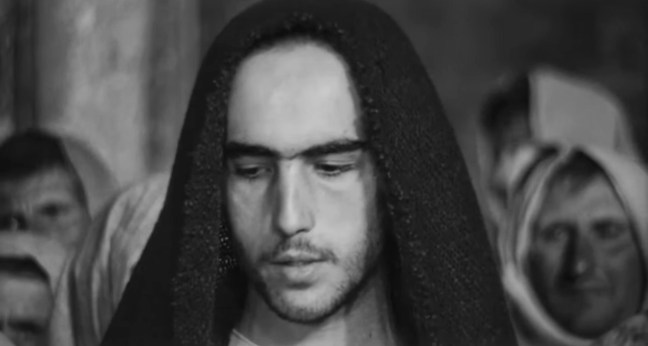
‘The Gospel According to St. Matthew’ – by Pier Paolo Pasolini – (With Enrique Irazoqui)

.

The motivation that unites all of my films
is to give back to reality
its original sacred significance
.”
~ Pier Paolo Pasolini

.

The famous Italian film director Pier Paolo Pasolini made this beautiful statement about his art: “When I make a film, I shift into a state of fascination with an object, a thing, a fact, a look, a landscape, as though it were an engine where the holy is about to explode.” This can be immediately felt as we stroll amongst the first scenes of his 1964 movie ‘The Gospel According to St. Matthew’. We are met with an angelic Mary looking at a bewildered Joseph leaving home after the discovery of her pregnancy. Silence prevails and only a concert of bird’s songs can be heard. Joseph wanders in solitude in a landscape that is desolate yet teeming with presence and energy. He comes to the edge of a town and kneels against a nearby stretch of land where a bunch of children are playing, giving like a lullaby of innocence to Joseph who closes his eyes and abandons himself to the moment. This is the chosen time when an androgynous angel appears and gives him the revelation of the divine nature of Mary’s pregnancy.

[…]

Discover the magnificent film by Pasolini on the Gospel of Matthew… (READ MORE…)

.

The Angel of Death

‘Stranger Things Graffiti’ – Paul Sableman (Jher Seno & the Arty Deeds) – Wikimedia

.

A myth is a mask of God, a metaphor
for what lies behind the visible world.”
~ Joseph Campbell (‘The Power of Myth’)

.

There is an astounding profundity in popular culture. It is just for us to see when it pops up, when it arises above the sea of confusion that our life is for the most part. What is designed to be just light entertainment, what appears to have no depth or consistence other than being an easy escape out of ourself, can hide the brightest of gems if we can elevate ourself to its hidden meaning. I stumbled across one such meaningful gem recently.

Running Up That Hill’ is a song created by pop singer Kate Bush in the eighties. It recently got a second life and triumph by appearing in one scene of the famous sci-fi thriller series ‘Stranger Things’. In this particular show, there is a hideous monster that roams in an imaginary city, and feeds on the minds of teens deeply affected and traumatised by their past, luring them into its parallel and ultimately illusory reality. In that particular scene, the girl is trapped in some dark chamber of her mind. The ugly beast keeps her prisoner there — a cave like place where she is about to be engulfed in the monster’s hideous mind. She manages to escape the grip and run towards an opening in the distance where is her true self and salvation. Pieces of rocks are falling all around her to stop her course, but she keeps running one-pointedly ahead while hearing Kate Bush’s song ‘Running Up That Hill’. The reason for her escape is to be found with her friends playing this song she deeply loves, and creating in her that powerful call and incentive.

Why does a particular blend of a scene and a song suddenly hit a target, move people beyond what could be possibly expected? Just one glance in the comments of that particular scene on YouTube makes it clear: “Best scene of the series”, “This scene made me want to live”, “Cathartic”, “A metaphor for what’s battling your mind”. Why does anything hit us and move us to feel in ourself a feeling of being alive? Tears may come, a feeling of thankfulness, maybe even some sense of profound happiness. What is tilting in our minds in these ineffable moments is the recalling of our life’s most essential meaning and purpose, and the remembering of a place in ourself that we have neglected. This place is the forgotten but obvious target for all our thirsty mind-arrows. It is the open space of our deepest being that we keep missing at every moment of our lives, precisely because of its total intimacy and openness. How do we manage to miss it? Because we focus on the periphery of objective experience. We are enclosed in a dark chamber of our own making that lures us into itself, and makes us fragile, hopeful dreamers with fearful minds, forever caught in the prospect of impending death.

[…]

See how popular culture is infused with non-dual reminiscences… (READ MORE…)

.

A Song of Two Humans

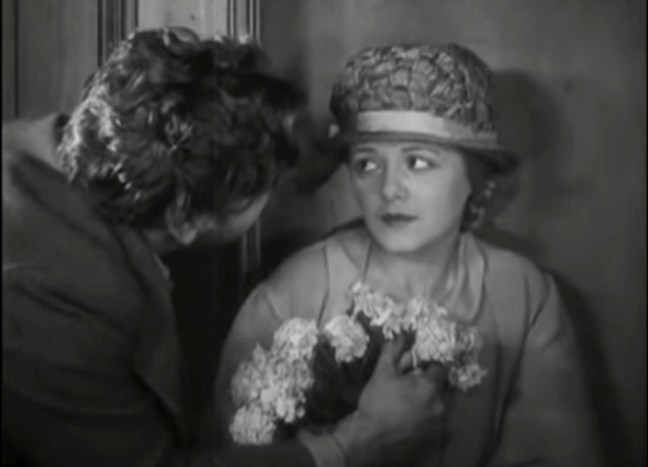
‘Sunrise: A Song of Two Humans’ – F. W. Murnau – (With actors George O’Brien and Janet Gaynor)

.

.
Silent films had a language of their own;
they aimed for the emotions, not the mind,
and the best of them wanted to be,
not a story, but an experience
.”
~ Roger Ebert on ‘Sunrise’ (film critic)

.

Life is relationship. No matter what. We are always engaged in a relationship with an apparent ‘other’. Should we be left alone in the world, with no other humans, life would remain an encounter with the other — any other being — be it the sun, the wind, the rugged stones on our path, or our very own self. Our life is always a song of apparent duality. And the success of any relationship, which is the coming of intimacy and love in our life, is always the road taken from apparent separation to the realisation of our shared being. Life is one. But that needs to be fully seen.

I was put on these tracks by watching the 1927 silent movie ‘Sunrise: A Song of Two Humans’ by German director F. W. Murnau. The film is a splendour. Although an overly simple love story, the title suggests that its lessons are of an universal nature. And the finesse and poetry of its making renders it as an archetypical manual for everything that a relationship can bring or teach. The story can be summarised in a few lines: a country man has become weary of his relationship with his wife, and has started a love affair with a passing woman from the city. His new lover convinces him to kill his wife while being on a boat trip on the lake, a plan which the man, overtaken by remorse, fails to execute at the very last moment. The rest of the film is the story of his winning his wife’s forgiveness and the return to a dazzling feeling of love and happiness between the two.

[…]

Discover the lessons contained in this masterpiece of the silent era… (READ MORE…)

.