God’s Flower Bed

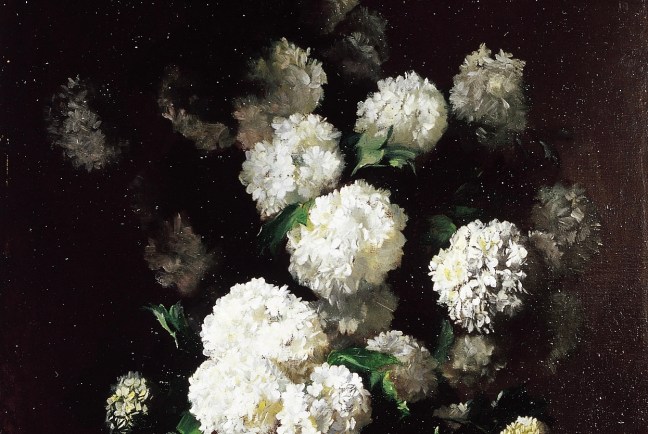
‘Fleur’ – Jean Benner, 1860 – WikiArt

.
The difficulty in the spiritual endeavour
is that we have to question the unquestionable. We have to doubt the obvious. We have to turn the stones that we have carefully placed here to pave the road. One such indisputable truth is that we choose our thoughts. That the decisions or actions we are taking, the thoughts or attitudes we are having, are the products of a controller, of a self that has them, chooses them. But is it so? Have we even tried to question it? Have we ever looked if there truly was a self here in capacity to choose? What if there wasn’t? What if this self, this ‘I’ that we seem to be, only drew its existence from our imagination? What if our own self was just another thought? If this entity that we love to pamper and strengthen was not there, not at all? If we have played a game with ourself? If there is here no person outside our indulgence in having the thought of one?

Many of our conflicts and problems in life come precisely from the belief that we are the chooser of our thoughts, that there is an ‘I’, a person here that runs the show when there is not. That’s the mistake, the original sin, to think of ourself as a doer, a thinker, a separate entity that has control, that manufactures happiness, freedom, and is responsible for our experience such as it is. We want to carry the load of our DNA, of our body, thoughts, habits, suffering, or even happiness, and not let them go. We want to be grandiose. The truth is: there is no personal ’I’ that can act on our thoughts or decision-making. These are better left alone, and informed by the only ‘I’ there is, that finds its true essence in the infinity of being, which is selfless. With this understanding or realising, we would come to treat what we have as a jewel of the most precious kind — beyond control but lovingly tailored for us by the universe and its supreme intelligence.

[…]

An enquiry on our ability to choose our thoughts or not… (READ MORE…)

.

Anatomy of a Desire

You must not desire the truth. You must let the truth desire you. For truth has the greatest desire, the most efficient one, to which yours is but a pale copy. It is the desire to be itself alone, unaccompanied, unsoiled. In the fulfilment of that desire, truth will swallow you, will undress you and render you transparent, nonexistent, naked. You’d be inspired to let go, to give in, to trust that desire which is so greater than yours. For your desires are small, inadequate, vile, selfish. They won’t get you where you truly want to be. They will miss the mark. Every time.

So don’t desire truth. Don’t make it like something you can possess. Truth is in fact already possessing you, the only one in command. So undress your being of the superfluous. The superfluous is all the beliefs attached to yourself, that makes you a self that feels separate, an entity in a body, delineated by its thoughts and feelings, that looks up to experience, and betrays its profound suffering through its constant desire for fulfilment.

Notice that your desire has no true owner. The one that desires is not really there. It is but an idea, a desperate attempt to feel that you are complete. But you won’t feel complete by means of desiring, for desire is already the sign of your incompleteness. The problem with being a desirer is that it places you ahead of your natural identity as being. It is a position of ignorance with a plan and a hope. The desirer is a made-up entity whose unacknowledged goal is to consolidate itself. So don’t make truth like a projected goal to be achieved. The desired object of enlightenment, or realisation, was never intended. It was in fact all for the desirer, to strengthen your false identity as a self, to adorn the temple of separation, to attach yourself to another idea. Liberation is not in desiring to be liberated.

[…]

Continue this exploration of desire in matters of truth… (READ MORE…)

.

The Intimacy of Experience

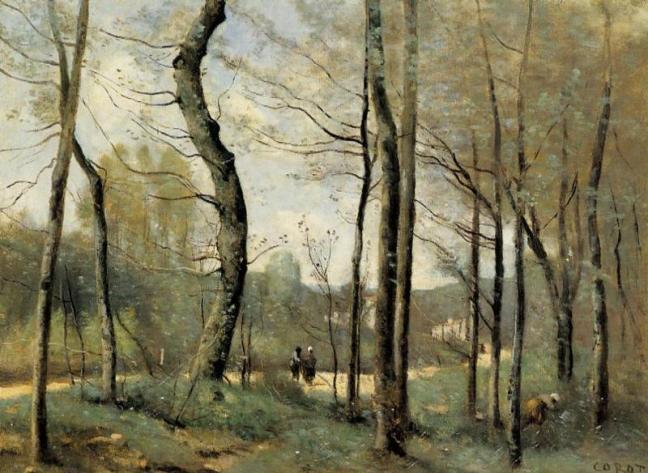
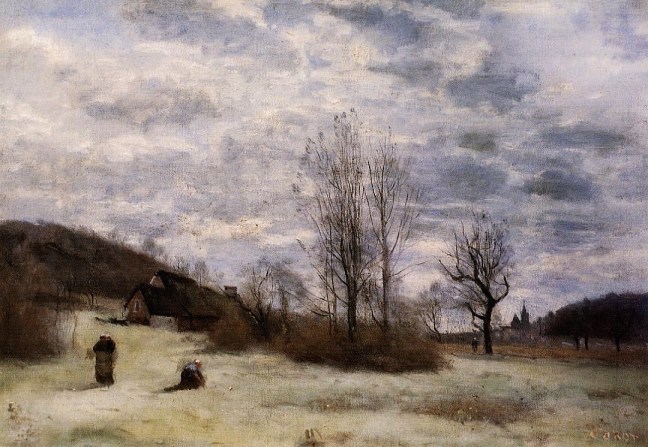
‘First Leaves, near Nantes’ – Camille Corot, 1855 – WikiArt

.
I will tell you where to be
. Be where every experience feels an equally good experience. Don’t be attached to judgment and comparison. These are the mind’s favorite tools and activities. The mind tricks you to believe that experience is an uneven ground. That according to the content of your experience, you will be gifted with either happiness or suffering, peace or conflict, harmony or disorder. So the experience you are having becomes extraordinarily important. We become dependent on what happens to us, and come to dread it. So we retire into the secure place of our habitual self, with its cortège of worry, control, expectation, and manipulation.

There is a place in us where you don’t find experience to be such a determining factor. Where you will not let experience determine you, fix you, limit you. You won’t be shaped by its content. You won’t be made into something, someone, with qualities and flaws, to be judged, evaluated, compared with — the likeness of experience — in fact, just another object. The mind is a manufacturer of objects, entities, persons, fixing the insubstantial nature of your being into a self to be moulded and made either happy or miserable. To be made happy by an experience is to be cheated on by it: we are being manipulated, and made to believe an illusion. To let experience make us miserable is sheer deceitfulness, it is us being easily dazzled by the treachery and artifice of objects.

[…]

Continue this exploration of the nature of experience… (READ MORE…)

.

The End of Self-Improvement

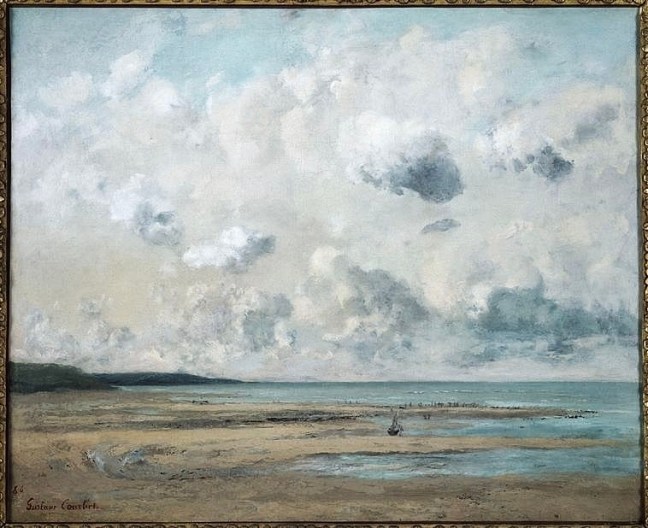
‘Shores of Normandy’ – Gustave Courbet, 1866 – WikiArt

.

To know that your Self has not changed,
this illustration itself is enough.”
~ Ramana Maharshi

.

There is no ameliorating emptiness, developing the unborn, aggrandising what is, and expecting the timeless to be anything more or different than what it is. Being leaves no room for improvement because it is not a thing, it is not a result, a something that has a cause. How do you improve the non-objective? How does the infinite progress? How do you make better a self that is absent as self — as something different or separate from experience? So self-improvement is a misunderstanding and a form of violence. It is an imposition, a belief that we squeeze to fit our idea of reality, an objection to the innate perfection of what is. It is mind-made, a product, a progeny of conditioning. It is designed for the continuation of our belief in being a self or entity that can be objectively defined. And remember this: every object, every ‘thing presented to the mind’ — as Latin word ‘objectum’ stands for — is in fact nothing but something thrown in the way of your knowing who you are. This is the meaning of Latin ‘obicere’ — ‘ob-‘: ‘in the way of’ and ‘jacere’: ‘to throw’. The self that you believe yourself to be, and that you strive to improve, is your hindrance. It is what makes you blind to your true nature.

To improve on a self is to make it continue, it is to give it credit, to give it the existence it never had. After all, we all want to feel real, to see that we can act, and have a power on our self. So we have the desire to consolidate and sculpt our being through rendering it an object that we can manipulate. We want to make a profit of our self, and see a return on our investment. In fact, to improve myself is nothing but a form of merchandising. It is a trade and a transaction. It is retail management, the ‘cutting off’ of our self with the aim of maximising profits. But don’t ever forget that if you are able to improve yourself, you can therefore also make it deteriorate, worsen, decline, decay. So what then?… is self-improvement decay, error, illusion? Is it ourself going astray, being mislaid? Are we really so sure that our being could ever decay? That awareness is a so fragile thing?

[…]

On how there is no improving our self and being… (READ MORE…)

.

God Unveiled

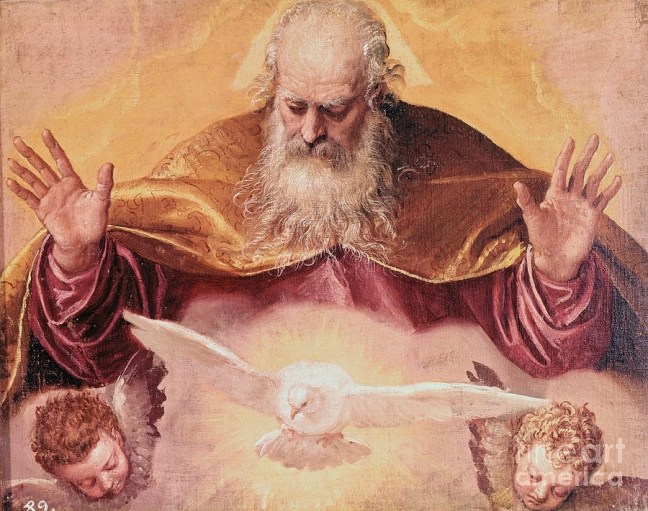
‘Illustrated Depiction of God with Holy Bettmann’ – Tintoretto, 16th AD – WikiArt

.
For many of us, god is nothing more
than the idea or belief we have inherited of such a being, an idea that is conditioned by religion as the lazy representation of an omniscient, omnipotent entity that is both our creator and protector — in the popular Christian imagery an old bearded figure who lives far and away from us, in a lofty, elevated place for a good view on its creation and creatures. The existence of such a god is almost only a matter of belief or faith, and the relationship we have with it one of reward and punishment, devotion, fear, prayer, praise, but rarely of understanding and exactitude. It seems that we better have god in a hazy place, feel more at ease with not knowing too much about the wisdom that may hide behind that term. So our ignorance is a calculated one, a refusal to rock the boat, and a patting of our carefully assembled opinions from which we derive our sacrosanct identity and security. But let’s tackle god here. Let’s undress the myth and have a thorough eye-contact with the divine. Let’s dare some experiential understanding. Let’s have god out of its hiding place.

Maybe god was never defined because it is the one thing in life that is indefinable. Everything objective that we can know, see, hear, touch, smell, taste — qualities and all — can be described with words and given a name. We have our life surrounded by objects. The objective has filled our experience to the brim, and we are being choked in it — with no breathing possible, and no space allotted to the unknown. God is one such unknown. But how could we describe something that we cannot know as an object? So to god we can only give a generic, provisional name. Because god cannot be pointed at and recognised as an object or entity. God is not an easy catch. The divine defies our understanding, and this defiance is at the core of our misinterpretation of god. So if you want to know god, you have to look for it in your life, and turn every stone and pebble that crowd your experience. So start by removing everything in existence that you can know, see, hear, touch, smell, taste — qualities and all — that have an objective quality and can be given a proper name. You know: everything that you can show to another fellow, and that he too can see, hear, know, understand, and comprehend, just like you. Take it all away, and then see what remains behind.

[…]

An explanation of the nature and reality of God’s being… (READ MORE…)

.

An Explanation of Reality

You may not be interested in these matters. You may be an atheist, a non-believer. You may have an aversion towards all things spiritual. It doesn’t matter. You will get it all the same, that the world, the universe, everything — including yourself — are not there. Nothing is really there. Not in the way you had imagined. This is not like everybody has been telling you. Not at all. And you will see it with your logic, with your scepticism — a golden value by the way —, with your Cartesian, rational, solid mind. I will explain. You just have to listen carefully. There is no world, and I will expose to you how it is so. I will demonstrate it to you.

You may think there are billions of other people, countless other versions of suffering, a multitude of experiences, a world teeming with crowds and achievements, and all manner of things, from the most sublime to the most appalling. And there are indeed multiple points of views. But all of the world’s sufferings will always ever be experienced as yourself. It will be for whoever you may be now, and be experienced in whatever experience you may be experiencing now. The whole world is always only a first person experience of the world — in whoever you happen to be at this moment. When another person experiences suffering, it will then be this person’s only reality, and so on. So you will always ever be yourself. There are no ways to be another than yourself, to have another experience that your own experience of being yourself — which you experience right now. So the totality of humanity is contained in that one subjective experience of being. It is all there — in being. The billions of subjectivities, the myriad of experiences, the unspeakable suffering, the expansion and the veiling, the gruesome and the awe, the glory and sacredness of truth, and the compelling ignorance. Every experience of every possible being in this world is in essence made of that one experience of pure, ethereal being. And suffering is when you don’t know that.

[…]

An explanation on how the reality of everything is only being… (READ MORE…)

.

Fear and Trembling

‘Plains near Beauvais’ – Camille Corot, 1860-70 – WikiArt

.

The fear of the Lord is a fountain of life,
to depart from the snares of death.”
~ Proverbs, 14:27

.

There is an expression that we may find puzzling, maybe slightly paternalist, condescending and outdated, but is well worth looking at. We find this expression mostly in Christianity and Islam, where the mentions ‘fear of God’, ‘fear of the Lord’, or the injunction ‘fear God’ are found far more than a hundred times in the Bible, or in the Quran. This fear is said to be one of the seven gifts of the Holy Spirit, along with wisdom, understanding, guidance, mightiness, knowledge, and devoutness. But why would we be afraid of what we longed for the most in our lives? We should be embracing it with ardour and ease. So what is this “fear of the Lord” that, in Proverbs 9:10, is said to be “the beginning of wisdom”? Why is it given such primary importance?

Maybe we fear god for the same reason that we fear death. We think that we are something, someone, a self that we appreciate and have a fondness for, that we love and want to cling to as something precious. We want it to continue. So we have elaborated strategies to keep our self padded with multiple pleasurable sensations through our various habits as thoughts, daydreams, pleasure oriented activities, routines, manipulations, avoidances, all these addictions that have come to form the main part of what we call our self. But these are vain distractions, for awareness as god seems to have in itself a momentum, a power to draw every thing and being to itself. So this pull can be felt as a threatening force from the limited point of view of a self that feels vulnerable, and finds temporary security in being something, even if this something is in final analysis the cause of its suffering. In Hebrews 10:31, it is said: “It is a fearful thing to fall into the hands of the living God.”

[…]

An essay that inquires into the notion of the fear of god… (READ MORE…)

.