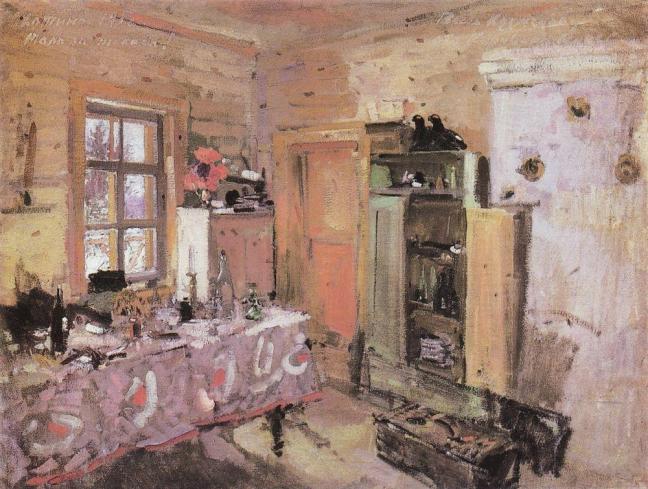
The Cave

As the innermost Self of all, 
he dwells within the cavern of the heart
.”
~ Mundaka Upanishad, Hymn II.1.9


I had this thought landing in my mind some time ago, that “now I might as well retire, take refuge into the cave of awareness”. This made me think of the retiring into caves, as monks and anchorites do in some spiritual traditions. Retiring from the world, falling into solitude can be useful to withdraw from the entanglement with the ten thousand things of experience. It allows a space in which we can be watchful, and have the leisure to deepen our understanding. In the Hindu concept of Ashrama, which represents the four different stages of life, two are dedicated to some form of withdrawal from the the world: Vanaprastha, which in Sanskrit literally means ‘retiring to the forest’, and Sannyasa, which means ‘to put down everything’. The western word ‘anchorite’ has a Greek origin which means ‘to withdraw’, and ‘monk’ comes from ‘monachos’, which means ‘solitary’.

But what does this withdrawal from the world mean, in deep analysis? All the religious concepts of renunciation, solitude, poverty must point to something deeper than just a physical attitude. Because no matter how thick the walls of renunciation may be, a strong sense of being a ‘person caught in the entanglements of its own re-created world’ can and certainly does survive any physical retirement, be it in a forest, a monastery, or a desert. So this retiring has to be a metaphor. In reality, the true retiring resides inside, where we for a time take our stand as the witness, the presence behind all objective experience. The Indian word ‘sādhu’, which also refers to a person living a form of renunciation, has more ambivalence. Its rich meaning goes from ‘not entangled’ to ‘leading straight to a goal, hitting the mark, unerring’, to simply ‘peaceful, excellent, virtuous’. There is much more here than just withdrawing.


The Lord is the supreme Reality.
Rejoice in him through renunciation
.”
~ Isha Upanishad, Hymn 1


So the cave, metaphorically speaking, is awareness, the peaceful presence at the core of our experience. This place need not be a remote one, except in the first stages of our understanding, when we need to disentangle our true self from the parasites of a busy and confused mind, or indeed an equally busy and confused world. But, in a way that is truly paradoxical, when you reach the deep, unfathomable cave of consciousness, the inside suddenly turns out to be the outside. The true cave turns out to be no cave at all. It turns out to be the world, the entirety of our experience. As Rupert Spira says: “This empty ‘nothing’ turns out to be the fullness of everything.”

The walls of the cave are made out of our daily experience. The world is the cave and it is placed at an infinite distance. Be careful here, ’infinite’ doesn’t mean ‘far away’, it means ‘at no distance at all’. The world is ourselves. The cave of consciousness where we have retired is ourselves. Not the little self for whom retiring was a separate action with an aim at hand, but rather a new self englobing everything, the whole world. And this world is not a cave of separation, it is the totality playing with itself. And believe me, the infinite possibilities for celebration, the number of possible games to be enjoyed are here if we are only willing to play. Not entering any caves, but giving ourselves – literally – to the non conceivable, the non fathomable, and to the ten thousand things of experience.


~~~

Text by Alain Joly

Painting by Joseph Wright (1734 – 1797)

~~~


Painting: A Cavern, Evening. 1774 – Joseph Wright – [Public Domain] WikiArt

Websites:
Rupert Spira
Joseph Wright (Wikipedia)


The Departure

It’s that dream that we carry with us
that something wonderful will happen,
that it has to happen,
that time will open,
that the heart will open,
that doors will open,
that the mountains will open,
that wells will leap up,
that the dream will open,
that one morning we’ll slip in
to a harbor that we’ve never known
.”
~ Olav Hauge (translated by Robert Bly)

.

His two bags were lying at his feet in the bedroom, wonderfully clean, square, tied up. Slowly, he had dressed with the clothes he had carefully chosen for the trip, had slipped his black leather belt on, in which slept a few bundles of neat traveler’s cheques, had put on his brand new, too new sneakers. Already, he imagined them, old and wrinkled, worn out, tanned, alive with six months of wandering in the land of gods and poverty. He was afraid of this journey, afraid of having to face, one by one, patiently, the thousand problems, the thousand worries, but also the joys, the discoveries, the surprises that would inevitably mark his path. He had prepared as thoroughly as his character allowed him and, at the time of departure, he looked like a bourgeois and shy little son who was about to fight the battle of his life. Nothing will ever be the same now, the die was cast, he would tread the foothills of the Himalayas, the Ganges plain, the Rajasthan desert, he would get drunk on wondrous visions, he would taste the smell of spices, he would marvel at beautiful faces. …

Continue reading about Pierre’s departure to India (READ MORE…)

.

The Deepest Acceptance

It is truth that liberates, 
not your effort to be free
.”
~ J. Krishnamurti

The question of ‘surrender’ is one that is often misunderstood. Surrender implies, in everyday language, something that the mind does, even remotely, in order to give itself to a reality that seems inescapable. It often comes down to a form of resignation, a giving up, something passive at its core, which brings more delusion and suffering. So what is true ‘surrender’, in a non-dual context? I have gathered here many quotes and pointers on this subject, from various spiritual teachers and poets of the eternal and the infinite. I hope that this will bring some clarity into that which Jeff Foster calls the deepest acceptance…


~~~


People often think that surrender means to renounce wealth, sexuality, or objects. Such a renunciation might be useful but it could also be a hindrance. Real surrender takes place when we cease to take ourself for a separate entity, an object. This renunciation seems, at first sight, limited in scope and too simple, but it is, in fact, the ultimate surrender. Such a giving up has no purpose, it comes from the deep understanding that our true nature, consciousness, is free from all limitations. From this perspective, surrender means to see the limitations for what they are: mere concepts superimposed onto our real being, which is limitless.”
~ Francis Lucille (‘Eternity Now’)

~

You may discover that when there is no resistance to totally being in hell, that heaven opens up and samsara reveals its true nature as nirvana. But the catch is, if you are embracing hell as a strategy to get you to heaven, that doesn’t work. Only the complete absence of wanting what is to be different in any way pops the imaginary bubble of separation. No one can do this. It is like dying or falling asleep. It is the absence of any doing, the absence of control, the absence of effort, the absence of any concern about what happens. It is a letting go, a dissolving, a relaxing. This letting go begins with letting go even of the need to let go, for the need to fall asleep keeps us awake, just as the imperative to surrender is a form of holding on and seeking control. True surrender is the absence of resistance even to holding on if that is how life is showing up in this moment. Surrender is the absence of trying to surrender.”
~ Joan Tollifson

Continue the exploration on the question of ‘surrender’ (READ MORE…)


Kabir Says:

(Painting by Tanya Bonello)

Lift the veil that obscures the heart
and there you will find what you are looking for
.”
~ Kabir


Little is known about Kabir. Legends abound and certainties are scarce. He was a weaver, probably spending most of his time working at his handloom. He was born in fifteenth Century Benares, and became a mystic and a poet whose songs and ‘bānīs’ – meaning ’utterances’ – spread in the whole of India and beyond, mostly handed down orally between seekers and sadhus along the roads, sometimes written down. They were the expression of a simple man, probably illiterate, and his first-hand understanding of the deepest truth of living. 

Kabir wasn’t a philosopher, far from it, and many of his poems were deeply grounded in everyday life. His expression was often ruthless, “I see the world. What a bag of tricks it is!” He execrated the bigotry and hypocrisy of Hindu and Muslim devotees alike, and he never tired of denouncing the contradictions between the religions in place, each asserting their own god, beliefs, practices, about something Kabir knew in his flesh and soul to be one single reality, unbroken, and timeless.

Servant, where dost thou seek Me? 
Lo! I am beside thee.
I am neither in temple nor in mosque:
I am neither in Kaaba nor in Kailash: 
Neither am I in rites and ceremonies,
nor in Yoga and renunciation. 
If thou art a true seeker, thou shalt at once see Me: 
thou shalt meet Me in a moment of time. 
Kabir says, ‘O Sadhu! God is the breath of all breath.’

Discover more of the wonderful poetry and legacy of Kabir (Read more…)


The Forgotten Things

You must go in quest of yourself, 
and you will find yourself again only 
in the simple and forgotten things. 
Why not go into the forest for a time, 
literally? Sometimes a tree tells you
more than can be read in books
.”
~ C.G. Jung 


~~~

Photograph by Corinne Galois

Quote by Carl Gustav Jung (1875-1961)

~~~


Bibliography:
– ‘Carl Jung: Wounded Healer of the Soul’ – by Claire Dunne – (Watkins Publishing)
– ‘The Earth has a Soul: C.G.Jung on Nature, Technology and Modern Life’ – by C.G. Jung and Meredith Sabini – (North Atlantic Books)

Website:
Carl Gustav Jung (Wikipedia)

~

35AC44F0-BB66-4EDC-A0C8-8B2347798964Corinne Galois is a lover of art and photography living in Paris. She is very eclectic and is an observer of what I would call the small theatres of everyday life, her subjects ranging from abstract details, to the loveliness of nature, or the poetry of street life.

Corinne’s websites: 500px & Galerie photographique 


Bhakti, the Song of Love

Don’t forget love;
it will bring all the madness you need 
to unfurl yourself across the universe
.”
~ Meera Bai (1498-1546)


I intend here to continue exploring the three different pathways towards realising our true nature. I have some time ago given my attention to Jñāna, which in the Indian tradition is the name given to the means of attaining truth through the investigative qualities of the mind, which are mostly thinking and the power of discrimination. The two other paths towards realisation are the tantric path, which involves the senses, and the path of love, which involves feeling, and is the subject of this essay.

The path of knowledge requires a certain steadiness, orderliness, being thorough, constant. But even somebody set on this logical path of knowledge will be exposed to ineffable, timeless moments of pure love. Some people are best suited to a more loving, encompassing pathway, that would allow them to be just as they are, with all their confusion and overwhelming feelings. I can be the me that I am, as long as I am too this loving, embracing presence to which I can offer myself. In love there is no theory, no guidelines to follow. And it is not a surprise to find this expression of truth as one of the means to the realisation of our true self. This pathway of love has been called ‘Bhakti’ in the tradition of India. All the Indian faith, at least in its more popular expression, is of a devotional nature, and has elevated this simple love for god or truth to the rank of art. That seemed to me a good starting point to embark on this path of devotion, which the Śivānanda Laharī (verse 61) describes as: “The way needle seeks magnet, the way creeper seeks tree, the way river unites with ocean and the way the mind seeks the lotus feet of Śiva.”

An exploration into Bhakti, the path of love and devotion (READ MORE…)


Where God Speaks

God is my final end;
Does he from me evolve, 
Then he grows out of me, 
While I in Him dissolve
.”
~ Angelus Silesius (The Cherubinic Wanderer)


Angelus Silesius was a German mystic born Johannes Scheffler in 1624. Although a Lutheran, he converted to Catholicism and became a priest. After being a physician for a while, he became known for his mystical poetry. He published two poetical works, “The Soul’s Spiritual Delight“, a collection of more than two hundred religious songs, and “The Cherubinic Wanderer“, a collection of over sixteen hundred alexandrine couplets, from which the following selection is excerpted.

These short mystical poems – like spiritual haikus – are like bubbles sparkling with meaning and depth, infused with humour and sweet tenderness, bearing at their core the accents of a true non-dual understanding. I have attempted to give them a loose classification, each theme with a short introductory text, for better access and clarity. Chew them lightly, and they will never fail to deliver, behind their somewhat naive and archaic attire, the honey of their essence. Angelus Silesius died in 1677.

I hope you enjoy this selection from “The Cherubinic Wanderer” by the poet Angelus Silesius…

~

God is a big word, and it is important to understand what reality is hidden behind such a word.
The poet warns: “To know Him, Knower must be one with Known.”
Enjoy a taste of the nature of God
:


Being is not measured
“Turn wheresoe’er I will, I find no evidence
of End, Beginning, Centre or Circumference.”
~ Godhead, 1.2.188

God is not grasped
“God is an utter Nothingness,
Beyond the touch of Time and Place:
The more thou graspest after Him,
The more he fleeth thy embrace.”
~ Godhead, 5.1.25

The knower must become the known
“Naught ever can be known in God: One and Alone
Is He. To know Him, Knower must be one with Known.”
~ Godhead, 8.1.285

God is without will
“We pray: Thy Will be done! and lo! He hath no Will:
God in His changelessness eternally is still.”
~ Godhead, 12.1.294

The Rest and work of God
“Rested God never hath, nor toiled—’tis manifest,
For all His rest is work and all His work is rest.”
~ Godhead, 13.4.166

Enjoy many more poems by Angelus Silesius (READ MORE…)