Lightness On End

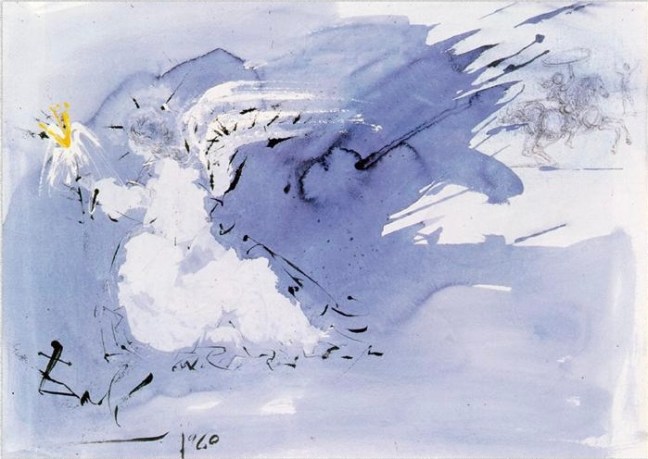
Angel of Light’ – Salvador Dali, 1960 – WikiArt

I can be me forever
There is no limit to being myself
I don’t have a home in a body
In the limitations contained
In a mind.

I don’t want to refer to anything
In order to describe myself, I can describe
My body, my thoughts or my actions
My hopes and my desires
But not myself.

Myself is for the infinite
I am not to be squeezed by words
Not to be qualified or situated
I won’t appear in the world
Of appearances.

Rather all things find a home
In my infinite embrace
So I am a universal home
I am a shelter for everything
That is finite.

I am not to be divided, I cannot be
disunited, driven apart, isolated,
Alienated — my fate is to be whole
My destiny is to have peace
As my horizon.

I cannot be suffering
For suffering knows boundaries
Is born of the finite; I know only
An expanse without end — definition
Of happiness.

How could one-you-I
Bear the infinite
Or find it has a weight
The infinite is for being,
It is for lightness on end. 

.

~~~

Text by Alain Joly

Painting by Salvador Dalí (1904-1989)

~~~

.

Website:
Salvador Dalí (Wikipedia)

Suggestion:
Voices from Silence (other poems from the blog)

.

The Poetic Genius

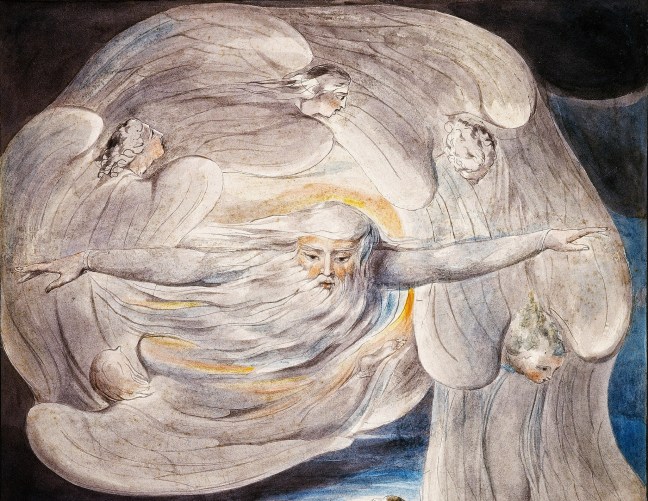
Job Confessing His Presumption to God’ (detail) – William Blake, 1803 – Wikimedia

.

I must Create a System, or be enslav’d by another Man’s;
I will not Reason and Compare: my business is to Create
.”
~ William Blake (‘Jerusalem’)

.

Artists, through their sensitivity to perception, their pointed quest towards beauty and harmony, are natural candidates for delving into the depth of reality and understanding their true nature. Many poets, painters, musicians, have been able to explore their being in ways that are traditionally the privilege of mystics. Indeed, they wrestle with eternity, and strive to find a way to convey it. William Blake was one such wrestler. He was a poet, painter and printer born in London in 1757. Although not recognised during his life, his art is bursting with creativity, intelligence, and vision. His profuse work, soaked with spiritual explorations, symbolic and personal mythologies, is not to be easily classified. Of William Blake, the 19th-century scholar William Michael Rossetti wrote that he was “a man not forestalled by predecessors, nor to be classed with contemporaries, nor to be replaced by known or readily surmisable successors“. Besides, his poetry is infused with pearls of the most profound non-dual understanding, which I invite you to explore here.

In his childhood, William Blake was fascinated by the work of great masters such as Raphael, Michelangelo, and Albrecht Dürer. He was educated at home, was given drawing lessons, and began writing poetry at an early age. Profoundly influenced by the Bible and Christianity, he was all his life gifted with visions and insights, from which he drew guidance and inspiration for his poetry and paintings. He was nevertheless not a follower, and developed his own vision and understanding. He was very critical of narrow-minded religiosity, or what he named the “general truth” or “general beauty“, writing uncompromisingly that: “To generalize is to be an idiot; To particularize is the alone distinction of merit“. William Blake wrote these enlightening verses about his religious endeavour and passion:

.
Trembling I sit day and night, my friends are astonish’d at me.
Yet they forgive my wanderings, I rest not from my great task!
To open the Eternal Worlds, to open the immortal Eyes
Of Man inwards into the Worlds of Thought: into Eternity
Ever expanding in the Bosom of God. the Human Imagination.”
~ ‘Jerusalem’ (Ch. 1, plate 5)

.
When will the Resurrection come, to deliver the sleeping body
From corruptibility? O when, Lord Jesus, wilt thou come?
Tarry no longer; for my soul lies at the gates of death:
I will arise and look forth for the morning of the grave:
I will go down to the sepulchre and see if morning breaks.
I will go down to self-annihilation and eternal death
Lest the Last Judgment come and find me unannihilate
And I be seized and given into the hands of my own selfhood.”
~ ‘Milton’ (Book the First)

[…]

An exploration of William Blake’s non-dual pearls and poetry… (READ MORE…)

.

The Brush of Ecstasy

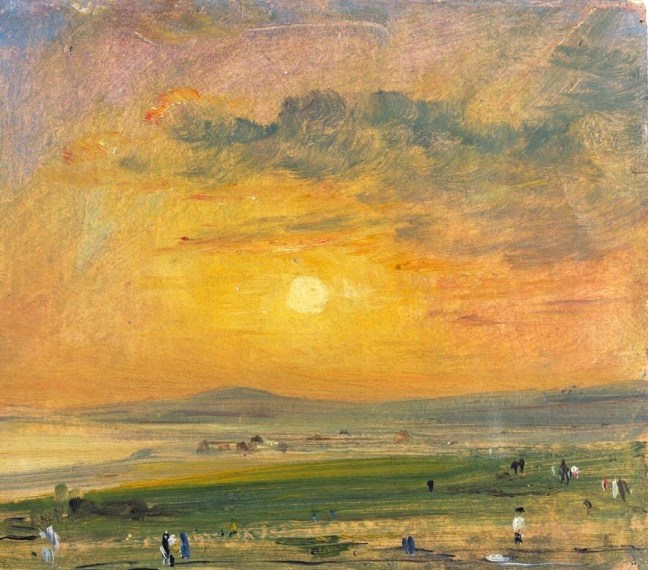
‘Shoreham Bay, Evening Sunset’ – John Constable, 1828 – WikiArt

.

There is a hidden ecstasy in your being;
Only you have — to access it — to ignore
The clamour of your endless thoughts,
Wildly thinking themselves to death;
To leave them behind, so far behind,
A thing of secondary importance,
Not that first, foolish, imaginary role.

Ecstasy has its own special requirements:
One is postponing all future goals and attainments
And envisaging yourself only in the now
Where peace can be seen to thrive,
Far and away from imagination,
Settled within the hard ground of being
Where is built a temple for yourself.

And stay there, don’t mingle with the body,
Don’t make it an essential — not more
Than necessary — it’s a fake friend;
Then, when you have built a home
Secure from the turmoil of feelings
Free from all that come to lure you into their net;
When you are — as to say —
Outside your usual self,
As the etymology concedes;
When you have recognised the world
As your own inseparable body;
When you have opened wide all windows,
Extricated yourself from the grip of time;
When you have habituated yourself
To the pure light of just being;
Then — and only then —
And only perhaps

Then might a brush of ecstasy
Come upon you — gently but noticeably;
Only beware of too much of it
Lest it will send you back to some
Old, stale beliefs about yourself — stay humble.

Then might a brush of ecstasy
Come upon you — that will make you
Leave your own dated sense of self,
And adopt that quiet remoteness of being
As your new, unmistakable home.

.

~~~

Text by Alain Joly

Painting by John Constable (1776-1837)

~~~

.

Website:
John Constable (Wikipedia)

Suggestion:
Voices from Silence (other poems from the blog)

.

A Tower of Watchfulness

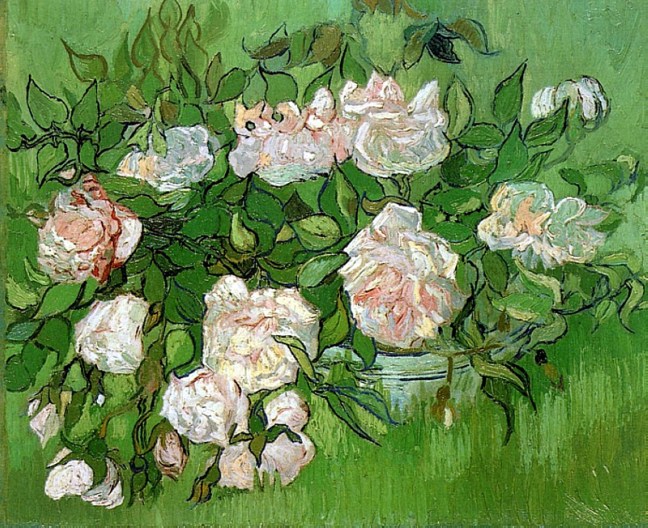
‘Still Life, Pink Roses’ – Vincent van Gogh, 1890 – WikiArt

.

We keep receiving invitations
from presence all the time.
But we turn them away
too often — and it’s a shame.

They could take care of our path
with the elegance of
their coming into being.
Paving it as it were.
Illuminating it.

For they are graceful messengers
blooming from the depth
of our innermost being.
They abhor objectivity.
They form surreptitiously
above and amongst
all that is unconscious
in ourself.
They are prodding little bells
that are here for a mission:
To wake us up.
To lure us into presence.

They may come suddenly as
the insistent call of a blackbird.
Its song a joyful reminder —
Stop it! Come back! —
so that you may let yourself
fall back into presence.
So that you may be reminded
of the intimacy of your
most tender being.

Honouring these invitations
is an ever present Sadhana.
One that requires very little effort.
For this is the effort of just
being — Being presence.
A tower of watchfulness.

.

~~~

Text by Alain Joly

Painting by Vincent Van Gogh (1853-1890)

~~~

.

Website:
Vincent Van Gogh (Wikipedia)

Suggestion:
Voices from Silence (other poems from the blog)

.

The Mystical Doctor

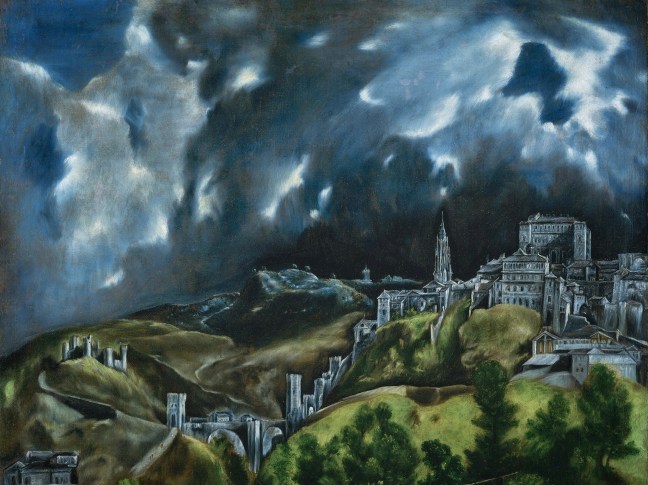
‘View of Toledo’ – El Greco, 1596 (Metropolitan Museum of Art) – Wikimedia

.During the night of 2 December 1577, in the city of Toledo in central Spain, a priest was imprisoned by a group of Carmelites who were refusing Teresa of Ávila’s reformation projects for their Order. He was jailed for 9 months in a monastery under brutal conditions. He was publicly beaten at least weekly, confined in a cell of barely 10 by 6 feet, with only a little light passing through a hole during the day, with bread and scraps of salt fish for a meal, and no change of clothes. But his burning love of god, along with his unfailing devotion and clarity of mind, allowed the 35 years old friar to compose, along with other shorter poems, the greater part of a sumptuous poem — ‘The Spiritual Canticle’ — about a bride’s search for her beloved. The poem, symbolising the soul seeking union with god, and inspired by the ‘Songs of Songs’ of the Bible, starts with these eloquent lines:.

Where have You hidden Yourself,
And abandoned me in my groaning, O my Beloved?
You have fled like the hart,
Having wounded me.
I ran after You, crying; but You were gone
.”
~ ‘The Spiritual Canticle’

The name of this priest and poet was John of the Cross, a Spanish Catholic mystic born in 1542 near Ávila, to whom we owe some of the brightest exposition of truth in the Christian world. Thomas Merton, who held him in very high esteem, presented him as “one of the greatest as well as the safest mystical theologians God has given to His Church.” John of the Cross was born in a poor family of Jewish converts to Catholicism, and received a simple education. He entered the Carmelite Order, made his First Profession when 21, and met Teresa of Ávila a few years later, of whom he remained a faithful associate all his life. Although not a scholar, his studies in theology and philosophy allowed him to quote abundantly from the Bible, and be acquainted with the work of St. Thomas Aquinas.

Although I have chosen to quote here only from the poem ‘The Spiritual Canticle’, John of the Cross is the author of many other poems, among which the renowned ‘The Dark Night’ — better known as ‘The Dark Night of the Soul’ — and ‘The Ascent of Mount Carmel’. His poems have a rich and powerful imagery and are considered to be masterpieces of Spanish poetry. Although they transpire with beauty and meaning, they are not to be readily understood. This is why John of the Cross wrote precise and extensive commentaries on them, some soaring pieces of teaching whose beauty and profundity is sometimes breathtaking. The most exquisite poetry is here going hand in hand with both a great depth of understanding, and the sweetest accents of devotion. The commentaries were written in prose but are here occasionally presented in a free verse form when they lent themselves to it. I am sharing the 1909 translation made by David Lewis, with corrections by Benedict Zimmerman. Listen with what tender accents of poetry and longing the bride is here conversing with her bridegroom, and how a suffering soul who has tasted of the divine is longing for “the secret chamber of God”, which is nothing but the pure consciousness that is hiding in our innermost being:

.
O you soul, then, most beautiful of creatures,
who so long to know the place where your Beloved is,
that you may seek Him, and be united to Him,
you know now that you are yourself
that very tabernacle where He dwells,
the secret chamber of His retreat where He is hidden.
Rejoice, therefore, and exult, because all your good
and all your hope is so near you as to be within you;
or, to speak more accurately, that you can not be without it.”
~ ‘The Spiritual Canticle’, 1.8 (Commentaries)

[…]

Discover the rich poetry and commentaries of John of the Cross… (READ MORE…)

.

The Craving

Why do you keep falling, my heart
To all that impart an immediate pleasure
Truth is not an easy catch that can be met
In the petty, neither one that you can grab
In the temporal and all its passing hues
There is more to it than mock or parody

You have to only stay where you are, to
Not take that first step ahead, allured by
The fire of thoughts, elated by feelings
Be only so present so as to sight
A calm within a space, a space within a calm
That nothing can stir or move or shake

And you shall stay there, not concerned
By all that in you shout and scream
By all these thieves that claim your fall
And beg in the usual, the false order restored
A peace so cheap as to be no peace at all
You know what an imitation of truth is

This is an endeavour of unbounded courage
You need some heart to inhabit your heart
You’ll be surrounded by liars and impostors
All these preachers of facile commands
They too dwell where you truly dwell
They go only by effort or indulgence

Presence is a magnetic field that attracts
Always only itself. No need for exertion
No need to launch a campaign for truth
Desire is their last treacherous injunction
So repulsive when it comes to being home
You are already where you crave to be

.

~~~

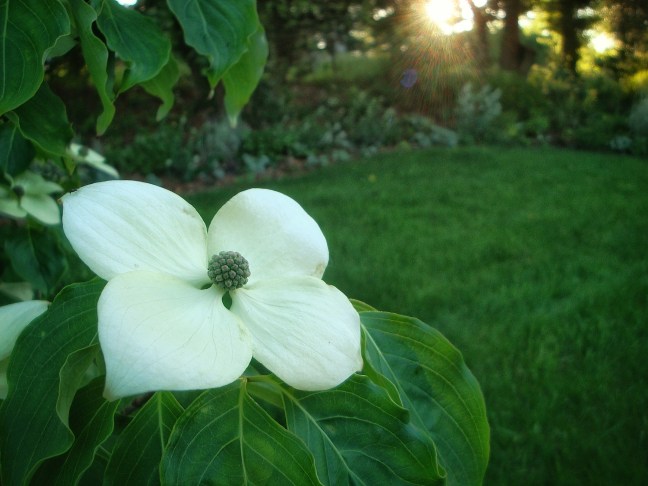
Text and photo by Alain Joly

~~~

.

Suggestion:
Voices from Silence (other poems from the blog)

.

The Coronation

I want to be all alone with you.
Who cares of these hundreds
relentless thoughts. I’ll let them
be and live their own thinking-life.
I’m not concerned with them.
They’re none of my business.
Have a good journey folks!
I’ll just stay here alone
with my silent friend.

I want to be all alone with you.
I have nothing to do with these
endless stories and beliefs.
All these far-fetched ideas
that keep giving birth to
that constant flow of suffering.
Waves after waves of feelings.
Don’t involve me. I want to be
in unaccompanied solitude.

I want to be all alone with you.
I won’t busy myself with these
ten thousand things. Not this time.
They have helped me well, with
pleasures and necessities.
To fight my fears off and
seek a hidden peace.
But god they’re clumsy! So
please, leave me alone for now.

I want to be all alone with you.
And when I’ll feel your presence
in me, so as to be just only you,
then I’ll return to all and everything;
To the feelings and the spicy;
To the world and its troubled affairs.
I shall welcome the weird and the inept,
and the thinking rendered innocuous.
I’ll make them my loyal attendants
And I’ll crown them with glory.

.

~~~

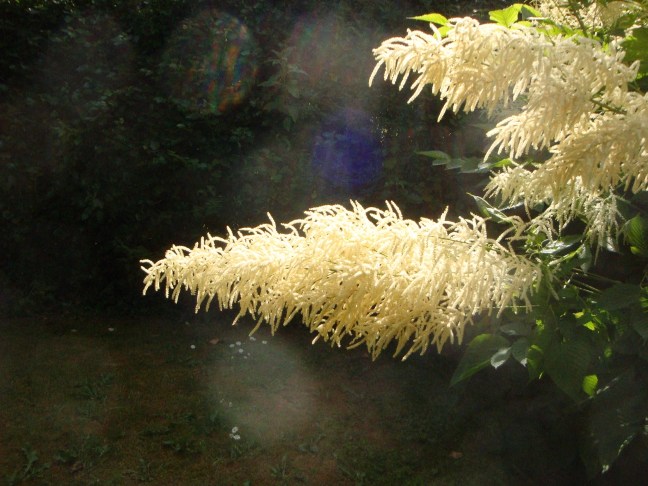
Text and photo by Alain Joly

~~~

.

Suggestion:
Voices from Silence (other poems from the blog)

.