Twisted Rainbow

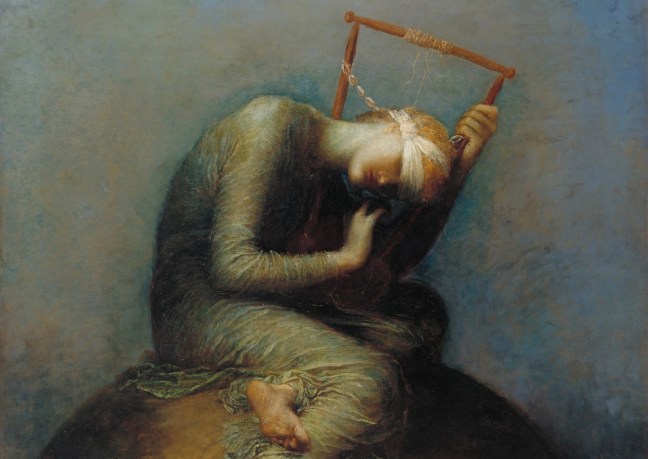
‘Hope’ (detail) – George Frederick Watts, 1886 – WikiArt

Unhappiness is a strange thing, for against all appearances, and under serious investigation, it is not really found. We are making it up as we go along. In fact, there is no such thing as an absence of happiness. Yet we are nurturing this absence with great consistency, designing our so called unhappiness with care, through our thoughts, our memory, our attachments, our stubborn persistence. But only try to experience its effects outside your thoughts and feelings, in the absence of your mind, and you’d have to confess that you can’t find here anything like a misery. The reason is: unhappiness is not a thing in itself. It is veiled happiness. It is the covering up of your innate peace. It is past residues and future expectations tossing the tranquillity of the now. But all such disturbances, discomforts, or distresses, are always only temporary events, passing weathers distracting us from what is always here, always faithful, always to be trusted: the peace contained in simply being. This peace is in fact the very making and backbone of our lives, its solid background. It could never leave you no matter how hard you may try. Its not being felt is a form of snobbery. You have missed your innate joy in reason of your not looking in the right place. You have neglected your true, natural being for wanting to be somebody. You have been scorning yourself out of vainglory. In fact, unhappiness is but the simple mourning of a loved one who is missed: our true self. It is but a distraction from the boredom of our ignorance. Or a warning for a wrong turn taken.

Unhappiness is not found in physical pain, or in the natural grief following a loss. These are all compatible with happiness, as is a shared, compassionate sorrow. These are wise and healthy responses to life situations and challenges. Unhappiness is of a different nature. It is more like a habit or an indulgence. Often, we would rather be unhappy than shatter a well-rehearsed idea of ourself, in which we have invested our most cherished identity. Unhappiness is also the result of a fallacy, and a form of delusion. It is a shadow which we nourish through our belief in being a person caught between seeking and resisting, and the reward of fulfilment. Unhappiness is only as real as our limited self is. One will follow the other both in death and in birth. So really, unhappiness is a self-inflicted pain. In a way, we could say that it is a sin. It is ourself being driven away from our happy, forgotten nature, and bound to the suffering self which we have identified ourself with. It is our twisted rainbow in the sky of ignorance, that appears naturally without being truly there. It is created by the rain of all our renouncements, of our constant search for security and approval, through accumulation and avoidance. So next time you meet some measure of unhappiness in your life, don’t believe it. Don’t be caught up and allured by its convincing appearance. See through it until you find its referent. See that unhappiness is not real as affliction or suffering. It only exists as the sum of all that hinders the happiness which is the nature of your self as being. Your misery may in fact only be a passing, unassuming thought, maybe an innocent, unchallenged belief, or just a feeling hovering about, which you are taking too seriously. Not very much really. Hardly enough to send you far and away from the delight of simply being.

.

~~~

Text by Alain Joly

Painting by George Frederic Watts (1817-1904)

~~~

.

Websites:
George Frederic Watts ( Wikipedia)
Hope (Watts) (Wikipedia)

Suggestion:
– Other ‘Reveries’ from the blog…

.
Perfect Days

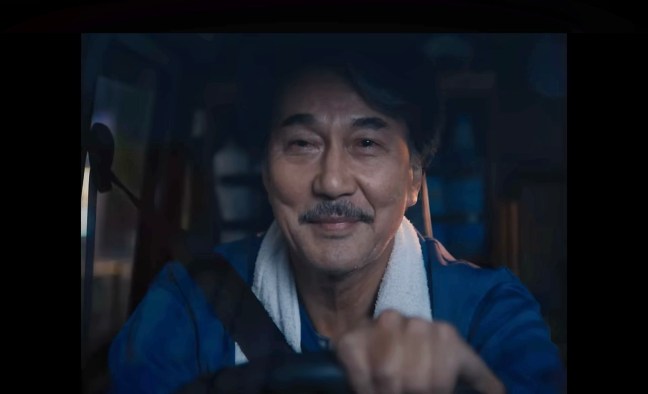
’Perfect Days’ – by Wim Wenders (with Koji Yakusho)

.

All my films deal with how to live.”
~ Wim Wenders

.

Why do we watch a movie or enjoy any piece of art but for the joy, happiness, or relief we derive from such activity? Well, sometimes we use a movie not so much to feel, but rather to stop feeling. We want to be alleviated from our sense of boredom, or be distracted from our constant worry, or have the lowest ambition to be rewarded with pleasure, plain simple pleasure which, if not delivered, will make us move on to something else. Film as an art form is ambiguous, for it has in itself an entertaining power which makes it the prey to our most suspect desires. Well, Wim Wenders, in this movie, wasn’t going to give way to that ubiquitous trap and fall. With ‘Perfect Days’, he made a movie in which there is no desire to be had, which offers no suspense, no excitement, no resolution of any kind, but from which you would never want to move away. A movie that describes the quiet, plain, orderly living of a man whose job is to clean public toilets in Tokyo.

Hirayama lives each and everyday as if it was a perfect day. For him, there is no possibility of failure in life. And he makes sure that boredom is an impossibility. So he cares. Hirayama cares about everything he does, and seems to be profoundly related to his modest home, to his morning toilet, and to the watering of his plants. He does what he has to do, with no judgment or resistance. He doesn’t mind. He feels his inner freedom. He has everything he needs, so he smiles at life and life smiles back at him. He breathes when he steps outside and looks at the sky as for the first time, the wonder of it all. Then he buys himself a can of coffee from a local vending machine, opens his van, sits, drinks a sip, chooses a song from a bunch of cassette tapes, lights the engine, drives, and listens to ‘The House of the Rising Sun’ by The Animals. For that’s where he is now, in the house of the rising sun, going to his work through the sprawling suburbs of Tokyo’s morning, undisturbed, confident, present.

[…]

A reflection on the film ‘Perfect Days’ by Wim Wenders… (READ MORE…)

.

A Place of Leisure

There is a place in ourself where we are not, strictly speaking, meeting anything. This is what ‘emptiness’ means, that we are not bumping into anything, that we don’t encounter any resistance whatsoever. There may be objective appearances showing up, but they are not met from the position of being ourself an object, a self, a thing with properties and qualities. As long as we believe to be a self separate from the world, and identified to a set of thoughts and feelings, we are placed in a loud and busy world, a world crowded with objects, where conflict is at home and suffering is the norm, both outside and inside. But only feel to be the empty presence that your self truly is, and your world will appear as a qualitatively empty and silent being. And this silent being is ourself, our being which had been previously crowded by our identification with perceptions, muted by our thoughts, and dumbed by our feelings. So, as empty being, we are never meeting objects and conversing with them, for the only reality we ever come upon is ourself — infinite, empty being. That being is that which we eternally converse with. So we keep company with being only, not with objects and persons. This meeting, or melting, with being — with the essence — is paradoxically the only source for a true, loving, and meaningful relationship between apparent people and objects. Any meeting that takes place only at the level of people and objects is a promise for suffering and conflict.

There is one easy and direct consequence of living, or relating, as and with being. It is that our life becomes a place of leisure. We are liberated from the constraints of objects. Therefore we have a free time, a free space where we are not occupied, not busy working it all out, being puzzled, grabbed by conflict, seized by suffering. We are therefore in for leisure. We are in a position of freedom from where we can contemplate the world and ourself as we are. We are on a holiday, a holy, consecrated day when we release our chronic identification with the objective world, and find behind it relief and an intrinsic peace. This freedom from identification bears joy as its DNA because we are finally allowed to just be. And this being forever shines through experience, which is seen as secondary. And this being renders the world back to its original transparency. Furthermore, being clothes experience with a space like quality. This is a space of ability and creativity, for we are not possessed by our entanglement with experience. This is a space of free will, for we are not constrained by our limiting faculties. This is a space of easiness, for it takes us home, in the loving harbour of our true self. This place of leisure is absolute freedom — freedom from space and time, and from the contingencies of appearances. It is a place of no haste, where you are with your spacious self alone, and enjoy its interior, which is nothing but the world. You stay in the perimeter of your self wherever you may go. And there is the loving influence of infinity in whatever you may do, which means that peace is coming forth in spite of circumstances. Above all, this place of leisure is the burial ground of your self as a limited and separated entity.

.

~~~

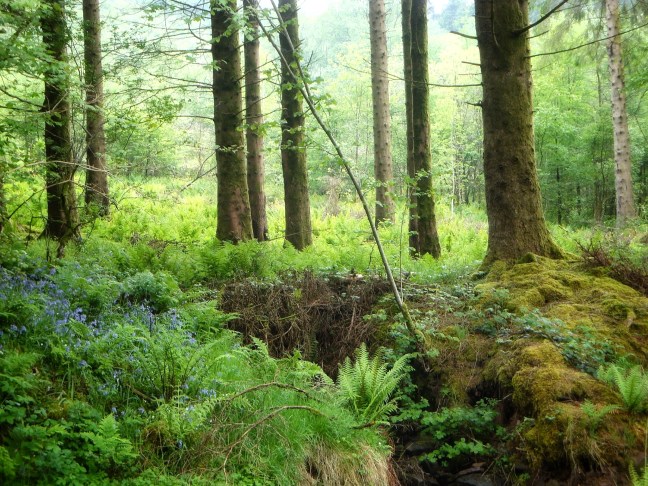
Text and photo by Alain Joly

~~~

.

Suggestion:
– Other ‘Reveries’ from the blog…

.

The Poetic Genius

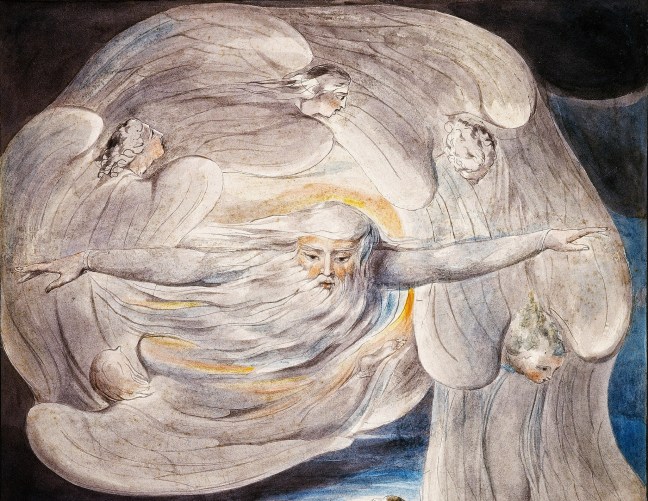
Job Confessing His Presumption to God’ (detail) – William Blake, 1803 – Wikimedia

.

I must Create a System, or be enslav’d by another Man’s;
I will not Reason and Compare: my business is to Create
.”
~ William Blake (‘Jerusalem’)

.

Artists, through their sensitivity to perception, their pointed quest towards beauty and harmony, are natural candidates for delving into the depth of reality and understanding their true nature. Many poets, painters, musicians, have been able to explore their being in ways that are traditionally the privilege of mystics. Indeed, they wrestle with eternity, and strive to find a way to convey it. William Blake was one such wrestler. He was a poet, painter and printer born in London in 1757. Although not recognised during his life, his art is bursting with creativity, intelligence, and vision. His profuse work, soaked with spiritual explorations, symbolic and personal mythologies, is not to be easily classified. Of William Blake, the 19th-century scholar William Michael Rossetti wrote that he was “a man not forestalled by predecessors, nor to be classed with contemporaries, nor to be replaced by known or readily surmisable successors“. Besides, his poetry is infused with pearls of the most profound non-dual understanding, which I invite you to explore here.

In his childhood, William Blake was fascinated by the work of great masters such as Raphael, Michelangelo, and Albrecht Dürer. He was educated at home, was given drawing lessons, and began writing poetry at an early age. Profoundly influenced by the Bible and Christianity, he was all his life gifted with visions and insights, from which he drew guidance and inspiration for his poetry and paintings. He was nevertheless not a follower, and developed his own vision and understanding. He was very critical of narrow-minded religiosity, or what he named the “general truth” or “general beauty“, writing uncompromisingly that: “To generalize is to be an idiot; To particularize is the alone distinction of merit“. William Blake wrote these enlightening verses about his religious endeavour and passion:

.
Trembling I sit day and night, my friends are astonish’d at me.
Yet they forgive my wanderings, I rest not from my great task!
To open the Eternal Worlds, to open the immortal Eyes
Of Man inwards into the Worlds of Thought: into Eternity
Ever expanding in the Bosom of God. the Human Imagination.”
~ ‘Jerusalem’ (Ch. 1, plate 5)

.
When will the Resurrection come, to deliver the sleeping body
From corruptibility? O when, Lord Jesus, wilt thou come?
Tarry no longer; for my soul lies at the gates of death:
I will arise and look forth for the morning of the grave:
I will go down to the sepulchre and see if morning breaks.
I will go down to self-annihilation and eternal death
Lest the Last Judgment come and find me unannihilate
And I be seized and given into the hands of my own selfhood.”
~ ‘Milton’ (Book the First)

[…]

An exploration of William Blake’s non-dual pearls and poetry… (READ MORE…)

.

Unconditional Love

I just happened to fall in love with my life recently. Don’t ask me how and why. I just did. That came surreptitiously after a long line of unfruitful attempts. I had given up the idea. Discarded the thought — too complicated! This happened when I simply stopped wanting, hoping, needing. These are the ways things get done, it seems, in this world. Life is not something that you can mould to your own convenience. You cannot love life if you set up conditions. If you want it to espouse the contours of your likes and dislikes. You might painstakingly get the life you want, but you will reduce love. You will wound it. That won’t be love anymore but bargain, economy. Love can never be found in the market place. Love shows up with its one fundamental, non-bargainable condition: it is unconditional. And I’ll tell you why:

I discovered that life is self. That the one constituent of life is simply being — who I am fundamentally. Not even a small portion of this life of mine stands outside myself. I love my life because my life is my self, and I cannot not love my self. We all love our self. To not love our self is an impossibility. We love our self dearly, because the nature of our self is love itself. Self is made of love. And everything in this world is made out of this very self of love. So we are bound to love this world unconditionally. To love our life unquestionably. To love people boundlessly. People are our brothers and sisters in love. They are made of the very same bright self that we are made of. Therefore the question of not loving life doesn’t even arise. Love is the very home where our life finds everything it could ever need or want. This is how life becomes a fountain of joy: when it is found to be entrenched in love. This fountain of love is sometimes referred as god’s self. Or ultimate being. Or simply happiness — without cause or condition.

.

~~~

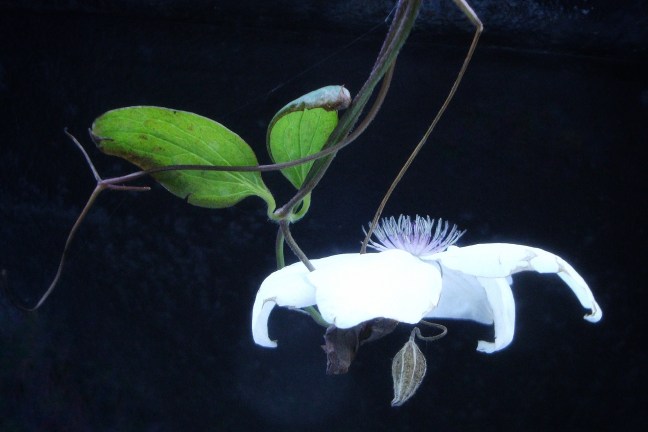
Text and photo by Alain Joly

~~~

.

Other ‘Ways of Being’ from the blog…

.

The Worth of a Life

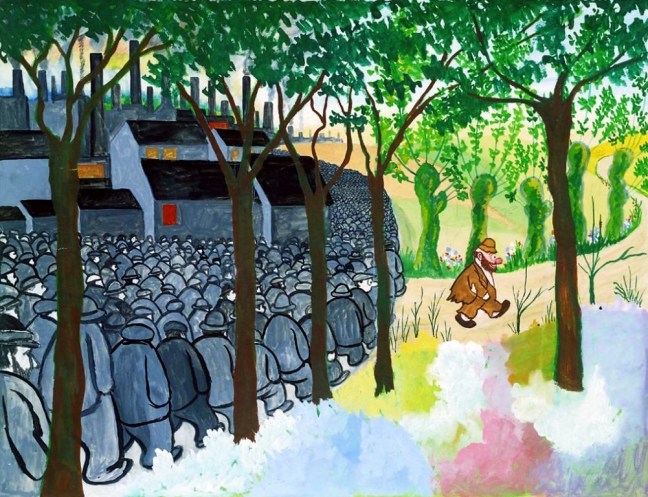
‘Back to nature’ – Robert Storm Petersen (Storm P.), 1945 – Wikimedia

.
We are all blessed with moments of intense happiness, no matter how ignorant of our true nature we may be. Happiness has always been in the picture. It may have come unexpectedly one glorious morning at the start of a day-long walk in the mountains, or while falling in love, or travelling in a busy train, or quietly sitting at the window sipping tea. You know, these moments when we enjoy every bit of the world around us, when we stop indulging in thoughts and are free to just watch, hear, taste, enjoy, admire. Such happiness is self-explanatory, the proof of god, an enhancer of being. It is beauty revealed, love in action. It is the worth of a life — any life. The only time when we truly see, and hear. Birds seem to have replenished the earth. Flowers appear and butterflies dance in the thin air of our self. Why do you think that, in common parlance, happiness is said to make you like the king of the world? Why do we say that, at the time of happiness, the world belongs to us? Why does happiness seem to be solving all our problems? Does that not express the intuition of our likeness with the world around us?

Happiness is the point of absolute equality in all human beings. When somebody is ignorant of his true nature, and when he has a moment of pure joy and happiness, he becomes a prince and a master in matters of truth. But unfortunately, he remains an ignorant master, who takes that joy, that living sense of being, for granted. Who thinks happiness to be just a passing thing, an accident, a beautiful feeling. Not something that needs to be looked into, explored, and expanded. These are the lost moments of truth that pass unknown, unnoticed in our lives, relegated in the field of time, soon covered up with our crass ignorance. What matters when we are happy, what presents itself with force, is just the plain awareness of being. Being commands. Being is refined. Being is all that matters, all the knowledge we need. When we experience true happiness, we are in a position of not knowing, even if we are a specialist in non-duality, with a ‘spiritual’ etiquette attached to ourself. This is why a true spiritual teacher has no knowledge to give. His place is one of innocence and humility. He never addresses ignorant people, but converses with truth itself. She only shares being with all around her, renders happiness recognisable. Being is the supreme teacher, and the supplier of joy. Don’t let it pass.

.

~~~

Text by Alain Joly

Painting by Robert Storm Petersen (Storm P.) (1882-1949)

~~~

.

Website:
Robert Storm Petersen (Wikipedia)

.

Other ‘Ways of Being‘ from the blog…

.