The Reluctant Messiah

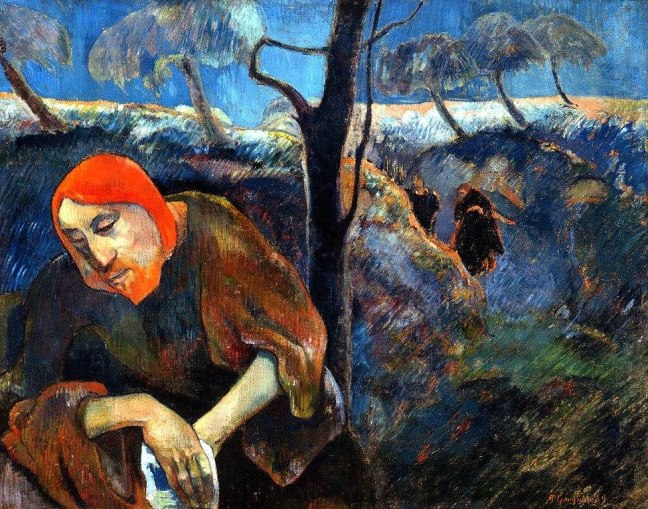
‘Christ on the Mount of Olives’ – Paul Gauguin, 1889 – Wikimedia

.

Father, if thou be willing, remove this cup from me:
nevertheless not my will, but thine, be done.”
~ Luke, 22:42

.

Maybe it is more serious than you think. Maybe the line has been crossed without your noticing. Maybe there is no return to being what you imagined to be: A self, a person, self-contained in a body, armed with all the thoughts needed to represent you. Maybe there is no memory left of this old belief, and that you have to let it all go, all the kaleidoscope of separation, all the daunting suffering, all the interplay and thrill contained in being just one piece in the puzzle of life. Now all pieces have been joined to fade into one single presence with no pieces in it, a presence that you have espoused, that you have recognised to be your home — inherited and inhabited since before the dawn of time. Now you may have to move in with fear and reverence, for living in that new identity has consequences. It might transform you beyond your recognising, and in more drastic ways than you had expected.

It might shatter your dearest hopes and expectations, that were here in your heart, entertained to the point of cultivation. It might give you what you have sought all along, and stop dead every single desire for an ‘other’ to satisfy and fulfil you. It might demolish a dream, and disintegrate the map of yourself, that described who you were in such lively, never-ending details. It might silence you, when you so much enjoyed the delightful babbling of your anxious mind. And I won’t mention all your intimately held treasures of belief, all your ideas and opinions, that have put together that carefully built image of yourself: how they might be dampened, damaged, discarded for being found redundant.

[…]

Read more about how our resistance can be made into surrender… (READ MORE…)

.
Cleansing the Temple

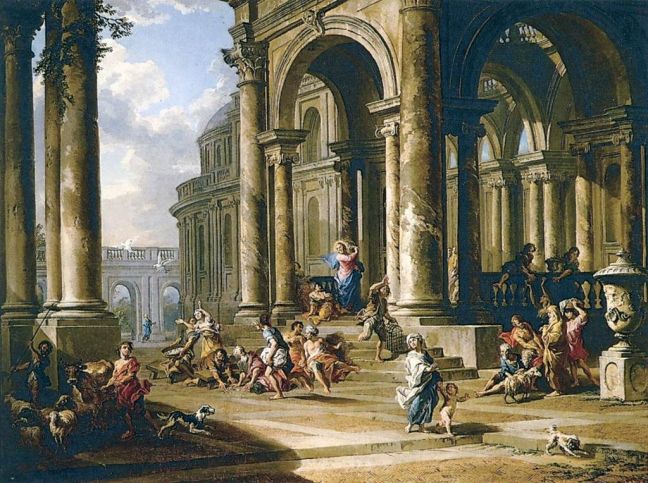
‘Expulsion of the Moneychangers from the Temple’ – Giovanni Paolo Pannini, 1724 – Wikimedia

Maybe this is where peace in fact resides. In the fact that peace or happiness can never be found, never be reached. It will be nowhere where you expect it, not in any objective appearance or event, not in any wish granted, not in any kind of alignment between what you want and what you have. You will never obtain what you want. Truth is not there, in what you wish. It doesn’t care for your egoistic projections, for your own private self-interest. Truth is not a mere good to be bargained for, or hoped for, or waited for, which, if not granted will disappoint you, and make you like a rejected lover, or a bruised self. Truth is not any kind of crude object. Remember Jesus who cast out the merchants in the temple. Were you really thinking that there was a physical Jesus actually chasing the merchants from the temple, on the ground of some kind of moral rule?

The merchants in the temple, it is you. It is all of us when we have decided to argue with reality, to buy our happiness with some kind of object obtained, to bargain or negotiate with some invented superior entity the responsibility of what is happening to us, to come to god with pockets full of expectations and desires, making peace a simple object to be bought in the market place of our likes and dislikes. “Wouldst thou be free from any taint of trade?” did Meister Eckhart ask. Imagine the relief that it is: to know or realise that you will not have what you want, that ‘what is’ is all there is, all that you will ever have. What a relief! What a load finally put down, and got rid of! All that you want, desire, expect, all that, will never ever be granted to you. You can forget it all. ‘What is’ is the deal. The grandiose enlightenment you were waiting for lies there, in what simply is! It will never get better than that! You have it all here, in front of you. That is the gift that was specially designed for you. Happiness resides in what you have, in what you are, here and now. This is the secret that Krishnamurti meant when he said: “I don’t mind what happens.”

[…]

On how truth is not an object to be bought in the marketplace… (READ MORE…)

.

The Beatitudes

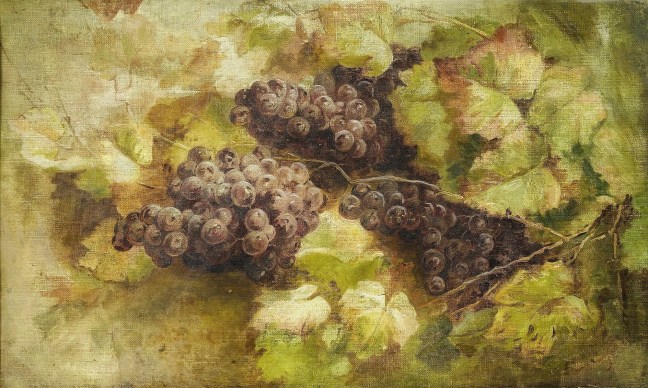
‘Still Life with grapes’ – Giovanni Segantini, 1899 – Wikimedia

.

The Beatitudes is the name given to eight blessings that Jesus pronounced at the beginning of his ‘Sermon to the Mount’ in the Gospel of Matthew (5:3-10). Each of these blessings begins with the Latin word ‘beātī’ (from ‘beātus’ meaning ‘happy’, ‘wealthy’), translated here as ‘blessed’. They are short and bold little sayings that I have come across lately, eight ways to be blessed, eight blessings on the path to our true being, each the recipient of some profound meaning which I have endeavoured to develop here. I hope you enjoy the reading…

Seeing the multitudes, he went up onto the mountain. When he had sat down, his disciples came to him. He opened his mouth and taught them, saying,
~ Matthew, 5:1-2 (World English Bible)

.

Blessed are the poor in spirit,
for theirs is the kingdom of heaven
.”
~ Matthew, 5:3

You’ve got to be empty. Not to indulge in your thoughts, feelings, and experiences, making them the owners of your kingdom. You’ve got to be empty. To not be seduced by every passing colours. To stop being a possessor, forever looking for what could enrich you. You’ve got to be empty. To not be involved, endlessly busying yourself with everything you have gathered to exist, looking in them for an identity. You’ve got to be empty, to stay away, to keep alone. To be the one disinterested, self-sufficient, which means finding peace in the essential of what you are. That essential is ‘being’. Simply being, devoid of anything that this being could be, or have, or think, or feel. Then this being will enrich you in its austerity, it will clothe you in nakedness, it will fill you in emptiness. Being is all you will ever own, for the simple reason that it is all you are. Nothing else is but being. This is the only asceticism worth living. Be blessed with that inner poverty.

[…]

My reading on Jesus’ eight blessings from the Beatitudes… (READ MORE…)

.

The Gospel According to St. Matthew

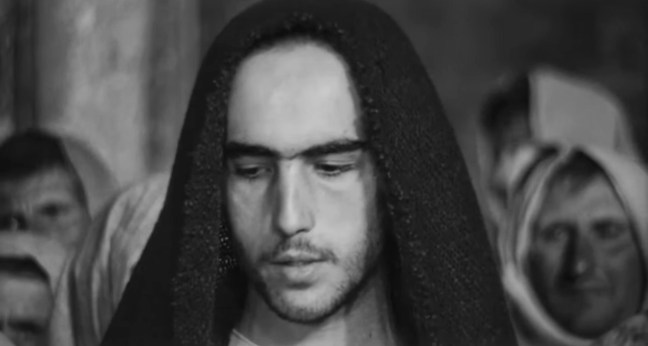
‘The Gospel According to St. Matthew’ – by Pier Paolo Pasolini – (With Enrique Irazoqui)

.

The motivation that unites all of my films
is to give back to reality
its original sacred significance
.”
~ Pier Paolo Pasolini

.

The famous Italian film director Pier Paolo Pasolini made this beautiful statement about his art: “When I make a film, I shift into a state of fascination with an object, a thing, a fact, a look, a landscape, as though it were an engine where the holy is about to explode.” This can be immediately felt as we stroll amongst the first scenes of his 1964 movie ‘The Gospel According to St. Matthew’. We are met with an angelic Mary looking at a bewildered Joseph leaving home after the discovery of her pregnancy. Silence prevails and only a concert of bird’s songs can be heard. Joseph wanders in solitude in a landscape that is desolate yet teeming with presence and energy. He comes to the edge of a town and kneels against a nearby stretch of land where a bunch of children are playing, giving like a lullaby of innocence to Joseph who closes his eyes and abandons himself to the moment. This is the chosen time when an androgynous angel appears and gives him the revelation of the divine nature of Mary’s pregnancy.

[…]

Discover the magnificent film by Pasolini on the Gospel of Matthew… (READ MORE…)

.