God’s Knowledge

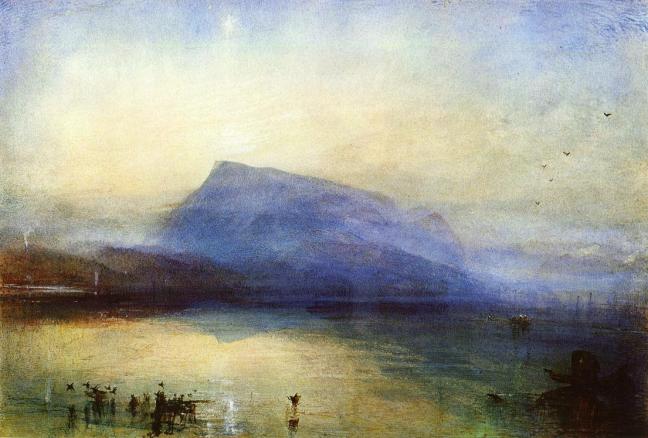
‘The Blue Rigi Lake of Lucerne Sunrise’ – J. M. W.  Turner, 1842 – WikiArt

We know so many things. Everything is based on knowledge, and maybe that’s the way to live, as long as there is a body and a world. Knowledge is the score we need to play our part. But to know something, anything, seems presumptuous. It implies another kind of knowledge — that there is somebody here, a person at a distance, that knows and is a recipient of knowledge. Knowledge fixes us. It gives us a dubious identity — that I am a man or a woman, of a certain age, with certain qualities, and with a whole lot of knowledge, identities, beliefs. That I am unhappy, clever, stupid, happy. That I am a cook, or a carpenter. That there is a chair, a world. That I have skills and preferences. I even have the knowledge of my spiritual attainment.

But there is no knowing anything. To think we know something is a mistake. If we know something, then we haven’t looked well enough. We have stayed at the surface of our illusory world and existence. What we ought to know is the knowledge of our reality, of ourself. That’s the only knowing there is. That’s our world: Knowing. Being aware. All other knowledge is superfluous, is not real knowledge. For what would any such knowledge be, when we discover that there is no entity here with the capacity to possess that knowledge. Go only for the knowing of being, a knowledge which is owned by itself. Notice that you don’t know anything — that’s important to know. We have no knowledge other than the knowledge of our being. Apart from that, everything exists only as in a dream.

We may play the part of the one in the dream, and that’s a beautiful part. There may be a world here that is gorgeous, with many ‘things’ that are known. There may be relationships that have meanings. But this world of things borrows its beauty and making from the reality in which it exists for a time — knowing. And the meaning of relationship is found through its reality, which is love — shared being. Everything happy and true in our life is borrowed from our reality as awareness — the only knowledge there is. If we live or act while ignoring that one knowledge, the world and ourself will appear ridden with conflict and suffering. So notice that the ten thousand things of life — all our knowledge — are transparent, ephemeral, ethereal. What is here massive and solid is their reality as being — the supreme essence of everyone and everything. The truth we live in. Ourself. What is. Not somebody that knows.

There is no other real knowing than the knowing of our essence, of our true nature or identity. This knowledge of ourself is not something we can possess as a person. It is nothing more than pure, objectless, impersonal knowing, and this knowing is all there is, all we are. Everything, everyone, have died in it. That’s why we cannot know anything, for how could we know something without there being first a knower and things with their own reality. The only thing we in fact truly know is ourself, our essence. Our knowledge of anything has died inside pure knowing long ago. It is still available, but its reality is apparent. That’s why we can never be sure that there is a chair, or a world. That’s why every object passes, is not there, is only an appearance.

Even ourself cannot be known objectively. We are alone. Nobody knows us. We as a person are absent. We don’t have a reality as an entity, or a self of any kind. So we are known by God alone, who knows us by knowing Its own being. We are all in the knowledge of God. What follows after the sentence ‘we don’t know anything’ is ‘the only knowledge there is is God’s knowledge’. Or ‘know God, love god, and you will know what you ought to know’. It all boils down to ‘knowing, knowing knowing’. Paul said it all very clearly in the First Epistle to the Corinthians: “If anyone thinks that he knows anything, he doesn’t yet know as he ought to know. But anyone who loves God is known by him.” (8:2-3).

.

~~~

Text by Alain Joly

Painting by J. M. W. Turner (1775-1851)

~~~

.

Website:
J. M. W. Turner (Wikipedia)

Suggestion:
– Other ‘Reveries’ from the blog…

.
Being Spiritual

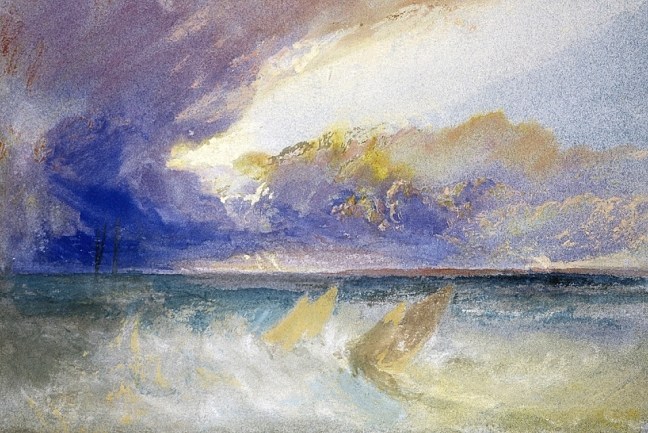
‘Sea View’ – J.M.W. Turner, 1820-1830 – WikiArt

This whole adventure of knowing oneself is not about being spiritual. It’s about being alive. Not just a little bit alive, with holes here and there, where unconsciousness can creep in, and steal us the best portion of what it is to be truly alive. For life is not a collection of deeds or experiences. Life is an energy and an essence that you can feel or know as the totality of your own being. And life extends to everything and everywhere. It is not about you. It never was.

To realise our true nature is not about being spiritual. It’s about being happy. Not the happiness that shakes and crumbles at the least twist of life’s circumstances. Happiness is not meant to be so fragile. And it is not something that you have to attain, or perform. You are not meant to work for that which is your inborn due and essence. Happiness is when you cannot even form or comprehend the concept of unhappiness. It is the distinguishing trait of being.

This understanding is not about being spiritual. It’s about being wholly a human being — inhabiting this whole experience while staying rooted in your true essence as awareness. There is immense delight in being awareness through your whole body and mind. Don’t leave your human experience at the door of consciousness anymore that you should leave consciousness at the door of your human experience. Include your humanness in your understanding.

To recognise our real identity is not about being spiritual. It’s about being in a world. Feeling what a world is — its golden nature — its sacredness — its dazzling presence. Having a world as our own being. Don’t think that you cannot know it through its essence. Knowing the world is like knowing yourself. And that will make you equip the world with ravishing beauty. The world is not about an outside. It is all inside yourself, curling itself into your own being.

I don’t want to be spiritual, or special, or humble. I want to be so fully being that I cannot even formulate such ideas. I want to be so fully myself that I cannot even know the meaning of these words. And I don’t want to be perfect. I want to be soft and malleable, and utterly vulnerable. Not fragile or brittle, but open to every passing feeling, to every hue inherent in living. This is how life shows its greatness. This is how you are truly grateful for being human.

I don’t want to have the identity of being spiritual. I want to have no contours where I can be fixed and localised. I don’t want to be anything that can be bumped into, and get hurt or scarred. I want to be being only being, to leave no room for an other, or for a difference. Why should I define myself? To be truly living is to be undefinable. And to be without objective identity is to belong in everything and in everyone. This is the true meaning of love.

I don’t quite fancy being tagged as spiritual. Being spiritual is only a nice word for everything in myself that cannot quite let go and espouse the pure essence of being. These are the leftovers on the failed path of being one with my essential being. I don’t want to be spiritual any more that I want my true nature to be identified with being French, or being this or that. I want to be what I ought to be when every form of control is seen detrimental and abandoned.

.

~~~

Text by Alain Joly

Painting by J. M. W. Turner (1775-1851)

~~~

.

Website:
J. M. W. Turner (Wikipedia) 

Suggestion:
– Other ‘Reveries’ from the blog…

.
Unsubstantiality

I remember one day being at the breakfast table, my eyes peeking randomly through the window. They landed on the courtyard down below where a thin layer of snow were covering the lawns. I was attracted by the curious behaviour of a couple of magpies. One was so to speak climbing up a tree, branch after branch, until it reached a spot where the building of a nest was being started. It wasn’t just flying there, in one big leap, and I wondered why. The other magpie was leisurely sitting on a bicycle shed looking at its friend, attentive, but somewhat unconcerned. I watched this little dance for a while, but realised that there was more to see. 

On the lawn, there was a big ball of snow, may be an unfinished snowman or something of the kind. It had been pushed there by the arms of a few playful children, and became this big, somewhat dirty giant ball sitting strangely in the courtyard. It was massive, solid, and yet had an odd, ethereal presence that drew me to it. It appeared as if it was not really there, somewhat absent in spite of its size and solidity. My mind wandered for a while, finding the snowball to be a perfect analogy for the ‘me’, this ‘thing’ that we assume to be the person, the doer. There is ‘somebody’ there, inside the skull so to say, that is directing the show, and for whom all actions are being undertaken. …

A reverie that speaks of our unsubstantial nature (READ MORE)