On God’s Existence

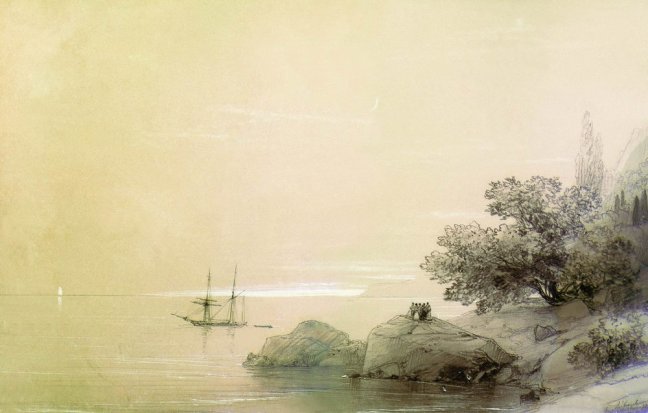
‘Calm on the Mediterranean Sea’ – Ivan Aivazovsky, 1892 – WikiArt

There is no god. God is an invention that we have placed far away, out there, as an object for our prayers and hopes. As an entity to whom we can address our suffering. God was given that role so that we are not alone. We have divided ourself up into a self here and another greater self there, between which reside our secret longings and our beliefs. We have made god into a handy projection, for our convenience. A soothing presence who will be there for us after death, whom we can trust and rely on, whom we can give ourself to, and find protection in. We feel good in that undoubted certainty of a god.

But there is no god outside of ourself, no distant god, either in place or time. Of this we can be sure. Because wherever we may travel, however far we may go, we find only ourself. We are bound to our own being which we feel in a ‘here’, and in a ‘now’. So we fail in going somewhere that is outside ourself. It’s an impossible task. We cannot go there. Not in a million years. So god cannot be found outside of ourself. Nothing can. Everywhere is here. And every time is now. The only place for god to be is in our own being. There is no other place to be — even for god. There is no way around it. But we have first to understand our own being, our own nature. There, in ourself, is the resolution of the conundrum of god.

So what is this place of ourself, to which we are bound? What is it made of? If we leave our body aside, and our many thoughts and sensations, if we leave the world out of the picture, what is left of ourself that we can say is here, is now? What is this consciousness that we have lived with for as long as we can remember, and for which we seem to have but little interest ? This thing which has held our peace, our happiness, our perceived sense of beauty, even if only experienced rarely or fleetingly? This consciousness that is holding us, that is giving us our very existence, holding our suffering and our conflicts? Should we not feel grateful to have been held with such consistency? To have been held with our feelings, whether happy or sorrowful? To have been lent a body, whether healthy or sick, and a mind, though both may be just a passing dream?

This thing which is here undoubtedly, showing that peace is possible, that beauty is real, that happiness is within reach, is this not our most profound self? Is it not our very being? What we are here? What we are now? And this god which cannot be anywhere outside of ourself, could this god not be this, this very presence of ourself? Our very being? Our very consciousness? Which we are by nature every day of our life? That which can be felt in every bit of our heart and soul? That can give an explanation for ‘there is no god’? That can give a reality to ‘there is god’? That can show that, in fact, not only there is god, but there is only god? That everything, all that we are and experience, is god? That the god which we had thought at a distance, is nothing but the loving presence and reality of ourself and of everything? That life is nothing but the living, pulsating being of god, which we are only and wholly? And which we share with every other apparent being, and every possible appearance? And that this, is the one thing that ever was, and will ever be? And that this, is not inside ourself, for of ourself it is seen that there is not? And that this, is not outside either, for there is no being outside something inexistant? And that now, at the end of our journey, and all things considered, is realised that god is not even god? Because for a god to be, there would have to be separate things and selves to give it a form, and to call it god. There would still have to be a trace of suffering. There would still have to be separation. So there’s got to be no god. God is only for the poor fellows. But for who we are, there is no god. Only being being, at the most. Beyond that, nothing much can be said, lest we should invent some other god.

.

~~~

Text by Alain Joly

Painting by Ivan Aivazovsky (1817-1900)

~~~

.

Website:
Ivan Aivazovsky (Wikipedia)

Suggestion:
– Other ‘Reveries’ from the blog…

.
A Safe Harbour

‘Sea against a rocky shore’ – Ivan Aivazovsky, 1851 – WikiArt

In our relative existence, we are always only a simple human being, a disciple of truth. We are seeking to merge the relative with the absolute, and to raise the finite where the infinite compels it to be. There is no being a super human, with a perfected soul. There is no being a specialist in the field of spirituality. The knower is a so shy and humble presence that it won’t show up when you are there. You will hide it with the boastful assertion of your own self. So if you want to espouse your true nature, you will have to feel yourself as almost nothing. You will have to stop reifying yourself, and make your person a servant of truth. There is a soothing freedom from pride and arrogance to be experienced in our human life.

The feeling of separation is what makes you assert yourself. To only and simply be is felt to be insufficient. You need to be or have something that makes you whole and happy, which you then seek through objects, qualities, qualifications, events, circumstances. To be somebody, to be important is the privilege of incompleteness. Being has no privilege, is not a superior position. it won’t make you anything. It won’t give you an advantage. You’d have to be miserable for that. You’d have to be limited. Your nature as peace doesn’t belong to you the person. When you have realised yourself as the one being that you truly are, then it won’t make you anything, it won’t give you a pedestal. Your knowing is in not knowing. In simply being.

There is a special, humble glory that lies in not being a self that feels separate. Peace is the perfume of your divine nature, that stands unaffected before the person that you happen to be. It is the nature that lends itself to the making of the world and to the selfing of its myriad of apparent entities. It is the secret power behind all appearances. Your nakedness is the key for its being seen and felt in your existence. You will then live from the stand of that knowing presence. Your self will cease feeling separate and superior. Your person will be depersonalised, will have infinity as its ‘I’ identity, and love as its guiding principle. But you won’t get any pride out of it, for your person is now devoid of its own, personal substance.

It is no accident that the life of many truth seekers is expressed through poverty and nakedness. In not possessing, in being undefended, as is the case for nuns, monks, hermits, anchorites. There is joy in not owning your own self, and your own identity. There is release in being at the service of the loving, silent being which you have discovered yourself to be. You have lost the prestige and identity contained in being a seeker. For there is no seeking in being. Being contains the gist of that which you want to obtain or achieve through your constant seeking — the juice of it. Being is the heart of life, and its reward. The Eden which you have placed far and away, as a cherished belief or possibility, is now found here, in the simple knowing of your being.

So there are no Shris, Maharshis, Bhagavans, Rinpoches, Maharaj-s, or Your Holiness, at the level of the person. There are even no sages. All these titles are only for ‘being’, for the reverence of truth, for the One. There is always only one Bhagavan. One Rimpoche. One sage. The peace contained in simply being is not another quality that is added to you as a person. A person, a body-mind, doesn’t have peace. Peace or understanding doesn’t belong to you. It is not for the person. It is all contained in that which lends you consciousness. It is in the presence that makes you, out of which you draw your personhood, and which allows you to love, live, and share. You are not an autonomous, self-contained person. You are infinity lending itself to a portion of finitude. How would an appearance be conscious, if it wasn’t for the presence which contains and creates this appearance? This peaceful, infinite presence is all there truly is. The One you have to bow to. Your teacher and your beloved. Your safe harbour in the storm of appearances.

.

~~~

Text by Alain Joly

Painting by Ivan Aivazovsky (1817-1900)

~~~

.

Website:
Ivan Aivazovsky (Wikipedia)

Suggestion:
– Other ‘Reveries’ from the blog…

.