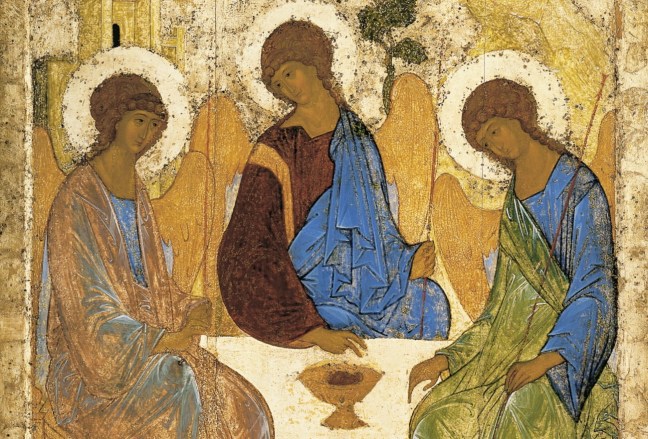
This is Meister Eckhart

‘Trinity’ – Andrei Rublev, 1410-1420 – WikiArt

.

The eye wherein I see God 
is the same eye wherein God sees me; 
my eye and God’s eye are one eye, 
one vision, one knowing, one love
.”
~ Meister Eckhart

.

In the Middle Ages, in the heart of Europe and of the Christian faith, rose a voice of such richness and profusion, of such dumbfounding wisdom and precision of thought, that it is a duty for all serious seekers to be reminded of it. The name shines with a polish of spiritual mastery and authority: Meister Eckhart. Eckhart von Hochheim OP was born in 1260 near Gotha in central Germany. OP stands in Latin for Order of Preachers, which is a mendicant order of the Catholic Church — better known as the Dominican Order — of which Meister Eckhart was a monk and a leader. His teaching and sermons left a deep impression but he was so ahead of his time and of the general understanding of his pairs, that his work went into oblivion only to reappear in the 19th century. His voice and light could not possibly be left unnoticed. He is now accepted as one of the most profound and eminent theologians, philosophers, and mystics of all times.

Little is known about his family and early life. From 1295 onwards, he held many posts of responsibility in various states of central Germany, and as far as Cologne or Strasbourg. Among others, he was a Prior of the Dominicans, managing tens of convents, and was later made Provincial of Saxony. He also travelled around Europe and more specifically to Paris where he studied Aristotle and the Platonists. With the degree of Master of Arts, he later on became a professor of theology at the school of Dominicans in the French capital and was invited as a magister — equal to the doctorate — for two consecutive years. At this time in Europe, during the Avignon Papacy, Christianity was prey to many tensions and confusion, the Inquisition was blowing a wind of suspicion and terror, as a result of which many new groups and movements were forming in search of new avenues of practice and understanding. It goes without saying that Meister Eckhart was a coveted source of wise counsel in these times of darkness. 

Let’s say it plainly: Meister Eckhart was a scholar, but it is as a preacher that he is most remembered. His sermons in the vernacular German were highly unusual for the time and took many a liberties with the conventional church rituals and dogmas. He stated: “When I preach, I usually speak of detachment and say that a man should be empty of self and all things.” […]

.

Blessed, supremely blessed, are they who are installed in the eternal now, 
transcending time and place and form and matter, 
unmoved by weal or woe or wealth or want, 
for in so far as things are motionless they are like eternity
.”
~ Sermon 16 

.

An exploration into the teachings of Meister Eckhart… (READ MORE…)

.

The Neglected Self

Relinquish yourself.
I mean this little voice
That feels it is in charge,
Entangled in things and situations.

Leave it behind.
Take height.
Experience how you can be
Detached from it.

Let it uninvolved,
It will smoothly die;
Will be englobed
By something higher, bigger.

It will release 
Its illusory presence,
Replaced by the one only being
That it so superbly ignored.

Be global. Be whole.
Take your stand as
The one thing in you that is
Complete, encompassing, ever present.

Stay with it. Be it.
For it is you, the real you
That you have left behind
Unexplored, unseen, neglected.

For you have busied yourself
With all things apparently separate;
Have engaged in an endless conversation
With a precarious little voice. Don’t.

Be like a prince: watch every thing
From the heights of your Self.
Let yourself go. Be with what is left.
With your long-neglected Self.


~~~

Text and photo by Alain Joly

~~~


Suggestion:
Voices from Silence (other poems from the blog)


The Poor Man

Reading again this sermon 87 by Meister Eckhart, entitled ‘The Poor Man’, I felt that I had to give it a place in this blog. I was stunned by its qualities, the modernity, profundity, clarity, precision, subtlety that breathes in and out of this piece, and its impeccable construction. We owe this translation to the teacher of nonduality Francis Lucille and I borrow it from the website ‘Stillness Speaks’ that offers wonderful resource for self exploration.

Meister Eckhart was a Christian theologian and mystic born in 13th century Germany. He became famous as a talented preacher and his sermons, unusual and disruptive to the church dogma and ritual, caused him troubles. Largely forgotten until the 19th century, he is now appreciated as one of the foremost exponent of the spiritual endeavour. The universal qualities of his message extend far beyond the usual Christian jargon and make it accessible for all who have a deep interest in these matters.

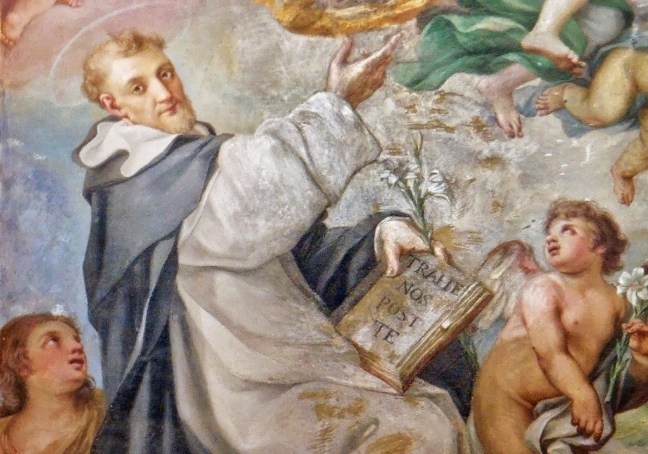
Starting with the famous biblical expression ‘Blessed are the poor in spirit’, he endeavours to describe the qualities that are to be found in a truly poor man, and that are a prerequisite to any real understanding of truth. In his own words, and in just a few passing sentences, he exposes nothing less than the nature of our true being, of free will, the pervading presence of consciousness in all beings, the blissful nature of God’s presence, the non-objective and empty substance of God, Its timeless and immortal nature, and the oneness that pervades all and everything. Be this piece a prayer illuminating these few Latin words contained in the picture above: ‘Trahe nos post te’, ‘Draw us to you’

~

Whoever is to be poor in spirit 
must be poor in all his own knowing 
so that he knows nothing of God, 
nothing of any created object, 
and nothing of himself
.”
~ Meister Eckhart

~


Beati pauperes spiritu, quia ipsorum est regnum coelorum.

Ultimate bliss speaking in its wisdom, said: ‘Blessed are the poor in spirit for theirs is the kingdom of heaven’ (Mathew 5,3). All angels, all saints, and all creatures that have been born, must be silent when this eternal wisdom of the Father speaks, because all the wisdom of the angels and all creatures is as pure nothing when compared to the limitless wisdom of God. This wisdom has said that the poor are blessed.

Now, there are two kinds of poverty. The first is an external poverty and it is good and very much to be praised in one who accepts such poverty willingly, out of love for our Lord Jesus Christ, because He, likewise, was poor on earth. I will not speak of this poverty any further. Then, there is yet another poverty, an internal poverty, which underlies each word of our Lord when He says ‘Blessed are the poor in spirit’.

Now I beg you to be likewise so that you can understand his words; for I tell you by the eternal truth: if you are not identical with this truth about which we will now speak you cannot possibly understand me.

Some people have asked me what poverty is in itself, and what a poor man would be. We will now answer them. […]

Continue reading this sermon by Meister Eckhart… (READ MORE…)


God Wants it All

Photo by Gerson Rodriguez / Pixabay

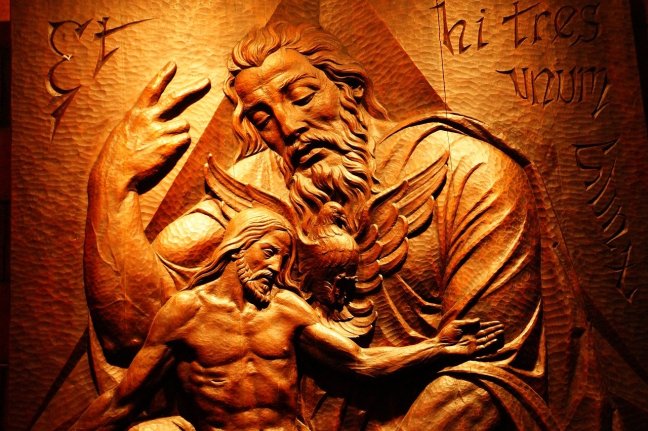
“(et hi tres unum sunt)
And these three are one
~ Bible, 1 John 5:7–8


God wants it all.
Beware if you’re planning
A little visit.
But don’t worry now!
He’s not going to eat you.
It doesn’t work that way.
Rather you will be pushed,
Through some gentle pressure of His,
To eat Him yourself.
How do we eat God?
Now relax!
It’s all been chewed already.
You just need to let go,
To leave the place for Him
To move in.
It’s not such a big move.
He’s here anyway,
Occupying your couch,
Eating your food,
Breathing your air.
Only gently move away.
Start by going out
Of your precious apartment.
It lives perfectly well
Without your being present.
Give it some air,
Take a little walk,
Have as many outings
You feel!
Let God gather its belongings
And get used to the place.
It’s His already but
You failed noticing it.
Don’t think you will feel crowded
When you come back.
God is the best room-mate ever.
He will make it all nice for you!
I bet you will enjoy
His presence.
He will only stay to the extent
You let Him in;
So don’t be so anxious!
He’s not the kind to impose Himself.
Rather do it yourself:
Impose Him on yourself!
You will feel so free;
You will enjoy and pray Him
To stay,
To live here for ever
While you keep on strolling
In the city.
But don’t feel shy!
Make the effort,
Pay Him a little visit.
It is your home after all!
He’ll be happy to see you,
For by seeing you,
He is enjoying your sweet friendship 
And flavour —
Which is His by the way!
Befriend Him as your best friend.
You might even start
Going out with Him,
Everywhere,
To enjoy the world:
Listen through His ears;
Admire through His eyes;
Sense the world with all
His generous being.
You will laugh!
You will love!
And who knows,
You might even date Him
Just as He might date you,
And you two will melt and
Go back home.
He might move in.
You might move in
Back into your flat.
But not alone this time,
And yet not two either.
Yet your presence
Will not feel lonely.
You will feel bigger,
Wider,
Richer,
Though still
Your own unique self.
As for your friend,
You won’t even see Him
Anymore,
For He is just only you.
But His glorious heart
Will beat inside you
Manifold
In your life.
I warned you!
Remember…
God wants it all.


~~~

Text by Alain Joly

Photo by Gerson Rodriguez / Pixabay

~~~


Suggestion:
Eternity with a Smile (other pieces from this category)


A Prayerful Mind

When I pray for aught my prayer goes for naught; 
when I pray for naught I pray as I ought
.”
~ Meister Eckhart

.

This prayer is borrowed from a treatise allegedly attributed to Meister Eckhart, ‘The Rank and Nature of the Soul’, in the translation of Miss C. de B. Evans, 1924. The authenticity of these treatises is discussed, but it appeared to me like a beautiful prayer well worth sharing here. I have adapted it in a more modern English, sometimes taking some liberty with the original, and other times leaving it as it is. Its authenticity goes inasmuch as it is speaks to our hearts and reveals the fragrance of the divine presence it prays…

Meister Eckhart was a Christian theologian and mystic born in 13th century Germany. He is nowadays appreciated for the universal qualities of his message. For Meister Eckhart, the most powerful form of prayer is “the outcome of a quiet mind” where there should only be “a pure going out of what is our own”. Such a mind, in his own words, is one that “is forever immersed in God’s most precious will, having left its own.” A prayer is an invitation to rest or abide in what is most essential in our being, it is “the practice of pure being”. I hope this prayer will find a resting place in your heart…

~

O divine presence, supreme fragrance,
Show me the way to your most precious nature
That in your wisdom you have sent my way
To be seen and recognised as my own self;
To be loved as my being beyond earthly manners;
To be enjoyed in this new birth as happiness.
To be owned in thy perfect wisdom.

Preserve me from all separation, for you have raised me above myself;
You have exalted my soul beyond the grasp of ego;
You have sealed me with the seal of your eternal image;
Have made nothing more like yourself than a man in his soul.

Teach me to live so that I may never want you; 
So as never to hinder the working of your love-stream in me; 
So as never to lend myself to any outward pleasure without you;
Nor occupy my mind with any creature other than you. 

You are that pure consciousness incomprehensible by ego,
Inspiring the soul and raising her above entanglement
So that she can do thy will only, O Eternal Wisdom;
So that in grace she can be freed from all that comes uninvited.

You have made the soul to suit yourself in her nature and her laws
And she maintains she has no room for anyone but you.
O Almighty! Most Merciful Creator!  Dear Lord!
Help me to overcome the pitfalls of my egoistic tendencies.

Help me to believe, to hope, to love; to live and feel exactly as you will,
And as much as you will and what you will. Lord, grant me 
The sorrow of the humble; a mind escaped from mortal body; 
To love, to laud and to behold you and cherish every act and thought that is toward you. 

Grant me a clear, sober and genuinely prayerful mind 
With real intuition of thy will, together with the love and joy 
Which make it easy to perform. Lord, grant me always modest progress 
Towards better things and never to backslide in any harmful way. 

And, O my Lord, condemn me not, as I deserve, 
To rely on my own powers, or my human weakness and foolishness,
But on your good providence alone. Direct me Lord to the Good itself;
Command my every thought and act to your own liking.

Make so happen that on my part, in me, your will is always being done,
And that I can be saved from evil and brought to the eternal life.
Make me be one where thou are three in Person, in the essence of thy divine nature: 
Father, Son and Holy Ghost and the ever blessed almighty God. 

Amen. 

.

~~~

Prayer by Meister Eckhart
(adapted from a translation by Miss C. de B. Evans)

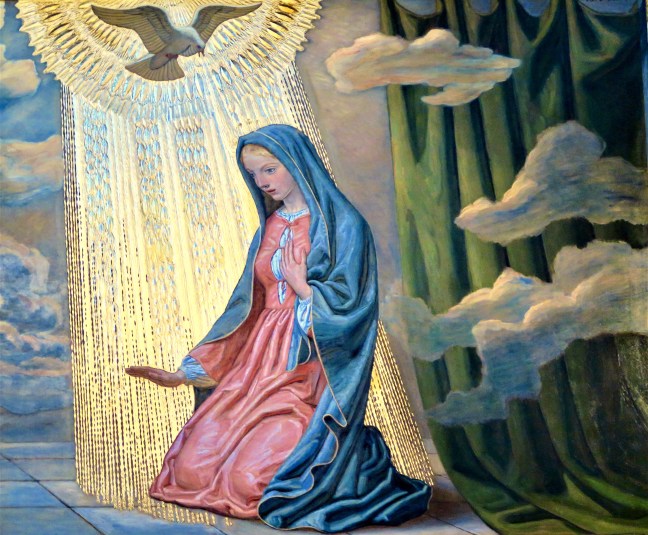
Painting by Joakim Frederik Skovgaard (1856-1933)
(Photo by Elsebet Barner)

~~~

.

Bibliography :
– ‘Meister Eckhart, Selected Writings’ – by Meister Eckhart – (Penguin Classics)
– ‘Conversations with Meister Eckhart’ – by Meister Eckhart & Simon Parke – (White Crow Books Ltd)

Website:
Meister Eckhart (Wikipedia)
Joakim Skovgaard (Wikipedia)

Suggestions:
This is Meister Eckhart (Homage to Meister Eckhart)
The Poor Man (a Sermon by Meister Eckhart)
– The Quiet Mind (a quote by Meister Eckhart)

.

The Philosopher’s Stone

Here is a reminder inspired from the words of Rupert Spira. It is necessary and terribly efficient to look into these matters for ourselves. This is why I like to share here the parts of a spiritual teaching that sounds like ‘something to do’, something to experiment and verify for ourselves:

See that all objects in your life are made out of gold, of this most precious thing, which is your self. That is the fabric of the world. The way to make real in your life this scratching and the discovery of the gold underneath, is to treat – relate to – everything, animals, people, objects, in that loving way. Then, the world responds, it says ‘thank you’…

~~~

Further exploring on the subject:

We discover that the stuff the world is made out of is more precious than gold. It’s made out of our self. The most precious thing. When you touch an object, you feel that it’s made out only of your self. As soon as we start treating the world like that, the world says thank you. The world responds. People, animal, and even so called dead stuff, it turns round and the first thing it says to us is thank you for treating me as I am. It has an infinite ways of saying thank you, and each way is uniquely tailored to each body-mind. But in one way or another, the world returns the gift. You treat me as I am, I will behave with you as I am. If someone truly loves and respect what we are, it commands us to behave as we truly are. It’s the ultimate generosity. The reciprocation that we get from people, from the world, from objects, that’s the real confirmation. The real confirmation really comes in our lives, in ordinary ways.”
~ Rupert Spira (From YouTube video clip ‘A Fairy Story’)

~

There was a deep widening intensity, an imminent clarity of that otherness, with its impenetrable strength and purity. What was beautiful was now glorified in splendour; everything was clothed in it; there was ecstasy and laughter not only deeply within but among the palms and the rice fields. Love is not a common thing but it was there in the hut with an oil lamp; it was with that old woman, carrying something heavy on her head; with that naked boy, swinging on a piece of string a piece of wood which gave out many sparks for it was his fireworks. It was everywhere, so common that you could pick it up under a dead leaf or in that jasmine by the old crumbling house.”
~ J. Krishnamurti (‘Krishnamurti’s Notebook’, Part 7 – Madras 20th November to 17th December 1961)

~

This day is dear to me above all other days, 
for today the Beloved Lord is a guest in my house; 
My chamber and my courtyard are beautiful with His presence. 
My longings sing His Name, and they are become lost in His great beauty
.”
~ Kabir

~

You are what you are, timelessly, but of what use is it to you unless you know it and act on it? Your begging bowl may be of pure gold, but as long as you do not know it, you are a pauper. You must know your inner worth and trust it and express it in the daily sacrifice of desire and fear. (…) Your only proof is in yourself. If you find that you turn to gold, it will be a sign that you have touched the philosopher’s stone.”
~ Nisargadatta Maharaj (‘I Am That’)

~

The Self is the centre of beauty and changeless. The symbols are numerous, but the centre is only one, the inmost core of one’s being. Beauty is the real nature of the Self and is unlimited. Beauty anoints with its own gild everything with which it comes into contact. (…) Beauty is something by which you are attracted without a cause. You are most attracted to your own self. Or in other words, your own nature is the only thing that can attract you. So beauty is only an experience of one’s own nature. (…) When the object is removed, the beauty stands alone and permanent.”
~ Atmananda Krishna Menon (‘Notes on Spiritual Discourses of Shri Atmananda’ by Nitya Tripta’)

~

The state of bliss that arises when you are freed of the accumulated experiences of separation, is like the relief you experience by putting aside a heavy load. The appearance of this light is like the discovery of a treasure once lost, the realm of universal non-duality.”
~ Abhinavagupta (from Anuttarāṣṭikā)


B4B1EF62-8C55-4D3A-A93C-CEF684A607CC


The photo is by Rüstü Bozkus / Pixabay

Read this fairy tale ‘Ishani’s Quest’ based on this very topic…

Bibliography:
– ‘Presence’, Vol. I & II – by Rupert Spira (Non-Duality Press)
– ‘Krishnamurti’s Notebook’ – by J. Krishnamurti – (Krishnamurti Publications of America,US)
– ‘I Am That’, by Sri Nisargadatta Maharaj (Chetana Pvt.Ltd)

Websites:
Rupert Spira
J. Krishnamurti
Atmananda Krishna Menon (Wikipedia)
Nisargadatta Maharaj (Wikipedia)
Abhinavagupta (Wikipedia)
Kabir (Wikipedia)

Suggestions:
Fleeing to God (other pointers from the blog)
Khetwadi Lane (Homage to Nisargadatta Maharaj)
Kabir Says: (Homage to Kabir)
A Day at Brockwood Park (Homage to J. Krishnamurti)


Verses on the Perfect Mind

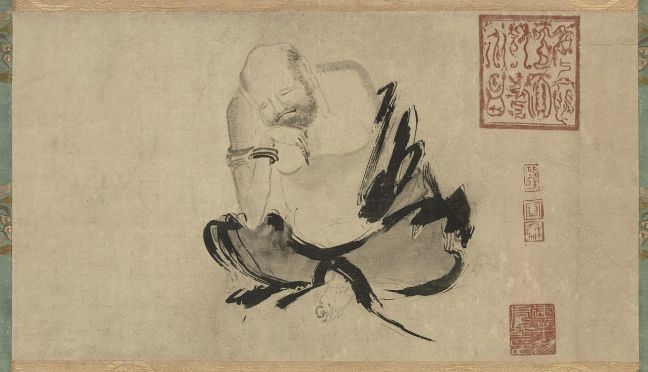
‘Huike thinking’ – Shi Ke, 10th Century – Wikimedia Commons

信心銘
鑑智僧璨


It is only recently that I have heard the first two lines of this Zen poem called ‘Hsin-hsin Ming’, which can be translated as ‘Verses on the Perfect Mind’. It is an ancient poem, one of the earliest and most influential Zen writings. It was allegedly composed by Chien-chih Seng-ts’an, who is referred as the Third Zen Patriarch. Very little is known about him, except that he was initiated into the Dharma by Dazu Huike (487–593) and died in 606. It has been multi-translated, and given various names. The title literally means ‘Inscription (or record) on the Believing Heart (or the Faith Mind)’. Verses on the Perfect Mind seems to be a good translation, considering the deeper meaning of the word ‘perfect’ which is ‘completed, accomplished’. The perfect Mind here is an ‘is-ness’, the natural mind, the Buddha mind. As the Nirvana Sutra says, “Great faith is no other than Buddha nature.”

What makes the translation of the poem difficult is the tension between conveying the right meaning and rendering the brevity of the poem. There is a passage in the present translation that goes: “When things can no longer be faulty, it is as if there are no things. When the mind can no longer be disturbed, it is as if there is no mind.” This was translated by Prof. Dusan Pajin: “No blame, no things; no arising, no mind.” The poem consists of 146 unrhymed four-character verses, which is shorter than the usual lines in Chinese poetry which have five or seven characters. So the form is concise, scarce, and that is in line with the Zen meditative form. 

It should not be read as a succession of individual quatrain, but more as a vision, something whole, indivisible. I think it was written in this spirit, for the original work is really just a succession of undivided characters. Maybe it was recited fast, concentrating on the meaning behind the words, the felt-understanding. It starts with these famous lines, so often quoted: “The Great Way is not difficult, for those who have no preferences.” It develops as variations on these lines before ending and finding completion — we could say vanishing — with this strong reminder: “Words! Words! The Way is beyond language, Words never could, can not now, and never will describe the Way.” The present interpretation is by Eric Putkonen. Eric is a Modern-day house-holder yogi and lover of what-is who lives in St. Petersburg, Florida where he hosts nonduality satsangs. I hope you will enjoy…


至道無難 
唯嫌揀擇 
但莫憎愛 
洞然明白 


The Great Way is not difficult, 
for those who have no preferences. 
Let go of longing and aversion, 
and it reveals itself.

Make the smallest distinction, however, 
and you are as far from it as heaven is from earth. 
If you want to realize the truth, 
then hold no opinions for or against anything.

Like and dislike 
is the disease of the mind.
When the deep meaning (of the Way) is not understood, 
the intrinsic peace of mind is disturbed.

As vast as infinite space, 
it is perfect and lacks nothing.
Indeed, it is due to your grasping and repelling 
that you do not see things as they are.

[…]

Continue reading this old poem by the Third Zen Patriarch… (READ MORE…)