That Flickering Flame

‘Mary Magdalene with Oil Lamp’ (part)  – Georges de la Tour, 1630-35 – WikiArt

The simple feeling of being — away from the contingencies of being a separate self enthralled, or assailed by objective experience — that feeling, that wee flame, needs to be attended at all costs, watched over patiently, and finally protected. Otherwise it will wither in no time, pushed by the winds of our egocentric activities, wiped out by our stubborn beliefs. Being can be such a shy being. But always remember: it is eager to shine; it is eager to warm your life up with its soft, tender flame. And it will bring you that little light you need, to find your way through the maze of existence. That flickering light is stronger than you think. At first, it might appear to be hesitant, wavering as if to die with any sudden burst of a boastful thought, or the surging of a distressing feeling. But look closer. For the apparent flickering of that little, intermittent flame is yours. You are that angry shadow threatening to shut its light off yourself. You are that cold gust ready to send its warmth far and away from your life, and leave you freezing like a lonely being. So be yourself that shyness, that hesitancy. Watch that you don’t come to disturb the flame of your self. Be that flickering entity, always ready to retire and fade your cumbersome presence off that joyous fire of being. That’s the extent of your attending: your not being there, your acceptance to die or surrender, your willing to fragilise that imposant self which you have identified yourself with along the way — that invention of yourself. That is all this wee flame needs to set fire to your existence, to inflame your being as to show it to be indestructible, and to shed a bright light on your true nature as being infinite and eternal — not that shy, fragile, flickering, coming and going presence. For presence is a wildly enthusiastic blaze if you let it be. It can burn you in a second, so as to render you inexistent. It is a firestorm that will scatter you in a thousand fluttering ashes, to leave you as you truly are: A peaceful being. A flame of happiness. Shining brightly like an ebullient sea of love. See what a little attending can do — a little nurturing! The humble succouring of a wee, flickering flame…

.

~~~

Text by Alain Joly

Painting by Georges de La Tour (1593-1652)

~~~

.

Websites:
Georges de La Tour (Wikipedia)
Magdalene with the Smoking Flame (Wikipedia)

Suggestion:
Other ‘Ways of Being’ from the blog…

.
Diary of a Country Priest

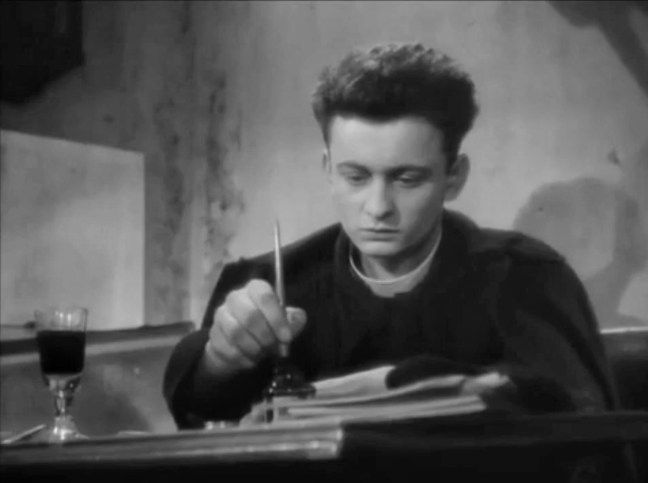
’Diary of a Country Priest’ – Robert Bresson – (With actor Claude Laydu)

.

I try to catch and to convey the idea that we have a soul
and that the soul is in contact with God.
That’s the first thing I want to get in my films
.”
~ Robert Bresson.

.

Robert Bresson is a unique film maker in the history of cinema. He has developed a very personal way of filming that wholly tends towards one thing only: conveying truth. This is achieved by means of the right use of cinema language. As the French master said in the newspaper ‘Libération’: “The true language of cinema is that which translates the invisible. I am trying to convey feelings rather than facts or actions. I am trying to substitute an internal movement for an external movement.” This is particularly well shown in his 1951 film ‘Diary of a Country Priest’, where Bresson, slowly, relentlessly, and above all with simplicity, is scanning the interior life in everything, in the dialogues, the lights, the camera movements, the acting. But this simplicity is here to serve an utter precision. The film is crafted. A skilful surgeon is here at work. And we make silence.

‘Diary of a Country Priest’ tells a simple story based on the novel of the same name by Georges Bernanos, published in 1936. A young priest arrives in his first rural parish where he and his faith will be met with misunderstandings and challenges, both from his parishioners and his declining health. The film opens with these simple lines in his diary: “I don’t think I’m doing anything wrong in writing down daily, with absolute frankness, the simplest and most insignificant secrets of a life actually lacking any trace of mystery.” In the first scene, we see the young priest appearing behind the bars of a gate, signifying that we are about to see the story of an imprisonment. The film is the description of his total dedication to his duty, which will prove to be an ordeal. We are always in a prison, when we are locked in the belief in being somebody.

[…]

Learn more about this movie by French director Robert Bresson… (READ MORE…)

.

The Everlasting Arms

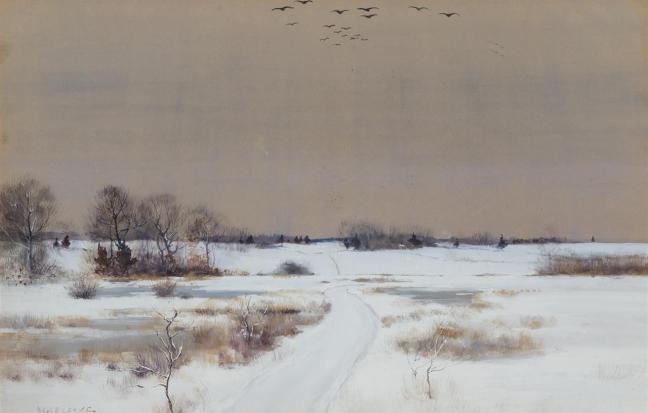
‘Winter Scene’ – Bruce Crane, 1890 – Wikimedia


yes is a world
and in this world of 
yes live 
(skillfully curled)
all worlds

~ E. E. Cummings


Really, to surrender seems the most difficult thing to do. Even in our most relaxed moments, we are unconsciously holding the show through a subtle kind of effort. And this effort is being maintained throughout our life, even more so in moments of threats and desperation. The consequences of this constant tension is visible in every aspects of our being, physically and psychologically where they shine in an obvious manner, but also in our inward, spiritual life where it has even more devastating effects, keeping us at bay, at distance of any deep understanding or realisation.

At every moment of our lives, we experience at best a subtle if not unnoticed resistance to the propositions of everyday experience. Let’s put it simply: we argue. We argue, complain, judge, evaluate, regret, hope, expect, and so many other gesticulations that we superimpose on reality. Really it sometimes feels there is a madman locked here in the room of existence. The present reality, what is taking place here and now offers nothing less, if you look at it carefully, than a quiet and smooth run. ‘What is’ flows majestically like a large river does. It bears the silence of presence, the quiet inescapability of ‘is ness’, of being just the way it is. So why does life and circumstances expose us to such amount of conflict and resistance? How did it all become such an unsolvable riddle? […]

An exploration into the meaning of true surrender… (READ MORE…)


The Deepest Acceptance

It is truth that liberates, 
not your effort to be free
.”
~ J. Krishnamurti

The question of ‘surrender’ is one that is often misunderstood. Surrender implies, in everyday language, something that the mind does, even remotely, in order to give itself to a reality that seems inescapable. It often comes down to a form of resignation, a giving up, something passive at its core, which brings more delusion and suffering. So what is true ‘surrender’, in a non-dual context? I have gathered here many quotes and pointers on this subject, from various spiritual teachers and poets of the eternal and the infinite. I hope that this will bring some clarity into that which Jeff Foster calls the deepest acceptance…


~~~


People often think that surrender means to renounce wealth, sexuality, or objects. Such a renunciation might be useful but it could also be a hindrance. Real surrender takes place when we cease to take ourself for a separate entity, an object. This renunciation seems, at first sight, limited in scope and too simple, but it is, in fact, the ultimate surrender. Such a giving up has no purpose, it comes from the deep understanding that our true nature, consciousness, is free from all limitations. From this perspective, surrender means to see the limitations for what they are: mere concepts superimposed onto our real being, which is limitless.”
~ Francis Lucille (‘Eternity Now’)

~

You may discover that when there is no resistance to totally being in hell, that heaven opens up and samsara reveals its true nature as nirvana. But the catch is, if you are embracing hell as a strategy to get you to heaven, that doesn’t work. Only the complete absence of wanting what is to be different in any way pops the imaginary bubble of separation. No one can do this. It is like dying or falling asleep. It is the absence of any doing, the absence of control, the absence of effort, the absence of any concern about what happens. It is a letting go, a dissolving, a relaxing. This letting go begins with letting go even of the need to let go, for the need to fall asleep keeps us awake, just as the imperative to surrender is a form of holding on and seeking control. True surrender is the absence of resistance even to holding on if that is how life is showing up in this moment. Surrender is the absence of trying to surrender.”
~ Joan Tollifson

Continue the exploration on the question of ‘surrender’ (READ MORE…)