The Householder Sage

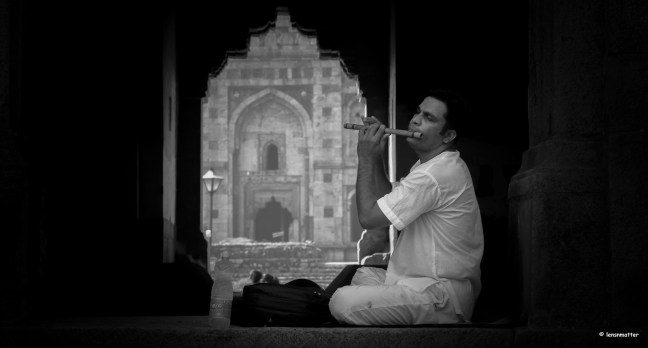
Photo by lensnmatter on Foter.com / CC BY-NC-SA

.

Objectivity, in any form, is the only obstacle to Truth.”
~ Atmananda Krishna Menon

.

It really is a remarkable thing that some of the clearest expressions of modern day non-duality have come from simple Indian men who lived simple lives in society. Atmananda Krishna Menon, married and a father of three children, a police inspector, was one such man. He became, along with Ramana Maharshi and Nisargadatta Maharaj, an essential pillar of the non-dual understanding in India, giving voice to a new approach called the Direct Path, and becoming a guiding light for many seekers of truth in the West. 

Krishna Menon was born in 1883 in Kerala. He grew up in a well educated Brahmin family — some of his relatives were poets or scholars — and had a happy childhood. He was endowed with a good and curious mind, that allowed him to find pathways towards understanding that are clear, simple and effective. Krishna Menon had the highest respect for the function of a true guru. His encounter with his teacher was simple and eloquent. Walking by the roadside, he met in 1919 a swami and sannyasin from Calcutta named Yogananda. It was a short, transforming and unforgettable meeting that lasted only one night but touched him to his very soul. “This paralyzed my ego.” did he say. He realised his true self in just a few years and began teaching. His impeccable logic and clarity drew many a student around him. 

The Truth goes into you undressed,
not through language at all
.”
~ Atmananda Krishna Menon

[…]

Discover the life and teaching of Atmananda Krishna Menon… (READ MORE…)

.

The Sacrifice

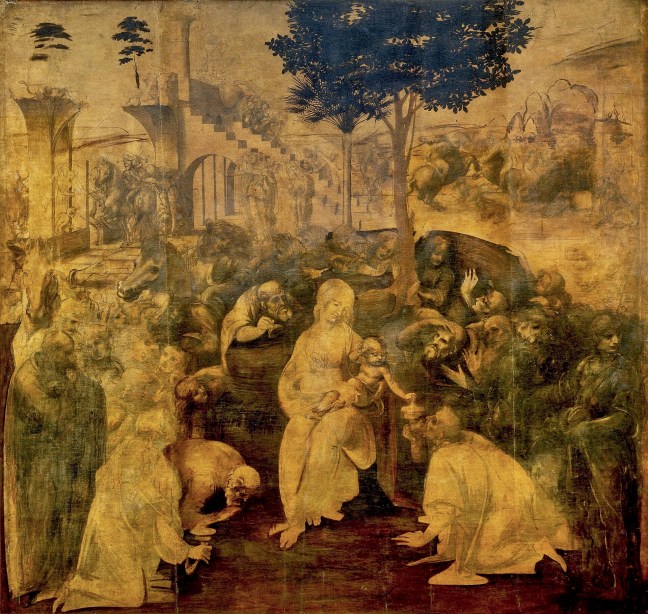
‘The Adoration of the Magi’ – Leonardo da Vinci, 1480 – WikiArt

This is the first piece of a new category in the blog called ‘Impressions of Truth’ which aims at exploring art and spirituality through the medium of films, and celebrating various famous masterpieces of world cinema. Art is at the core of the spiritual endeavour and creativity is one of the foremost qualities and expressions found with the discovery of our true nature. The function of art is to give us a taste of the deepest reality hidden behind our human endeavours. And filmmaking has uniquely tailored visual and narrative qualities, perfectly conducive to bringing us closer to the inherent peace, harmony and love within us. So let’s immerse ourselves in the unique intimacy of a cinema room, the play of forms on the screen, and the ancient gift of being told another human story…

As an introduction, I would like to warn that, for the specific purpose of this text, I have chosen to describe the precise contours of the movie’s storyline. This is a film where the narration is not of the utmost importance, but be prepared if you plan to watch the movie and would rather not know so much

.

.

The aim of art is to prepare a person for death, 
to plough and harrow his soul, 
rendering it capable of turning to good.”
~ Andrei Tarkovsky

.

The screen and cinema room turned to a pitch black. Only the faint crackling murmur of an old empty sound track could be heard. And then… Then slowly rose the most exquisite music. ‘Erbarme Dich’ of the St Matthew Passion by J. S. Bach. Only hear this piece once in a movie by Andrei Tarkovsky, and its hearing will be forever associated with the great Russian film maker. Tarkovsky once wrote: “My function is to make whoever sees my films aware of his need to love and to give his love, and aware that beauty is summoning him.” The film ‘The Sacrifice’, by the master, is a living testimony of this claim. 

As this most divine music unfolds, a darkly lit portion of a painting comes to life. This is Leonardo da Vinci’s ‘The Adoration of the Magi’, where you see Jesus as a baby, sitting in Mary’s lap, reaching for the gift that is presented to him by one of the Magi. Then an exquisite feminine voice rises among the violins and sings these poignant verses: ”Have mercy, my God, for the sake of my tears! See here before you, heart and eyes weep bitterly. Have mercy, my God.”

Tarkovsky’s movies move slowly, with long takes, and unconventional scenario and structure. This can be a challenge for the viewer who is used to expect from a movie the usual suspense, pleasure and excitement. The thrill comes here from a wholly different place. It comes from silence, harmony and beauty. And if the purpose of art is of the deepest kind, Tarkovsky is indeed one of its most faithful representative, and could very well make his these words by Rupert Spira: “The role of the artist is to transmit to humanity the deepest experience of reality. Art is remembrance. It is love. It is like a sword that distinguishes between appearances and reality, or a cradle that reminds us of home.” This indeed is a form of elevation, and the film makes it immediately clear.

[…]

Discover the beauty and qualities of Andrei Tarkovsky’s last movie… (READ MORE…)

.

Love Remains

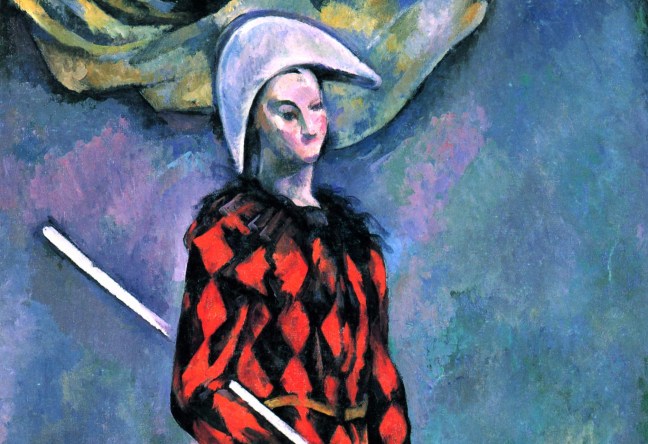
‘Harlequin’ (part) – by Paul Cezanne, 1890 – WikiArt

O my self, why do you stand in the way? For the living of these many experiences, you are not necessary. The pure consciousness that is present in all of us here and now is perfectly equipped. So don’t worry and please move away. This pure being has held effortlessly the millions of billions of beings and experiences generated so far, and has allowed for ever more choices and decisions to be made, so it need not being chaperoned by you. I thank you for your good will, but your work has been too laborious. Come again if you really want to, but your presence here is not welcome anymore. 

Haven’t you noticed, by now, how your participation has been an unnecessary feature in the unfolding of experience, in the many activities of our human company? Haven’t you seen how all your unnecessary thoughts and feelings have been a perturbing element among the team work that is generated here? And has cost us dear in our expenses and plannings? We understand that you want to participate, that all this is important to you, is dear to your heart, and we have accommodated you so far the best we could. But now we gently ask you to revise your presence here. […]

A humorous divagation where the self is being confronted… (READ MORE…)

.

Tao Te Ching

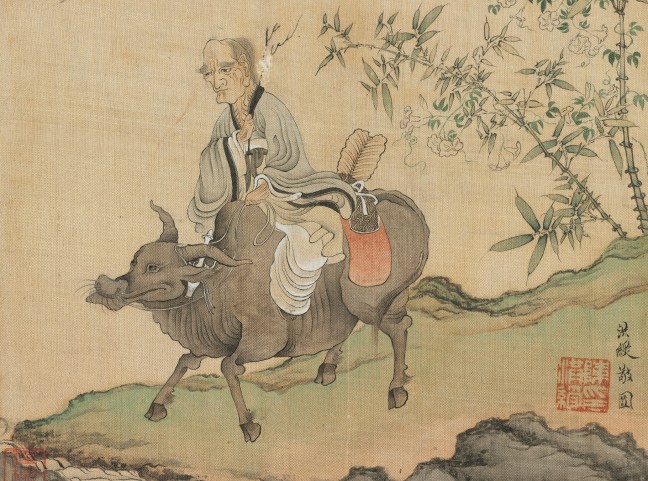
‘Lao-tzu Riding an Ox’ (Part) – Chen Hongshou – Wikimedia

.

道德經

.

The Sage attends to the inner 
and not to the outer; 
he puts away the objective 
and holds to the subjective
.”
~ Tao Te King (trans. Lionel Giles)

.

The Tao Te Ching is an ancient treatise and one of the most widely translated work in world literature. Its philosophical influence was major in the civilisation of China, colouring other religious currents like Buddhism, and becoming a guiding light for millions of people, including countless thinkers, artists, and poets — even political movements. It was allegedly composed between the 6th and 4th centuries BC, and has been traditionally ascribed to the sage Lao Tzu, which literally means ‘Old Master’. There is doubt among scholars that Lao Tzu is a historical figure, and not a semi-legendary one, but he is nevertheless a key figure in Chinese culture and history, being both the founder of Taoism and one of its deities. 

The Tao Te Ching is a fairly short text of 5000 chinese characters, divided in 81 chapters. Written in Classical Chinese, it is linguistically complex and is a challenge for translators. Tao is a central word and concept in East Asian philosophy, which means ‘way’ or ‘path’. It is understood as being a principle that is eternally present and is described as being the natural order of the universe, empty and hidden, ‘nameless and unchanging’, yet the ‘source of all things’ and the giver of excellence and virtue.

.

Tao is like an empty container:
it can never be emptied and can never be filled.
Infinitely deep, it is the source of all things.
[…]
It is hidden but always present.
I don’t know who gave birth to it.
It is older than the concept of God
.”
~ Tao Te Ching (trans. J. H. McDonald)

[…]

Discover more of Lao Tzu’s ancient Book on Tao and Virtue… (READ MORE…)

.

What is Sought

“You are what needs to be found –
you are not the finder of anything –
the truth is in back of us,
not in front of us.
That’s why it can never be reached,
it can never be understood,
it can never be felt,
it can never be sensed —
because we are what needs
to be sensed, felt and seen.
We are not the seeker, 
we are what is sought.”

~ Eric Baret

.

~~~

Quote by Eric Baret

Photo by Alain Joly

~~~

.

The quote is excerpted from an interview in ‘Science & Nonduality’ entitled ‘What is Truth?’…

Bibliography:
– ‘Let the Moon Be Free: Conversations on Kashmiri Tantra’ – by Eric Baret (translation by Jeanric Meller) – (CreateSpace Independent Publishing Platform)

Website:
Eric Baret (in French) 
Eric Baret (YouTube Channel) 

.

Other quotes from the category Beauty in Essence

.

Chalices of Wonder

Alfred K. LaMotte is my newly invited guest on ‘The Dawn Within’. His poetry has been a regular companion over the years and I’m happy to share here five of his poems. Most of Fred’s writings and poems have been shared in his website  Uradiance’, and in his ‘numerous books’. Fred is an interfaith chaplain and a college teacher of world religions and philosophy. He wrote: “Poems are maps for getting lost in your heart where everyone can find you. Poems are momentary Sabbaths when eternity breaks in. These moments can heal the world.” Fred lives with his wife Anna near Seattle WA, where he “loves to walk barefoot in wet grass at midnight, un-naming the stars.” You will find, in between his poems, some of Fred’s writings on Beauty and Creation. I hope you enjoy these few pieces and excerpts…

.

Beauty unfolds in the silence between thoughts.
The dark loam of thought-free awareness 
is where Words of creation spring up and cry,
‘Let there be light’.

.

~~~

.

Invincible 

I don’t want to be invincible.
I want to be astonished by loss.
I want to be stunned
and defeated by wonder,
shocked into a new creation
where only dancing is allowed.
I want to fall down again and again.
How close can my head come to your toes
before it shatters into spirals of gold?
Lift me up, I’ll do
what a fountain does to sunbeams.
Step on me, I’ll be the sky. 

.

~

Creation is neither a tale of the past nor a vision of the future, but a history of this moment. 
That is why, for me, meditation is the mother of poetry
.”

~

[…]

Discover the poetry and wisdom of Alfred K. LaMotte… (READ MORE…)

.

Shankara the Great

‘Adi Shankara and his disciples’ – by Raja Ravi Varma, 1904 – Wikimedia

.

अहं निर्विकल्पो निराकार रूपो, 
विभुत्वाच सर्वत्र सर्वेन्द्रियाणाम् । 
न चासङ्गतं नैव मुक्तिर्न मेयः, 
चिदानन्दरूपः शिवोऽहम् शिवोऽहम् ।

ahaṃ nirvikalpo nirākāra rūpo
vibhutvā ca sarvatra sarvendriyāṇaṃ |
na cāsaṅgataṃ naiva muktir na meyaḥ
cidānandarūpaḥ śivo’ham śivo’ham |

.

The early spiritual works produced in India were anonymous, probably stated by some ancient sages whose identities got lost. There is one name though that rose and was brought to fame and excellence, a teacher whose life has been narrated in many hagiographies and legends. His name: Adi Shankara, or Shankaracharya. His work as a philosopher and religious reformer is considered prominent in the unfolding of Hinduism. He is also known for having formulated and codified the ancient spiritual current of Non-duality, called in India Advaita Vedanta.

India’s most celebrated teacher was born in Kerala, in a village called Kaladi, in the accepted year of 788. Everything is uncertain about Shankara, since his numerous biographies were written centuries after his death and were designed to build a legend around his life. The name ‘Shankaracharya’ means the teacher ‘acharya’ of the way to bring about happiness (‘sham’ means ‘auspicious’ and ‘kara’ ‘maker’). He died at the early age of 32. A short life that nevertheless allowed him to travel widely all over India, initiating debates, founding monasteries ‘Matha’, and writing numerous pieces of work among which commentaries of ancient texts like the Brahma Sutras, the Bhagavad Gita, or the Principal Upanishads. 

Amongst the many works authentically attributed to him is the Atmashatkam, also known as Nirvanashatkam. The legend says that Shankara, aged only eight at the time, wrote this devotional poem of six slokas as an answer to his newly found guru Govindapada who asked him the simple question “Who are you?”. This is a very striking and moving exposition of everything that we are not, everything that has been wrongly attributed as being our identity. Through experientially discarding every such thing, one comes to dawn on the simple realisation of our true nature, namely the Self or, as it is named in this translation, ‘the auspicious, love and pure consciousness’. This was concluding each stanza in the original Sanskrit as ‘I am Shiva! I am Shiva!’ (Shivoham)…

I am not mind, nor intellect, nor ego, 
nor the reflections of inner self. 
I am not the five senses. I am beyond that. 
I am not the seven elements or the five sheaths. 
I am indeed, That eternal knowing and bliss, 
the auspicious, love and pure consciousness.

[…]

A discovery of the ancient teachings of Adi Shankara… (READ MORE…)

.