Pathways

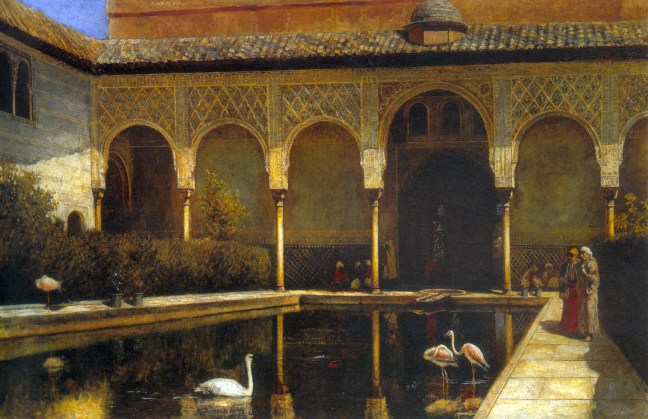
‘Court in the Alhambra’ – Edwin Lord Weeks, 1876 – WikiArt

The spiritual endeavour is really such good fun. You may happen to experience some suffering in your life and feel entangled — with thoughts rushing into your mind and problems seizing the entirety of yourself. The web of experience is overwhelming you and you can find no space to breathe within. You may then have to have a little conversation with yourself. You may have to disentangle yourself from your stubborn identification with thoughts and with the overcrowding objects born of the senses. That’s when you may present yourself with a simple question like: “What is this part in myself that is aware of my experience?” And so are you now taken amongst the scents of 8th century India, treading its immemorial dust with Shankara, debating with the great Vedantic master. He will show you how to move inwards right at the core of that aware presence in yourself. You will be taken with him to the core of this investigation, which is but the separation of the multiple objects of experience from the one aware, pervading presence of consciousness that is your true identity. That’s when Shankara leaves you with this one infaillible recipe:

.
I bow down to that all-knowing One
which is pure Consciousness, all-pervading, all,
residing in the hearts of all beings
and beyond all objects of knowledge.”
~ Shankara (Upadesasahasri, 1:1)

.
You may then find yourself sitting in your kitchen, cutting vegetables, with your thoughts suddenly wandering in the 17th century Paris, surrounded by the walls of a Carmelite monastery’s kitchen, chatting along with Brother Lawrence. He might tell you with his big generous smile: you know brother, “nothing is easier than to repeat often in the day these little internal adorations.” That’s when you understand that this investigation can be made into a joyful, often repeated practice, where you go and meet yourself within, have a little chat with this hidden presence, spontaneously, as you gaze into the eyes of a friend. Amongst the frantic sound of knives hitting the wooden board and the fumes of the next meal simmering on the stove, you meet Brother Lawrence’s glance offering you this last precious advice:

.
I renounced, for the love of Him,
everything that was not He;
and I began to live as if there was none
but He and I in the world.”
~ Brother Lawrence

[…]

Continue this journey into the investigation of your true nature… (READ MORE…)

.
O Mystic Nuns!

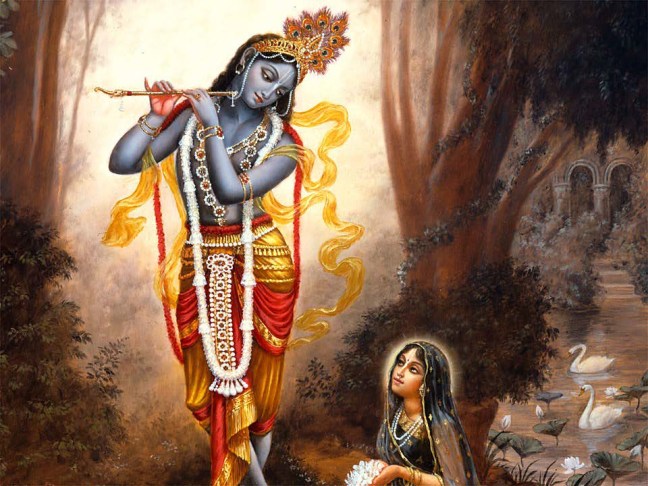
Photo by Abee5 on Foter.com / CC BY-SA

Thy love was not of earth; no woman’s soul 
For mortal love craved with such a yearning. 
So thou didst wed great God Himself! O Goal 
Beyond our ken, beyond our dim discerning! 
And soul to soul, like sunbeam unto Sun, 
Thou didst vanish away, O mystic Nun!

~ Sri Devendranath Sen


At all times, India has embraced the love and longing for God as a privileged access to our ultimate reality. This path of love or devotion, called bhakti, was trodden by countless seekers and poets who have offered their verses to posterity. Amongst them many women. Women who, alone, have walked the steep path to God, going against the society of men, marriage and conventions, with only one goal: to reach divine love. I present here three such women — Andal, Akka Mahadevi, and Mirabai — these mystic nuns, whose personality and poetry are an unforgettable milestone to this day in India and elsewhere.

Through devoting or directing their love to a god, be it Krishna or Shiva, these devotees were searching to experience the bliss of their own being, the happiness that is the very nature of their self. But by conditioning their love to an object, they also experienced suffering, longing, sadness, anger, which all came to feed their poetry, their songs, all these exquisite expressions. These were the very vector that supported their spiritual search. But don’t think that this is a path that is limited or lacking depth. For though directed towards an object, the love they feel is always their own. The forms of Krishna or Shiva were a vehicle to lead them to their very self, to realise that their longing is and has always been for their own unborn nature, for love itself, the oneness of their own being.

This tension between the love for God as a form, and for being or oneness as a principle, between saguna and nirguna bhakti, as it is expressed in the Indian tradition, is at the core of the bhakti endeavour, of the journey to divine love. In ‘The Embodiment of Bhakti’, Karen Pechilis Prentiss wrote: “The lord is characterized by both ‘paratva’ (otherness) and ‘soulabhaya’ (ease of access). He is both here and beyond, both tangible as a person and intangible as a principle.” These nuns were expressing this tension with various degrees in their many songs and poems. Listen to their voice. Listen to how Krishna’s forms and attributes, ramblings and happenings are only expressions of a deeper reality, of the understanding and tensions at play in the seeker’s very being. They are their paths whose completion will lead to the recognition of their own true self. […]

Listen to the poetry of Andal, Akka Mahadevi, and Mirabai… (READ MORE…)