The Wisdom of Humility

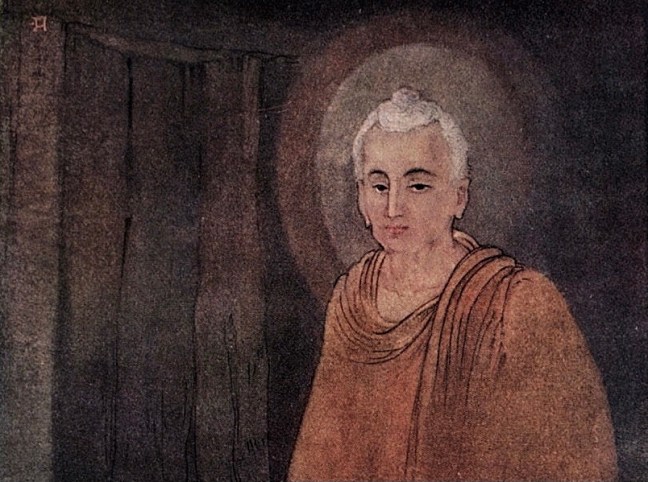
‘Buddha as mendicant’ (Part) – Abanindranath Tagore, 1914 – Wikimedia

.

To look into and understand the meaning and implications of being truly humble, of that state of humility which we often hear about — but rarely fully understand — is a precious thing. The word ‘humble’ finds its roots in the Latin ‘humilis’ which means ‘lowly’, literally ‘on the ground’ (from ‘humus’ meaning ‘earth’). Its etymology covers both the more active aspect contained in being ‘humiliated’, or being ‘humbled’, and the one that refers to the state, or quality, of being ‘selfless’. The first one gives the primary importance to the self that we are, to this separate entity that we believe to be, and which needs to be rendered humbler, smaller, lower. But why would we want to do that? Why, if it wasn’t for our deep intuition that this self is illusory, false, and is ultimately preventing our true identity of peace and happiness to be recognised and realised? 

This inherent peace contained in just ‘being’ refers to the second aspect of the word. Being humble is being without self, without the belief of being separate from objective experience. We are not this restless entity that wants to achieve, to aggrandise itself, and needs to be rendered low. We are rather this pure being whose very nature is complete, and already, unconditionally humble. Otherwise, why would Shiva or Buddha be portrayed as a mendicant? Therefore, the solution to our chronic state of suffering and conflict does not lie in having more, or less, or better ‘self’, but in realising, and living from, this deep and already achieved peace that we are. This realisation, and the action that is born of it, is what true humility is about. This simple phrase from the Bible made it crystal clear long ago: “When pride comes, then comes disgrace, but with humility comes wisdom.” (Proverbs 11:2)

I am sharing here a few quotes that will further explore this deep and essential question:

~~~

In a space of humility,
no conflict is possible
.”
~ Éric Baret (‘Let the Moon be Free’)

~

Humility contains in itself the answer to all the great problems of the life of the soul. It is the only key to faith with which the spiritual life begins: for faith and humility are inseparable. […] If we were incapable of humility we would be incapable of joy, because humility alone can destroy the self-centeredness that makes joy impossible.”
~ Thomas Merton (‘Seeds of Contemplation’)

[…]

Discover many more quotes on this question of humility… (READ MORE…)

.
The Fountain of Dark Silence

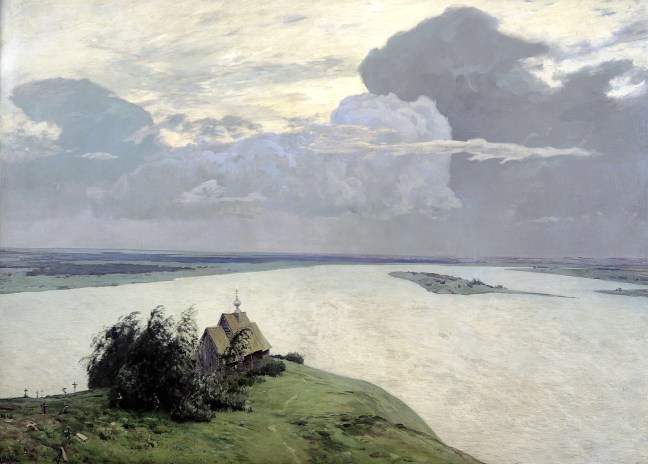
‘Above the eternal tranquility’ – Isaac Levitan, 1894 – WikiArt

.

There is a fountain inside you.
Don’t walk around
with an empty bucket
.”
~ Rumi

.

Dorothy Walters is my newly invited guest on ‘The Dawn Within’. The ‘fountain’ refers here to this deep source at the core of our being, this “fountain of dark silence”, as Dorothy wrote in one of her poems. Dorothy experienced a profound Kundalini awakening in 1981, at the age of 53, which she described as “God moving through your body”, “the Beloved within“, “the goddess above all other goddesses”, or a “relentless agony of ascent”. This was her first expression of the ‘fountain inside’, a fountain of bliss in which she dipped again and again until, as she beautifully expresses in one poem:

“… nothing is left of us
but a fine ash
at the core
and then that, too, melting
to a nothingness,
a no place,
only a marker
where a somebody,
a something
once was.”
(Marrow of Flame)

Profoundly transformed by her experience, Dorothy began writing numerous spontaneous poems which are the direct expressions of the beauty and freshness of this inexhaustible source. They have been gathered in her website “Kundalini Splendor”, and in her numerous books.

Dorothy spent most of her youth as a lover of language and books. She took a PhD in English and American literature and taught both classical and contemporary literature at university. She had a life-long interest in some of the great poets and philosophers like W.B. Yeats, Carl Jung, Joseph Campbell, and later on Rumi, Hafiz, Mirabai and Kabir, which had a deep influence on her poetry. She also helped to found one of the earlier women’s studies programs in the U. S. and directed it for many years. She continues sharing and writing on the subject of Kundalini awakening to this day. After an extended residence in San Francisco, Dorothy now lives and writes in Colorado. I have selected here a few of her poems, which are like the “raw honey of God”. I hope you will enjoy…

~~~

Turn me to gold.”
~ Kabir

~~~

Preparing to Meet the Goddess

Do not think of her
unless you are prepared
to be driven to your limits,
to rush forth from yourself
like a ritual bowl overflowing
with sacramental wine.

Do not summon her image
unless you are ready to be blinded,
to stand in the flash
of a center exploding,
yourself shattering into the landscape,
wavering bits of bark and water.

Do not speak her name
until you have said good-bye
to all your familiar trinkets –
your mirrors, your bracelets,
your childhood adorations –
From now on you are nothing,
a ghost sighing at the window,
a voice singing under water.

(from ‘Unmasking the Rose’)

[…]

Discover more of Dorothy Walter’s beautiful poems… (READ MORE…)

.

Into the Night

Photo by johnpaulsimpson on Foter.com

.

They left into the night, like thieves, far from the crowd and the taxis. The old Delhi airport was still human-sized for them to be able to get away from it so easily. Peter had no idea what was going on. Where was he going, riding on the determined, almost fiery steps of his two guides? What madness had he gotten himself into?

The little group stopped in front of a garage door. By accepting the hotel proposal from his flatterer, Peter had set in motion a chain of events of which he was not yet aware. Barely off the plane for his first trip to India, he chided himself for being so malleable, for not being more resistant. But the abandonment to which he had now succumbed had the full-bodied taste of the tropical Indian night that enveloped him. A shiver of excitement appeared and mingled with his general apprehension. He became more attentive to the scene unfolding before his eyes.

[…]

A very short story that narrates Peter’s entry to sacred India… (READ MORE…)

.

The Guard and the Prison Breaker

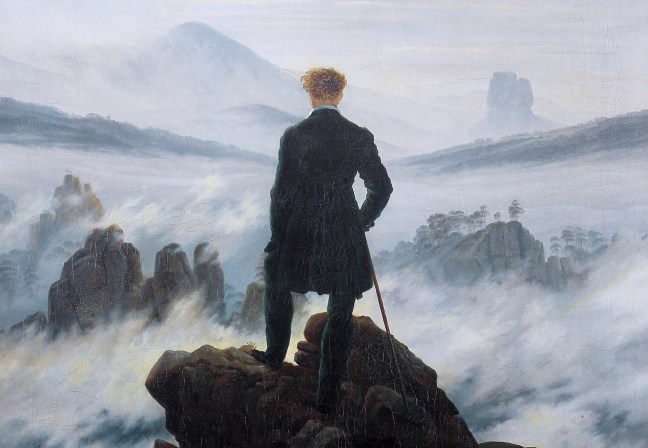
‘The Wanderer Above the Sea of Fog’ (part) – Caspar David Friedrich, 1818 – WikiArt

.

Without freedom there is no self-knowing 
and without self-knowing there is no meditation
.”
~ J. Krishnamurti 

.

Few sensations are as boisterously exhilarating as freedom is. Freedom is something that we all love to feel. To be freed! Freed from all weights and limitations. Freed from everything that bullies us and pins us down. But most of the time, this feeling is experienced from the vantage point of the little thought in our head that thinks it runs the show. This entity thinks that its freedom comes from being separate, and from its capacity to do what it wants. This is what being free means to most people. But is this really what freedom is, where freedom lies? In expressing all that comes from the lack and desperation of a limited, vindicative little self? If that is so, then this freedom takes us nowhere but in the already known boundaries of our self. How could that account for the power and magnitude of this feeling? Freedom cannot be so small and contrived. What is it then? Where is true freedom to be found? 

Freedom can never be fully felt within the conglomerate of our thoughts, feelings and perceptions, between the four walls of our prison cell. We may feel some occasional bursts of pleasure but this is not the real deal. If you search for freedom through that portion of yourself that is fleeting, fragile, untrue, you will by definition prevent the advent of any meaningful freedom. You will have limited freedom, something to be achieved, something to be added that becomes just another object, another aim in view. And don’t forget that this limited freedom can never be achieved anyway, for we in truth can never do what we want. And of what advantage would it be to follow the clumsy, limited, fanciful ideas of a mind that stands on false premises. Because of this impossible claim, we feel bitter, sad, violent, jealous, regretful. Let’s move away from such dangerous idea. 

[…]

An inquiry into the question of freedom… (READ MORE…)

.

A Thing of Beauty

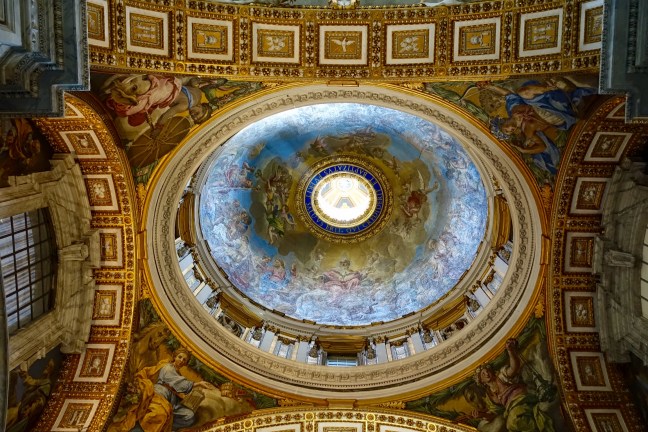
‘Saint Peter’s Basilica’ – Rome (Vatican)

Isn’t the world the most extraordinary place? I’ll explain. Take a tree. A single tree, with its roots spreading and fiddling deep into the soil. And its erected trunk that divides itself into branches, and a thousand twigs, and a whole foliage of leaves. The shadow it gives. The home that it is for birds and little animals. And the shelter. And a thing of beauty. To be admired, listened to, touched, felt. The roughness of its bark under your fingers. And the presence. There are millions — most certainly trillions — of such trees that spread over the world to form groves and vast forests. Extending their sheltering embrace to countless beings. And to you too, today. A tree! The strangest thing there is. To look at one is to be taken into a well of wonder. Feel that amazement. See where it takes you. You will be surprised.

[…]

A reflection and meditation on the beautiful world that we are… (READ MORE…)

.

The Song of God

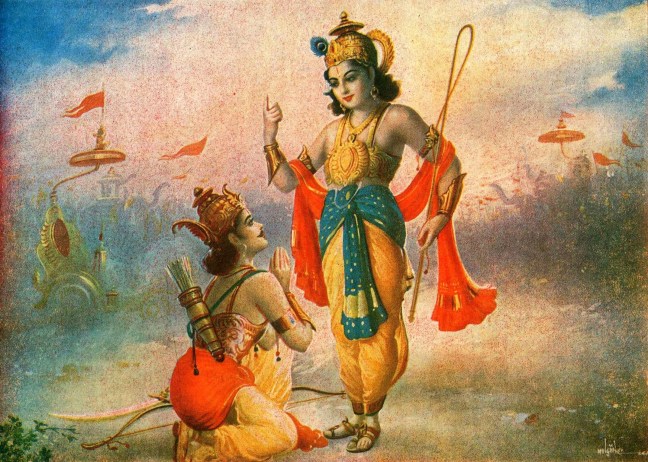
‘Lord Krishna preaching Gita to Arjuna’ – Mahavir Prasad Mishra – Wikimedia

.

भगवद् गीता

.

अहं सर्वस्य प्रभवो 
मत्तः सर्वं प्रवर्तते ।
इति मत्वा भजन्ते मां 
बुधा भावसमन्विताः 

ahaṁ sarvasya prabhavo
mattaḥ sarvaṁ pravartate
iti matvā bhajante māṁ
budhā bhāva-samanvitāḥ

.

I am the self, O Gudākesa! 
seated in the hearts of all beings.
I am the beginning and the middle
and the end also of all beings
.”
~ Lord Krishna (Bhagavad Gita)

.

There is an old and long Sanskrit story that arose in India around the fourth century BC. So long that it has been described as “the longest poem ever written“. So encompassing that the poem mentions about itself: “That which occurs here occurs elsewhere. That which does not occur here occurs nowhere else.”(XVIII.5.38). A story that is as big and epic as life and which took centuries to write, up until the fourth century AD. This masterpiece of universal literature, which influenced the thought, customs, and festivals of a whole civilisation and beyond, is called the Mahābhārata. It is composed of fables, myths, and tales of every kind, that are recipients for multiple religious, philosophical and political considerations. The eminent British film and theatre director Peter Brook wrote: “I sincerely believe that, of all the subjects that exist — including the totality of Shakespeare’s work — the richest, densest and most complete myth is the Mahabharata.”

Among the infinite number of episodes in the poem is concealed a jewel. A short 700-verse scripture — out of the 100 000 contained in the Mahabharata — composed of 18 chapters, that stands as a monument of Hinduism and one of the most highly praised spiritual text in the world. Written around the second century BC by the legendary sage Vyasa — also the main author of the Mahabharata — it has been named nothing less than the ‘Song of God’. This text, called the ‘Bhagavad Gītā’, is a magistral teaching given to the Pandava prince Arjuna by Lord Krishna, who happened to be his charioteer. It is set in the middle of the worst battle between two branches of the same family, the Pandavas and the Kauravas, for the control of the kingdom — a war whose story is the subject of the Mahabharata. So here we are, at the dawn of a horrific battle: 

And then all at once, conchs,
and kettledrums, and tabors,
and trumpets were played upon; 
and there was a tumultuous din.” (I.13)

[…]

A summary of the Bhagavad Gita, a monument of spiritual literature… (READ MORE…)

.

There is a Land

There is a land in your sky
When you’re climbing high enough
Above all that is swirling round and round:
The thoughts of yourself, all that finally
Doesn’t stand any scrutiny, that is ready
To shrivel at the slightest disturbance.

There is a land in your sky,
A ground so hard as to secure
Everything in you that is hesitant
Unsure, fragile, lacking, misty; 
That life that you had thought was one 
But shows to be no place to land on.

There is a land in your sky,
A place covered up by your mist,
That needs a certain habituation
Of eyes and ears and mind,
But is the most solid ground of all,
The fairest land where stands all life.

There is a land in your sky,
Feel it in the ethereal air of your self;
Let all your weighty substance fall back
And mingle with its vaporous consistency.
It will show you its strengthy arms,
Will reveal itself as the ultimate ground.

There is a land in your sky,
And another sky above that land.
Your self has here the solidity
Of all that is infinite and calm,
And the world now shows to be
The heavenly harbour of your being.

.

~~~

Text and photo by Alain Joly

~~~

.

Suggestion:
Voices from Silence (other poems from the blog)

.