
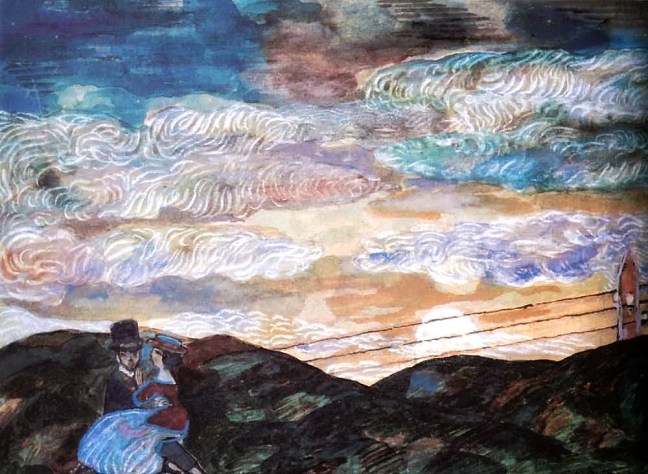
‘Lovers under the moon’ – Serge Sudeikin, 1910 – WikiArt
The word ‘spiritual’ is quite a nebulous one. It is used indiscriminately, carelessly, for a bewildering array of wildly different practices or beliefs. Krishnamurti didn’t like the word, which he found ‘ugly’, ‘romantic’, ‘unpleasant’, and used it cautiously. So maybe the time has come to clean the word, to give it some of its forgotten brilliance, and dig out its original meaning and raison d’être. I would start with the suggestion that the word ‘spiritual’ simply wants to point something at us: that the world, the whole of it, our experience, everything, is in fact made of ‘spirit’. Spirit is all there is, the only thing in presence. And believe me, this is a timely pointer, for most of us believe the world to be a hard reality, made of something solid, composed of a variety of different objects — our body-mind being considered one such object. So the word has the virtue of reminding us of our true nature, of the nature of everything as spirit, or consciousness.
But it is only a provisional word, one for our time of misunderstanding. There will come a time when the suggestion that experience is made of spirit will be a matter of fact, something integrated, not to be thought about anymore. The word will then become redundant, to be replaced by another word of a higher intensity and meaning. Or maybe there won’t be any need for a word to describe reality. Reality will have been understood, digested, lived as the fact of simply being. Spirituality will have become useless. There will be no need of spirituality, no need even of the word ‘happiness’, or ‘peace’. Once you are wholly, and only spirit, which is peace, which is happiness, what need is there to mention it? There will be no seeking either. After all, what you are, you are. Identity will have been achieved. No suffering around. Seeking obsolete. Out of date. To be disposed of. What will remain is a splendour, indescribable, filling the world of experience to the brim with its essence.
Also, spirit means ‘breath’. It is the breath of life, a thing invisible, transparent, quietly sitting in the background, and yet essential and life-giving. It is what is playing us, giving us an identity and a sweetness of living. For spirit is like the air we breathe. It is still, silent, empty, yet a breath that can blow our mind and make us like an inextinguishable fire. It is the breath of god that we have left unnoticed time after time, but whose presence is holding us in its firm embrace. It is a breath of devastating effects, laying us waste, destroying all traces of suffering and separation, blowing our self away, not by slaying it but by showing this self to be just the air within the divine breath of god. You had thought yourself a hard, solid, but fragile entity, and are now shown to be empty yet as indestructible as is a fire in the wind. That’s what being spiritual, or spirit-like, truly means.
Spirit also means character, and courage. It doesn’t pretend, and rejects a lukewarm understanding. It is uncompromising and free. It is not afraid, not conditioned by the hazards of life. It stays firm, alone, whole, undisturbed. Spirit is eternally high, but mingles with the lowly too, for it is humble by nature. And it has clarity as its best asset, for it is blessed with the purity contained in knowing without being itself a knower. This knowing is undivided, self-contained, total, applying to all and everything. This is what makes it holy, a spirit which cannot be taken apart, and which contains universes beyond universes. It has a religious quality, a sanctity that is beyond what humans have called sacred. The wholeness of spirit cannot be broken, dampened, violated, injured, or even changed. Its holiness lies in the fact that it is one without any division or addition.
And spirit is music too. It has a sound to it, and it is our duty to play it, or rather being played by it — the musician being god, or spirit itself. Our being is found to be the breath of god, the movement of consciousness singing our life on the reed of our apparent self. As that, we may become the vessel of a life whose notes have risen above the ten thousand things of existence, to be taken by various harmonies of silence, peace, love — all carried by a quiet but devastating breeze of inner joy, like a hum. We are like God’s music, and our experience is bathing inside it, and being made melody. This is what spirituality is, and what a life lived in and as spirit sounds like.
“‘Tis the fire of Love that is in the reed, ‘tis the fervour of Love that is in the wine”, Rumi once wrote in the Masnavi. So spirit is a delightful beverage too. It is what gives us this gentle drunkenness which is the state of our self when it recognises itself to be but God’s being. In Spirit, we are intoxicated by the ‘Love that is in the wine’. For this nectar, we are willing to pay the price of surrender at the tavern.
.
~~~
Text by Alain Joly
Painting by Serge Sudeikin (1882-1946)
~~~
.
Website:
– Serge Sudeikin (Wikipedia)
Suggestion:
– Other ‘Reveries’ from the blog…
.
 The Dawn Within
beautiful
LikeLike
Thank you Ananda! 🙏
LikeLike
Beautiful! Thank you, I continually look forward to your words!🇨🇦
LikeLiked by 1 person
Thank you! I’m glad to hear. 🙏
LikeLike
Well spoken…….and as far as I can tell, reflective of my own POV. I am reading a book now entitled “Consciousness is All There Is”, by Dr. Tony Nader (2024) and it is a bit unique in that it states all of these same conclusions that you come to in your essay more from a scientific point of view rather than an emotional or religious point of view. The book actually blends both points of view in a friendly way. Thank you.
LikeLike
Thank you for your comment and book reference. I will look it up. Yes, possibly the next coming revolution in our understanding of the world. 🙏
LikeLike
The above comment is from Prema Raghavan, as I have long been one of your followers!
LikeLiked by 1 person
Joly, I enjoyed reading it. Thank you
LikeLike
Thank you Prema, for your comment! 🙏
LikeLike