The Dream of a World

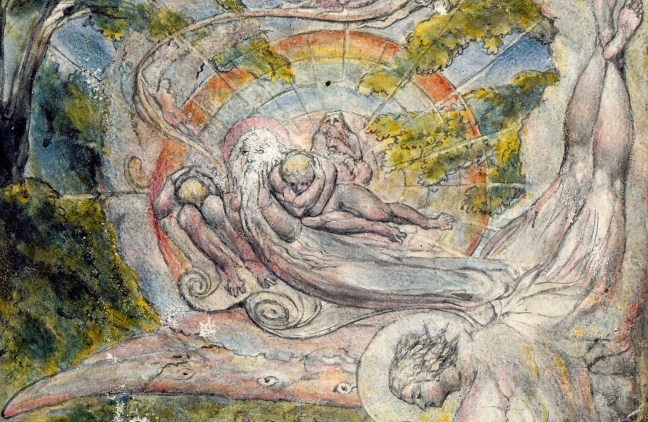
‘Milton`s Mysterious Dream’ (part) – William Blake, 1816-20 – WikiArt

There is a fraud in our life. An illusion that makes us feel that life is going to get better. That time or circumstance will bring us to a place of understanding, where our troubles will come to an end, where there will be betterment, improvement, change. To believe this will make us miss that we are already here and now in a place of no change, of no betterment, where nothing can improve or get better. This place is our very self, our sense of being that we have never been able to affect or modify, no matter how relentless our life has been, no matter our despair, our sorrow, our losses. Nothing we have gone through has touched it in any way. All our stories and sufferings have taken the shape of our thoughts and beliefs about them. But while we are desperately trying to give a form to our life, a solidity to our body, a reality to our problems, and a truth to our beliefs, right here and now, right where it all is seemingly taking place, hidden within experience, enveloping it all, is already a presence, a vastness, a reality that is embracing everything, and that is our only reality, our only place, our only possible self in this living experience.

For there is not a world there where we could be in. That would be a lovely idea, but the fact is: there is no possibility to prove the existence of such a world. We can only assert it, marvel at it through our senses, study it, analyse it, but of a solid proof there is none. The existence of a world is dependent on our perceiving it, and perceptions are contained in our knowing them. Without the knowing faculty, there cannot be a world. The whole glory and misery of the world, of the whole universe, is all gathered in that fathomless fraction of knowing, or awareness. Without that simple, ungraspable, dimensionless, ethereal element of knowing, no world could ever come into existence. So in fact, knowing is all there is, consciousness is the essence of every single appearance that comes to be seen, heard, touched, or experienced. The world is shaped, or its appearance created, through our being aware of it. So the whole of our living experience is but a dream in consciousness, a game that can be played and enjoyed at the level of our body-mind, but whose reality is only the awareness of it.

Now, where are we if we are not in a world? Where are we if the world is not even there? What is this something that we feel we are in, and exists, and is undoubtedly? What is a world, an experience, when we have passed through all illusions, all beliefs, all shaky appearances? What is left here that holds our experience, that is indomitable, indestructible, present without a shadow of doubt? This place is our self, what we are, our very essence, the reason behind our saying ‘I’. So we live in our self, not in a world. We see our limited existence pass and consume itself within that which is creating it, which is our own aware being, the knowing that we are and could never not be. And there, in ourself, in being, where the world takes its apparent form, is found what we have been looking for in every direction, in a non-existing world, in experience: a sense of relief, peace, beauty, love, and the understanding of our essence, the explanation of it all. An explanation that is not conceptual, but a living one, a subjective one, something made plain by being it. We and life then become self-explanatory. The fraud has been diluted. All imagination has died down. Now our living experience has acquired the rawness of truth. Something that is, unlike the world or our experience, beyond doubt and absolute.

.

~~~

Text by Alain Joly

Painting by William Blake (1757-1827)

~~~

.

Website:
William Blake (Wikipedia)

Suggestion:
– Other ‘Reveries’ from the blog…

.
The Poetic Genius

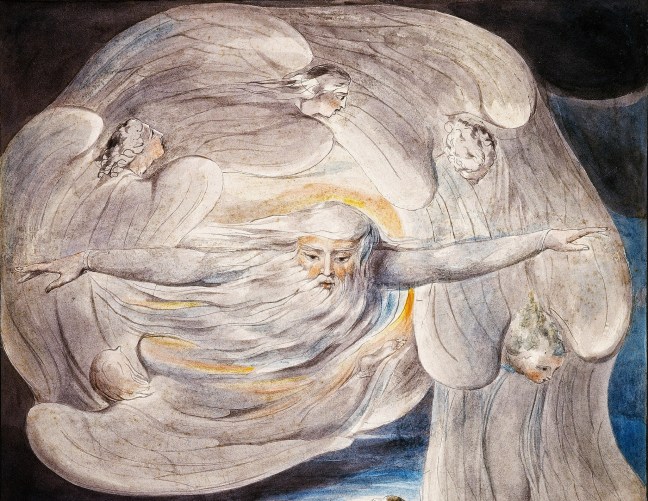
Job Confessing His Presumption to God’ (detail) – William Blake, 1803 – Wikimedia

.

I must Create a System, or be enslav’d by another Man’s;
I will not Reason and Compare: my business is to Create
.”
~ William Blake (‘Jerusalem’)

.

Artists, through their sensitivity to perception, their pointed quest towards beauty and harmony, are natural candidates for delving into the depth of reality and understanding their true nature. Many poets, painters, musicians, have been able to explore their being in ways that are traditionally the privilege of mystics. Indeed, they wrestle with eternity, and strive to find a way to convey it. William Blake was one such wrestler. He was a poet, painter and printer born in London in 1757. Although not recognised during his life, his art is bursting with creativity, intelligence, and vision. His profuse work, soaked with spiritual explorations, symbolic and personal mythologies, is not to be easily classified. Of William Blake, the 19th-century scholar William Michael Rossetti wrote that he was “a man not forestalled by predecessors, nor to be classed with contemporaries, nor to be replaced by known or readily surmisable successors“. Besides, his poetry is infused with pearls of the most profound non-dual understanding, which I invite you to explore here.

In his childhood, William Blake was fascinated by the work of great masters such as Raphael, Michelangelo, and Albrecht Dürer. He was educated at home, was given drawing lessons, and began writing poetry at an early age. Profoundly influenced by the Bible and Christianity, he was all his life gifted with visions and insights, from which he drew guidance and inspiration for his poetry and paintings. He was nevertheless not a follower, and developed his own vision and understanding. He was very critical of narrow-minded religiosity, or what he named the “general truth” or “general beauty“, writing uncompromisingly that: “To generalize is to be an idiot; To particularize is the alone distinction of merit“. William Blake wrote these enlightening verses about his religious endeavour and passion:

.
Trembling I sit day and night, my friends are astonish’d at me.
Yet they forgive my wanderings, I rest not from my great task!
To open the Eternal Worlds, to open the immortal Eyes
Of Man inwards into the Worlds of Thought: into Eternity
Ever expanding in the Bosom of God. the Human Imagination.”
~ ‘Jerusalem’ (Ch. 1, plate 5)

.
When will the Resurrection come, to deliver the sleeping body
From corruptibility? O when, Lord Jesus, wilt thou come?
Tarry no longer; for my soul lies at the gates of death:
I will arise and look forth for the morning of the grave:
I will go down to the sepulchre and see if morning breaks.
I will go down to self-annihilation and eternal death
Lest the Last Judgment come and find me unannihilate
And I be seized and given into the hands of my own selfhood.”
~ ‘Milton’ (Book the First)

[…]

An exploration of William Blake’s non-dual pearls and poetry… (READ MORE…)

.

The Mystic Heart of Sport

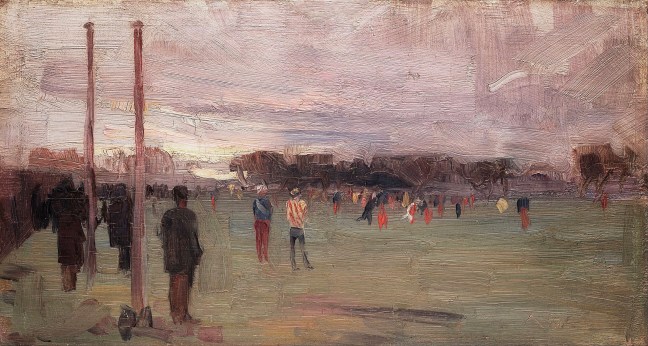
‘The national game’ – Arthur Streeton, 1889 (Art Gallery of New South Wales) – Wikimedia

.
Brendan McNamee
is my newly invited guest on ‘The Dawn Within’. Brendan is an independent scholar and lecturer with a PhD at the University of Ulster in Ireland. He is the author of numerous books and essays on a wide range of writers, including John Banville, Michel Houellebecq, Gerald Murnane, Elizabeth Bowen, Sean O’Casey, Flannery O’Connor, W B Yeats and others. I’d like to present here one of his essays called ‘The Mystic Heart of Sport’. My attention was one day drawn to this eloquent title, while browsing through the platform ‘Academia’.

The text speaks about sport in general, using here the example of football, and mingling its wonderful argument with quotes by William Blake, Meister Eckhart, or W. B. Yeats. Brendan McNamee shows that “the conflict” on the football pitch is “between gods and mortals”, between “time and eternity”, both “inextricably entwined”. At its best, a game of football can give birth to “moments that justify sport at its best being called ‘poetry in motion’. Moments of sheer grace” when “skill and spontaneity join hands and, momentarily, dancer and dance are one.” I hope you will enjoy Brendan’s skilful writing and exposition as much as I have…

.

Eternity is in love with the productions of time.”
~ William Blake

.
~~~

The Mystic Heart of Sport

.
In The Hitchhiker’s Guide to the Galaxy Arthur Dent makes the startling discovery that white mice, rather than being the objects of experiments carried out by humans, were in fact carrying out experiments on humans. I wonder if a similar principle might be applied to sport. Take any high-stakes football match. Passions run high. The passion, on the parts of both players and spectators, is primarily for victory. The players receive a huge ego (and cash) boost, and from the fans’ point of view, a win for their team is, by some mysterious process of osmosis, a win for themselves. This lust for victory is so intense that the other source of sporting joy, the quality of the game itself, is often relegated to a secondary position, rendered lip service, of course, but seen really as essentially a means to an end. This, I would contend, is topsy-turvy. I want to argue here that it is the lust for victory that should serve the game, not the other way around, and that this order of things reflects a wider truth about life itself.

[…]

Discover Brendan McNamee’s skilful essay on the mystic of sport… (READ MORE…)

.