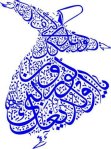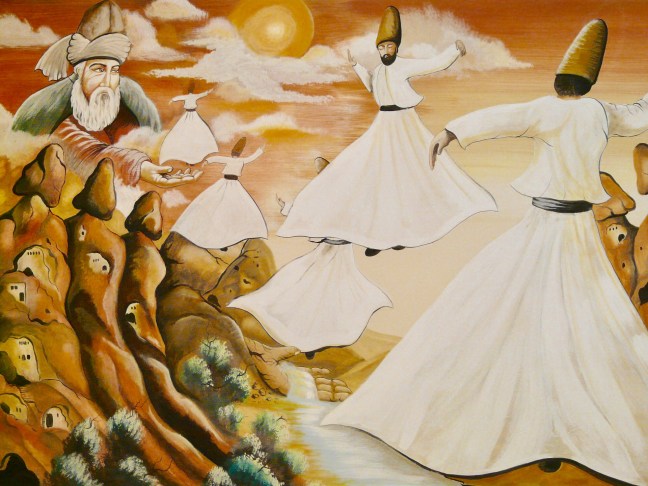
Rumi

“We are all returning.”
~ The Koran


“On the seeker’s path, wise men and fools are one.
In His love, brothers and strangers are one.
Go on! Drink the wine of the Beloved!
In that faith, Muslims and pagans are one
.”
~ Rumi, Quatrain 305

6BFFE2AC-01F8-45DD-8892-0D968690B787

در راه طلب عاقل و دیوانه یکی است
در شیوه‌ی عشق خویش و بیگانه یکی است
آن را که شراب وصل جانان دادند
در مذهب او کعبه و بتخانه یکی است


Rumi is a giant. Somebody whose words resonate with the perfume of truth, but about whom we paradoxically know very little. At least I didn’t. Quoted far beyond the small circle of spiritual seekers, he is taken for granted, like a distant angular stone of spirituality. His verses are shared, loved as so many gems of human history, but without showing off. And yet, what depth of understanding they convey! In what subtle and intricate ways they describe the torturous alleys of spiritual endeavour! And with what simplicity!


“Why do you stay in prison
When the door is so wide open?
Move outside the tangle of fear-thinking.
Live in silence.
Flow down and down in always 
widening rings of being
.”
~ ’The Essential Rumi’ (Translated by Coleman Barks)


Rumi was a Sufi. He was born Jalāl ad-Dīn Muhammad Balkhī, in 1207, in Balkh in present day Afghanistan, in a family of Sufi tradition. Sufism, which could be defined as ‘the inward dimension of Islam’, has its origins shrouded in mystery. How did it suddenly grow, nobody knows. The word comes from ‘sūf’ which refers to the woollen garment worn by the first mystics who broke away from the mainstream Islamic religion. Sufism didn’t grow in opposition to Islam, the religion that gave it birth around the 9th century, but as a deepening, a going back to the very source and meaning behind traditional Muslim orthodoxy. The Sufi devotee wanted to feel, to know God as the true presence in the heart, not putting an illusory figure at a distance to be worshipped. That’s how Sufism placed love, the love of god, at the centre and expressed it in the most exquisite poetry. That’s how music and dance were allowed and praised. Sufism is understanding and living this primary statement of faith in Islamic religion: ‘There is no god but god.”

Immerse yourself in Rumi’s path of divine love and poetry… (READ MORE…)


Variations on the Separate Self

“Who am I, and in what really do I consist of?
What is this cage of suffering?
”
~ Jayakhya Samhita, Verse 5.7


Why is it so difficult to recognise something that’s staring us in the face? The distance is always so short between our worse moments of separation and the full recognition of the truth of our being. The tiniest, softest change of focus can either show you a world made of infinite space or throw you into an abyss of tortured thinking. When we stand in the apparent coziness of our false beliefs, we seem to be ages away from any kind of understanding. We feel that no amount of effort will ever bring us into the light. We might as well give up. This is the road towards self-indulgence and sorrow. We think that the burden is too big, the effort required out of reach. No. It’s never like that. We are an infinitesimal move away from the light. No effort is even required. Something of a relaxation. A so slight change of focus that it seems no move at all. It’s here already, waiting for our humbleness. …

Continue finding out about these variations on separation… (READ MORE…)


God Only Knows

This poem was written by Katarina Jonsson, a Danish friend. I loved this poem from my first reading for its truth and simplicity. 


Where do you come from
he asked
I never arrived
she answered
but I come from a thousand different places
sometimes from sorrow and hurt
sometimes from the greatest joy
other times from shame and guilt
from projections and competition
she said

But where do you come from
he asked
I come from a thousand different places
she answered
I never arrived
Sometimes I come from ignorance and blame
sometimes from darkness and despair
I have come from happiness and communion
from disappointment and loneliness
she said

But where do you come from
he asked
I come from a thousand places 
I never arrived 
she answered 
I came from inferiority and superiority 
sometimes from equality 
I have come from thoughts and emotions 
and I have called them love

They both fell silent

Where do you come from
he asked 
I come from silence 
from love 
from God
she said
I have arrived 

Who has arrived 
he asked
I don’t know
she said


~~~

Poem by Katarina Jonsson

Photo by Alain Joly

~~~