
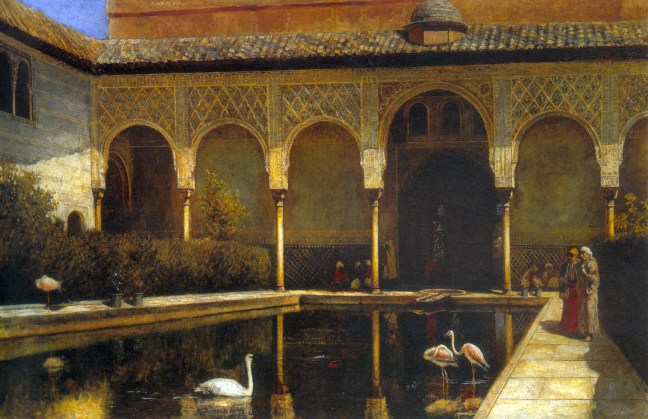
‘Court in the Alhambra’ – Edwin Lord Weeks, 1876 – WikiArt
The spiritual endeavour is really such good fun. You may happen to experience some suffering in your life and feel entangled — with thoughts rushing into your mind and problems seizing the entirety of yourself. The web of experience is overwhelming you and you can find no space to breathe within. You may then have to have a little conversation with yourself. You may have to disentangle yourself from your stubborn identification with thoughts and with the overcrowding objects born of the senses. That’s when you may present yourself with a simple question like: “What is this part in myself that is aware of my experience?” And so are you now taken amongst the scents of 8th century India, treading its immemorial dust with Shankara, debating with the great Vedantic master. He will show you how to move inwards right at the core of that aware presence in yourself. You will be taken with him to the core of this investigation, which is but the separation of the multiple objects of experience from the one aware, pervading presence of consciousness that is your true identity. That’s when Shankara leaves you with this one infaillible recipe:
.
“I bow down to that all-knowing One
which is pure Consciousness, all-pervading, all,
residing in the hearts of all beings
and beyond all objects of knowledge.”
~ Shankara (Upadesasahasri, 1:1)
.
You may then find yourself sitting in your kitchen, cutting vegetables, with your thoughts suddenly wandering in the 17th century Paris, surrounded by the walls of a Carmelite monastery’s kitchen, chatting along with Brother Lawrence. He might tell you with his big generous smile: you know brother, “nothing is easier than to repeat often in the day these little internal adorations.” That’s when you understand that this investigation can be made into a joyful, often repeated practice, where you go and meet yourself within, have a little chat with this hidden presence, spontaneously, as you gaze into the eyes of a friend. Amongst the frantic sound of knives hitting the wooden board and the fumes of the next meal simmering on the stove, you meet Brother Lawrence’s glance offering you this last precious advice:
.
“I renounced, for the love of Him,
everything that was not He;
and I began to live as if there was none
but He and I in the world.”
~ Brother Lawrence
[…]
Continue this journey into the investigation of your true nature… (READ MORE…)
.
 The Dawn Within