
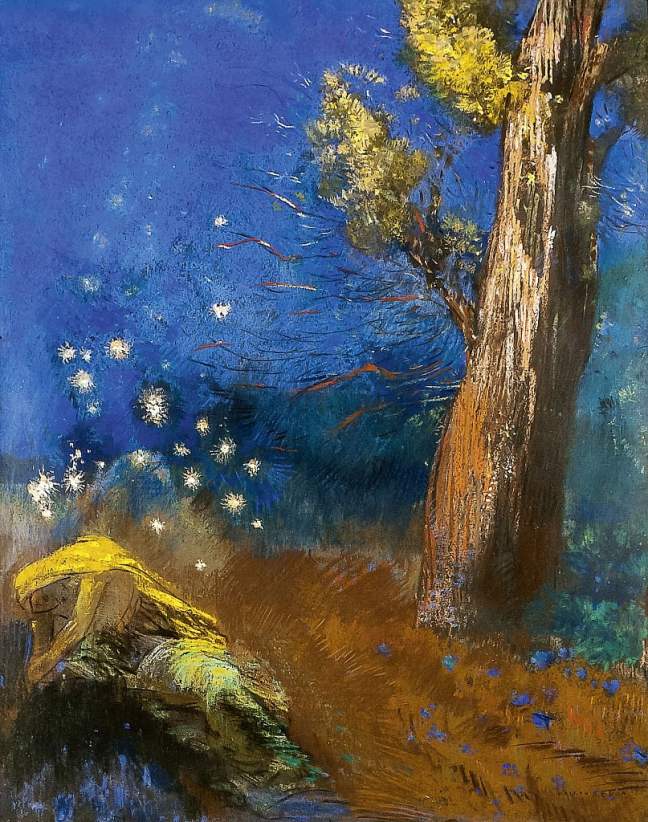
‘The Death of Buddha’ – Odilon Redon, circa 1899 – Wikimedia
It is striking to think that the day when we die is always today. It is not happening tomorrow, will not take place in the future. Death is for now. This is where and when it takes place. In the present. In presence. The death of the body, its ending, may take place in the future, but is not death. It doesn’t have the implications, the magnitude of it. The death of the body is like a wave that ceases to undulate, to imagine its difference, its conflicting attributes, and finally breaks before we notice that it is not what we are, that there is here, before it, as our very making and identity, an ocean of peace. This ocean is what death is — before we imagine to be a self that thinks itself separate.
We have been moulded in and as a presence that was never born and could never die. This inability to exist or appear as something distinct, or different, is real death. This incapacity to cease or find an ending at our being, is true ending. It is a place where we can never go. This place of being has no objectivity. It is nothing that we can be or project ourself to be. It is pure being, done, final, already perfected, unattached, a free fall. It is a death so complete that it has no object. It is not the death of something, of an object, of an entity — for such death is not truly death. It is the realisation that we are not what we have believed ourself to be. That there is not here an entity, a self that could be dying, that has an existence of its own. That realisation, and above all what is left here to be and live by, truly is death. And in that death is contained, concentrated, achingly shining, the whole of life.
So death is now. It is happening now without our noticing. It is achieved — our death, the one that we fear, that we have pushed away, that we don’t want to envisage, envision, is done, gone through already. It’s a matter of noticing what is — that we are not here, that nothing was born, that it would be curious to die, that what we are has no other attributes than being. How would you put to death something that is without attributes or qualities? How would you end something that was never born? Moreover, no appearance, or thing, or body, could ever die without it being the expression or the modulation of something untouched by death. That something exists deathless is the sine qua non for the existence of death itself. That’s why life itself thrives through the exercice of death. What is deathless is our being. It is being — that which we all share in, which we call eternity, or the infinite, for it is one, and being one, it cannot be measured, qualified, or put to death. That’s how we are immortal — through only being, which we share as the experience of love. Death is when we cannot die anymore. It is obliterating objectivity — therefore our existence as an entity. An impeccable death comes at this price.
.
~~~
Text by Alain Joly
Painting by Odilon Redon (1840-1916)
~~~
.
Website:
– Odilon Redon (Wikipedia)
Suggestion:
Other ‘Ways of Being’ from the blog…
.
 The Dawn Within