The Coveted Jewel

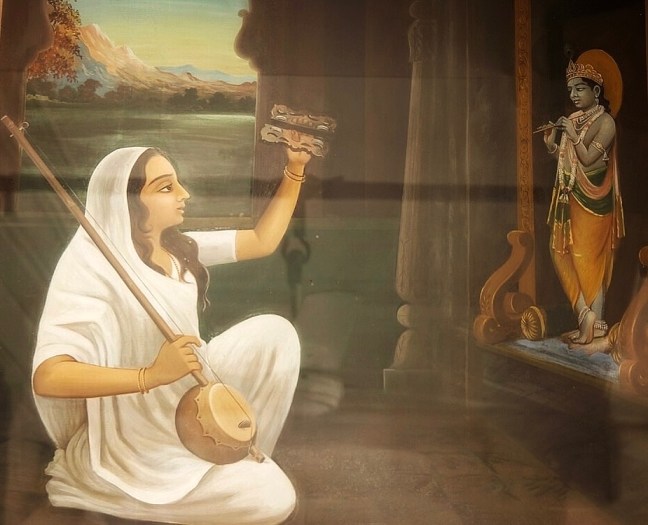
‘Meera and Krishna’ – City Palace Museum, Udaipur – Wikimedia

With god, or with our utmost being, one shouldn’t be too clinical. Presence is better seen, better felt, as our beloved. That’s how you have truth nearer, when you’re in love with it, and want to bring it close, so very close to you. Because its most intimate essence is not at a distance from you, but has merged in you, and as you, from the eternal now, so that you could remember him on all occasions, and feel her, feel him, as the very core of your eternal being. So your beloved is already hugging you, forever holding you in its infinite, most loving embrace. That’s where you draw your unabated search from, for who wouldn’t do anything, anything at all, to seek to reunite with the love of his life. And how could you not cross the most ruthless torrent to marry the intimate essence of her wondrous being. So go through love. Seek her in your tender heart, where she has been aching for your presence. Look for him in your innermost bosom, where only he longs to surrender. And feel the pang of separation, for it is itself the pathway to your beloved.

And there is more to it: love is uncompromising. So you won’t fancy being separated, won’t like finding yourself away from the warmth of your beloved. So your gaze will never wander far and away from your lover’s tender eyes. And you won’t find difficult to spot her even in the wildest display of experiences and activities, where objects come to assail you. You won’t be easily seduced by another than your beloved, for who would want to leave the bliss of a shared love for the chill contained in seeking an outside pleasure, far so far away from your lover’s beating heart. But be careful now, for this love for the beloved is a unique love. Beware! You can never love your loved one as an other. Love is indivisible. The love you feel is always only the expression of your own silent being. So you will have to let your lover go, not because you separate from her, but rather because you merge your being with his being, and in so doing become one being. This one beingness of the lover and the beloved is the truth of eternal love. Love cannot be split in two, and the love you feel for the beloved — for any beloved — doesn’t belong to you. Love is a burning flame that consumes itself into itself. For there is always ever one mind, one love, one being, regardless of the number of apparent lovers. This is what makes love the most coveted jewel of our lives. Because you disappear, and in that disappearing, you find your gorgeous, luminous, infinite self.

.

~~~

Text by Alain Joly

~~~

.

Suggestion:
Other ‘Ways of Being’ from the blog…

.
O Mystic Nuns!

Photo by Abee5 on Foter.com / CC BY-SA

Thy love was not of earth; no woman’s soul 
For mortal love craved with such a yearning. 
So thou didst wed great God Himself! O Goal 
Beyond our ken, beyond our dim discerning! 
And soul to soul, like sunbeam unto Sun, 
Thou didst vanish away, O mystic Nun!

~ Sri Devendranath Sen


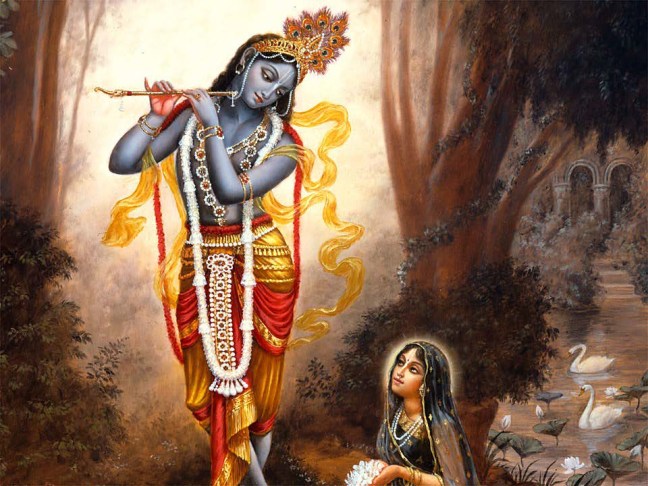
At all times, India has embraced the love and longing for God as a privileged access to our ultimate reality. This path of love or devotion, called bhakti, was trodden by countless seekers and poets who have offered their verses to posterity. Amongst them many women. Women who, alone, have walked the steep path to God, going against the society of men, marriage and conventions, with only one goal: to reach divine love. I present here three such women — Andal, Akka Mahadevi, and Mirabai — these mystic nuns, whose personality and poetry are an unforgettable milestone to this day in India and elsewhere.

Through devoting or directing their love to a god, be it Krishna or Shiva, these devotees were searching to experience the bliss of their own being, the happiness that is the very nature of their self. But by conditioning their love to an object, they also experienced suffering, longing, sadness, anger, which all came to feed their poetry, their songs, all these exquisite expressions. These were the very vector that supported their spiritual search. But don’t think that this is a path that is limited or lacking depth. For though directed towards an object, the love they feel is always their own. The forms of Krishna or Shiva were a vehicle to lead them to their very self, to realise that their longing is and has always been for their own unborn nature, for love itself, the oneness of their own being.

This tension between the love for God as a form, and for being or oneness as a principle, between saguna and nirguna bhakti, as it is expressed in the Indian tradition, is at the core of the bhakti endeavour, of the journey to divine love. In ‘The Embodiment of Bhakti’, Karen Pechilis Prentiss wrote: “The lord is characterized by both ‘paratva’ (otherness) and ‘soulabhaya’ (ease of access). He is both here and beyond, both tangible as a person and intangible as a principle.” These nuns were expressing this tension with various degrees in their many songs and poems. Listen to their voice. Listen to how Krishna’s forms and attributes, ramblings and happenings are only expressions of a deeper reality, of the understanding and tensions at play in the seeker’s very being. They are their paths whose completion will lead to the recognition of their own true self. […]

Listen to the poetry of Andal, Akka Mahadevi, and Mirabai… (READ MORE…)


Kabir Says:

(Painting by Tanya Bonello)

Lift the veil that obscures the heart
and there you will find what you are looking for
.”
~ Kabir


Little is known about Kabir. Legends abound and certainties are scarce. He was a weaver, probably spending most of his time working at his handloom. He was born in fifteenth Century Benares, and became a mystic and a poet whose songs and ‘bānīs’ – meaning ’utterances’ – spread in the whole of India and beyond, mostly handed down orally between seekers and sadhus along the roads, sometimes written down. They were the expression of a simple man, probably illiterate, and his first-hand understanding of the deepest truth of living. 

Kabir wasn’t a philosopher, far from it, and many of his poems were deeply grounded in everyday life. His expression was often ruthless, “I see the world. What a bag of tricks it is!” He execrated the bigotry and hypocrisy of Hindu and Muslim devotees alike, and he never tired of denouncing the contradictions between the religions in place, each asserting their own god, beliefs, practices, about something Kabir knew in his flesh and soul to be one single reality, unbroken, and timeless.

Servant, where dost thou seek Me? 
Lo! I am beside thee.
I am neither in temple nor in mosque:
I am neither in Kaaba nor in Kailash: 
Neither am I in rites and ceremonies,
nor in Yoga and renunciation. 
If thou art a true seeker, thou shalt at once see Me: 
thou shalt meet Me in a moment of time. 
Kabir says, ‘O Sadhu! God is the breath of all breath.’

Discover more of the wonderful poetry and legacy of Kabir (Read more…)


Bhakti, the Song of Love

Don’t forget love;
it will bring all the madness you need 
to unfurl yourself across the universe
.”
~ Meera Bai (1498-1546)


I intend here to continue exploring the three different pathways towards realising our true nature. I have some time ago given my attention to Jñāna, which in the Indian tradition is the name given to the means of attaining truth through the investigative qualities of the mind, which are mostly thinking and the power of discrimination. The two other paths towards realisation are the tantric path, which involves the senses, and the path of love, which involves feeling, and is the subject of this essay.

The path of knowledge requires a certain steadiness, orderliness, being thorough, constant. But even somebody set on this logical path of knowledge will be exposed to ineffable, timeless moments of pure love. Some people are best suited to a more loving, encompassing pathway, that would allow them to be just as they are, with all their confusion and overwhelming feelings. I can be the me that I am, as long as I am too this loving, embracing presence to which I can offer myself. In love there is no theory, no guidelines to follow. And it is not a surprise to find this expression of truth as one of the means to the realisation of our true self. This pathway of love has been called ‘Bhakti’ in the tradition of India. All the Indian faith, at least in its more popular expression, is of a devotional nature, and has elevated this simple love for god or truth to the rank of art. That seemed to me a good starting point to embark on this path of devotion, which the Śivānanda Laharī (verse 61) describes as: “The way needle seeks magnet, the way creeper seeks tree, the way river unites with ocean and the way the mind seeks the lotus feet of Śiva.”

An exploration into Bhakti, the path of love and devotion (READ MORE…)