The Distant Country

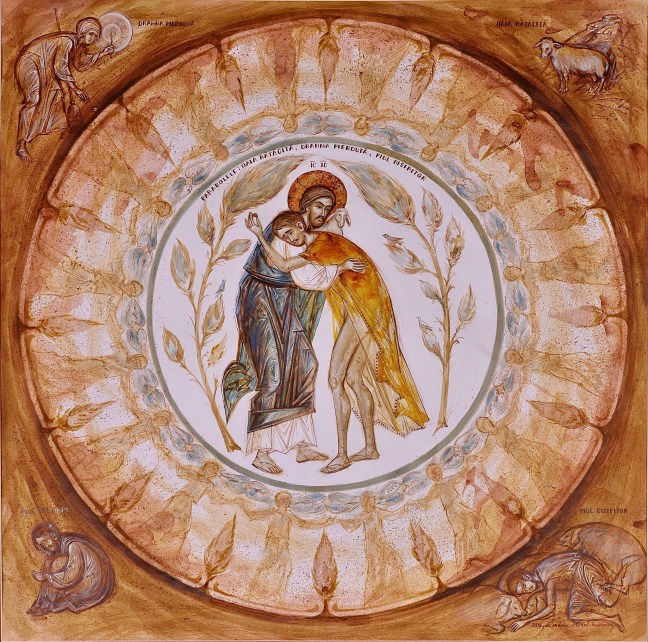
‘The return of the prodigal son’ – by Elena Murariu, 2018 – Wikimedia

How ironic this life is, isn’t it? How incongruous to have imagined that this is the real deal: being a person locked in and bound to the limits of a body. How astonishing to have this certainty to be a self that feels separate and needs to be fulfilled. To think we have to fight our way through the world, and suffer with such consistency. To have been persuaded that seeking is our way of life, without which we are doomed to poverty and stagnation. Yet the illusion of our being in a world is so convincing that we had to buy its many effects and constraints, and be subjected to its perils. So we have gone far away, thinking that we could live remote from our true home and identity, that we could roam the world on our own, and snob our essence. So we have landed into what we are not. We have lived the adventures of a person, gone through challenges and despair, carried ourself through time and space, and lived attached to worries and hopes, to the aches of regrets and loneliness, and the brief consolation contained in the occasional relief from our wrestling with the physicality of the world. So we have paid the price of such a lonesome, faraway trip. As Augustine of Hippo once said: “Distant country signifies forgetfulness of God“. We have left our father behind, despised his presence, judged his love as unworthy. Unhappiness is intrinsic in having mistaken an illusion for the reality, just as it is natural to be in the shadow when we hide from the sun. But maybe there is a return from our erroneous view. Maybe the time has come to stop being tied to a false idea, and to return from our adventures into deceitfulness.

Now see that this faraway trip is but the following of a belief. It is our being led into an illusion, a fantasy — shared by all — that the life in and as this body-mind is all the reality there is, and that the way we live and believe is our truthful condition, to which we have to submit ourself. We have swallowed that suffering is the condition of life, and the way to alleviate it resides in either circumstances, good luck, or smart choices. But in fact, suffering is but the consequence of our departure from our true, forgotten nature. It is the natural outcome of our prodigality, of our obsessive desire to possess and be more than what we already are, of our seeking happiness inside the development of our adventures into ego-land. But as far as we may have erred into agony and chance, there is chiselled in our very nature, a return into the open arms of our simple, inescapable being. This quiet resting as our innermost being is the home from which we should never depart, no matter how enticing is the call for an adventure in the distant land of separation. There is a father or mother here, a being eternal, always waiting for the return of their prodigal son or daughter. And it is in the nature of this return to be a welcoming one, for the simple reason that you are yourself the embrace contained in being only being. So your return to the father was never a return from any kind of reality, but the noticing that we had in fact never left its loving embrace, and that all that was needed is our letting go, our bowing to the grace contained in simply being.

.

~~~

Text by Alain Joly

Painting by Elena Murariu (born 1963)

~~~

.

Website:
Elena Murariu (Your Portal to the Art of Icon)

Suggestion:
– Other ‘Reveries’ from the blog…

.
Fear and Trembling

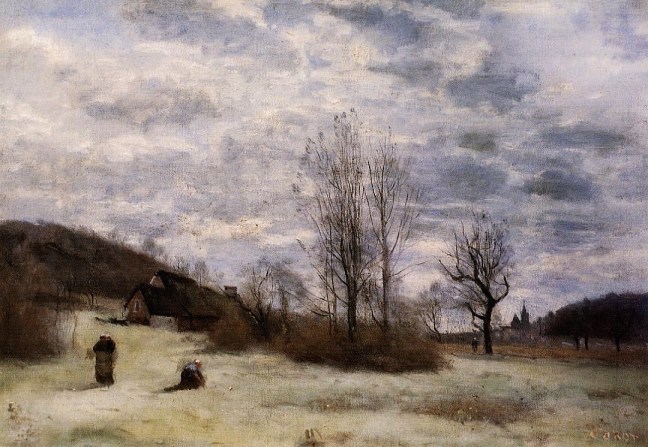
‘Plains near Beauvais’ – Camille Corot, 1860-70 – WikiArt

.

The fear of the Lord is a fountain of life,
to depart from the snares of death.”
~ Proverbs, 14:27

.

There is an expression that we may find puzzling, maybe slightly paternalist, condescending and outdated, but is well worth looking at. We find this expression mostly in Christianity and Islam, where the mentions ‘fear of God’, ‘fear of the Lord’, or the injunction ‘fear God’ are found far more than a hundred times in the Bible, or in the Quran. This fear is said to be one of the seven gifts of the Holy Spirit, along with wisdom, understanding, guidance, mightiness, knowledge, and devoutness. But why would we be afraid of what we longed for the most in our lives? We should be embracing it with ardour and ease. So what is this “fear of the Lord” that, in Proverbs 9:10, is said to be “the beginning of wisdom”? Why is it given such primary importance?

Maybe we fear god for the same reason that we fear death. We think that we are something, someone, a self that we appreciate and have a fondness for, that we love and want to cling to as something precious. We want it to continue. So we have elaborated strategies to keep our self padded with multiple pleasurable sensations through our various habits as thoughts, daydreams, pleasure oriented activities, routines, manipulations, avoidances, all these addictions that have come to form the main part of what we call our self. But these are vain distractions, for awareness as god seems to have in itself a momentum, a power to draw every thing and being to itself. So this pull can be felt as a threatening force from the limited point of view of a self that feels vulnerable, and finds temporary security in being something, even if this something is in final analysis the cause of its suffering. In Hebrews 10:31, it is said: “It is a fearful thing to fall into the hands of the living God.”

[…]

An essay that inquires into the notion of the fear of god… (READ MORE…)

.

Lectio Divina

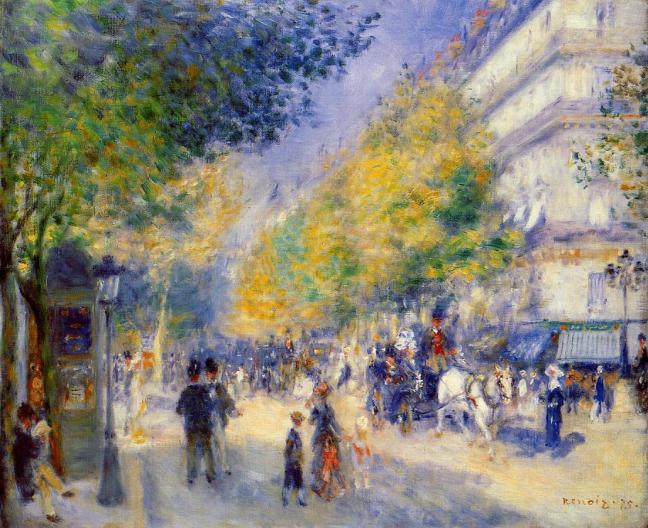
‘The Great Boulevards’ – Pierre-Auguste Renoir, 1875 – WikiArt

I have been feasting on some words recently. I was sitting leisurely on a cafe’s terrace, watching life coming and going, browsing through my phone with some ideas in mind. And there it came, and took me by surprise, like a koan suddenly unveiled, a pathway revealed without my knowing. There it came, taking the form of one single, simple phrase that seemed innocuous, by Saint Augustine:

Is any man skilful enough to have fashioned himself?
~ Augustine of Hippo

And that emptied my mind. It made me sink into no content, aware of all that is now; my self suddenly made a container for life. We all feel that we are so smart and powerful, or so stupid and powerless. That we have made ourselves what we are, and feel in consequence the pride or shame of it. That we have destroyed, or elevated ourselves. That we are responsible for our happiness, our success, our failure. That we have moulded our thoughts and actions, wilfully designed them. That our beliefs are believed. Our thoughts thought. Our words uttered by a ‘somebody’ here, inside the skull. But these are all beliefs, and beliefs are flawed from the start. Beliefs need a believer to believe them, and look as you may, you will never find such one behind your deeds. For the simple reason that there is no self behind our selfing. We have therefore never been in charge, never been truly responsible for collecting what we have collected, for misusing what we have misused, and for making the mistakes that we have made. Except in hindsight, in thoughts and beliefs, in cascades of randomly built illusions and memories in which we are caught and made blind. And these are what we have busied ourselves managing and arranging into a sensible self. And that self has gotten in the way of our living harmoniously.

[…]

The ‘Lectio Divina’ of a quote by Augustine of Hippo… (READ MORE…)

.

Sayings of the Church Fathers

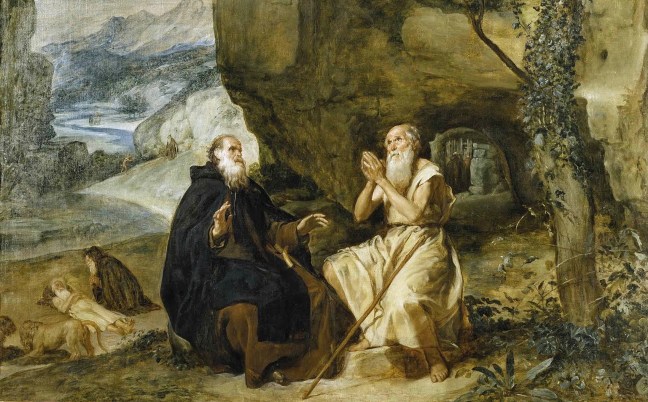
‘St. Anthony the Abbot and St. Paul the First Hermit’ – Diego Velazquez, 1635 – WikiArt

.

The whole earth is a living icon of the face of God.”
~ John of Damascus

.

The birth of a religion is always a time of effervescence. This was the case with Christianity, when appeared many monks, hermits, writers and theologians who contributed to build what would become the foundations of this religion. They were later called the Church Fathers, for they were the first Christians, who cleared the grounds. They took the teaching of Jesus and put it to the test, to the fire of experimentation. They explored it in Greek, in Latin, in Syriac, in silence, in poverty, in the desert, in knowledge. They were the first commentators, the first bishops, popes, exegetes, monks, martyrs of a religion that was still under construction. They came to it with fresh minds. They popped up from Syria, Egypt, Arabia, Turkey, Algeria, Italy, Spain, France, some of them still hungry to find out in their body and mind the traces of truth. They bore the evocative names of a distant time: Anthony the great, Moses the Black, Augustine of hippo, Papias of Hierapolis, Polycarp of Smyrna, Isaac of Nineveh, Maximus the confessor, and many more. Some of the oldest ones had been the direct students of the apostles. Others went to the desert where they lived in reclusion, as was the case with Anthony the Great.

Anthony the Great was born in 251 in Egypt. He was one of these Desert Fathers, and amongst the very first ones to live the hardships of a solitary life in the wilderness. For decades, he remained a strict ascetic. His purpose for doing so was clear enough: “The person who abides in solitude and quiet is delivered from fighting three battles: hearing, speech, and sight. Then there remains one battle to fight — the battle of the heart.” Towards the end of his life, he organised the many people who had finally gathered around him into the first body of monks in history, which is why he was later known as the ‘Father of All Monks’. He died in 356, leaving to his companions this very touching message: “Be earnest to keep your strong purpose, as though you were but now beginning. You know the demons who plot against you, you know how savage they are and how powerless; therefore, fear them not. Let Christ be as the breath you breathe; in Him put your trust. Live as dying daily, heeding yourselves and remembering the counsels you have heard from me. […] And now God save you, children, for Anthony departs and is with you no more.”

~

To one whose mind is sound, letters are needless.”

~

To say that God turns away from the sinful
is like saying that the sun hides from the blind
.”

[…]

Discover many more excerpts of the first Christians’ writings… (READ MORE…)

.