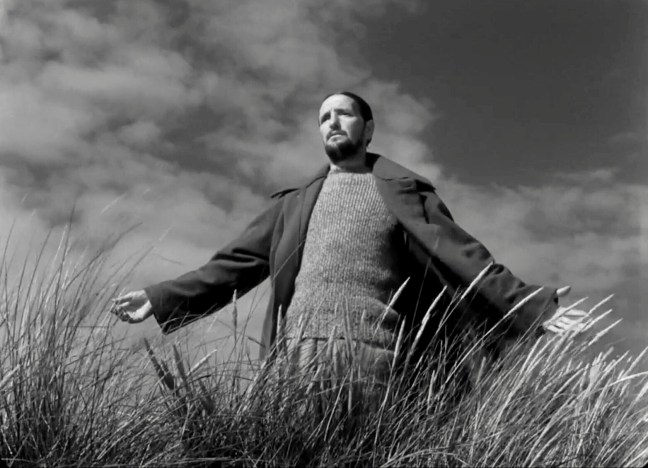
The Sacrifice

‘The Adoration of the Magi’ – Leonardo da Vinci, 1480 – WikiArt

This is the first piece of a new category in the blog called ‘Impressions of Truth’ which aims at exploring art and spirituality through the medium of films, and celebrating various famous masterpieces of world cinema. Art is at the core of the spiritual endeavour and creativity is one of the foremost qualities and expressions found with the discovery of our true nature. The function of art is to give us a taste of the deepest reality hidden behind our human endeavours. And filmmaking has uniquely tailored visual and narrative qualities, perfectly conducive to bringing us closer to the inherent peace, harmony and love within us. So let’s immerse ourselves in the unique intimacy of a cinema room, the play of forms on the screen, and the ancient gift of being told another human story…

As an introduction, I would like to warn that, for the specific purpose of this text, I have chosen to describe the precise contours of the movie’s storyline. This is a film where the narration is not of the utmost importance, but be prepared if you plan to watch the movie and would rather not know so much

.

.

The aim of art is to prepare a person for death, 
to plough and harrow his soul, 
rendering it capable of turning to good.”
~ Andrei Tarkovsky

.

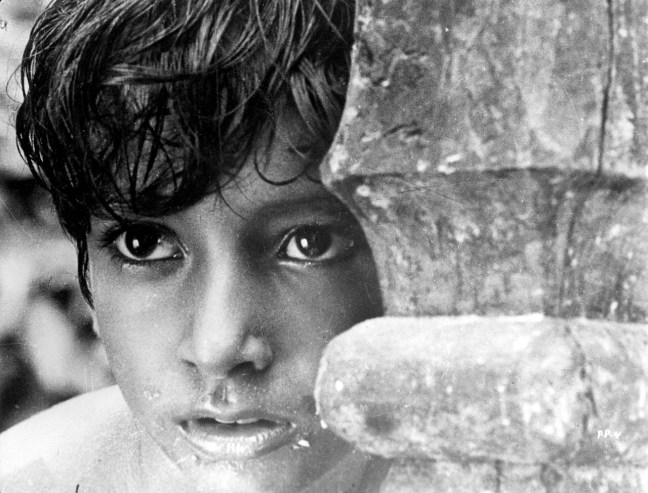
The screen and cinema room turned to a pitch black. Only the faint crackling murmur of an old empty sound track could be heard. And then… Then slowly rose the most exquisite music. ‘Erbarme Dich’ of the St Matthew Passion by J. S. Bach. Only hear this piece once in a movie by Andrei Tarkovsky, and its hearing will be forever associated with the great Russian film maker. Tarkovsky once wrote: “My function is to make whoever sees my films aware of his need to love and to give his love, and aware that beauty is summoning him.” The film ‘The Sacrifice’, by the master, is a living testimony of this claim. 

As this most divine music unfolds, a darkly lit portion of a painting comes to life. This is Leonardo da Vinci’s ‘The Adoration of the Magi’, where you see Jesus as a baby, sitting in Mary’s lap, reaching for the gift that is presented to him by one of the Magi. Then an exquisite feminine voice rises among the violins and sings these poignant verses: ”Have mercy, my God, for the sake of my tears! See here before you, heart and eyes weep bitterly. Have mercy, my God.”

Tarkovsky’s movies move slowly, with long takes, and unconventional scenario and structure. This can be a challenge for the viewer who is used to expect from a movie the usual suspense, pleasure and excitement. The thrill comes here from a wholly different place. It comes from silence, harmony and beauty. And if the purpose of art is of the deepest kind, Tarkovsky is indeed one of its most faithful representative, and could very well make his these words by Rupert Spira: “The role of the artist is to transmit to humanity the deepest experience of reality. Art is remembrance. It is love. It is like a sword that distinguishes between appearances and reality, or a cradle that reminds us of home.” This indeed is a form of elevation, and the film makes it immediately clear.

[…]

Discover the beauty and qualities of Andrei Tarkovsky’s last movie… (READ MORE…)

.

Love Remains

‘Harlequin’ (part) – by Paul Cezanne, 1890 – WikiArt

O my self, why do you stand in the way? For the living of these many experiences, you are not necessary. The pure consciousness that is present in all of us here and now is perfectly equipped. So don’t worry and please move away. This pure being has held effortlessly the millions of billions of beings and experiences generated so far, and has allowed for ever more choices and decisions to be made, so it need not being chaperoned by you. I thank you for your good will, but your work has been too laborious. Come again if you really want to, but your presence here is not welcome anymore. 

Haven’t you noticed, by now, how your participation has been an unnecessary feature in the unfolding of experience, in the many activities of our human company? Haven’t you seen how all your unnecessary thoughts and feelings have been a perturbing element among the team work that is generated here? And has cost us dear in our expenses and plannings? We understand that you want to participate, that all this is important to you, is dear to your heart, and we have accommodated you so far the best we could. But now we gently ask you to revise your presence here. […]

A humorous divagation where the self is being confronted… (READ MORE…)

.

A Frame for Life

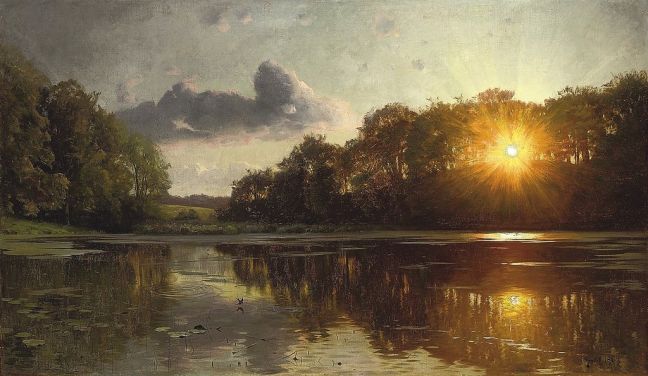
‘Sunset’ – Claude Monet, 1880 – WikiArt

.

The Soul, which is eternal Spirit,
Standeth above Time’s sovranty:
Already in this present world
She liveth in Eternity
.”
~ Angelus Silesisius

.

There seems to be an inescapable canvas that allows our life to take place and unfold in the world. This is the concept of time and space. It is the frame in which our seeming existence can spread its tentacles in every directions of our four dimensional reality. At least this is what thought tells us. This is our representation of reality. But is that truly so? 

Time seems to work vertically, allowing experiences and events to unfold one after the other, in sequences, allowing for birth and death, progress and becoming. It is intimately related to space, which works more horizontally, allowing objects and selves to move in different directions and places. And of course, time and space require that things and selves in the world are made out of matter and have all a separate, independent existence. Things and selves are like the set and actors on the stage of life, the never ending search for happiness being the script or the story, space being the place of the representation, and time the duration of the play that allows the story to unfold before the audience. As for the latter, it is composed of us all. We are all watching the representation of our existence.

[…]

An inquiring journey into the concepts of time and space… (READ MORE…)

.

The Seagull

Photo by MaxNegro on Foter.com / CC BY-SA

.

It stopped my line of thoughts:
A simple seagull
Flying through the courtyard,
Both wings elegantly spread

It taught me of pure grace
And effortlessness,
And brought within its trail 
The simple taste
Of bliss — of what is given 
Down here
Not to a deserving one
Or any special being
But to only a bird passing by
In the nonchalance of a fleeting moment;
Almost non existing,
A ghost within a ghost

It taught me of the ease of being
And the silence contained
In a movement unfettered.
Could I ever feel such joy?
Could I ever be brought down
To my knees
And let myself drift
In the same infinite gift
Of being.
Could I too spread my wings
And be given
Such a splendid death

It taught me of flow and pride
And of oneness too,
Of how the bird — any bird
Any small creature,
Is but a king in its kingdom,
And how a glance
Though caught elusively
Immediately raised me
To the rank of prince,
And made me feel
My own seagull reality,
My own soaring into the sky

.

~~~

Text by Alain Joly

~~~.

.

Suggestion:
Voices from Silence (other poems from the blog)

.

Tao Te Ching

‘Lao-tzu Riding an Ox’ (Part) – Chen Hongshou – Wikimedia

.

道德經

.

The Sage attends to the inner 
and not to the outer; 
he puts away the objective 
and holds to the subjective
.”
~ Tao Te King (trans. Lionel Giles)

.

The Tao Te Ching is an ancient treatise and one of the most widely translated work in world literature. Its philosophical influence was major in the civilisation of China, colouring other religious currents like Buddhism, and becoming a guiding light for millions of people, including countless thinkers, artists, and poets — even political movements. It was allegedly composed between the 6th and 4th centuries BC, and has been traditionally ascribed to the sage Lao Tzu, which literally means ‘Old Master’. There is doubt among scholars that Lao Tzu is a historical figure, and not a semi-legendary one, but he is nevertheless a key figure in Chinese culture and history, being both the founder of Taoism and one of its deities. 

The Tao Te Ching is a fairly short text of 5000 chinese characters, divided in 81 chapters. Written in Classical Chinese, it is linguistically complex and is a challenge for translators. Tao is a central word and concept in East Asian philosophy, which means ‘way’ or ‘path’. It is understood as being a principle that is eternally present and is described as being the natural order of the universe, empty and hidden, ‘nameless and unchanging’, yet the ‘source of all things’ and the giver of excellence and virtue.

.

Tao is like an empty container:
it can never be emptied and can never be filled.
Infinitely deep, it is the source of all things.
[…]
It is hidden but always present.
I don’t know who gave birth to it.
It is older than the concept of God
.”
~ Tao Te Ching (trans. J. H. McDonald)

[…]

Discover more of Lao Tzu’s ancient Book on Tao and Virtue… (READ MORE…)

.

What is Sought

“You are what needs to be found –
you are not the finder of anything –
the truth is in back of us,
not in front of us.
That’s why it can never be reached,
it can never be understood,
it can never be felt,
it can never be sensed —
because we are what needs
to be sensed, felt and seen.
We are not the seeker, 
we are what is sought.”

~ Eric Baret

.

~~~

Quote by Eric Baret

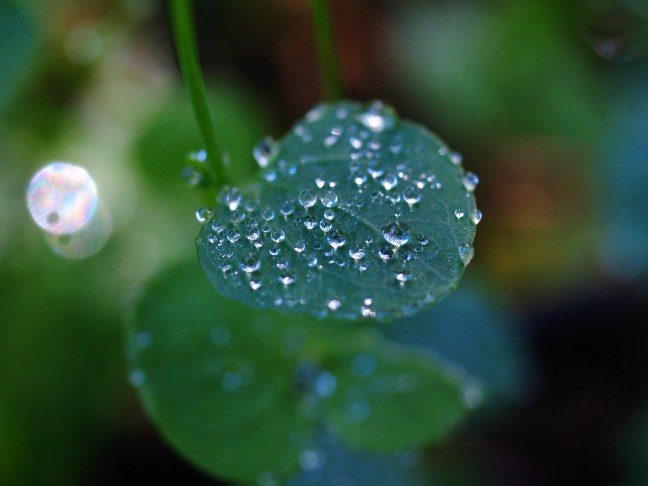
Photo by Alain Joly

~~~

.

The quote is excerpted from an interview in ‘Science & Nonduality’ entitled ‘What is Truth?’…

Bibliography:
– ‘Let the Moon Be Free: Conversations on Kashmiri Tantra’ – by Eric Baret (translation by Jeanric Meller) – (CreateSpace Independent Publishing Platform)

Website:
Eric Baret (in French) 
Eric Baret (YouTube Channel) 

.

Other quotes from the category Beauty in Essence

.

One Rock-like Reality

‘Mont Sainte Victoire’ – Paul Cezanne, 1902-1906 – WikiArt

.

If we think we are just a little body in a world, that very thought will put us in a position of extreme fragility. No wonder we are depressed, insecure, frightful, for ever claiming, hoping, dreaming, desiring, expecting. No wonder we feel we have to do something to sustain ourself, to make us viable, to give us consistency. I mean, what a depressing view to see ourself lodged in a little corner of a vast world. What poor little thing that makes us. And we go along with it. We bump our heads against that made up reality of ours, that was passed on to us like a poisoned gift. Have we only looked at it thoroughly? I mean outside any believed cultural or spiritual constraints. Have we only looked at it seriously, intently, to actually find the truth of it? There must be a truth hiding here. Maybe it is even in full view. That we only have to look wholeheartedly at what we are. If we look at anything with that kind of intensity, the false is bound to crack up, recede, and break down into a puny heap of sand. For truth is standing like a rock. It won’t budge whatever we do. It cannot be harmed. But the untruth is fragile, precarious, forever modifying itself. What a poor thing to rely on. So for once I looked. For once I didn’t let my eyes drift nonchalantly in another thought invented direction. For once I let my eyes stare at the matter as if it was a question of life and death. And suddenly it jumped onto my face. I mean this reality. This immensity that is staring me in the face. And that I pretended was so hidden that it needed, to be uncovered, a task Herculean, an appetite gargantuan, and a time in infinite amount. No. God, oh no! It is waiting for a sign from you like an enamoured lover is. She is waiting for your letting go, your total abandon. Your resisting will put her off. Your postponing will make him turn his back on you. But the back is of your own making. It is made out of all that is acquired and fleeting in you, of all that is believed and resisting, all that doesn’t wish to open itself, that is shy and hesitant, untrustful, and therefore untrustworthy of your own majestic self and presence. So don’t pursue it through time or space. Don’t expect your understanding to dawn in some future day, some future place. That will prevent it. Why should you feel that this moment is not ripe, not quite the time for it to be revealed? That it should be postponed, waited for, prayed about. That it can’t be now. It can’t be here. I’m not ready, give me some more time. This now is not the now that I need. I’d rather drop it for now, and catch up with it at some future, more suitable occasion. Don’t do that. For you yourself are the very occasion that you need. You yourself are the very moment you need. You yourself are the only one thing there is, and ever will be. Don’t run away. Abandon yourself. You-are-now-here-it. And see how our own little frightened self has suddenly grown to infinite proportions. Rest in this Self. Don’t move. Any movement will make you separate from it. Will make you miss her rock-like vulnerability. So give up moving too. Be the very love you were seeking to acquire. For what is expected is already here. Made only of you. And now just see what happened. Becoming has receded into Being. Amen.

.

~~~

Text by Alain Joly

Painting by Paul Cezanne (1839-1906)

~~~

.

Website:
Paul Cezanne (Wikipedia)

.