
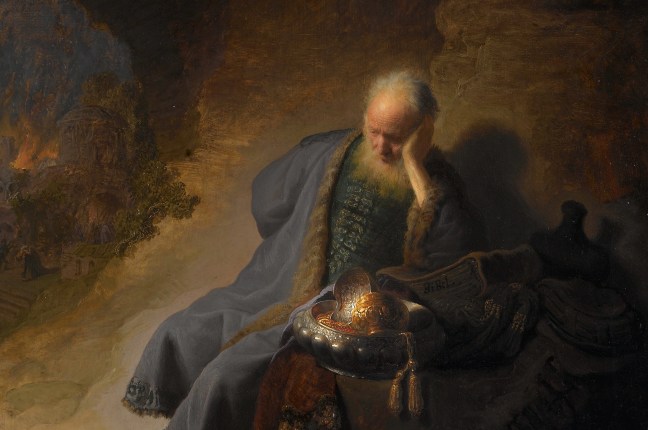
‘Jeremiah mourning over the Destruction of Jerusalem’ (part) – Rembrandt, 1630 – WikiArt
What needs to be seen and understood is that the story of humanity, the story of every life lived here under the sun, is the story of a desperation. We are fighting off the feeling that something is lacking. We want to reach or attain something, and this something that we are looking for is the same thing for everybody. Whatever form may take our life search, our drives, our dreams, our desires, our pleasures, they are all here to make us feel at peace, content, whole. They are here to free us from ourself, from our search, from our never-ending desperation. Outside, we may put on the appearance of control, normality, and responsibility, but inside we are burning, seeking, longing for that which we have never been able to put into words, explain, rationalise, or make sense of. But in fact, we are looking for something that we already possess in infinite quantity, although unknowingly. We are craving for the abundance that we already have, searching for a peace that is already given, begging for a joy that is throbbing unnoticed in the background of our everyday experience.
Our suffering or desperation is the symptom of this misunderstanding. We fail to notice that we have what we are looking for, that it is here in plain view, already achieved, already formed in and as our most intimate identity. Our self is made of that sweet fire of peace, contentment, and sufficiency. So the misery we are in is only apparent, imagined, made up by our thinking about it, and by our looking for peace unnecessarily, out there, in the wrong place, in experience. There is no amount of effort that will ever help us to attain something that is already attained. On the contrary, the disturbance involved in seeking what we have will cause us misery, in the form of a desperate, separate sense of self. We are too eager. We never sit still, always foraging our experience to harvest some scattered drops of peace or joy, when our very being is already overflowing with them.
The only necessity, or even possibility of being a self separate from experience is through managing the tension involved in seeking a peace that is already our most intimate nature. Our self is the story, the memory of this seeking. When peace is here, there is no self present, no tension that could make us a suffering entity. In fact, we seem to proceed by distraction. We are not looking, and then we complain that it is not there. All our efforts to obtain an enduring peace in our life are vain and doomed to failure for the simple reason that peace is not a thing that can be had. Peace is something that we have to realise is present here and now. It is our vey being, what we are made of, our unborn reality. So there is no real, substantial suffering here to be rid of. It is not that suffering is not experienced. It is that its only reality is only in and as our imagined self. It is but the friction that goes with believing to be a separate entity. Suffering is essentially made of our believed self, which is but our constant seeking to alleviate this apparent misery. The ending of the belief in being a self, which is also the ending of time, space, and separation, will make fully apparent our nature as peace and happiness, in which there can be no suffering, no self, no seeking, no desperation.
.
~~~
Text by Alain Joly
Painting by Rembrandt (1606-1669)
~~~
.
Website:
– Rembrandt (Wikipedia)
Suggestion:
– Other ‘Reveries’ from the blog…
.
 The Dawn Within