What is Sought

“You are what needs to be found –
you are not the finder of anything –
the truth is in back of us,
not in front of us.
That’s why it can never be reached,
it can never be understood,
it can never be felt,
it can never be sensed —
because we are what needs
to be sensed, felt and seen.
We are not the seeker, 
we are what is sought.”

~ Eric Baret

.

~~~

Quote by Eric Baret

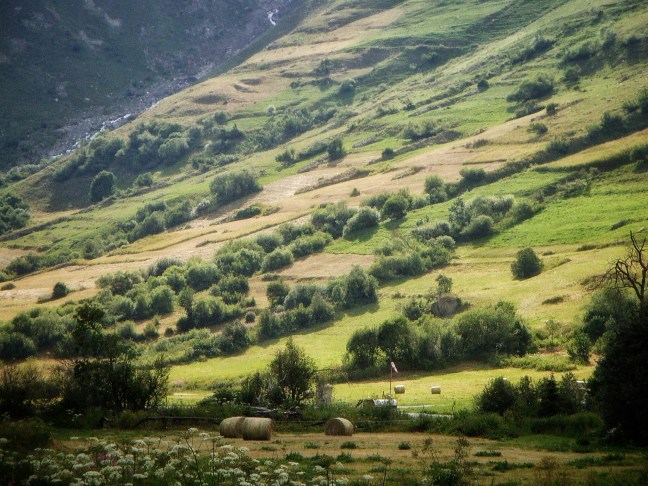
Photo by Alain Joly

~~~

.

The quote is excerpted from an interview in ‘Science & Nonduality’ entitled ‘What is Truth?’…

Bibliography:
– ‘Let the Moon Be Free: Conversations on Kashmiri Tantra’ – by Eric Baret (translation by Jeanric Meller) – (CreateSpace Independent Publishing Platform)

Website:
Eric Baret (in French) 
Eric Baret (YouTube Channel) 

.

Other quotes from the category Beauty in Essence

.

One Rock-like Reality

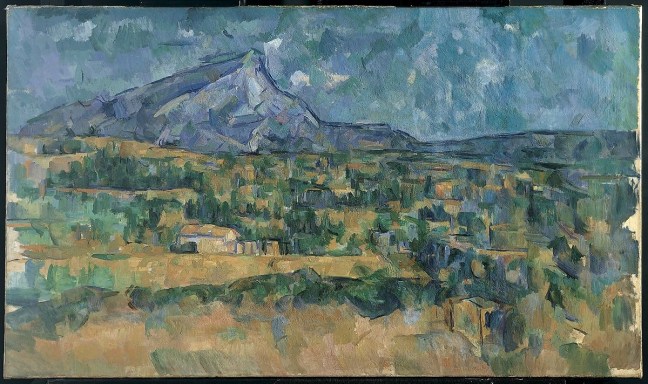
‘Mont Sainte Victoire’ – Paul Cezanne, 1902-1906 – WikiArt

.

If we think we are just a little body in a world, that very thought will put us in a position of extreme fragility. No wonder we are depressed, insecure, frightful, for ever claiming, hoping, dreaming, desiring, expecting. No wonder we feel we have to do something to sustain ourself, to make us viable, to give us consistency. I mean, what a depressing view to see ourself lodged in a little corner of a vast world. What poor little thing that makes us. And we go along with it. We bump our heads against that made up reality of ours, that was passed on to us like a poisoned gift. Have we only looked at it thoroughly? I mean outside any believed cultural or spiritual constraints. Have we only looked at it seriously, intently, to actually find the truth of it? There must be a truth hiding here. Maybe it is even in full view. That we only have to look wholeheartedly at what we are. If we look at anything with that kind of intensity, the false is bound to crack up, recede, and break down into a puny heap of sand. For truth is standing like a rock. It won’t budge whatever we do. It cannot be harmed. But the untruth is fragile, precarious, forever modifying itself. What a poor thing to rely on. So for once I looked. For once I didn’t let my eyes drift nonchalantly in another thought invented direction. For once I let my eyes stare at the matter as if it was a question of life and death. And suddenly it jumped onto my face. I mean this reality. This immensity that is staring me in the face. And that I pretended was so hidden that it needed, to be uncovered, a task Herculean, an appetite gargantuan, and a time in infinite amount. No. God, oh no! It is waiting for a sign from you like an enamoured lover is. She is waiting for your letting go, your total abandon. Your resisting will put her off. Your postponing will make him turn his back on you. But the back is of your own making. It is made out of all that is acquired and fleeting in you, of all that is believed and resisting, all that doesn’t wish to open itself, that is shy and hesitant, untrustful, and therefore untrustworthy of your own majestic self and presence. So don’t pursue it through time or space. Don’t expect your understanding to dawn in some future day, some future place. That will prevent it. Why should you feel that this moment is not ripe, not quite the time for it to be revealed? That it should be postponed, waited for, prayed about. That it can’t be now. It can’t be here. I’m not ready, give me some more time. This now is not the now that I need. I’d rather drop it for now, and catch up with it at some future, more suitable occasion. Don’t do that. For you yourself are the very occasion that you need. You yourself are the very moment you need. You yourself are the only one thing there is, and ever will be. Don’t run away. Abandon yourself. You-are-now-here-it. And see how our own little frightened self has suddenly grown to infinite proportions. Rest in this Self. Don’t move. Any movement will make you separate from it. Will make you miss her rock-like vulnerability. So give up moving too. Be the very love you were seeking to acquire. For what is expected is already here. Made only of you. And now just see what happened. Becoming has receded into Being. Amen.

.

~~~

Text by Alain Joly

Painting by Paul Cezanne (1839-1906)

~~~

.

Website:
Paul Cezanne (Wikipedia)

.

Chalices of Wonder

Alfred K. LaMotte is my newly invited guest on ‘The Dawn Within’. His poetry has been a regular companion over the years and I’m happy to share here five of his poems. Most of Fred’s writings and poems have been shared in his website  Uradiance’, and in his ‘numerous books’. Fred is an interfaith chaplain and a college teacher of world religions and philosophy. He wrote: “Poems are maps for getting lost in your heart where everyone can find you. Poems are momentary Sabbaths when eternity breaks in. These moments can heal the world.” Fred lives with his wife Anna near Seattle WA, where he “loves to walk barefoot in wet grass at midnight, un-naming the stars.” You will find, in between his poems, some of Fred’s writings on Beauty and Creation. I hope you enjoy these few pieces and excerpts…

.

Beauty unfolds in the silence between thoughts.
The dark loam of thought-free awareness 
is where Words of creation spring up and cry,
‘Let there be light’.

.

~~~

.

Invincible 

I don’t want to be invincible.
I want to be astonished by loss.
I want to be stunned
and defeated by wonder,
shocked into a new creation
where only dancing is allowed.
I want to fall down again and again.
How close can my head come to your toes
before it shatters into spirals of gold?
Lift me up, I’ll do
what a fountain does to sunbeams.
Step on me, I’ll be the sky. 

.

~

Creation is neither a tale of the past nor a vision of the future, but a history of this moment. 
That is why, for me, meditation is the mother of poetry
.”

~

[…]

Discover the poetry and wisdom of Alfred K. LaMotte… (READ MORE…)

.

The Starry Night

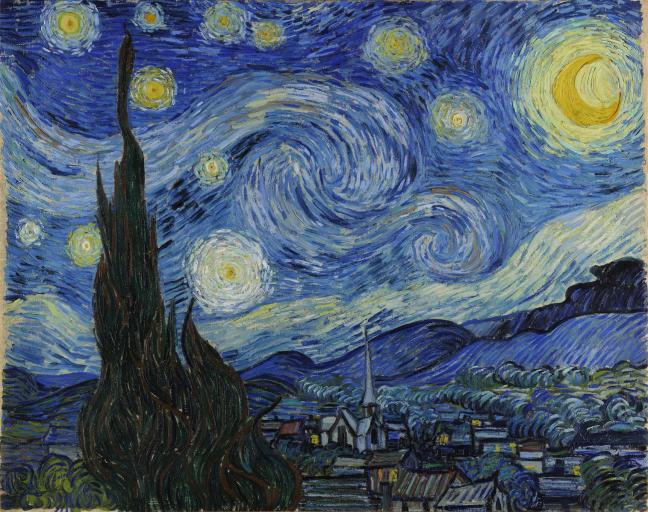
‘The Starry Night’ – Vincent Van Gogh, 1889 – WikiArt

.

Van Gogh was depressed
A lonely heart in an asylum,
So he painted a starry night
And made it bright.
He said ‘The night is so alive
And more richly coloured 
Than day.’
The flame of his pain
Became a dark cypress
That rose on to the skies.
The grim is found in the defined;
The light and the spacious,
Say the precious — in airy sky.
There is a wide expanse
Below Van Gogh’s window,
An even larger one shining
Behind the iron bars of mind.
The darkest mood embraced
Turns into soft and tender mist;
Let it clear up, reveal a sky
Lit up by countless twinkling stars.
There is no mind, no gloom inside
That doesn’t rest on happy ground,
So he painted a starry night
And made it bright.
There is peaceful living under heaven
In a village with some shiny windows 
But more is meant in illumination.
Among the shadows, the murky
Does run a light so clear and vast,
Whirlpools of joy, luminous streams,
A saraband of radiant beings.
Even the quieter moon bragged 
And clothed itself in gleaming apparel;
There is glory in a silent night
And fireworks concealed
In the obscure.
There is a sea 
Beneath the hectic waves
And an eternity
Amongst the fainted lights of day,
So he painted a starry night
And made it bright.

.

~~~

Poem by Alain Joly

Painting by Vincent Van Gogh (1853-1890)

~~~

.

Websites:
Vincent Van Gogh (Wikipedia)
The Starry Night (Wikipedia)

Suggestion:
Voices from Silence (other poems from the blog)

.

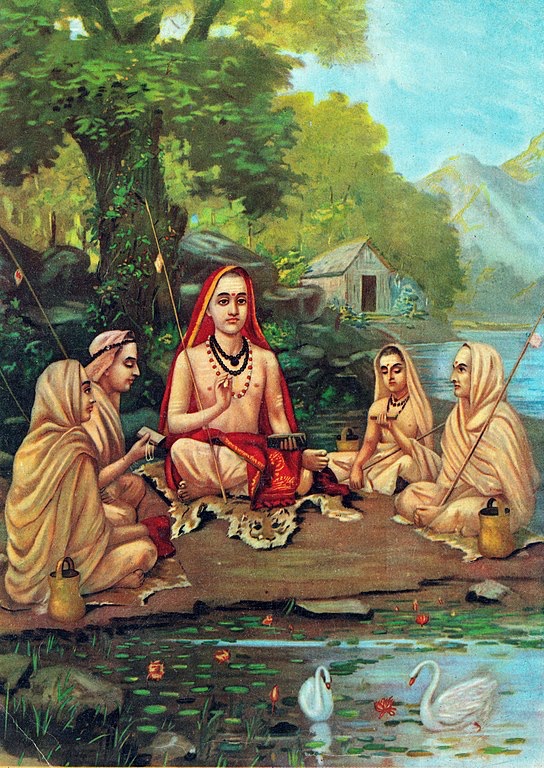
Shankara the Great

‘Adi Shankara and his disciples’ – by Raja Ravi Varma, 1904 – Wikimedia

.

अहं निर्विकल्पो निराकार रूपो, 
विभुत्वाच सर्वत्र सर्वेन्द्रियाणाम् । 
न चासङ्गतं नैव मुक्तिर्न मेयः, 
चिदानन्दरूपः शिवोऽहम् शिवोऽहम् ।

ahaṃ nirvikalpo nirākāra rūpo
vibhutvā ca sarvatra sarvendriyāṇaṃ |
na cāsaṅgataṃ naiva muktir na meyaḥ
cidānandarūpaḥ śivo’ham śivo’ham |

.

The early spiritual works produced in India were anonymous, probably stated by some ancient sages whose identities got lost. There is one name though that rose and was brought to fame and excellence, a teacher whose life has been narrated in many hagiographies and legends. His name: Adi Shankara, or Shankaracharya. His work as a philosopher and religious reformer is considered prominent in the unfolding of Hinduism. He is also known for having formulated and codified the ancient spiritual current of Non-duality, called in India Advaita Vedanta.

India’s most celebrated teacher was born in Kerala, in a village called Kaladi, in the accepted year of 788. Everything is uncertain about Shankara, since his numerous biographies were written centuries after his death and were designed to build a legend around his life. The name ‘Shankaracharya’ means the teacher ‘acharya’ of the way to bring about happiness (‘sham’ means ‘auspicious’ and ‘kara’ ‘maker’). He died at the early age of 32. A short life that nevertheless allowed him to travel widely all over India, initiating debates, founding monasteries ‘Matha’, and writing numerous pieces of work among which commentaries of ancient texts like the Brahma Sutras, the Bhagavad Gita, or the Principal Upanishads. 

Amongst the many works authentically attributed to him is the Atmashatkam, also known as Nirvanashatkam. The legend says that Shankara, aged only eight at the time, wrote this devotional poem of six slokas as an answer to his newly found guru Govindapada who asked him the simple question “Who are you?”. This is a very striking and moving exposition of everything that we are not, everything that has been wrongly attributed as being our identity. Through experientially discarding every such thing, one comes to dawn on the simple realisation of our true nature, namely the Self or, as it is named in this translation, ‘the auspicious, love and pure consciousness’. This was concluding each stanza in the original Sanskrit as ‘I am Shiva! I am Shiva!’ (Shivoham)…

I am not mind, nor intellect, nor ego, 
nor the reflections of inner self. 
I am not the five senses. I am beyond that. 
I am not the seven elements or the five sheaths. 
I am indeed, That eternal knowing and bliss, 
the auspicious, love and pure consciousness.

[…]

A discovery of the ancient teachings of Adi Shankara… (READ MORE…)

.

A Perfect Bull’s-eye

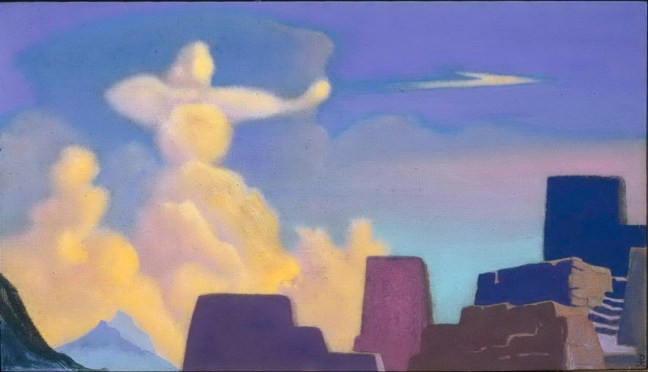
‘Defender. Cloud-archer.’ – Nicholas Roerich, 1937 – WikiArt

The Mullah Nasruddin is what could be called a sublime idiot. He is a liar, irreverent, a disturber of peace. But he is also ingenious, free, full of wit, a timeless figure whose stories have spread and been adapted the world over. In the Sufi tradition, they were used for study purposes. “There is the joke, the moral — and the little extra which brings the consciousness of the potential mystic a little further on the way to realisation.” writes Idries Shah.

~

The Mullah Nasruddin brought his students to the fair so that they could watch him compete in the archery contest. Before his first shot, the Mullah fixed his cap military style and, assuming a soldier’s posture, drew the bow and fired. The arrow missed the target completely, and the crowd roared with derisive laughter.

Then he picked up the bow again, this time with little strength, and shot the second arrow. It flew straight, but landed far short of the mark. Again, the onlookers guffawed. For the last of his three allotted shots, Nasruddin nonchalantly turned to face the target, aimed, and let fly. It was a perfect bull’s-eye.

The crowd went wild, then fell into a stunned silence. Nasruddin chose the moment to take his prize and indifferently started to walk on. 

But his students and the astonished throng demanded an explanation. 

Nasruddin complied and told them, “For the first shot, I was identified with a soldier, face-to-face with the enemy. Fear made the arrow miss. With the second shot, I became like the man who, having failed miserably with the first shot, was so anxious and eager he could not concentrate. He simply had no power.”

“And the third shot?” inquired a brave soul. “Who fired that one?” 

“That? Oh, that was me.”

~

Nasruddin’s pointers:
Nasruddin makes the point perfectly clear. Why is it that to be ‘me’, I think that I have to do something? I have to pretend, imitate, add, subtract, hide, and god knows what else. I make such efforts, such desperate attempts, at being myself, and yet it’s not really working. I fail again and again at being just myself. I am only myself plus. But simply being my plain, simple self, I’m not. I miss the mark. And then I find ways to reconcile my various fabricated selves into an acceptable one. One that would make a little sense, that would have some kind of logic, that would  be presentable to the world. Well, it seems that there is too much thinking that goes into it, isn’t there? So how can I be ‘me’? Nasruddin is almost discarding this ‘being me’, brushing it aside very matter-of-factly. He seems to imply that ‘being me’ is the simplest thing to achieve. It’s not even worth considering. I am ‘me’ by only ‘being’. There is no ‘more’ in simply being. And don’t think that this is too easy, too universal, not enough the fancy ‘me’ that you’ve been trying to be for so long — and all along failing it so miserably. Listen carefully: This ‘being’ is the ‘me’ that has been perfectly designed for the ‘you’ that you truly are. No ‘me’ could ever be more ‘you’ than this me-being, this ‘I am’. This ‘being’ will make your life easier, happier. You will never miss the mark with ‘I am’. For the mark is yourself. And see for yourself: by being my most precious, simple self, I already am that, that I am. See? This is a perfect bull’s-eye! Nasruddin knew it all along. What clever man he is! Always hitting the target — as far as his true Self is concerned!

.

~~~

.

The Nasruddin’s story is borrowed from ‘365 Spirit: A Daily Journey for Your Soul’ – by Aaron Zerah – (A to Z Spirit Publishing).

‘Nasruddin’s pointers’ is by Alain Joly

Bibliography:
– ‘365 Spirit: A Daily Journey for Your Soul’ – by Aaron Zerah – (A to Z Spirit Publishing)
– ‘Every Day is a Blessing: 365 Illuminations to Lift the Spirit’ – by Aaron Zerah – (Grand Central Publishing)
– ‘As You Grieve: Consoling Words from Around the World’ – by Aaron Zerah – (Sorin Book, U.S.)
– ‘The Exploits of the Incomparable Mulla Nasrudin’ – by Idries Shah – (ISF Publishing)
– ‘Nasreddin Hodja: 100 tales in verse’ – by Raj Arumugam – (CreateSpace Independent Publishing Platform)

Websites:
A to Z Spirit (Aaron Zerah’s website)
Nasreddin Hodja (Wikipedia)
The Idries Shah Foundation
Nicholas Roerich (Wikipedia)

Suggestions:
Self Recognition (An interrogation by Nasreddin Hodja…)
I Am Nobody (The newly discovered identity of Nasreddin Hodja…)
Hodja Tells the Truth (A story where Nasreddin Hodja tells the truth…)

.

The Price of Immortality

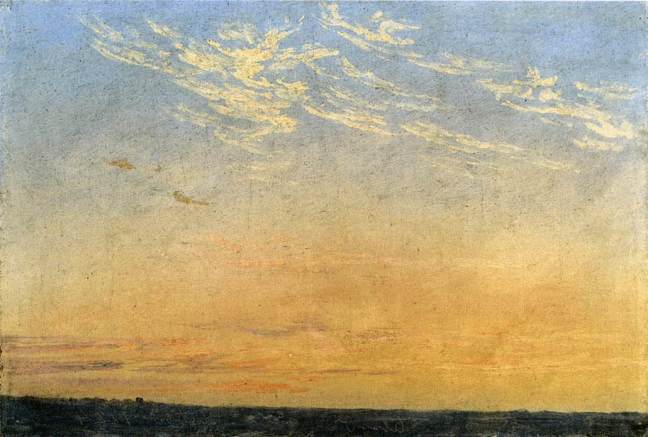
‘Evening’ – Caspar David Friedrich, 1824 – WikiArt

.

Death doth not trouble me. 
‘Tis through that door I come
Unto the place which long 
hath been my spirit’s home
.”
~ Angelus Silesius 

.

There is one thing in life that is haunting us. This is the fact of our certain death. And yet, considering that we all know that we are going to die, most people don’t actually worry that much about it. How come that people who believe that they are solely their body can stay so cool when waiting for a certain death? They should be terrified. This should come as some unbearable news. But it’s not. Even though we don’t look forward to dying, we nevertheless take the news with a remarkable composure. We don’t mind that much if you ask me. Why is that? 

Is it that we have deep down the intuition of our immortality? If I say ‘I’m going to die’, how does it feel? Am I saying the truth? Do I really know this for certain? Or am I casually repeating something that I have learned and has now become a deeply ingrained belief? But this being said, don’t let us be mistaken. Most of the time, we push death far away and numb ourself to its dreadful reality. And the fear of death is conditioning and bending our lives in the most ruthless manner. What a paradox it all is! But in that paradox lies the whole riddle of life and death, of suffering and happiness, of love and God. Death is a portal to our true nature. One that is inescapable. Who is it that is going to die? Or rather what is it? Let’s have a look at it…

[…]

An exploration of the nature and meaning of death… (READ MORE…)

..