Pathways

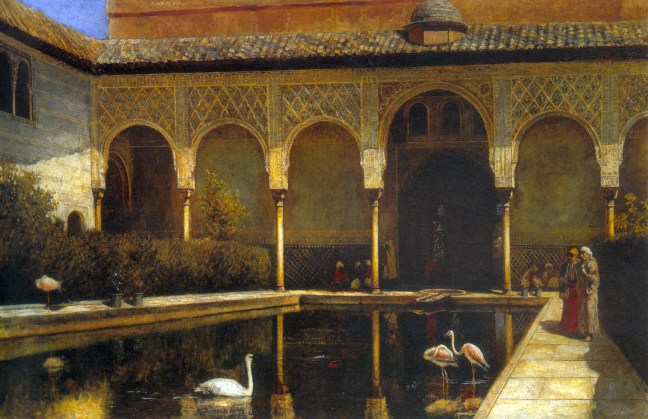
‘Court in the Alhambra’ – Edwin Lord Weeks, 1876 – WikiArt

The spiritual endeavour is really such good fun. You may happen to experience some suffering in your life and feel entangled — with thoughts rushing into your mind and problems seizing the entirety of yourself. The web of experience is overwhelming you and you can find no space to breathe within. You may then have to have a little conversation with yourself. You may have to disentangle yourself from your stubborn identification with thoughts and with the overcrowding objects born of the senses. That’s when you may present yourself with a simple question like: “What is this part in myself that is aware of my experience?” And so are you now taken amongst the scents of 8th century India, treading its immemorial dust with Shankara, debating with the great Vedantic master. He will show you how to move inwards right at the core of that aware presence in yourself. You will be taken with him to the core of this investigation, which is but the separation of the multiple objects of experience from the one aware, pervading presence of consciousness that is your true identity. That’s when Shankara leaves you with this one infaillible recipe:

.
I bow down to that all-knowing One
which is pure Consciousness, all-pervading, all,
residing in the hearts of all beings
and beyond all objects of knowledge.”
~ Shankara (Upadesasahasri, 1:1)

.
You may then find yourself sitting in your kitchen, cutting vegetables, with your thoughts suddenly wandering in the 17th century Paris, surrounded by the walls of a Carmelite monastery’s kitchen, chatting along with Brother Lawrence. He might tell you with his big generous smile: you know brother, “nothing is easier than to repeat often in the day these little internal adorations.” That’s when you understand that this investigation can be made into a joyful, often repeated practice, where you go and meet yourself within, have a little chat with this hidden presence, spontaneously, as you gaze into the eyes of a friend. Amongst the frantic sound of knives hitting the wooden board and the fumes of the next meal simmering on the stove, you meet Brother Lawrence’s glance offering you this last precious advice:

.
I renounced, for the love of Him,
everything that was not He;
and I began to live as if there was none
but He and I in the world.”
~ Brother Lawrence

[…]

Continue this journey into the investigation of your true nature… (READ MORE…)

.
The Mystical Doctor

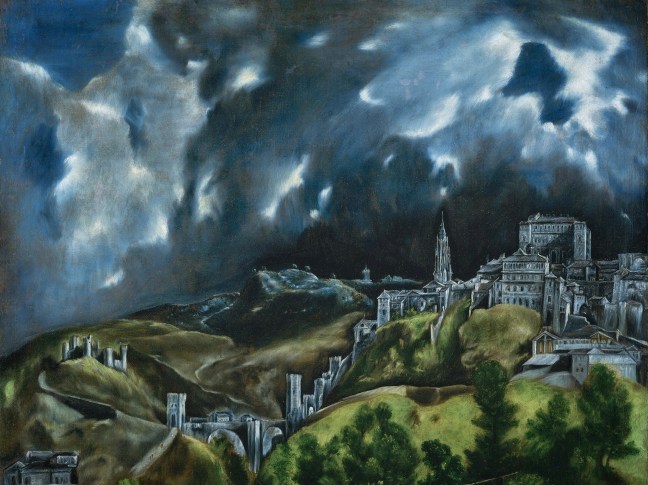
‘View of Toledo’ – El Greco, 1596 (Metropolitan Museum of Art) – Wikimedia

.During the night of 2 December 1577, in the city of Toledo in central Spain, a priest was imprisoned by a group of Carmelites who were refusing Teresa of Ávila’s reformation projects for their Order. He was jailed for 9 months in a monastery under brutal conditions. He was publicly beaten at least weekly, confined in a cell of barely 10 by 6 feet, with only a little light passing through a hole during the day, with bread and scraps of salt fish for a meal, and no change of clothes. But his burning love of god, along with his unfailing devotion and clarity of mind, allowed the 35 years old friar to compose, along with other shorter poems, the greater part of a sumptuous poem — ‘The Spiritual Canticle’ — about a bride’s search for her beloved. The poem, symbolising the soul seeking union with god, and inspired by the ‘Songs of Songs’ of the Bible, starts with these eloquent lines:.

Where have You hidden Yourself,
And abandoned me in my groaning, O my Beloved?
You have fled like the hart,
Having wounded me.
I ran after You, crying; but You were gone
.”
~ ‘The Spiritual Canticle’

The name of this priest and poet was John of the Cross, a Spanish Catholic mystic born in 1542 near Ávila, to whom we owe some of the brightest exposition of truth in the Christian world. Thomas Merton, who held him in very high esteem, presented him as “one of the greatest as well as the safest mystical theologians God has given to His Church.” John of the Cross was born in a poor family of Jewish converts to Catholicism, and received a simple education. He entered the Carmelite Order, made his First Profession when 21, and met Teresa of Ávila a few years later, of whom he remained a faithful associate all his life. Although not a scholar, his studies in theology and philosophy allowed him to quote abundantly from the Bible, and be acquainted with the work of St. Thomas Aquinas.

Although I have chosen to quote here only from the poem ‘The Spiritual Canticle’, John of the Cross is the author of many other poems, among which the renowned ‘The Dark Night’ — better known as ‘The Dark Night of the Soul’ — and ‘The Ascent of Mount Carmel’. His poems have a rich and powerful imagery and are considered to be masterpieces of Spanish poetry. Although they transpire with beauty and meaning, they are not to be readily understood. This is why John of the Cross wrote precise and extensive commentaries on them, some soaring pieces of teaching whose beauty and profundity is sometimes breathtaking. The most exquisite poetry is here going hand in hand with both a great depth of understanding, and the sweetest accents of devotion. The commentaries were written in prose but are here occasionally presented in a free verse form when they lent themselves to it. I am sharing the 1909 translation made by David Lewis, with corrections by Benedict Zimmerman. Listen with what tender accents of poetry and longing the bride is here conversing with her bridegroom, and how a suffering soul who has tasted of the divine is longing for “the secret chamber of God”, which is nothing but the pure consciousness that is hiding in our innermost being:

.
O you soul, then, most beautiful of creatures,
who so long to know the place where your Beloved is,
that you may seek Him, and be united to Him,
you know now that you are yourself
that very tabernacle where He dwells,
the secret chamber of His retreat where He is hidden.
Rejoice, therefore, and exult, because all your good
and all your hope is so near you as to be within you;
or, to speak more accurately, that you can not be without it.”
~ ‘The Spiritual Canticle’, 1.8 (Commentaries)

[…]

Discover the rich poetry and commentaries of John of the Cross… (READ MORE…)

.