Four Variations on Love

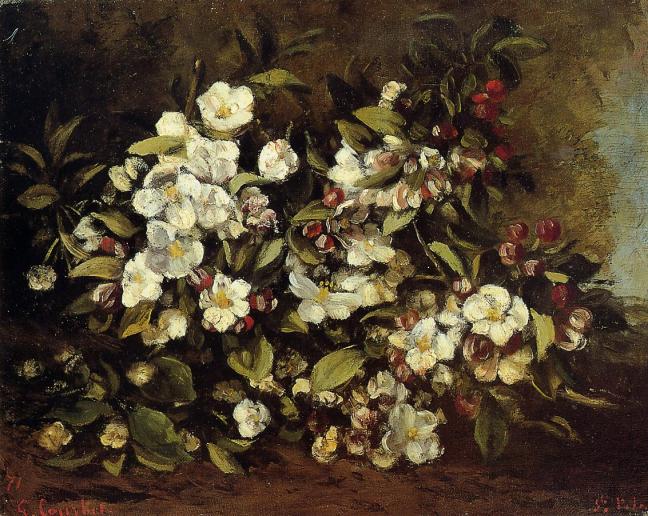
‘Branch of apple blossoms’ – Gustave Courbet, 1871 – WikiArt

.

God is love, and he who dwells in love
dwells in God and God in him.”
~ The Bible (1 John, 4:16)

.

I have been reading Meister Eckhart’s sermon n°5 lately, in the translation by Clare de B. Evans, from an old publication named simply ‘Meister Eckhart’. It’s a sermon dedicated to love and its many aspects. At the very beginning, Meister Eckhart sums up the nature of love in four magistral sentences that had a deep effect on me. So I decided to write down some of my take and understanding on each of these quotes by the Meister and present them to you. I hope they will be of interest…

.

‘God is love’. That is so, inasmuch as all that can love,
all that does love, he compels by his love to love him.”
~ Meister Eckhart

It is greatly convincing to think that we can love someone or something. That there is something inside us, a quality or emotion, that can spring out of our mind and body and direct itself towards an object, a someone loved, a something loved, and that this love is a personal affair. Well now the question arises: What is it in us that can love, and what is this other that is loved? Notice first that there is nothing in you that can love but love itself. Our mind is in no capacity to love. Rather love happens, shows up naturally, when our mind is set aside for a while — for our thoughts, most of our thoughts, have the power to defeat love, to render it unfelt, dormant, as if inexistent. So if you love anything, anyone, it is not because of him, or her, or it. It is because you have been freed from yourself as a private, separate self or mind, and that in this freedom, love can arise, unfettered, can stretch its dormant limbs, and shine in all directions. After all, have you ever been in love with someone without at the same time loving everyone, everything, around that one? Love is an awakening, an opening. And in that opening, in that crack, reality shows its profound nature. Love is the profound, intimate nature of everything. So when you love someone, there is nothing there, and nobody, no other, that can be loved, except the essence that this one is. Therefore you can only ever love the essence. And you could not love the essence of anything if you were not yourself the essence of everything. That’s how you are compelled, when you love anything, to love god first, which is the essence of both the lover and the loved.

[…]

More reflections on some Meister Eckhart’s statements about love… (READ MORE…)

.
The Will of God

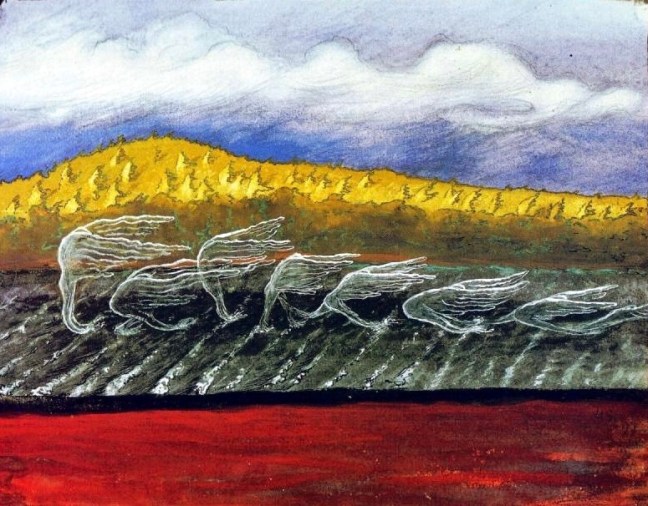
‘The Wind Blows’ – Hugo Simberg, 1897 – WikiArt

God’s will is what is happening now. Not as a body or an entity, not as a form or any kind of event. The reason is: form has already happened. Every object comes from the past. It has traversed at least a length of time to land in the field of awareness. Like a thought has. A thought is never now. It is the termination of something that took place a moment ago. It is an achieved result. But there is something in our experience that doesn’t come from the past, that hasn’t travelled any distance to be here, and that hasn’t moved through time to be now. So if you want to know what is God’s will, find the only thing in your life that is not a thing, that hasn’t yet taken form, and therefore needs neither space nor time to be. Find that which cannot be found, that which is formless, that which hasn’t travailed. For God’s will doesn’t come second, it cannot be a result, for such a thing would need a cause for itself to be. No. God’s will is first. As a ‘first’, it is in capacity to initiate, to create. But what is created is never itself God’s will, for it is already formed, with a life of its own. It is corruptible as form. So go to the essence, the origin. Find the incorruptible in yourself — that one uncreated thing — and take that only to be the will of God.

So we are in our essence uncreated. This is our identity, to be without form, forever here, forever now, eternally landed, therefore without a will of our own. For what would a separate will be but a thing already formed, an effect with already a cause; and therefore not the causeless, therefore not God’s will. So if we want our life to follow a divine trajectory, we have to give our utmost attention to who we are. That will condition the rest of our existence. That matters the most: that little name we give to ourself, that little identity. Start with the truth of who you are, and be only concerned with the tail of that star. Make yourself bright with it — that’s how to follow God’s will. Be that one that is in no capacity to be a follower. Stand as and for the truth of being and be concerned with nothing else but that. That is the only possible will you can afford. Any other kind of will is not your own, although it may appear to be. So don’t expect to have a will, for a will is but an appearance that has formed in yourself. Go to yourself first. Go for that part of yourself that has no will but God’s will. You will find there a will that encompasses all other wills — for what is a will but the will to be happy, rested, fulfilled? Only at the condition of being without a will of your own can you embrace the one will of your true identity as being. Being is in fact its own will, for it has as its DNA the purpose of all wills, which is the peace of living. From that peace firmly set in your heart, any will is the will of God.

.

~~~

Text by Alain Joly

Painting by Hugo Simberg (1873-1917)

~~~

.

Website:
Hugo Simberg (Wikipedia)

Suggestion:
Other ‘Ways of Being’ from the blog…

.

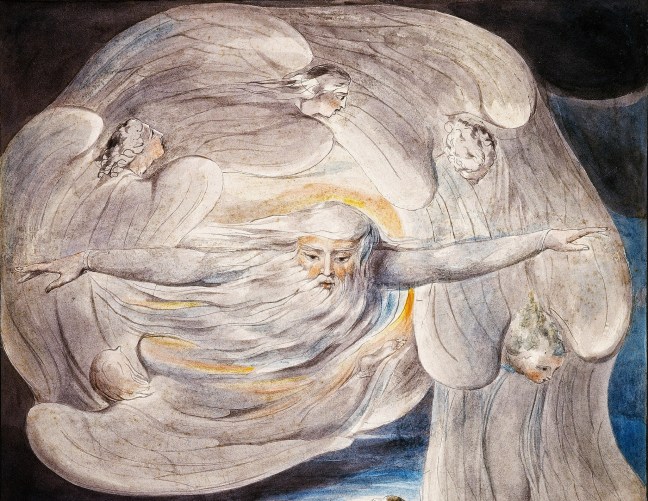
The Poetic Genius

Job Confessing His Presumption to God’ (detail) – William Blake, 1803 – Wikimedia

.

I must Create a System, or be enslav’d by another Man’s;
I will not Reason and Compare: my business is to Create
.”
~ William Blake (‘Jerusalem’)

.

Artists, through their sensitivity to perception, their pointed quest towards beauty and harmony, are natural candidates for delving into the depth of reality and understanding their true nature. Many poets, painters, musicians, have been able to explore their being in ways that are traditionally the privilege of mystics. Indeed, they wrestle with eternity, and strive to find a way to convey it. William Blake was one such wrestler. He was a poet, painter and printer born in London in 1757. Although not recognised during his life, his art is bursting with creativity, intelligence, and vision. His profuse work, soaked with spiritual explorations, symbolic and personal mythologies, is not to be easily classified. Of William Blake, the 19th-century scholar William Michael Rossetti wrote that he was “a man not forestalled by predecessors, nor to be classed with contemporaries, nor to be replaced by known or readily surmisable successors“. Besides, his poetry is infused with pearls of the most profound non-dual understanding, which I invite you to explore here.

In his childhood, William Blake was fascinated by the work of great masters such as Raphael, Michelangelo, and Albrecht Dürer. He was educated at home, was given drawing lessons, and began writing poetry at an early age. Profoundly influenced by the Bible and Christianity, he was all his life gifted with visions and insights, from which he drew guidance and inspiration for his poetry and paintings. He was nevertheless not a follower, and developed his own vision and understanding. He was very critical of narrow-minded religiosity, or what he named the “general truth” or “general beauty“, writing uncompromisingly that: “To generalize is to be an idiot; To particularize is the alone distinction of merit“. William Blake wrote these enlightening verses about his religious endeavour and passion:

.
Trembling I sit day and night, my friends are astonish’d at me.
Yet they forgive my wanderings, I rest not from my great task!
To open the Eternal Worlds, to open the immortal Eyes
Of Man inwards into the Worlds of Thought: into Eternity
Ever expanding in the Bosom of God. the Human Imagination.”
~ ‘Jerusalem’ (Ch. 1, plate 5)

.
When will the Resurrection come, to deliver the sleeping body
From corruptibility? O when, Lord Jesus, wilt thou come?
Tarry no longer; for my soul lies at the gates of death:
I will arise and look forth for the morning of the grave:
I will go down to the sepulchre and see if morning breaks.
I will go down to self-annihilation and eternal death
Lest the Last Judgment come and find me unannihilate
And I be seized and given into the hands of my own selfhood.”
~ ‘Milton’ (Book the First)

[…]

An exploration of William Blake’s non-dual pearls and poetry… (READ MORE…)

.

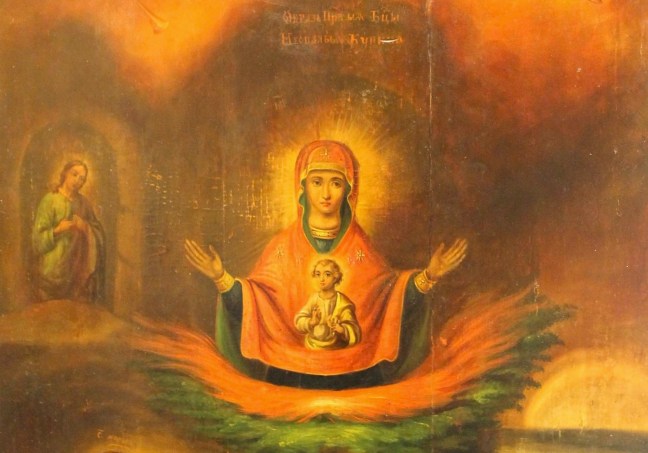
The Burning Bush

‘The Icon of Theotokos the Unburnt Bush’ (detail) – 19th AD, Museum of Radomysl Castle, Ukraine – Wikimedia

Don’t be shy. Come out of the bush. That bush which is of your own making. The hazy bush of your thoughts, feelings, and the ten thousand things perceived. All that you have invented to keep your self going, to give it a form and a lustrous appearance. This is a bush of endless confusion and deceit. Don’t get entangled in its thorny maze, to be kept here safe but miserable. Don’t be lured into the bush of your apparent self, with its intricate problems, and its endless, unresolvable knots. Don’t make that bush your prison, be it a golden one. Don’t let it dictate your life, to forever seek in the world all that can soothe and heal for a time. And don’t expect that you will find in other similar bushes the remedy to your entanglement. You can gather as many bushes you like, they will never make a marriage worth of the name. Any other thought-induced bush will be revealed as being lost in the same, inherent, desperate obscurity which your self is lost in.

Don’t be deceived once more. Don’t be shy. Come out of the bush. Put it on fire. Burn it to the ground. You’d be surprised of what is left behind. How do you burn a bush? Expose it to the sun of your being. How do you expose the false, but by seeing the truth? How do you fight the fear of death, but by realising your immortality? How do you disengage yourself from your endless suffering, but by recognising your true nature as peace and happiness? You have a sun at hand that is more than happy to help you in that enterprise. Expose the mirror of your separation to that sun and its burning rays will strip this idea naked of any true reality. Show yourself. Come out of the bush. Let that pure being do its job on you. Let it burn that bush of yours down to its roots.

And don’t expect a desolate land after that. There will be no carpet of black, sullen, malodorous ashes. Be audacious, for you will only burn the false that is in you. All that doesn’t truly stand on its own. All that which is not. All that you have made up. These sure will go to never return. These are the unburnt bush of your apparent self. For how do you burn something that isn’t there? How do you extricate something that wasn’t truly entangled in the first place? How do you spot the unseen? How do you kill the invisible? As for the burnt ground, you will only meet what truly is. As for the desolation, you will only be welcomed with opulent love and beauty. As for the loss and suffering, you will only be exposed to the profound peace of your essential being. You will be blessed to notice a self that was here all along but that you had been made blind to. This is where this fire is not a fire of destruction but one of creation. This is where this fire is a never ending fire where no bush, no seeds of folly can ever thrive.

.

~~~

Text by Alain Joly

Painting by Museum of Ukrainian Home Icons

~~~

Websites:
Museum of Ukrainian Home Icons
Radomysl Castle (Wikipedia)

.

Other ‘Ways of Being’ from the blog…

.