Sayings of the Church Fathers

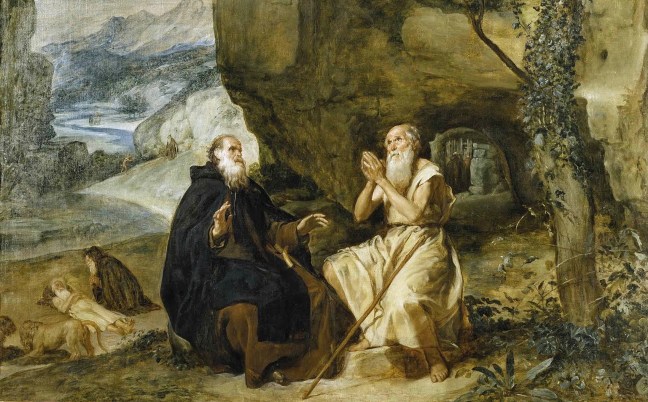
‘St. Anthony the Abbot and St. Paul the First Hermit’ – Diego Velazquez, 1635 – WikiArt

.

The whole earth is a living icon of the face of God.”
~ John of Damascus

.

The birth of a religion is always a time of effervescence. This was the case with Christianity, when appeared many monks, hermits, writers and theologians who contributed to build what would become the foundations of this religion. They were later called the Church Fathers, for they were the first Christians, who cleared the grounds. They took the teaching of Jesus and put it to the test, to the fire of experimentation. They explored it in Greek, in Latin, in Syriac, in silence, in poverty, in the desert, in knowledge. They were the first commentators, the first bishops, popes, exegetes, monks, martyrs of a religion that was still under construction. They came to it with fresh minds. They popped up from Syria, Egypt, Arabia, Turkey, Algeria, Italy, Spain, France, some of them still hungry to find out in their body and mind the traces of truth. They bore the evocative names of a distant time: Anthony the great, Moses the Black, Augustine of hippo, Papias of Hierapolis, Polycarp of Smyrna, Isaac of Nineveh, Maximus the confessor, and many more. Some of the oldest ones had been the direct students of the apostles. Others went to the desert where they lived in reclusion, as was the case with Anthony the Great.

Anthony the Great was born in 251 in Egypt. He was one of these Desert Fathers, and amongst the very first ones to live the hardships of a solitary life in the wilderness. For decades, he remained a strict ascetic. His purpose for doing so was clear enough: “The person who abides in solitude and quiet is delivered from fighting three battles: hearing, speech, and sight. Then there remains one battle to fight — the battle of the heart.” Towards the end of his life, he organised the many people who had finally gathered around him into the first body of monks in history, which is why he was later known as the ‘Father of All Monks’. He died in 356, leaving to his companions this very touching message: “Be earnest to keep your strong purpose, as though you were but now beginning. You know the demons who plot against you, you know how savage they are and how powerless; therefore, fear them not. Let Christ be as the breath you breathe; in Him put your trust. Live as dying daily, heeding yourselves and remembering the counsels you have heard from me. […] And now God save you, children, for Anthony departs and is with you no more.”

~

To one whose mind is sound, letters are needless.”

~

To say that God turns away from the sinful
is like saying that the sun hides from the blind
.”

[…]

Discover many more excerpts of the first Christians’ writings… (READ MORE…)

.

The Practice of the Presence of God

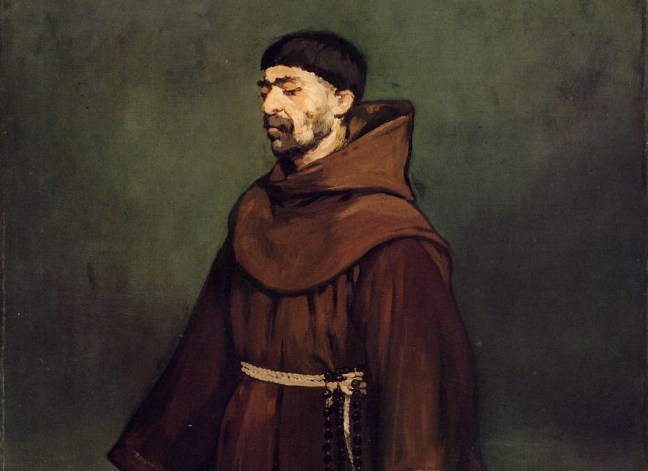
The monk at prayer’ (detail) – Edouard Manet, 1865 – WikiArt

.

A little lifting up of the heart suffices.
A little remembrance of GOD, 
one act of inward worship
.”
~ Brother Lawrence

.

From the remote time of the seventeenth century in Paris has come a voice whose freshness and intimacy struck a chord in many a spiritual seeker throughout the generations. The man behind it was a lay brother working in the kitchen of a Carmelite monastery in the French capital. He was born Nicolas Herman in 1614 in the region of Lorraine, but took the religious name of Lawrence of the Resurrection. What a miracle that the writing of this simple lay brother found its way down to us. But although a remarkable journey, it is understandable that it did so. For the words of this humble, hardworking man, all occupied to his cooking activities, show a mountain of dedication to God. His simplicity and softness, combined to an undefeatable and spontaneously joyful practice, is a deeply valuable gift passed down to us.

Sometimes I consider myself there as a stone before a carver, whereof he is to make a statue; presenting myself thus before GOD, I desire Him to form His perfect image in my soul, and make me entirely like Himself. At other times, when I apply myself to prayer, I feel all my spirit and all my soul lift itself up without any care or effort of mine, and it continues as it were suspended and firmly fixed in GOD, as in its centre and place of rest.”
~ Brother Lawrence

[…]

Rejoice in the illuminating life and practice of Brother Lawrence… (READ MORE…)

.

The Flowers of St. Francis

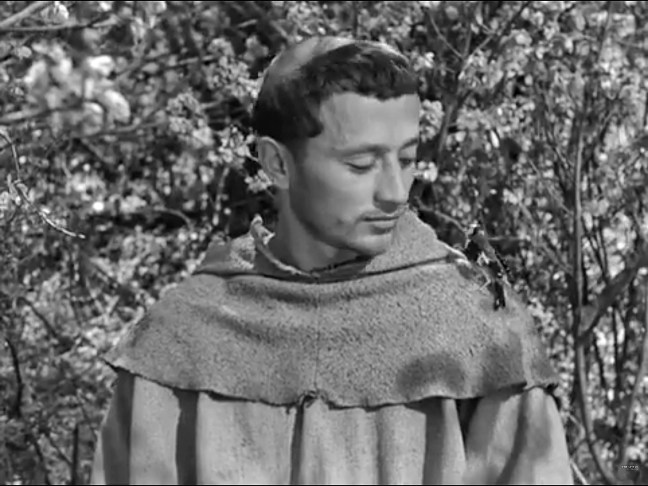
Brother Nazario Gerardi – ‘The Flowers of St. Francis’

.

Praise be to you, O Lord, and to all your creatures. 
Especially Brother Sun, through whom you light our days. 
He is beautiful and radiant and resplendent, 
and derives all meaning from you
.”
~ Canticle to the Sun

.

The deepest realisations and expressions of truth in Christianity have sometimes come from words and understanding, as was the case with Meister Eckhart, but it is, by far, not the most common path. Many a man or a woman have come to embrace God’s being through the expression of profound love and surrender. Such a path was trodden by Francis of Assisi, and has been splendidly shown in Roberto Rossellini’s 1950 film ‘The Flowers of St. Francis’. And if all one knew of Francis of Assisi was through watching this supremely elegant film, one would know what needs to be known, one would meet the essential — the essence — of this man’s life, of anybody’s life when it is lived from love and humility. One would know of the pure joy of being, of trust in life’s bounty, of care and attention for every beings on earth.

Showing only a moment of Francis’ life, the film is more a parable on the qualities that were emphasised throughout his life and teachings, than the real description of his life’s journey. Through a succession of simple vignettes, we are exposed to a panoply of Francis’ various expressions of love. We are shown a man who lived with his heart, and a life that has been made into a prayer to god. We are shown that prayer is but an act of love. We are shown people coming together around a common faith in God, their daily life and turmoils, their behaviours. Francis of Assisi encouraged his disciples to access or express god’s being by being oneself an example of the presence of god. And by making this presence shine in all their daily activities, so that the brightness of god can be harvested by everybody around. These expressions are in the film like the little flowers of St. Francis. A whole bouquet of them.

Praise be to you, O Lord, 
for Sister Moon and all the stars, 
which you cause to shine clear and bright
.”
~ Canticle to the Sun

[…]

A homage to Francis of Assisi through Roberto Rossellini’s movie… (READ MORE…)

.

The Householder Sage

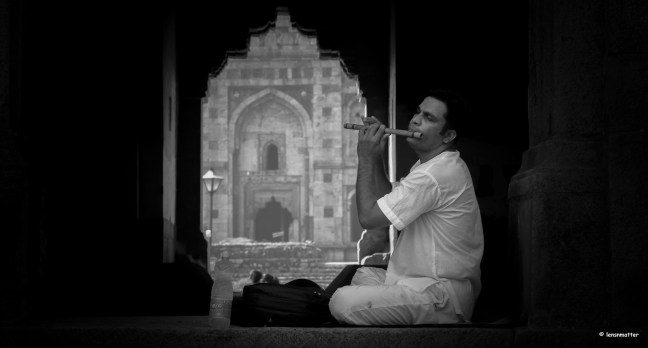
Photo by lensnmatter on Foter.com / CC BY-NC-SA

.

Objectivity, in any form, is the only obstacle to Truth.”
~ Atmananda Krishna Menon

.

It really is a remarkable thing that some of the clearest expressions of modern day non-duality have come from simple Indian men who lived simple lives in society. Atmananda Krishna Menon, married and a father of three children, a police inspector, was one such man. He became, along with Ramana Maharshi and Nisargadatta Maharaj, an essential pillar of the non-dual understanding in India, giving voice to a new approach called the Direct Path, and becoming a guiding light for many seekers of truth in the West. 

Krishna Menon was born in 1883 in Kerala. He grew up in a well educated Brahmin family — some of his relatives were poets or scholars — and had a happy childhood. He was endowed with a good and curious mind, that allowed him to find pathways towards understanding that are clear, simple and effective. Krishna Menon had the highest respect for the function of a true guru. His encounter with his teacher was simple and eloquent. Walking by the roadside, he met in 1919 a swami and sannyasin from Calcutta named Yogananda. It was a short, transforming and unforgettable meeting that lasted only one night but touched him to his very soul. “This paralyzed my ego.” did he say. He realised his true self in just a few years and began teaching. His impeccable logic and clarity drew many a student around him. 

The Truth goes into you undressed,
not through language at all
.”
~ Atmananda Krishna Menon

[…]

Discover the life and teaching of Atmananda Krishna Menon… (READ MORE…)

.

Shankara the Great

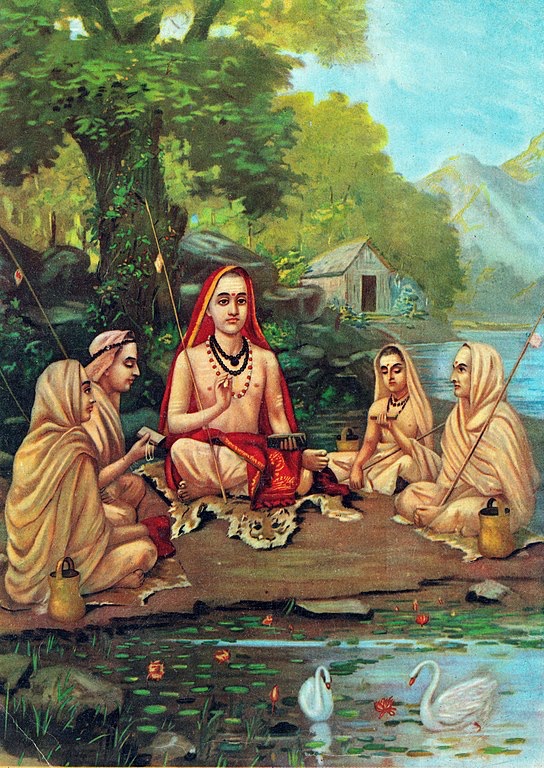
‘Adi Shankara and his disciples’ – by Raja Ravi Varma, 1904 – Wikimedia

.

अहं निर्विकल्पो निराकार रूपो, 
विभुत्वाच सर्वत्र सर्वेन्द्रियाणाम् । 
न चासङ्गतं नैव मुक्तिर्न मेयः, 
चिदानन्दरूपः शिवोऽहम् शिवोऽहम् ।

ahaṃ nirvikalpo nirākāra rūpo
vibhutvā ca sarvatra sarvendriyāṇaṃ |
na cāsaṅgataṃ naiva muktir na meyaḥ
cidānandarūpaḥ śivo’ham śivo’ham |

.

The early spiritual works produced in India were anonymous, probably stated by some ancient sages whose identities got lost. There is one name though that rose and was brought to fame and excellence, a teacher whose life has been narrated in many hagiographies and legends. His name: Adi Shankara, or Shankaracharya. His work as a philosopher and religious reformer is considered prominent in the unfolding of Hinduism. He is also known for having formulated and codified the ancient spiritual current of Non-duality, called in India Advaita Vedanta.

India’s most celebrated teacher was born in Kerala, in a village called Kaladi, in the accepted year of 788. Everything is uncertain about Shankara, since his numerous biographies were written centuries after his death and were designed to build a legend around his life. The name ‘Shankaracharya’ means the teacher ‘acharya’ of the way to bring about happiness (‘sham’ means ‘auspicious’ and ‘kara’ ‘maker’). He died at the early age of 32. A short life that nevertheless allowed him to travel widely all over India, initiating debates, founding monasteries ‘Matha’, and writing numerous pieces of work among which commentaries of ancient texts like the Brahma Sutras, the Bhagavad Gita, or the Principal Upanishads. 

Amongst the many works authentically attributed to him is the Atmashatkam, also known as Nirvanashatkam. The legend says that Shankara, aged only eight at the time, wrote this devotional poem of six slokas as an answer to his newly found guru Govindapada who asked him the simple question “Who are you?”. This is a very striking and moving exposition of everything that we are not, everything that has been wrongly attributed as being our identity. Through experientially discarding every such thing, one comes to dawn on the simple realisation of our true nature, namely the Self or, as it is named in this translation, ‘the auspicious, love and pure consciousness’. This was concluding each stanza in the original Sanskrit as ‘I am Shiva! I am Shiva!’ (Shivoham)…

I am not mind, nor intellect, nor ego, 
nor the reflections of inner self. 
I am not the five senses. I am beyond that. 
I am not the seven elements or the five sheaths. 
I am indeed, That eternal knowing and bliss, 
the auspicious, love and pure consciousness.

[…]

A discovery of the ancient teachings of Adi Shankara… (READ MORE…)

.

This is Meister Eckhart

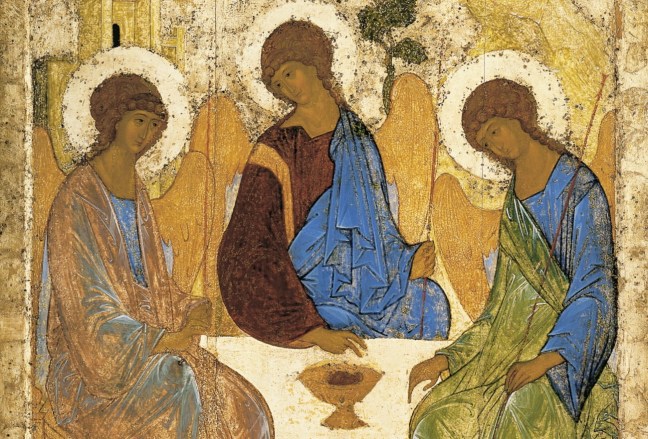
‘Trinity’ – Andrei Rublev, 1410-1420 – WikiArt

.

The eye wherein I see God 
is the same eye wherein God sees me; 
my eye and God’s eye are one eye, 
one vision, one knowing, one love
.”
~ Meister Eckhart

.

In the Middle Ages, in the heart of Europe and of the Christian faith, rose a voice of such richness and profusion, of such dumbfounding wisdom and precision of thought, that it is a duty for all serious seekers to be reminded of it. The name shines with a polish of spiritual mastery and authority: Meister Eckhart. Eckhart von Hochheim OP was born in 1260 near Gotha in central Germany. OP stands in Latin for Order of Preachers, which is a mendicant order of the Catholic Church — better known as the Dominican Order — of which Meister Eckhart was a monk and a leader. His teaching and sermons left a deep impression but he was so ahead of his time and of the general understanding of his pairs, that his work went into oblivion only to reappear in the 19th century. His voice and light could not possibly be left unnoticed. He is now accepted as one of the most profound and eminent theologians, philosophers, and mystics of all times.

Little is known about his family and early life. From 1295 onwards, he held many posts of responsibility in various states of central Germany, and as far as Cologne or Strasbourg. Among others, he was a Prior of the Dominicans, managing tens of convents, and was later made Provincial of Saxony. He also travelled around Europe and more specifically to Paris where he studied Aristotle and the Platonists. With the degree of Master of Arts, he later on became a professor of theology at the school of Dominicans in the French capital and was invited as a magister — equal to the doctorate — for two consecutive years. At this time in Europe, during the Avignon Papacy, Christianity was prey to many tensions and confusion, the Inquisition was blowing a wind of suspicion and terror, as a result of which many new groups and movements were forming in search of new avenues of practice and understanding. It goes without saying that Meister Eckhart was a coveted source of wise counsel in these times of darkness. 

Let’s say it plainly: Meister Eckhart was a scholar, but it is as a preacher that he is most remembered. His sermons in the vernacular German were highly unusual for the time and took many a liberties with the conventional church rituals and dogmas. He stated: “When I preach, I usually speak of detachment and say that a man should be empty of self and all things.” […]

.

Blessed, supremely blessed, are they who are installed in the eternal now, 
transcending time and place and form and matter, 
unmoved by weal or woe or wealth or want, 
for in so far as things are motionless they are like eternity
.”
~ Sermon 16 

.

An exploration into the teachings of Meister Eckhart… (READ MORE…)

.

O Mystic Nuns!

Photo by Abee5 on Foter.com / CC BY-SA

Thy love was not of earth; no woman’s soul 
For mortal love craved with such a yearning. 
So thou didst wed great God Himself! O Goal 
Beyond our ken, beyond our dim discerning! 
And soul to soul, like sunbeam unto Sun, 
Thou didst vanish away, O mystic Nun!

~ Sri Devendranath Sen


At all times, India has embraced the love and longing for God as a privileged access to our ultimate reality. This path of love or devotion, called bhakti, was trodden by countless seekers and poets who have offered their verses to posterity. Amongst them many women. Women who, alone, have walked the steep path to God, going against the society of men, marriage and conventions, with only one goal: to reach divine love. I present here three such women — Andal, Akka Mahadevi, and Mirabai — these mystic nuns, whose personality and poetry are an unforgettable milestone to this day in India and elsewhere.

Through devoting or directing their love to a god, be it Krishna or Shiva, these devotees were searching to experience the bliss of their own being, the happiness that is the very nature of their self. But by conditioning their love to an object, they also experienced suffering, longing, sadness, anger, which all came to feed their poetry, their songs, all these exquisite expressions. These were the very vector that supported their spiritual search. But don’t think that this is a path that is limited or lacking depth. For though directed towards an object, the love they feel is always their own. The forms of Krishna or Shiva were a vehicle to lead them to their very self, to realise that their longing is and has always been for their own unborn nature, for love itself, the oneness of their own being.

This tension between the love for God as a form, and for being or oneness as a principle, between saguna and nirguna bhakti, as it is expressed in the Indian tradition, is at the core of the bhakti endeavour, of the journey to divine love. In ‘The Embodiment of Bhakti’, Karen Pechilis Prentiss wrote: “The lord is characterized by both ‘paratva’ (otherness) and ‘soulabhaya’ (ease of access). He is both here and beyond, both tangible as a person and intangible as a principle.” These nuns were expressing this tension with various degrees in their many songs and poems. Listen to their voice. Listen to how Krishna’s forms and attributes, ramblings and happenings are only expressions of a deeper reality, of the understanding and tensions at play in the seeker’s very being. They are their paths whose completion will lead to the recognition of their own true self. […]

Listen to the poetry of Andal, Akka Mahadevi, and Mirabai… (READ MORE…)