
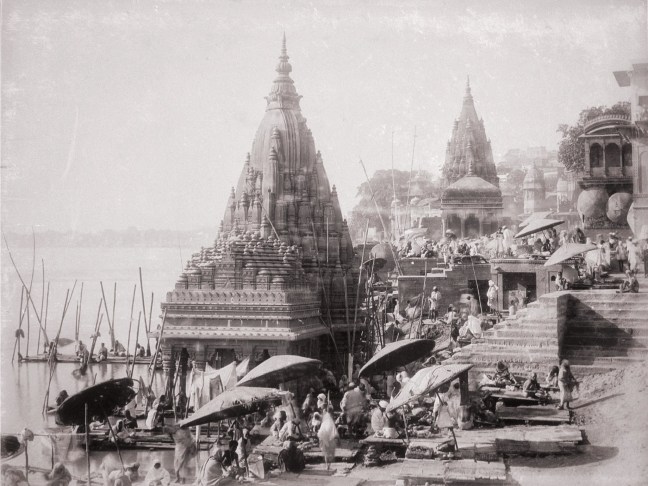
‘Benares, Temple of Tarhishwara or Well of Manikarankia – Samuel Bourne, 1860 – Wikimedia
The thing in ourself that has the capacity to know anything is itself not a thing. We can only exist in relation to things, but only the state of no-thing can we ever truly be. The illusion that we are something separate, a self — whatever we are — is due to the knowing of an object. When no such objective knowing is being activated, then there is no necessity to be anything. There is no purpose in being a self. The being that we appear to be is realised as void. And without a self to know them, things have no support for their reality. Within that perspective, all things dis-appear, are swallowed back into no-thingness, into where they have never ceased to be. This ultimate realisation is in fact not a realisation. It is the ultimate truth contained in simply being, when all duality has been nipped in the bud, unable to show any reality as such, lost in a being so subjective that nothing can be there which could be formed and recognised as ‘other’. This is the end of form. It is the state of no-thing that cannot be spoken of. It can only be approached, envisaged, but never lived as an objective experience, or from the position of an experiencer. It is the timeless, objectless point where the moth dis-appears into the flame of being. Its identity as ‘moth’ has been dis-qualified from itself to never be formed again. Now engulfed into the very no-thing that we are when all objectivity has dis-appeared, we are left with being, our pure essence, where no form could ever be formed. This is in fact, paradoxically, how a world, a thought, anything, can seem to appear — through the intercession of formlessness. This place is where we can never go. This thing is what we can never be. World, thought, self, death, bondage, liberation, are only the gaming of god, or infinite being, with no reality of their own. Only at the point of un-being, of coming to an end, can we ever be true, ultimate being. This is what ‘ultimate’ in fact means: ‘to come to an end’. To cease being anything is the ultimate truth of life. What is left is pure, essential, unqualified, infinite being, where no self or world could ever come to be. This, truly, is the ultimate. That ultimate, because of its purity, can bear in itself the illusion of being coloured or stained; because of its essentiality, can be divided in an endless chain of cause and effect; because of its unqualified nature, can adopt any form or quality; in reason of its unknowability, can be known through a multiplicity of names; and because of its infinite nature, can be seemingly separated as a multitude. And it does this without ever ceasing to be the ultimate. Now, know in all occasions that you are not a suffering self lost in the multitude, with a name, a form, and qualities — an entity living in a world, endlessly caught in multiple, arbitrary causes and effects. Know only being as your ultimate, uncreated self. There only is the abode of peace.
.
~~~
Text by Alain Joly
Photograph by Samuel Bourne (1834-1912)
~~~
.
Website:
– Samuel Bourne (Wikipedia)
Suggestion:
Other ‘Ways of Being’ from the blog…
.
 The Dawn Within